
Article 1 of 16 · AI for PMIS
No Data, No AI: Why the Substrate Decides the Answer
Everyone has now seen the demonstration. Someone asks an AI assistant a question about a project, and back comes a fluent, confident paragraph. The room nods. Then somebody asks the question that actually matters, which is where that answer came from, and the honest reply is that it came from a document uploaded eleven months ago by a person who has since left the company.
That is the failure mode of AI in capital delivery, and it is not a failure of the AI. The model did its job. It read what it was given. The problem is what it was given.
Before any organisation evaluates an AI capability for its projects, it needs to answer a prior question that almost nobody asks: what is the AI reading? The substrate underneath an AI system sets a ceiling on the quality of every answer it can produce, and no amount of model sophistication lifts that ceiling.
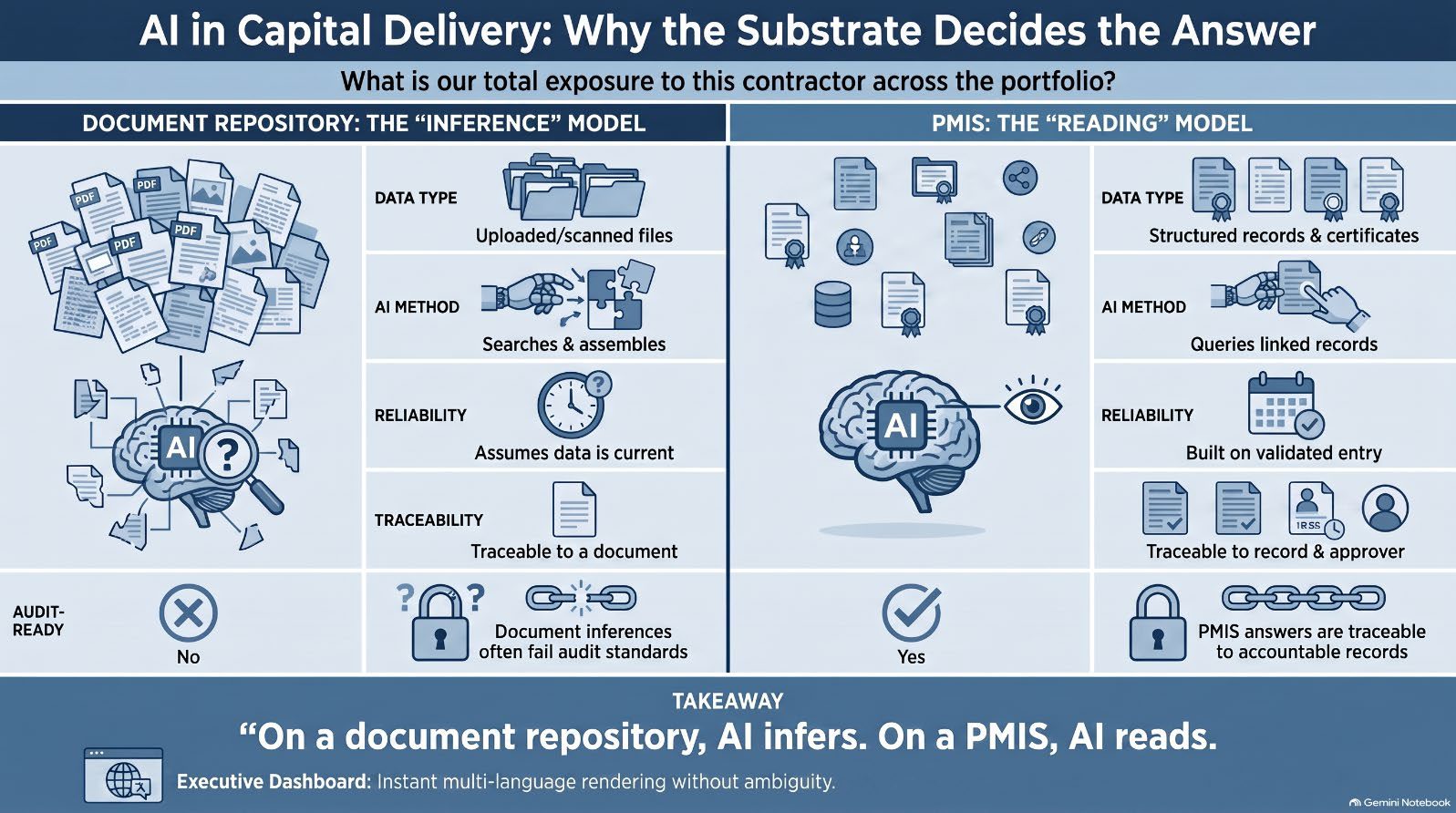
Before evaluating any AI capability for your projects, answer a prior question that almost nobody asks: what is the AI reading?
The capabilities in circulation are document capabilities
Look at the AI feature lists moving around our industry at the moment. Assisted drafting. OCR intake. Tone matching. Smart search. Policy referencing. Sensitive content detection. Document quality checks. A tracking assistant. Automated follow-ups.
Every one of those is a genuinely useful capability. And every one of them was designed for a world in which documents arrive, get uploaded or scanned, and then need to be understood. They are document management capabilities. Several are excellent document management capabilities. They are being sold, increasingly, with project management labels attached.
A project management information system does not wait for a document. It captures information at the point it is created, through a process template designed for that specific transaction.
When a change order is raised in a PMIS, it is not a letter that someone will later scan. It is a record with a defined structure. The cost codes come from a controlled list. The dates are validated. The originating commitment is a relationship, not a sentence referring to one. The approval routing is defined before the record exists, so the question of who authorised it is answered by the system rather than reconstructed from an email chain afterwards.
Multiply that by every transaction on a programme, over several years, and the difference is not incremental. One organisation has a repository of documents about its projects. The other has a structured, validated, permissioned model of what actually happened.
On a document repository, AI infers. On a PMIS, AI reads.
Inference and reading are not the same answer
Ask both systems the same question. What is our total exposure to this contractor across the portfolio?
The document system searches its content, finds the contracts and correspondence that mention the contractor, extracts the numbers it recognises, and assembles a figure. That figure is an inference. It may well be right. But it rests on the assumption that every relevant document was uploaded, that none of them is superseded, and that the numbers in them were never varied by an instruction that took a different form.
The PMIS queries commitments, change orders, invoices and payment certificates that are already linked to that vendor as structured records. The figure it returns is not an inference. It is a reading of the system of record, and every component of it can be opened and inspected. contact with a quantity surveyor, an auditor, or eventually a tribunal. An answer that cannot be traced back to its source is an answer that cannot be defended, and an answer that cannot be defended has no operational value no matter how well written it is.
A consequence for executive reporting
There is a second effect of structured capture that matters particularly in this region, and it is rarely connected to the AI conversation at all.
Most project communications in the Gulf are captured in English. RFIs, change orders, correspondence and meeting minutes are written in the language the project teams work in. Boards, ministries and senior government stakeholders, however, often expect to review performance in Arabic.
A PMIS bridges that gap without translating a single record. Structured data carries controlled vocabulary: statuses, categories, cost codes, phases, disciplines, value lists. These are not free text. They are defined terms with a fixed set of permitted values, so each one has to be labelled in Arabic only once. From then on, the records the project teams captured in English can be presented in Arabic dashboards and reports for executive review, as the contracts performance dashboard below shows. Every figure is read directly from PMWEB; only the titles, measures and categories change language.
A document repository has no equivalent, because everything inside it is narrative. To present it in Arabic you have to translate it, and translating contractual language introduces exactly the ambiguity the contract was written to remove.
The detail beneath the dashboard stays in the language it was written in. The summary layer, the layer senior stakeholders actually read, follows the structure and can be generated in whichever language the audience needs.
That is a property of the substrate, not a feature anyone had to build.
Contracts performance dashboard in PMWEB, generated in Arabic for executive review from records captured in English.
Over the coming months every platform serving this industry will announce AI capability, and the announcements will be difficult to tell apart. They will use the same adjectives. Several will use the same screenshot of a chat panel.
The question that separates them is not what the AI can do. It is what the AI is reading, and whether the answer it gives you can be traced back to a record that someone was accountable for creating.
Ask a vendor to show you the answer. Then ask them to show you where it came from. The second demonstration is the one worth watching.
This is no longer only the buyer's position. In September 2026 PMWEB published its own checklist for owners and construction managers, Six Questions to Ask Before You Put AI Near Your Project Data, and two of its six questions are the argument of this article in question form. The first asks whether the AI can show the source record behind every number: whether a cost forecast, a schedule risk score or a contract summary links through to the record it came from, so that a reviewer can open the pay application or the schedule revision behind it and check it. The sixth asks whether it works on your actual records, meaning live commitments, change orders, RFIs, submittals, cost and schedule, rather than a curated set of documents uploaded to a chat window for the demonstration.
Together those two questions are the substrate argument turned into a test. A demonstration built on a curated document set tells you how the AI performs on the documents the vendor chose. A demonstration run against a live programme tells you how it performs on yours.
The question that separates platforms is not what the AI can do. It is whether the answer it gives you can be traced back to a record that someone was accountable for creating.
This is the first of sixteen articles on AI in project management information systems, published weekly. Next week: why AI value on a PMIS arrives in three distinct layers, and why most organisations evaluate only the first.

Next step
Bring this to your portfolio.
Tell us which processes matter most to you, and we will show them running in PMWEB.