
Article 10 of 16 · AI for PMIS
Where a PMIS Needs Help: Capture, OCR and the Archive Nobody Has Read
A well-run PMIS holds an accurate, structured, permissioned account of everything that was entered into it. That is a considerable asset and this series has spent eight articles explaining why it matters.
It is also a fraction of what a capital programme produces.
The rest sits in letters, meeting minutes, transmittals, RFI correspondence, technical submittals, site diaries, photographs, drawing revisions and an email estate that nobody has ever measured. On a programme of any age this material outweighs the structured record by an order of magnitude, and it carries most of the contractual history — including, reliably, the parts that become contentious.
No PMIS closes that gap on its own, and a vendor who claims otherwise is describing a document management product.
No PMIS closes the gap between the structured record and the archive on its own, and a vendor who claims otherwise is describing a document management product.
Two capabilities that get confused
The gap is usually discussed as one problem and it is two, with different engineering behind them.
The first is capture. Turning paper, scans, images and unstructured files into text and structure at volume. This is a mature discipline with its own accuracy engineering, its own failure modes and its own specialists, and it is measured in documents per hour and error rates per field. governs this letter, which commitment this instruction varies, whether the position described in correspondence matches the position in the system.
Products are frequently sold as though these are one capability. They are not, and an organisation that buys a reasoning layer without solving capture has bought something with very little to read.
Why your PMIS vendor is the wrong supplier for the first
This is worth saying plainly, including by those of us who implement a PMIS for a living.
High-volume capture at archive scale is not adjacent to project controls. It is a different engineering problem, and the organisations that are good at it have spent years on the specific failure cases — the photocopy of a fax, the drawing with handwritten markup, the scanned page bound at an angle, the table that spans three pages with a repeating header.
A platform vendor building capture as one feature among forty will not match that, and buying it bundled generally means buying the weakest available version of a capability you could have bought properly. The bundle is convenient. Convenience is not the criterion when the output feeds a contractual record.
Buying a specialist capability as a bundled feature usually means buying the weakest available version of it.
What good looks like at this layer
Four properties separate capture worth deploying from capture that generates a review queue nobody will work through.
Confidence scoring on every extracted value, so that the system distinguishes what it is sure of from what it guessed. A system that presents all output with equal certainty forces uniform review, and uniform review does not scale.
Exception routing driven by those scores, so that human attention goes to the values that need it. This is the same drift argument from earlier in this series applied to document processing: attention is the scarce resource, and directing it is most of the value.
Human verification designed as a fast confirmation step rather than a re-reading. The reviewer should be confirming a mapping, not reading a document.
And traceability back to the source page, for the same reason it mattered in the PMIS: an extracted value that cannot be traced is a value that gets re-checked manually the first time it is disputed.
The decision that determines whether the project finishes
Here is the pattern that sinks archive projects, and it is a scoping error rather than a technology one.
An organisation decides to bring its legacy correspondence under control. The scope is set as extracting governed records from the archive. The archive turns out to contain forty thousand documents. The pilot goes well on two hundred. The full run is estimated, the number is uncomfortable, the project is paused for review and it does not restart.
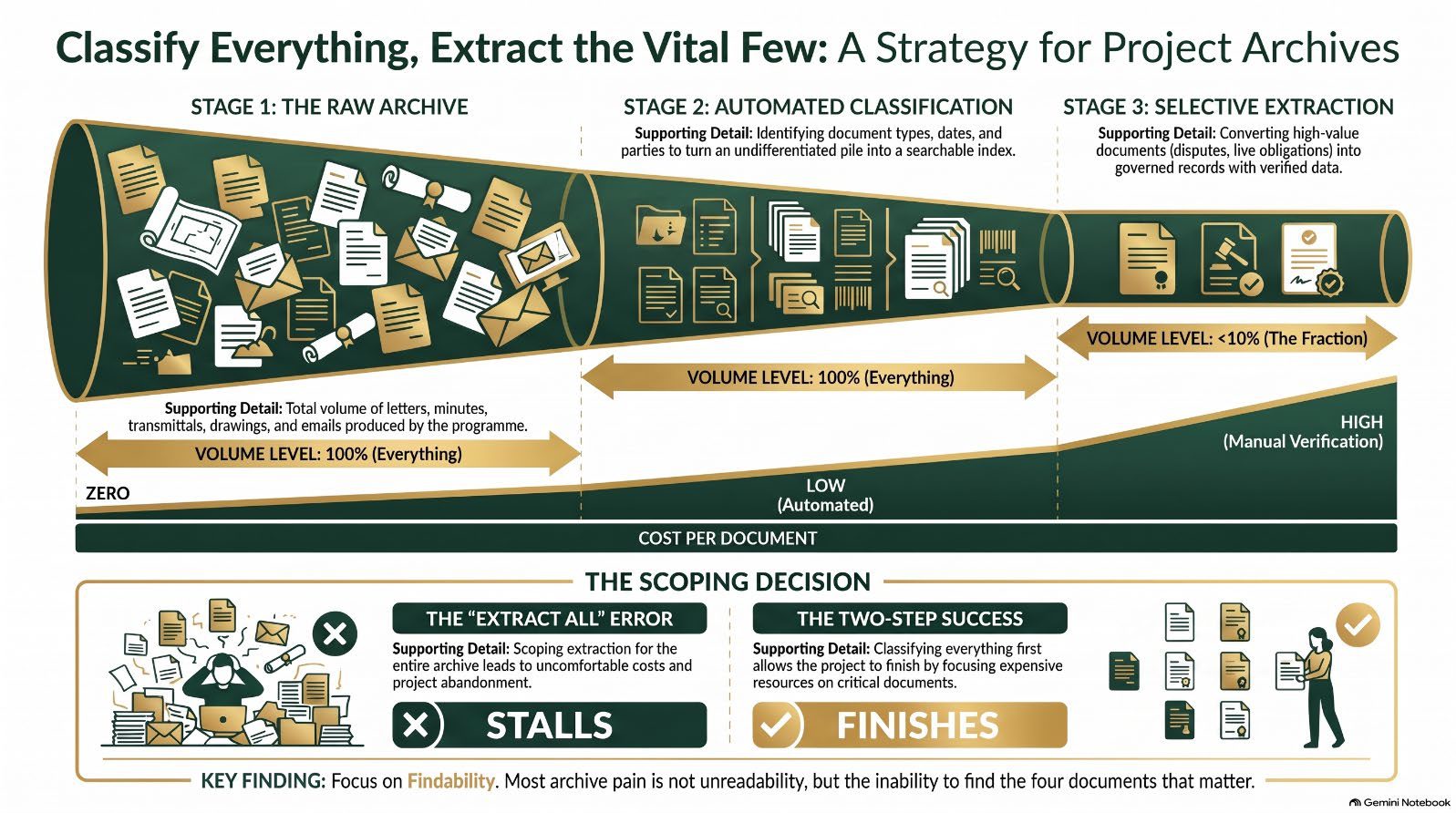
The alternative is to separate two activities that get merged. project and which contract it belongs to — is fast, largely automatable, and immediately useful on its own. It converts an undifferentiated pile into a searchable index. Most of the operational pain of a legacy archive is not that the content is unreadable; it is that nobody can find the four documents that matter.
Extraction is expensive. Pulling governed values out of a document and turning them into records carries a verification cost per document that does not fall much with volume.
Classify everything. Extract from the fraction that warrants it — the live obligations, the open commitments, the disputed history. Organisations that scope it this way finish. Organisations that scope it as one exercise generally do not.
What to ask a capture partner
Test on your worst documents, not a clean sample. Every product demonstrates well on a born-digital PDF and your archive is not made of those.
Ask what happens to a value the system is unsure about, and require the answer to be that it is flagged rather than filled.
Ask how output reaches the PMIS. A capture capability that produces a spreadsheet somebody re-keys has moved the work rather than removed it.
And ask about entity matching specifically, because it is the same requirement as inside the platform: content extracted from a document needs to attach to the record it belongs to, or you have built a second archive alongside the first.
And ask what happens to the documents. An archive holds contract prices, claim positions and correspondence a counterparty expects to stay confidential, and a capture partner processes it at volume. The question PMWEB puts on its own buyer checklist applies here with more force: is it reading your data, or training on it? Establish where documents are processed, whether they leave your tenant, how long they are retained and whether they train models serving anyone else, and get the answers in the contract rather than the sales deck.
Classify everything. Extract from the fraction that warrants it — the live obligations, the open commitments, the disputed history. Organisations that scope it this way finish.
Next week: the questions that cross three systems at once, and the layer that answers them.

Next step
Bring this to your portfolio.
Tell us which processes matter most to you, and we will show them running in PMWEB.