
Article 1 of 4 · The PMO and the Capital Project P&L
On Time, On Budget, and Still Losing Money: How a PMO Tracks Project Profitability with PMWEB
A project can finish on time, within scope and to specification, and still lose money. A PMO that reports only delivery and cost against budget discovers the loss after it has been booked. PMWEB already holds both sides of the project ledger, cost and revenue, and with ERP integration it turns them into a real-time Project and Portfolio P&L.
Most PMO dashboards answer one question well: are we on schedule and within budget? That question matters, but it is not the one the CEO and the board ask. They ask whether the project is earning the margin we bid, whether that margin is holding, and whether profit is turning into cash.
For contractors, EPC and design-build firms, project management consultants, and developers delivering projects for clients, every project carries a revenue contract and a cost base. Profit is the gap between the two, and it moves every time a change order is approved, a subcontractor invoice is certified, or a client payment is delayed. A PMO that cannot see both sides together is reporting delivery, not performance.
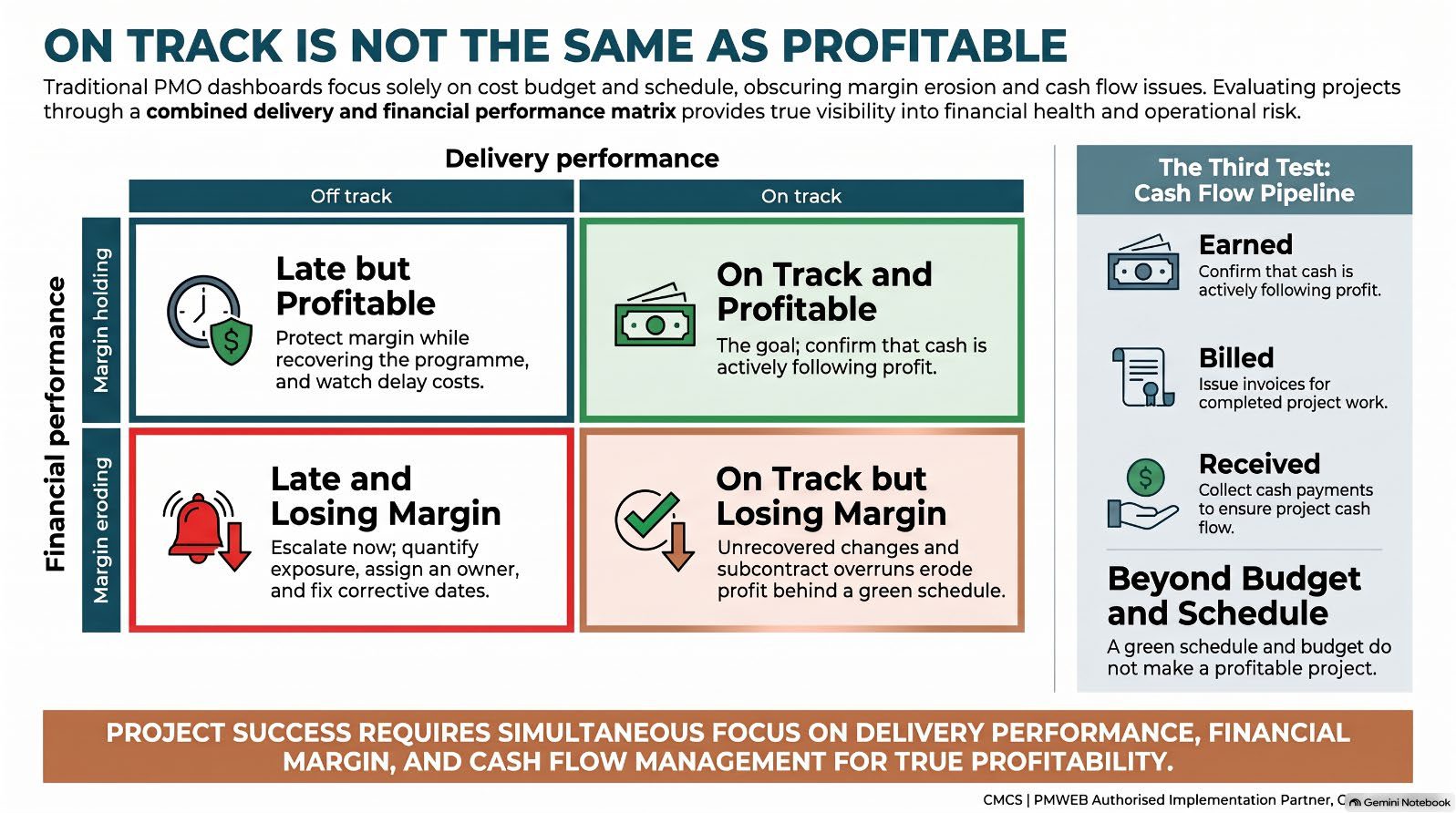
Why cost reporting alone is not enough
Traditional PMO cost reporting compares committed and actual cost with the budget. It tells management whether the project is spending as planned. It does not tell them whether the project is earning as planned. Four blind spots are common:
• Revenue lives somewhere else. The prime contract, client variations and payment applications sit with the commercial team in spreadsheets, while invoicing and collection sit in the ERP. • Changes are seen on one side only. A variation instructed to a subcontractor appears as cost growth. The matching claim to the client, if it was raised at all, sits in a separate log. • The books lag the site. The ERP records cost when an invoice is posted and revenue when a bill is issued, often weeks after the work was done. Without accruals, the month's P&L reflects paperwork, not progress.
The result is a month-end reconciliation in which the PMO, finance and the commercial team debate whose number is right, and margin erosion is discovered one or two quarters too late.
PMWEB already holds both sides of the ledger
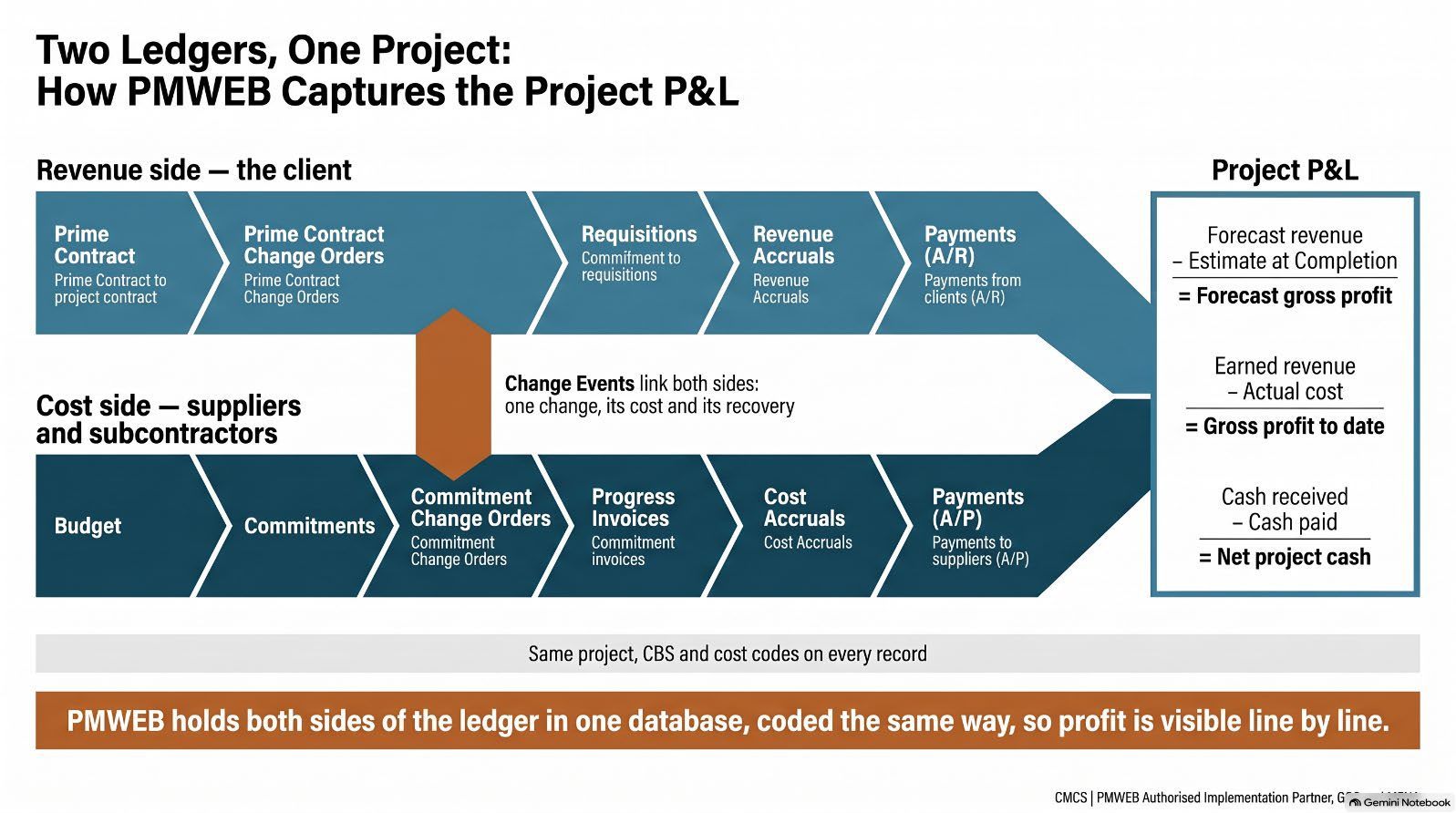
PMWEB was built for capital project financial control, so the building blocks of a project P&L are standard modules, not customisation. The cost side and the revenue side are captured in matching records:

Every record carries the same project, CBS and cost code, so cost and revenue line up at line-item level. A change event raised once can be carried through to the commitment change order with the subcontractor and the prime contract change order with the client. The PMO sees the cost and its recovery side by side, and can flag immediately any approved cost change that has no matching revenue change.
Accruals: a P&L that reflects the work, not the paperwork
Work on site does not wait for invoices. PMWEB accruals close the gap between progress and the books. Each month the project team records the value of work performed but not yet invoiced against each commitment, and the value of work earned but not yet billed against the prime contract.
Three things follow. The month's P&L reflects work actually done. The difference between earned and billed revenue becomes visible as under-billing or over-billing. And finance receives accrual journals supported line by line, rather than estimates sent by email at month-end.
This is where PMWEB differs most from a financial system. An ERP P&L is built on the last closed period: cost when an invoice is posted, revenue when a bill is issued. PMWEB accruals add the work in place that has not yet been invoiced or recognised as revenue, so the P&L reflects the project as it stands today. For Project P1000:

Management sees the margin of the work actually done, not the margin of the paperwork processed so far, and it sees it between closes, when there is still time to act.
ERP integration: one P&L, in real time
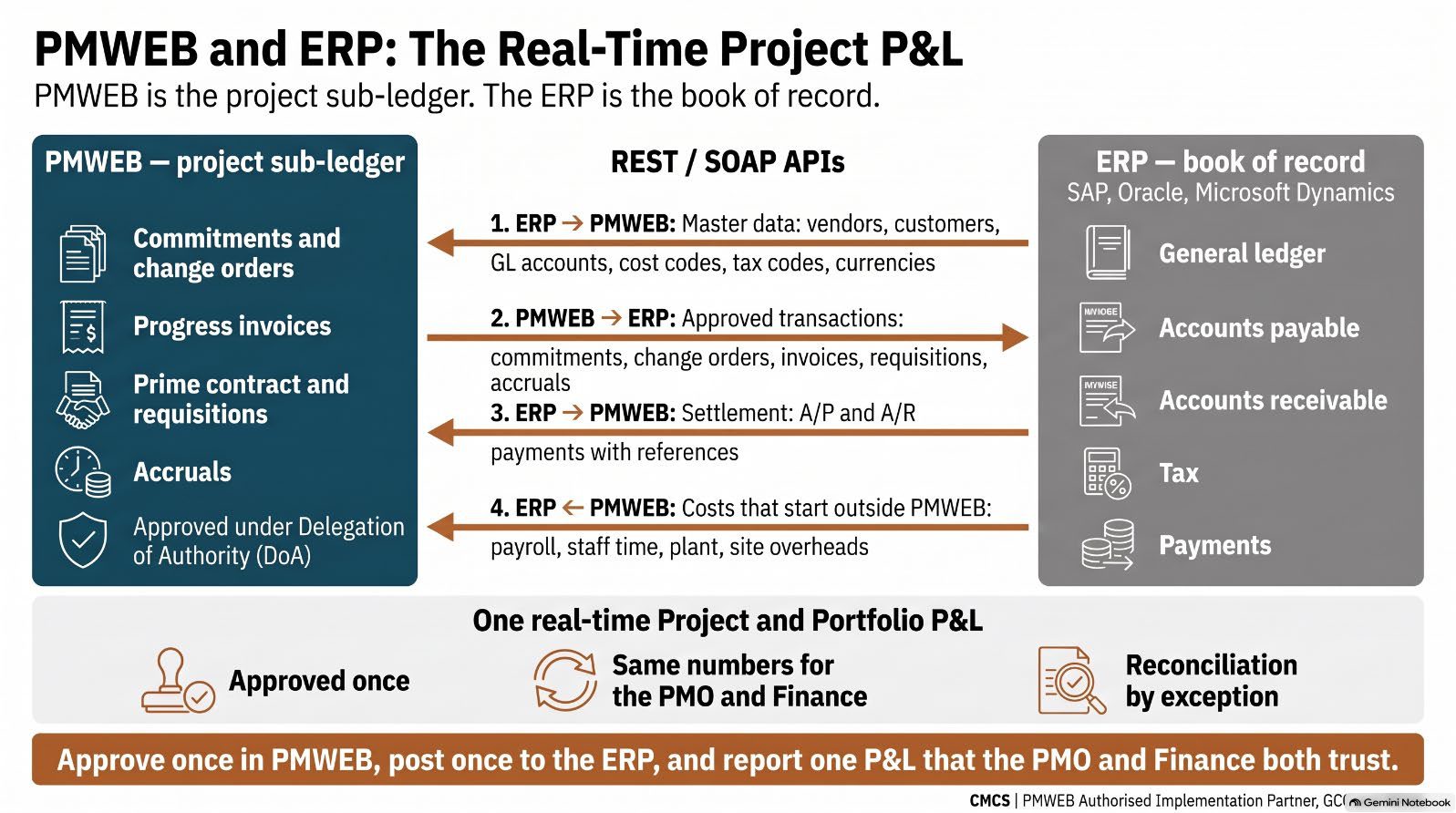
PMWEB does not replace the general ledger, and it should not. The right division of work is clear. PMWEB is the project sub-ledger, where commitments, changes, certifications, requisitions and accruals are created, approved under the Delegation of Authority (DoA) and documented. The ERP is the book of record for accounting, tax, payables, receivables and payments, whether it is SAP, Oracle, Microsoft Dynamics or another system.
PMWEB's REST and SOAP APIs connect the two:
• Master data from the ERP to PMWEB: companies, vendors, customers, GL accounts, cost codes, tax codes, currencies and exchange rates. • Approved transactions from PMWEB to the ERP: commitments, commitment change orders, approved progress invoices, requisitions and accruals. • Settlement from the ERP to PMWEB: A/P and A/R payments with invoice and payment references, so cash is visible against every contract. • Costs that start outside PMWEB: payroll, staff time, plant and site overheads posted to project cost codes in the ERP and brought back, so the P&L is complete. Because each transaction is approved once and passed by API, the P&L the PMO reports and the numbers finance closes the month with come from the same records. Reconciliation becomes an exception report instead of a monthly exercise.
Potential change orders: claims, disputes and the P&L range
The P&L also needs to show what could still change it. In PMWEB, potential change orders (PCOs) capture claims and disputes before they are settled, on both sides of the ledger. PCOs on the prime contract are potential revenue: variations and claims the organisation expects to recover from the client. PCOs on commitments are potential cost: claims from subcontractors and suppliers, and changes in its own operations. For Project P1000:

Holding both sides in PMWEB lets the PMO report the P&L as a range, not a single number:

The gap between best and worst case, 16.1 million, is the financial exposure that executives must manage. It shows which claims to pursue, which to settle, and how much of the forecast margin depends on negotiations still open.
Five questions every P&L review must answer
An executive P&L review is useful only if it answers five questions. Each one maps to data PMWEB already holds:


The dashboard below is built in PMWEB's embedded Power BI reporting on the same records described above. It uses a sample project, with values in AED millions.
Project P&L dashboard in PMWEB: Project P1000, Mixed-Use Tower (sample data, AED millions)
Read from left to right, it tells a story that a cost report would miss:
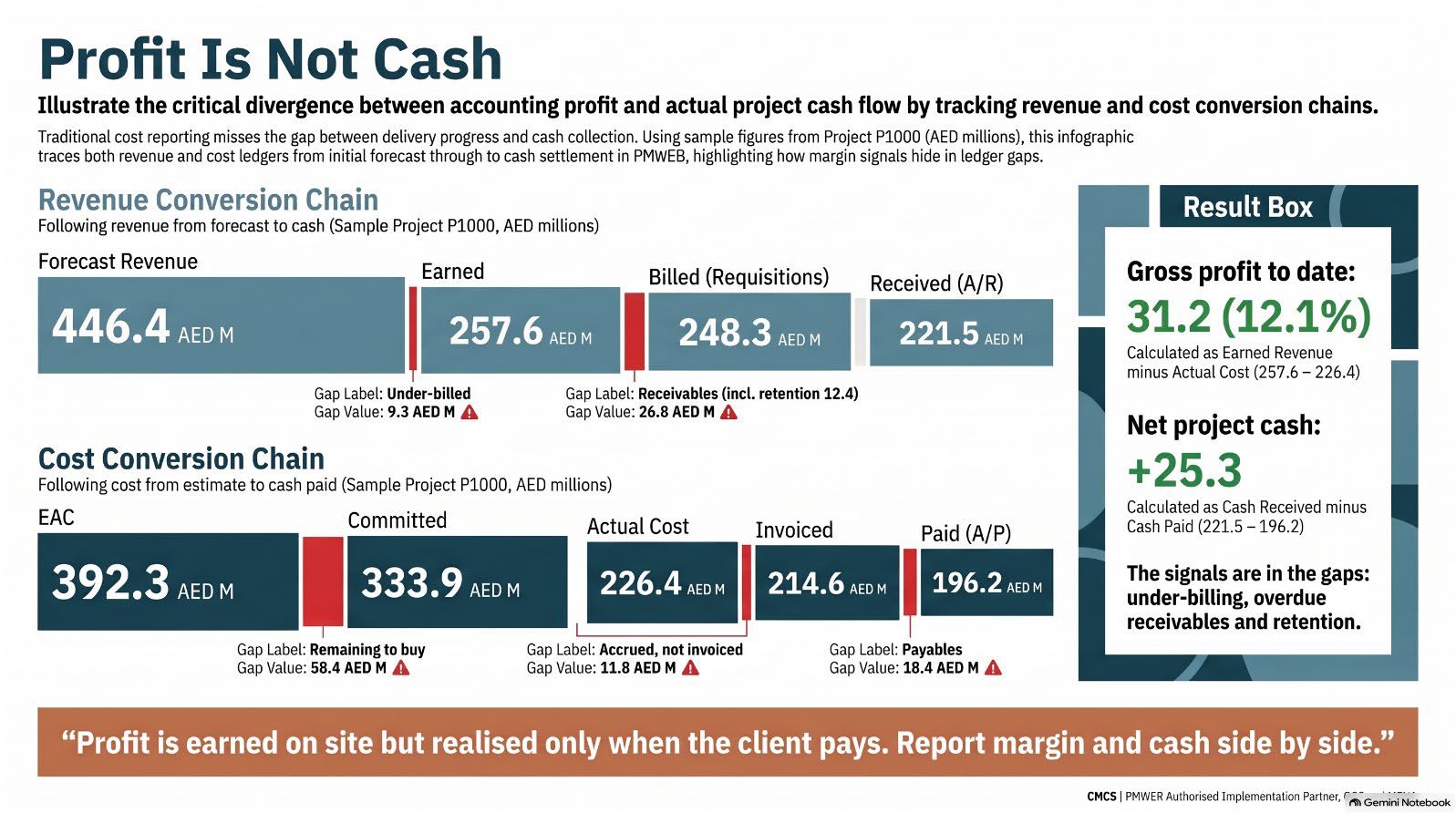
• Margin is slipping, not collapsing. Forecast gross profit is 54.1 on forecast revenue of 446.4, a 12.1% margin against a 13.0% target. The trend has drifted down steadily since late 2025. • Changes add revenue but little profit. Approved change orders added 18.6 of revenue but only 2.4 of profit, after 16.2 of matching cost. • The forecast depends on unapproved claims. It assumes 7.8 will be recovered from 12.4 of pending client change orders. Without it, the margin falls to 10.6%. Four of those change orders, worth 5.1, are more than 60 days old. • The loss sits in two places. Preliminaries are running at a loss because of delay, and the facade package is 4 points below target. • Cash is positive, but under-billing is building. Revenue earned is 257.6 against 248.3 billed, so 9.3 of work is not yet billed. Net project cash is +25.3.
The Portfolio P&L dashboard
At portfolio level, the same measures roll up across every project, business unit and country. This is the view for the executive committee.
Portfolio P&L dashboard in PMWEB: nine active projects (sample data, AED millions)
• The portfolio is 46.5 short of target profit. Forecast gross profit is 301.4, an 11.0% margin against a weighted target of 12.7%.
The margin trend shows a steady fade of 1.7 points over twelve months. No single month looked alarming, and that is exactly why a quarterly finance pack would have caught it late.
Profit is not cash
A profitable project can still consume cash, and a cash-positive project can be losing margin. The P&L review must show both. PMWEB tracks the full chain on each side: on revenue, from earned to billed (requisitions) to received (A/R payments); on cost, from committed to invoiced (progress invoices) to paid (A/P payments). The gaps between the links are the management signals: under-billing, overdue receivables, retention held by the client, and the balance between what the project collects and what it pays.
Beyond management: the P&L for third-party stakeholders
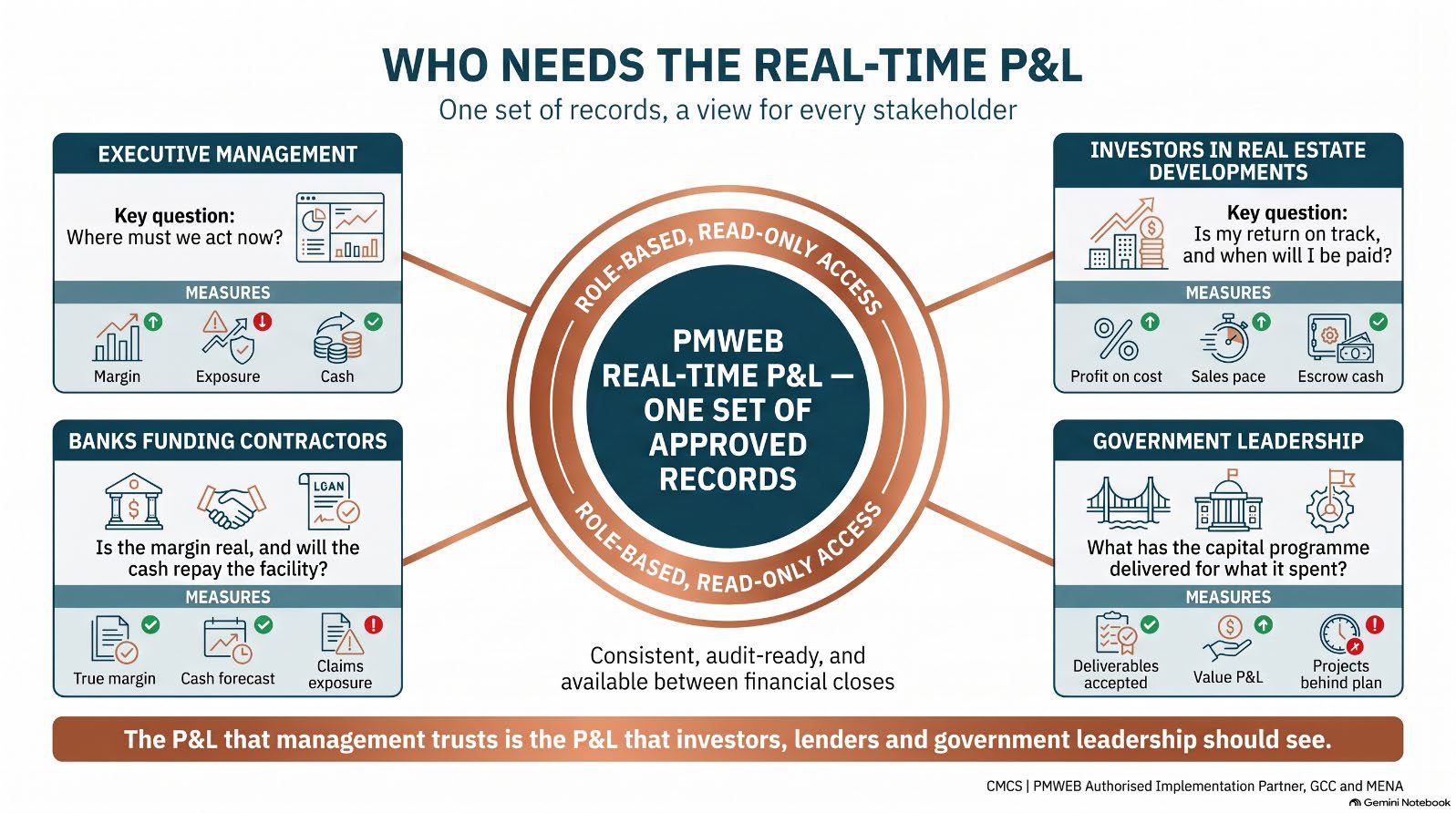
A real-time P&L is not only for the executive committee. The parties who fund, invest in or oversee capital projects need the same view, and they usually receive it late, summarised and reconciled by hand. Parts 2 to 4 of this series look at each case in detail:

Every external view is drawn from the same approved records the PMO uses, so it is consistent and audit-ready. PMWEB security settings give each party a read-only view of only the projects and measures it is entitled to see, through a role-based login or scheduled report distribution.
PMWEB 2026 AI on P&L data
The PMWEB 2026 release introduces the first wave of PMWEB AI. On P&L work its value comes from the same fact as the dashboards: every commitment, change, invoice, requisition and payment is held as structured data.

Action is taken only with the user's approval, and PMWEB AI honours security settings: a site user sees only the commercial data their role permits.
What the PMO must put in place
The system makes profitability visible. The PMO makes it managed. Six practices make the difference:
• A target margin for every project, approved at award and held as the baseline. • One coding structure for CBS, cost codes and GL accounts, shared by PMWEB and the ERP. • Both sides of every change. No commitment change order is approved without a decision on the matching prime contract change order. • Monthly accruals on every active commitment and prime contract. • Escalation thresholds, for example margin fade above 2 points, pending revenue changes older than 90 days, or negative net project cash. • A monthly P&L review in which every red item leaves with an owner, an action and a date.
Key takeaway
Delivery performance tells you whether the project is being built as planned. The P&L tells you whether it is creating value for the business. PMWEB holds both ledgers, and with ERP integration the PMO can show executives margin, exposure and cash for every project and the whole portfolio, early enough to act.
Over to you: how does your PMO track project profitability today: through cost reports and month-end finance packs, or through an integrated P&L in your PMIS?
Next in the series: Part 2, The Real Estate Developer: Sales, Milestones and Escrow.

Next step
Bring this to your portfolio.
Tell us which processes matter most to you, and we will show them running in PMWEB.