
Article 3 of 7 · Project Fraud Prevention with PMWEB
Procurement Integrity: Prequalification, Bid Analysis and Unbalanced Bids in PMWEB
The most expensive fraud on a capital project is often decided before the first shovel enters the ground. An unqualified bidder invited, an unbalanced bid accepted, a design error known to one bidder and not the others: each turns the contract itself into the vehicle for loss.
Part 2 showed how PMWEB enforces approval authority on every transaction. This article applies those controls to the procurement cycle, where the value at stake is largest and the window to act is shortest. Once a contract is signed, a flawed award is very hard to unwind. The owner pays for it in change orders, claims and acceleration costs for the rest of the project.
Is this article for you?
Read this if bids arrive as attachments in an e-tendering portal, a document platform such as Aconex or by email, or if your PMIS has no estimate, bid comparison and commitment chain connecting the evaluated rates to the contract and its changes. If you advise clients on project governance, the adviser's checklist near the end turns this article into diagnostic questions and recommendations. Ministries of finance and sovereign funds will find a funder's lens on this topic near the end.
A Case That Shows How It Works Case: the pile design that everyone but the owner knew about
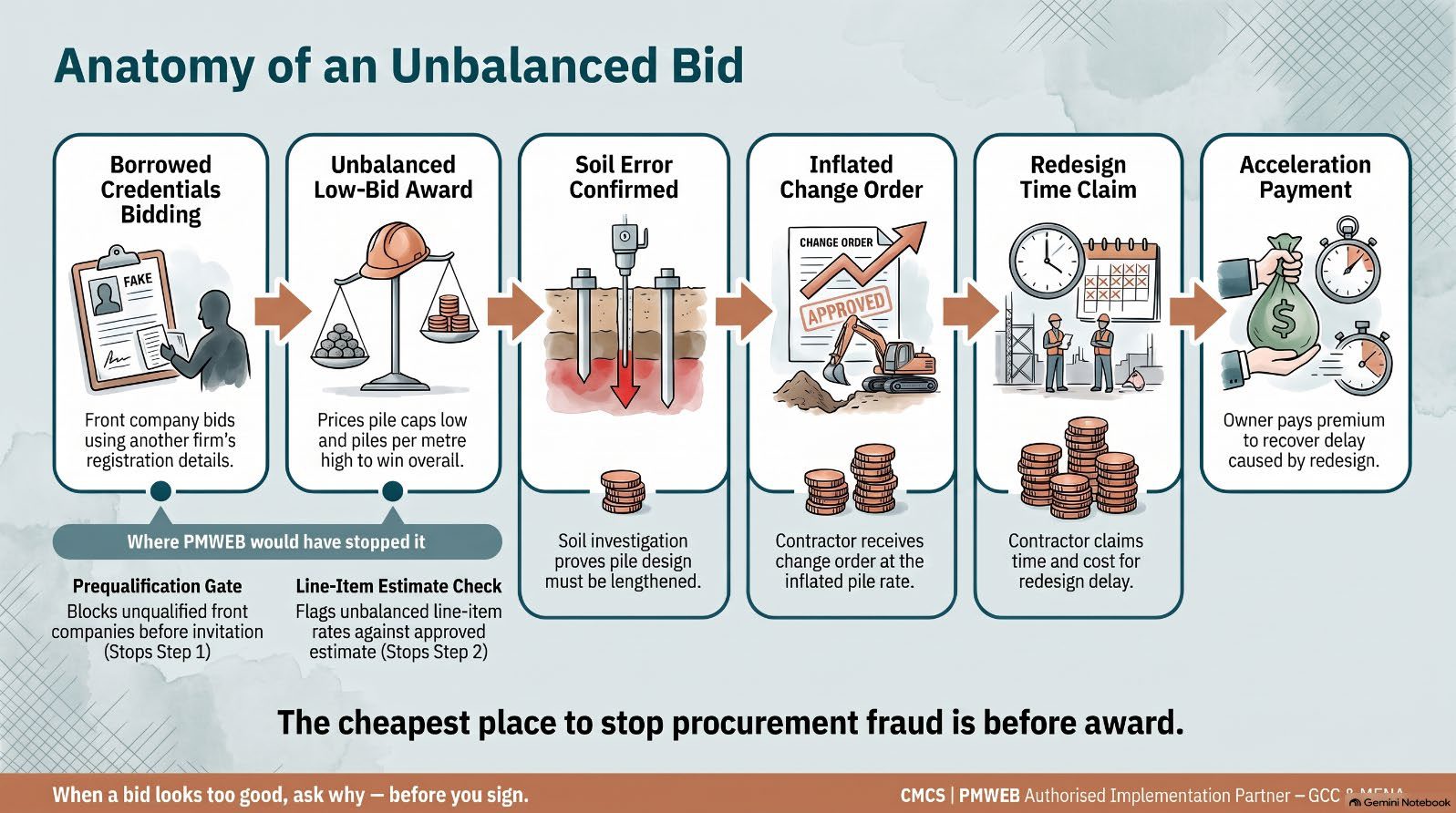
On a major building project, a contracting company was formed specifically to bid. It used another firm's registration credentials to be accepted onto the tender list. Its founders had inside information that the pile design in the tender documents was wrong: after a post-award soil investigation, the piles would have to be redesigned and lengthened.
The new company unbalanced its bid accordingly. It priced pile caps, which would not change, very low, and priced piles by the metre, which would grow, well above market. Its total was the lowest, and it won.
After award, the soil investigation confirmed the error. The piles were redesigned and extended. The contractor received a change order at its inflated pile rate, then claimed time and cost for the redesign, and was finally paid for a directive acceleration to recover the delay.
At least three failures by the owner's team made this possible: an incorrect soil investigation and design, an unqualified contractor invited to bid, and an unbalanced bid accepted without challenge. The last two are procurement controls that a PMIS enforces.
Six Questions Every Bid Analysis Must Answer
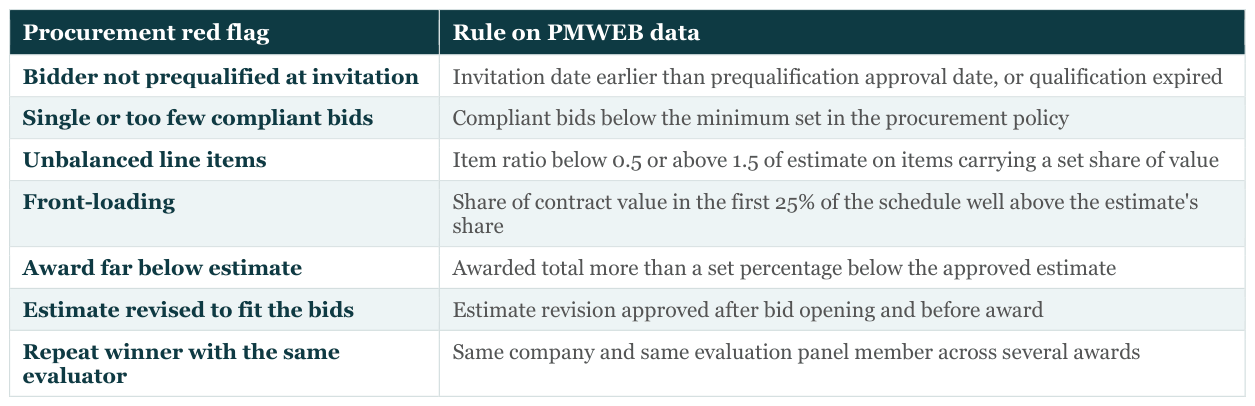
My earlier article on machine learning for fraud detection used the bid analysis report as its example, because a single report can expose six possible fraud transactions. Each question needs specific data, captured in a structured form, to be answered with evidence rather than opinion.

Prequalification as a Gate, Not a Formality
The PMWEB vendor prequalification module holds each company's registration details, departments, contacts, insurances, applications and scoring. The scoring questionnaire is configured by the owner: years in business, comparable projects completed, financial capacity, key staff, health and safety record, pending claims and disputes, and conflict-of-interest declarations. Each question carries points and a weight; the weighted score decides whether the company is qualified for a category and value band.
The prequalification decision itself has a workflow. Procurement reviews documents, finance reviews financial statements, the technical team reviews experience, and the approver is set by the DoA. Each reviewer's comments and dates are recorded. In the case above, a company with no history, no financial record of its own and borrowed credentials would have failed at this gate, and the reviewers who passed it would be on record.
Bid packages in PMWEB draw their invitees from the prequalified vendor list. A rule can flag any invitation to a company whose qualification had not been approved by the invitation date, or had expired, which is how the dashboard later in this article counts bidders who were invited before they were qualified.
Bid Comparison Against the Approved Estimate
The approved cost estimate is the owner's independent view of what the work should cost. In PMWEB it is held line by line, with quantities, units and rates, and every revision is kept. The procurement module then holds each bidder's prices against the same bid items, alongside the estimated unit cost and total. With that structure, the comparison is calculated rather than eyeballed:
- Bid-to-estimate ratio per line item. Bid rate ÷ estimate rate for every item and every bidder.
- Unbalancing. Items priced far below estimate in one bid while others in the same bid sit far above, especially where the high items are quantity-driven or likely to change.
- Front-loading. Early activities such as mobilisation, preliminaries and substructure priced high, and later activities low, to accelerate cash flow and reduce the contractor's exposure if it defaults.
- Outlier totals. A lowest bid well below the estimate and below the other bids, which warrants a scope and assumption review rather than a celebration.
- Identical patterns. Bids from different companies with near-identical rates or errors, which may indicate collusion.
Unbalanced items are not proof of fraud. Contractors price risk differently, and a low rate may reflect a genuine efficiency. They are, however, a signal to go back to the tender documents and ask a specific question: is there something about this item's quantity or design that this bidder knows and the owner does not? In the case above, that question asked of the pile items would have exposed the design error before award.

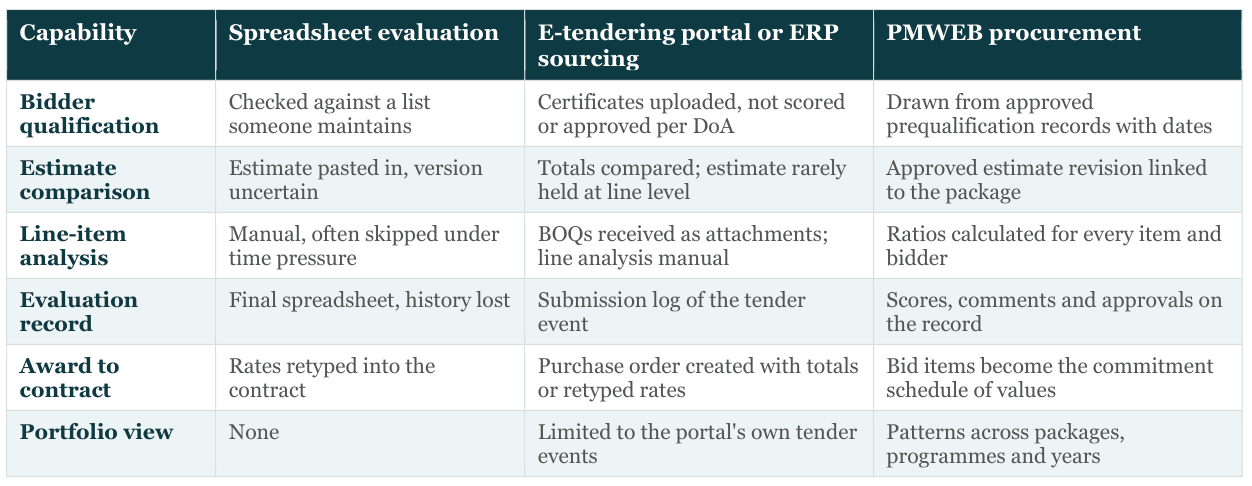
Owners often point to their e-tendering portal or ERP sourcing module as proof that procurement is digital and transparent. Those tools are valuable: they control access to tender documents, time-stamp submissions and keep bids sealed until opening. But they were designed to manage the tender event, not the integrity of the award. Used as the only procurement system, they create false assurance in three ways.
- Bids arrive as attachments. The priced bill of quantities is an uploaded spreadsheet or PDF. The portal compares totals; nobody compares every line item with the approved estimate, so unbalanced rates such as the piling case pass unseen.
- Prequalification is a document upload. Certificates and financial statements are attached but not scored, weighted or approved through a DoA workflow. A front company with borrowed credentials can upload the same files as a genuine contractor.
- The evaluated rates disappear at award. The ERP purchase order is created with a total or retyped rates. When change orders arrive months later, nobody can check them against the rates that were evaluated, because those rates live in a closed tender event.
"Procurement is online" is then reported as "procurement is controlled". PMWEB closes the gap by holding prequalification scores, the estimate, every bidder's line items and the recommendation as related records, and by turning the winning bid into the commitment's schedule of values.
A PMIS can create the same false assurance if it lacks comprehensive cost and contract management. If the estimate lives in one tool, bids in a portal, contracts in the ERP and changes in correspondence, there is no single chain from evaluated rate to paid rate, and the unbalanced bid in the case above would be just as invisible as it was on paper.
From Award to Contract Without Re-keying
Once the recommendation is approved, the successful bid's line items become the commitment's schedule of values in PMWEB. Nothing is retyped, so the rates paid on future change orders and progress invoices are exactly the rates evaluated at award. If a change order later uses a rate that differs from the contract rate for the same item, PMWEB data shows it immediately.
No excuse to stay on the wrong platform
If bids arrive as attachments and the evaluated rates never reach the contract, procurement fraud will stay invisible however carefully the tender is run. Moving prequalification, bid comparison and commitments to a PMIS like PMWEB is the single most effective procurement control an owner can add.
Procurement Integrity Report — Power BI on the PMWEB database, embedded in PMWEB. Illustrative data.
The top-left chart reproduces the pattern from the case. For package P-04, Bidder A, the lowest, is priced at nearly twice the estimate rate for piles per metre and less than a third of it for pile caps, while Bidders B and C track the estimate closely. The flagged packages table shows that P-04 also carries a later RFI pattern on piling, which Part 4 will follow. The bottom charts show competition and qualification by programme: one programme averages barely three compliant bidders per package and has invited almost one in five bidders before their qualification was approved.
Where PMWEB 2026 AI Helps
Bid evaluation is detailed work under deadline pressure. The PMWEB 2026 AI Assistant shortens the search part of it: a procurement auditor can ask it to find all bid packages on a programme awarded below estimate this year, open the package with the largest gap, and open the prequalification record of the winning bidder, without navigating menus. When a red flag is warranted, the assistant can create the record with the auditor's approval. Comparing line-item patterns across hundreds of packages and years, the kind of analysis that reveals a bidder who always prices the same items low, is where analytics on PMWEB data come in, and Part 7 covers that.
The funder's lens — ministries of finance and sovereign funds
- Procurement is where value for money is won or lost for the life of the contract. Ask funded entities to report award-versus-estimate, compliant bids per package and unbalanced items flagged before award.
- A single procurement standard across all funded entities lets the ministry or fund compare contractors, rates and outcomes across the whole portfolio.
Adviser's checklist — for consultants recommending project governance
Questions to ask in the diagnostic
- Are bidders' qualifications scored and approved before invitation, with dates?
- Is every bid compared line by line with the approved estimate, and is that comparison retained?
- Do the evaluated rates flow into the contract without re-keying?
Recommendations to put in the governance report
- Make prequalification a system gate tied to the procurement DoA.
- Require documented clarification of every unbalanced line item before award.
- Carry the winning bid's line items into the commitment so later changes can be tested against them.
Evidence That Procurement Controls Are Working
- Qualified invitations. Every invited bidder qualified for the category and value band at the invitation date.
- Competition. Compliant bids per package at or above policy minimum, by programme.
- Unbalancing challenged. Every flagged line item has a documented clarification before award.
- Estimate stability. No estimate revisions approved between bid opening and award without a recorded reason.
- Post-award change on flagged items. Change value on items flagged at award, tracked to see whether the flag was right.
Procurement fraud is cheapest to stop before award and most expensive to recover after it. PMWEB makes prequalification a gate, compares every bid line against the approved estimate, and carries the evaluated rates straight into the contract.
An e-tendering portal makes the tender event secure; only a PMIS makes the award defensible.
When a bid looks too good, the data tells the owner which question to ask while there is still time to ask it.
Moving procurement into PMWEB is the most effective procurement control an owner can add.
Next in the series: Part 4 follows the contract after award: how linking RFIs, potential change orders, change orders and claims in PMWEB exposes design errors being paid for, over-priced changes and claim-oriented contractors.

Next step
Bring this to your portfolio.
Tell us which processes matter most to you, and we will show them running in PMWEB.