
Article 12 of 12 · Digitalizing the PMO Mandate
From Option to Obligation: What to Do in the Next 180 Days
Over eleven articles I have argued a single proposition from eleven directions. For a government, semi-government or PIF entity in the Kingdom delivering capital construction projects under an NPMO-aligned mandate, a Project Management Information System is not a tool that improves the Project Management Office. It is the mechanism by which the PMO exists as a governing function rather than as a reporting one.
This closing article is about what an entity does with that conclusion.
The maturity question, answered honestly
Before deciding on a course of action, an entity should establish where it actually stands. Five questions are sufficient, and they should be answered by evidence rather than by intention.
Can you state your committed position across the portfolio today, without asking anyone?
Not the budget. The committed position, including pending commitments.
Can you produce the complete approval history of any transaction from the last quarter within one hour?
Do your contractors and consultants transact in your system, or do they send you documents that your staff re- enter?
Is your reporting produced or queried?
If someone assembles it, it is produced.
How much consistently structured project history do you hold, and in what system?
An entity answering all five affirmatively has a functioning PMIS and should be reading this series as validation rather than as advice. An entity answering none of them has an intention rather than a capability, and the gap is larger than an IT project.
Most entities answer two or three, which is the normal and manageable position.
A realistic sequence
The following is the sequence that works, based on implementations across the region. It is deliberately unambitious in its first phase, because the failure mode of PMIS implementation is scope, not technology.
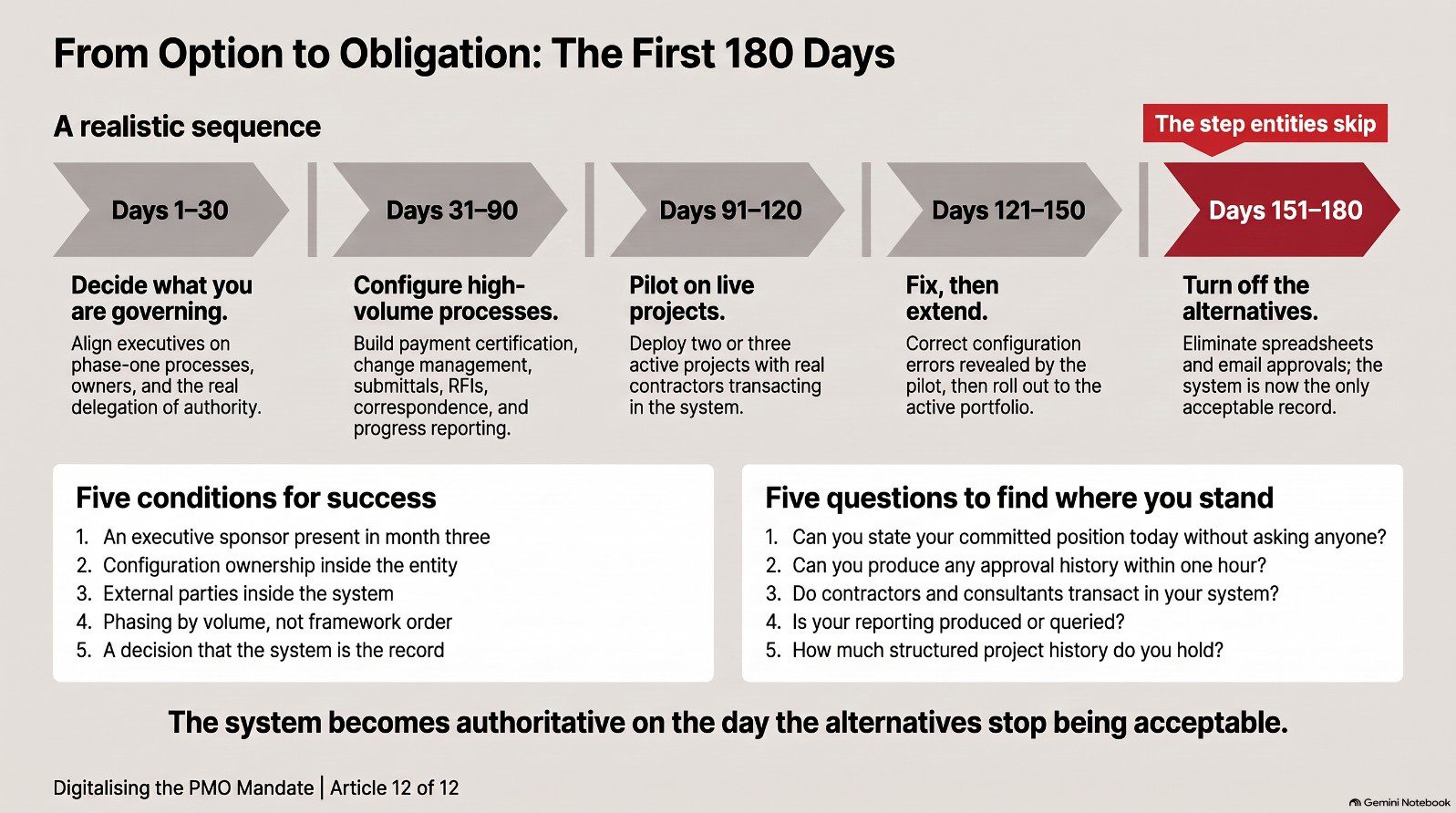
Days 1 to 30 — Decide what you are governing. Not a software selection exercise. An agreement, at executive level, on which processes will be governed in the system in phase one, who owns each, and what the delegation of authority Days 31 to 90 — Configure the high-volume processes. Payment certification, change management, submittals, RFIs, correspondence, progress reporting. These six account for the overwhelming majority of transactions and disputes. Configure them properly, with the real approval routes, the real thresholds and the real forms. Resist the pressure to add the quarterly processes now.
Days 91 to 120 — Pilot on live projects. Not a test environment. Two or three real projects, chosen because they are active enough to generate volume, with real contractors transacting in the system. A pilot on a quiet project proves nothing.
Days 121 to 150 — Fix what the pilot revealed, then extend. Every pilot reveals process ambiguities and workflow errors. Fix them in configuration, which is a matter of days when the platform supports it. Then extend to the remainder of the active portfolio.
Days 151 to 180 — Turn off the alternatives. This is the step entities skip and it is the one that determines success. As long as a parallel path exists — the spreadsheet, the email approval, the manual certificate — a proportion of transactions will use it, the record will be incomplete, and the reporting will remain untrustworthy. The system becomes authoritative on the day the alternatives stop being acceptable, and not before.
Six months is enough for this. It is not enough for a full NPMO framework configuration, and entities that attempt that in the same window will finish neither.
The five conditions for success
Across a large number of implementations, the ones that succeed share five characteristics and the ones that fail lack at least two.
An executive sponsor who is present in month three. Signature is not sponsorship. Month three is when the visibility becomes uncomfortable and someone senior has to say that the discomfort is the point.
Configuration ownership inside the entity. If every process change requires a vendor, process improvement stops within a year. The entity's own PMO staff must be able to configure forms, workflows and reports.
External parties inside the system. A PMIS holding only the entity's half of each process captures the half that was never in dispute.
Phasing by volume, not by framework order. Digitalize what happens a thousand times before what happens twice.
A decision that the system is the record. Not a copy of the record. The record.
What each stakeholder should do next
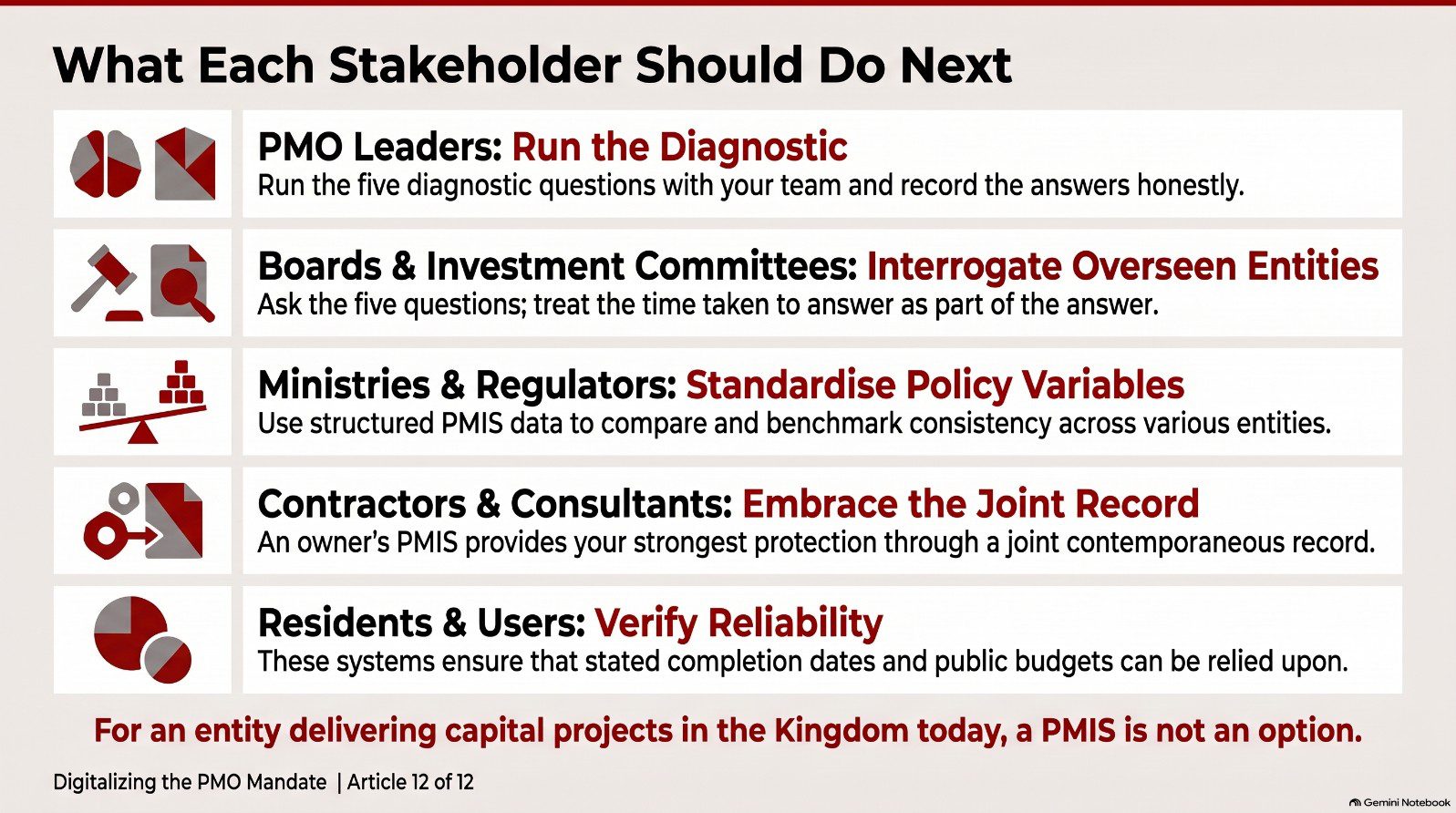
If you lead a PMO. Run the five diagnostic questions above with your own team this month and write down the answers honestly. The result will tell you whether your next investment should be in process definition, in system implementation, or in enforcement of what you already have. All three are common answers and they lead to very different programmes.
If you sit on a board or an investment committee. Ask the five questions of the entities you oversee, and treat the time taken to answer as part of the answer. Governance assurance that rests on reports which take four weeks to assemble is weaker than it appears.
If you are a contractor or consultant. Working within an owner's PMIS is frequently perceived as an administrative imposition. In practice it is the strongest protection available to a delivery party, because it produces a joint contemporaneous record. The party with the better record wins the disagreement, and in an integrated system neither party has a worse one.
If you are affected by these projects as a resident, a user or a future occupant. The systems described in this series are the reason a stated completion date can be relied upon, a public budget can be accounted for, and a facility can be operated properly from the day it opens. They are not administrative overhead. They are the difference between a programme that delivers what it promised and one that explains why it did not.
The closing argument
The Kingdom is delivering the largest concurrent capital programme in the world. The institutional frameworks to govern it — the PMO requirement, the NPMO process architecture, the accountability and transparency expectations — have been defined with unusual clarity.
What remains is execution, and execution at this scale is not achievable through documents, spreadsheets and monthly reports. It requires that the processes be executed inside systems that enforce them, capture the evidence, and make the resulting position visible in something close to real time.
That capability then becomes the foundation for everything that follows: the control tower that combines project records with geography and direct site observation, and the artificial intelligence layer that will only ever be as good as the data beneath it.
A Project Management Information System is where all of it starts. For an entity delivering capital projects in the Kingdom today, it is not an option. It is the condition of being able to do the job.
CMCS is the PMWEB Authorized Implementation Partner for the GCC and MENA region and PMWEB Partner of the Year 2025. We have implemented PMWEB for government, semi-government, PIF-affiliated and private capital delivery organisations across Saudi Arabia, the UAE, Qatar and Kuwait, including integrated PMWEB, Primavera P6 and ESRI GIS deployments in Arabic-language environments for Saudi public sector clients.
If your entity is establishing or maturing a PMO under an NPMO-aligned mandate, we run structured assessment workshops that produce a phased digitalization roadmap against your own process framework. Send me a message.

Next step
Bring this to your portfolio.
Tell us which processes matter most to you, and we will show them running in PMWEB.