
Article 5 of 12 · Digitalizing the PMO Mandate
Real-Time Reporting: The Cost of Finding Out Late
There is a number that almost no entity measures and that predicts capital programme performance better than most of the numbers that are measured. It is the interval between an event occurring on a project and the responsible decision-maker becoming aware of it.
Call it reporting latency. On a typical capital programme managed through periodic reporting cycles, it runs between four and eight weeks. Something happens on site in the first week of a month. It is captured in the project manager's records. It enters the monthly report submitted in the second week of the following month. That report is consolidated by the PMO, reviewed, formatted and presented to the executive committee in the third or fourth week.
By the time the decision-maker learns of the event, five to seven weeks of subsequent decisions have been taken by people who did not know about it.
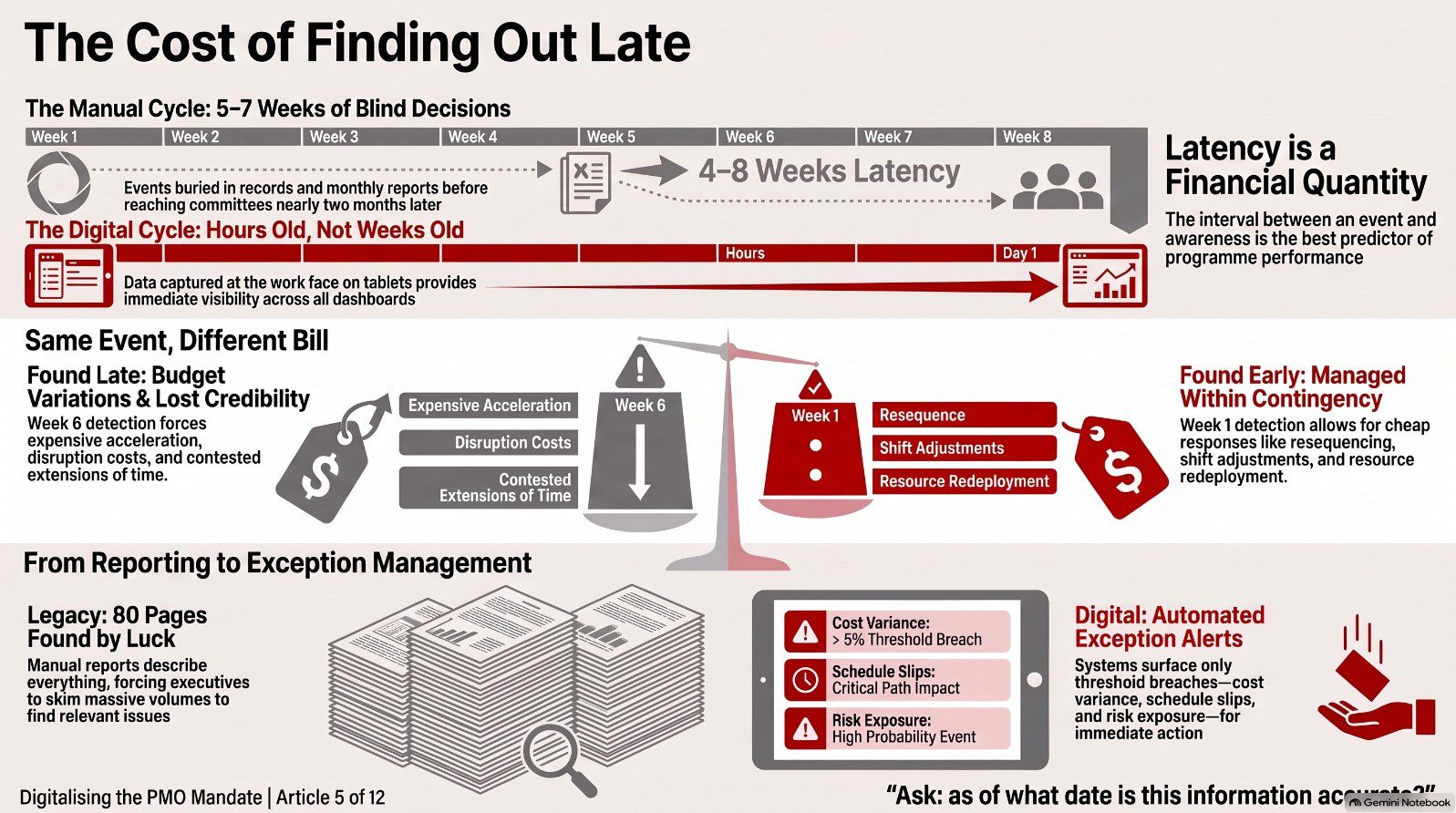
Latency is a financial quantity
The instinct is to treat this as an administrative inefficiency. It is more usefully treated as a cost, because it behaves like one.
Consider a productivity shortfall on a critical activity. Identified in the week it emerges, the available responses are cheap: resequence, add a shift, redeploy resources, adjust the look-ahead. Identified six weeks later, the shortfall has propagated. Successor activities have been planned against dates that will not hold. Subcontractors have been mobilised for the wrong periods. The available responses are now acceleration, disruption cost, or an extension of time — all expensive, and some of them contested.
In every case the cost of the underlying event is a small fraction of the cost of learning about it late. This is the central economic argument for a real-time system, and it is stronger than the efficiency argument that is usually made.
Why the monthly cycle exists
It is worth understanding why capital programmes settled on monthly reporting, because the reason is no longer valid and this is not widely recognised.
The monthly cycle is an artefact of manual data collection. When information had to be gathered by people from other people, consolidated by hand and formatted for presentation, the effort was substantial enough that doing it more than twelve times a year was not feasible. The cycle length was set by the cost of producing the report, not by the rate at which the project changed.
Projects have never changed on a monthly rhythm. They change daily. The monthly report was always a compromise imposed by the technology of reporting.
That constraint no longer exists. When transactions are captured in a system as they occur, the marginal cost of a report is close to zero, and the reporting frequency can be set by what the project requires rather than by what the PMO can produce. Some information genuinely warrants monthly review. Cash flow position, contractual exposure, safety performance and approval bottlenecks do not.
From reporting to exception management
The more consequential shift is not from monthly to daily. It is from reporting to exception management.
A system with continuous data does not need to describe everything. It needs to surface deviation. Configure the thresholds that define acceptable performance — cost variance, schedule variance, approval aging, open non- conformances, risk exposure against contingency — and let the system report only what breaches them.
This inverts the executive's role. Instead of reading a description of the portfolio and attempting to detect problems, the executive receives a short list of items that require attention, each one clickable through to the underlying record. Attention goes where it is needed rather than where it is spread.
What "real time" honestly means
I want to be careful here, because "real time" is often oversold and the overselling damages credibility with the audiences that matter most.
Real time in a PMIS means that a transaction is visible the moment it is entered, and every report and dashboard drawing on it reflects it immediately. It does not mean that the physical state of the project is known instantaneously. It means the latency between recording and reporting falls to zero, leaving only the latency between the event and its recording.
That residual latency is a genuine constraint, and it is addressed differently: by moving data capture to the point of occurrence. Site inspections completed on a tablet at the work face. Progress recorded against measured quantities as they are surveyed. Safety observations logged when observed. Photographs attached where taken. Each of these compresses the gap between event and record from days to minutes.
Combine that with zero recording-to-reporting latency and the entity approaches genuine currency. Not perfection, but a portfolio picture that is hours old rather than weeks old. That is a different management proposition.
The consolidation problem disappears
There is an operational benefit that PMO leaders tend to value even more than the management benefit.
In a manual environment the PMO spends the majority of its capacity on consolidation. Chasing submissions, reconciling formats, resolving contradictions, correcting arithmetic, assembling decks. On many programmes this consumes most of a team's month, every month, in perpetuity.
None of that work adds analytical value. It is the cost of assembling data that should already have been assembled.
When the data is captured at source in a common structure, that cost approaches zero, and the PMO's capacity is released for the work it was actually established to do — analysing trends, challenging forecasts, identifying systemic issues across the portfolio, developing the entity's delivery capability. Entities frequently find that they have effectively doubled their PMO's analytical capacity without adding headcount.
The stakeholder's question
If you rely on reports from an entity delivering capital projects, there is a question worth asking that reveals more than any content in the report itself.
As of what date is this information accurate?
If the answer is the last day of the preceding month and you are reading it in the third week of the current one, you are making decisions on information that is up to seven weeks old, about a portfolio that changes daily.
The question that follows is whether it could be otherwise. For an entity running an integrated PMIS, it can, and the cost of continuing to work from stale information is a choice rather than a constraint.
Next in the series: governing the public riyal — budget, commitment, certification and cash flow.

Next step
Bring this to your portfolio.
Tell us which processes matter most to you, and we will show them running in PMWEB.