
Article 7 of 12 · Digitalizing the PMO Mandate
The Schedule Is a Governance Instrument, Not a Contractor Deliverable
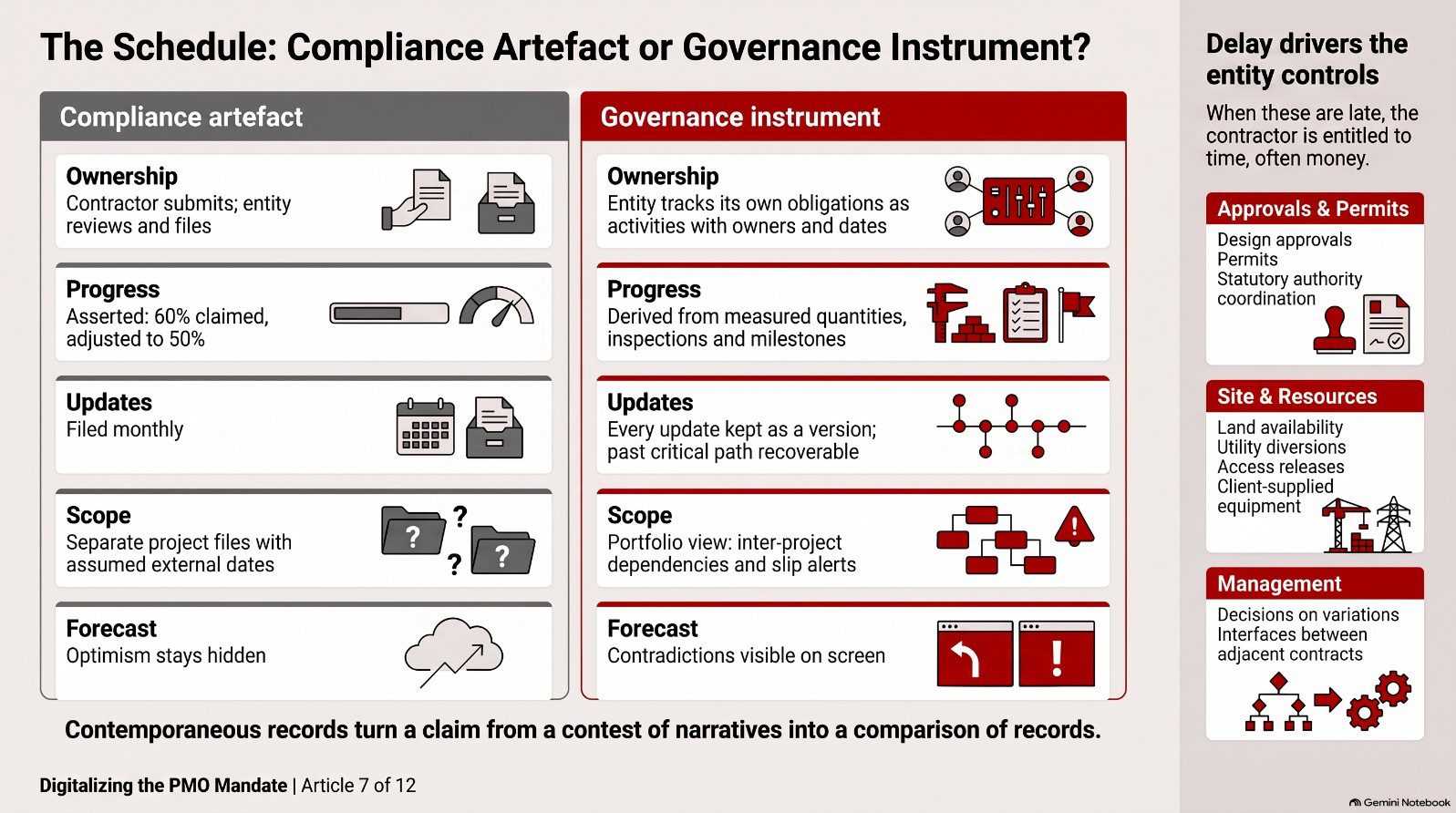
On a large number of capital projects, the programme is treated as something the contractor produces to satisfy a contractual requirement. It is submitted, reviewed, commented on, revised, and eventually accepted. It is then updated monthly, and the update is filed.
That schedule has no governance function whatsoever. It is a compliance artefact.
A schedule that governs is one against which decisions are tested before they are taken, one whose critical path is understood by people who are not planners, and one whose forecast dates are believed by the executive committee. The gap between the two is where most programme delay originates.
Why entity-side schedule capability is not optional
There is a view, still common, that scheduling is the contractor's responsibility and that the entity's role is to review submissions. This is a misunderstanding of where delay risk sits.
The entity controls a large share of the activities that drive completion. Design approvals. Permit applications. Land availability. Utility diversions. Statutory authority coordination. Client-supplied equipment. Decisions on variations. Access releases. Interface coordination between adjacent contracts within the same programme.
When these are late, the contractor is entitled to time, and frequently to money. The entity that has no independent schedule capability discovers this at claim stage, from the contractor's analysis, and is in a weak position to contest it — not because the analysis is wrong, but because it has no contemporaneous record of its own performance against the dates it was obliged to meet.
Progress that means something
The percentage complete figure is the single most abused number in construction.
It is abused because it is usually asserted rather than derived. A contractor states that an activity is sixty percent complete. A consultant, lacking a better basis, adjusts it to fifty. The figure is entered, aggregated up through the WBS with some weighting, and reported to a board as portfolio progress. Nobody at any level of that chain can say what evidence supports it.
Deriving progress rather than asserting it requires linking it to something measurable — installed quantities, completed deliverables, passed inspections, milestones achieved. When progress is calculated from measured quantities that were surveyed and inspected, and those records exist in the same system as the schedule, the percentage complete figure becomes an output rather than an opinion.
This has an immediate commercial consequence, because on most contracts progress determines payment. An entity paying against asserted progress is exposed. An entity paying against derived progress, with the derivation visible, is not.
It also has a forecasting consequence. Productivity trends calculated from derived progress are meaningful and can be extrapolated. Trends calculated from asserted progress are noise, which is why so many project forecasts hold steady for months and then move catastrophically at the point where assertion collides with physical reality.
Delay, and the discipline of contemporaneous records
Extension of time claims are decided on evidence, and the evidence that decides them is contemporaneous. What was the accepted programme at the time. What was the actual progress at the time. When did the delaying event occur. What was its effect on the critical path as it then stood. What mitigation was available and what was instructed.
Entities lose extension of time claims they should win, and settle claims they should contest, for one reason above all others: they cannot reconstruct the position as it stood at the relevant time. The programme updates were not retained. The progress records are incomplete. The correspondence establishing when the entity was notified is scattered across mailboxes. The analysis is therefore conducted on the contractor's records, which are complete because the contractor understood their value.
A PMIS holding schedule versions, progress records, site records, instructions and correspondence in a single time- stamped structure removes this asymmetry entirely. Every monthly update is retained as a version. The critical path at any past date is recoverable. The instruction, the notification, the response and the delay are linked records with dates that nobody disputes.
The entities that invest in this discipline find that the number of claims they face falls, independently of how the claims are decided. Contractors assess the strength of a claim partly by assessing the quality of the opposing record.
Interface risk in a portfolio
Most of what is written about scheduling concerns individual projects. For an entity delivering a portfolio, the more consequential risk is between projects.
A road that must open before a development can be occupied. A substation that must energise before a facility can commission. A utility corridor shared between three contracts. A road closure that can only be taken by one project at a time. A specialist subcontractor market that cannot serve four simultaneous packages.
Managing this requires a portfolio-level view where inter-project dependencies are modelled explicitly and a slip in one project raises an alert in the others. This is only practical when all project schedules are held in a common structure — which is precisely what a PMIS with integrated scheduling provides, and precisely what a collection of separately maintained schedule files cannot.
Forecasting honestly
A final observation, directed at PMO leaders rather than at systems.
Schedule forecasts on capital projects are optimistic with remarkable consistency, and the mechanism is not technical. It is that the forecast is produced by parties who have an interest in it being acceptable, reviewed by parties who have an interest in not being the bearer of bad news, and presented to an audience that has previously reacted badly to bad news.
No system fixes this. What a system does is make optimism visible. When a forecast holds a completion date while the productivity trend, the open change position and the approval backlog all point elsewhere, the contradiction is on the screen. Someone still has to raise it. But they can raise it with evidence rather than with intuition, and that is usually the difference between the conversation happening and not happening.
Next in the series: records as evidence — document control as institutional memory.

Next step
Bring this to your portfolio.
Tell us which processes matter most to you, and we will show them running in PMWEB.