
Article 4 of 12 · Digitalizing the PMO Mandate
Transparency Is Not a Report. It Is Access.
Most organisations believe they are transparent because they publish a lot. Monthly reports, quarterly board packs, steering committee decks, dashboards exported to PDF. The volume of material produced by a large capital programme is genuinely impressive.
Very little of it constitutes transparency, and it is worth being precise about why.
A report is a curated selection of facts, chosen by a party, presented in a sequence that party constructed, at a moment that party controlled. This is not an accusation of dishonesty. Every report is a selection, because complete disclosure of everything that happened on a project in a month would be unreadable. Someone has to select. But the party doing the selecting is usually the party whose performance is being described, and this is a structural problem that no amount of professional integrity fully resolves.
Transparency is the ability of a legitimate stakeholder to look at the underlying data directly, without asking, and to reach their own view.
The single source of truth, understood properly
The phrase "single source of truth" is used loosely enough to have lost most of its meaning. In the context of a capital project it has a specific and testable definition.
There is one place where a fact is recorded. Everything that needs that fact reads it from there. Nothing holds a copy.
Consider the contract value of a construction contract. In a typical entity, that number exists in the contract document, in the finance system, in the cost report spreadsheet, in the PMO's portfolio tracker, in the board pack, and in the project manager's own working file. Six locations. Each was correct when created. A variation is approved and four of the six update. Nobody notices for a quarter.
This is not a hypothetical failure mode. It is the normal condition of capital programmes managed without an integrated system, and it is the reason why the question "what is the current approved value of this contract" so often produces different answers from different parts of the same organisation.
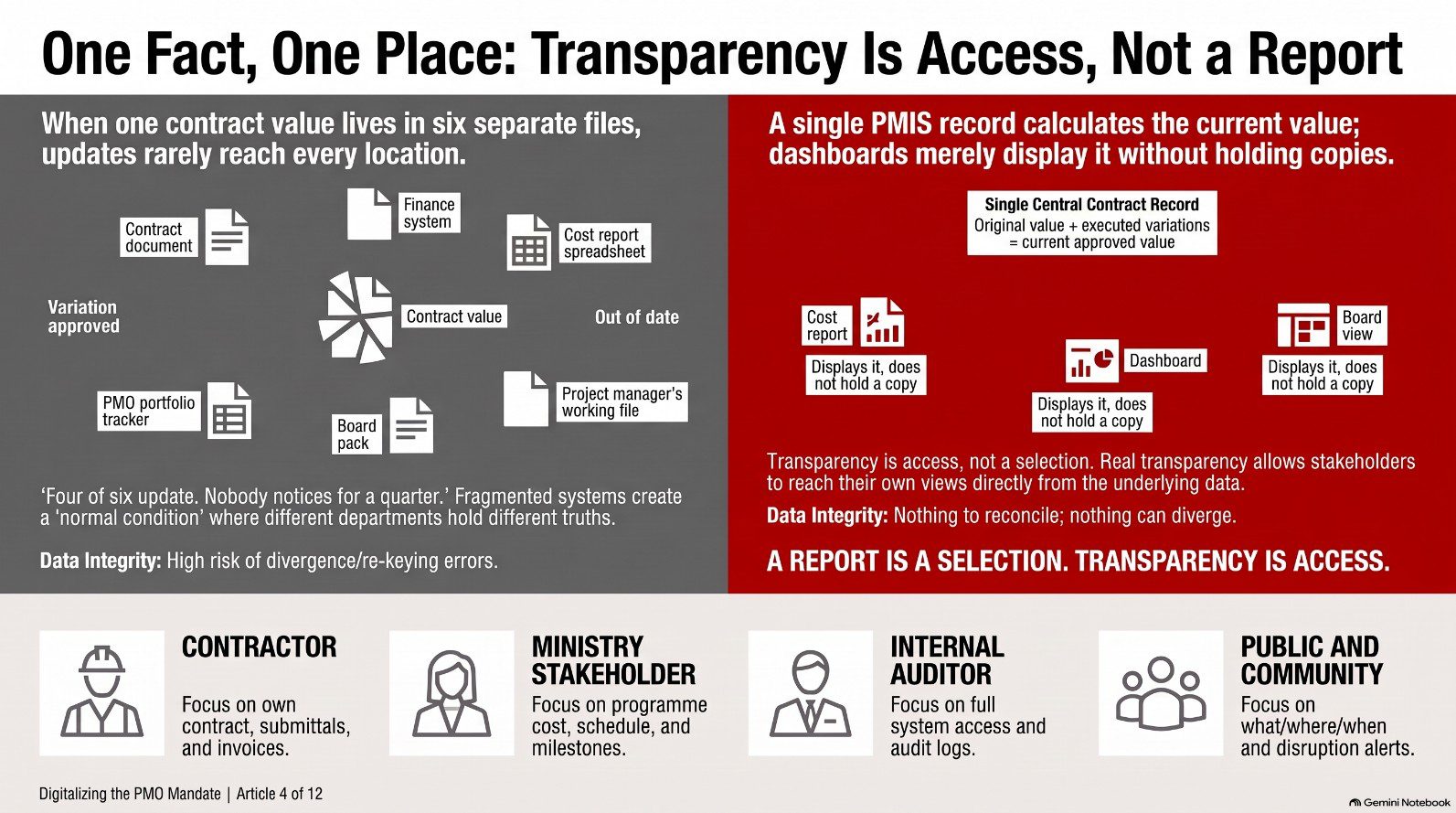
A PMIS resolves this by holding the contract as a record. The original value, every executed variation, and the current approved value are properties of that record. The cost report does not contain the number; it displays it. The dashboard does not contain the number; it displays it. There is nothing to reconcile because there is nothing to diverge.
The reasonable objection to transparency is confidentiality. Not every stakeholder should see everything. Contractor rates are commercially sensitive. Claim positions are legally sensitive. Personnel matters are personal. Some information is restricted by regulation.
This objection is often used to justify closed systems, and it should not be, because the two requirements are not in tension. They are solved by the same mechanism.
Role-based permissions in a PMIS mean that access is defined once, at the level of role and record type, and applied consistently everywhere. A contractor sees its own contract, its own submittals, its own invoices, and the drawings relevant to its scope. It does not see other contractors' commercial terms. A ministry stakeholder sees programme- level cost, schedule and milestone status across the portfolio without seeing individual claim correspondence. An internal auditor sees everything, and the system records that they looked.
The result is more openness and better control simultaneously — which is not the trade-off most people expect. Under an email-and-spreadsheet regime, confidentiality is protected by each individual's judgement about what to attach to what message, and it fails regularly. Under a permissioned system it is protected by configuration, and it fails rarely.
Bringing the delivery supply chain inside
The most significant decision an entity makes when implementing a PMIS is whether external parties transact within it.
An internal-only deployment gives the entity a better version of its own records. That has value. But the events that determine project outcomes largely occur at the interface between organisations — a submittal issued, a response returned, a payment application made, an instruction given. If those events enter the entity's system by re-keying from email, the system holds a delayed and lossy copy of reality.
When contractors and consultants transact directly in PMWEB, three things change immediately. The data becomes contemporaneous rather than reconstructed. The administrative burden of re-keying disappears, along with the errors There is a fourth effect that entities discover later. Contractors who work in the owner's system develop a strong interest in the accuracy of what it contains, because it is the basis on which they are paid. Data quality improves for reasons that have nothing to do with instruction.
Transparency toward the public interest
For entities delivering projects that shape communities — hospitals, schools, roads, housing, transport, stadiums, municipal works — there is a category of stakeholder that governance discussions frequently omit.
The people who will use the asset. The residents whose neighbourhood is a construction site for three years. The businesses whose access is affected. The ministries answerable for the outcome.
These stakeholders do not need the cost ledger. What they need is reliable answers to a small number of questions: what is being built, where, by when, what disruption to expect, and whether the current answer differs from the one given last time.
An entity with a properly maintained PMIS can answer these continuously and consistently, because the answers come from the same records that drive its internal governance. An entity without one publishes a milestone date, revises it privately three times, and communicates the revision only when it becomes undeniable. The reputational cost of that pattern is significant and entirely avoidable.
The credibility of large capital programmes with the public rests substantially on whether stated dates prove to be real. Systems that keep internal and external statements drawn from the same source make that far more likely.
Transparency is genuinely uncomfortable at the start of an implementation, and any consultant who tells an entity otherwise is not being straight with them.
When a portfolio moves into a live system, problems that were previously distributed across many spreadsheets and many mailboxes become visible simultaneously. Projects that were reported as on track appear as at risk. Approval bottlenecks that everyone privately knew about become measurable and attributable. The first quarter of accurate reporting frequently looks like a deterioration in performance, when in fact it is the first period of accurate measurement.
Entities that push through this emerge with control. Entities that respond by softening the reporting return to where they started, having spent the money.
Senior sponsorship is what determines which happens, and it is needed most in month three, not at signature.
Next in the series: the cost of reporting latency, and why the monthly cycle is no longer defensible.

Next step
Bring this to your portfolio.
Tell us which processes matter most to you, and we will show them running in PMWEB.