
Article 7 of 9 · PMWEB for Contractors and Subcontractors
Early Warning and Risk
Projects rarely fail suddenly. They fail slowly, through small problems that someone on site noticed and nobody recorded. By the time the problem reaches management, the time to act cheaply has passed. The difference between a profitable contractor and a struggling one is often nothing more than how early problems are reported.
This article shows how PMWEB turns early warning from a contract clause into a company culture: anyone can raise a warning, everyone is obliged to, and every warning is assessed, priced and acted on through the risk register and the change event process.
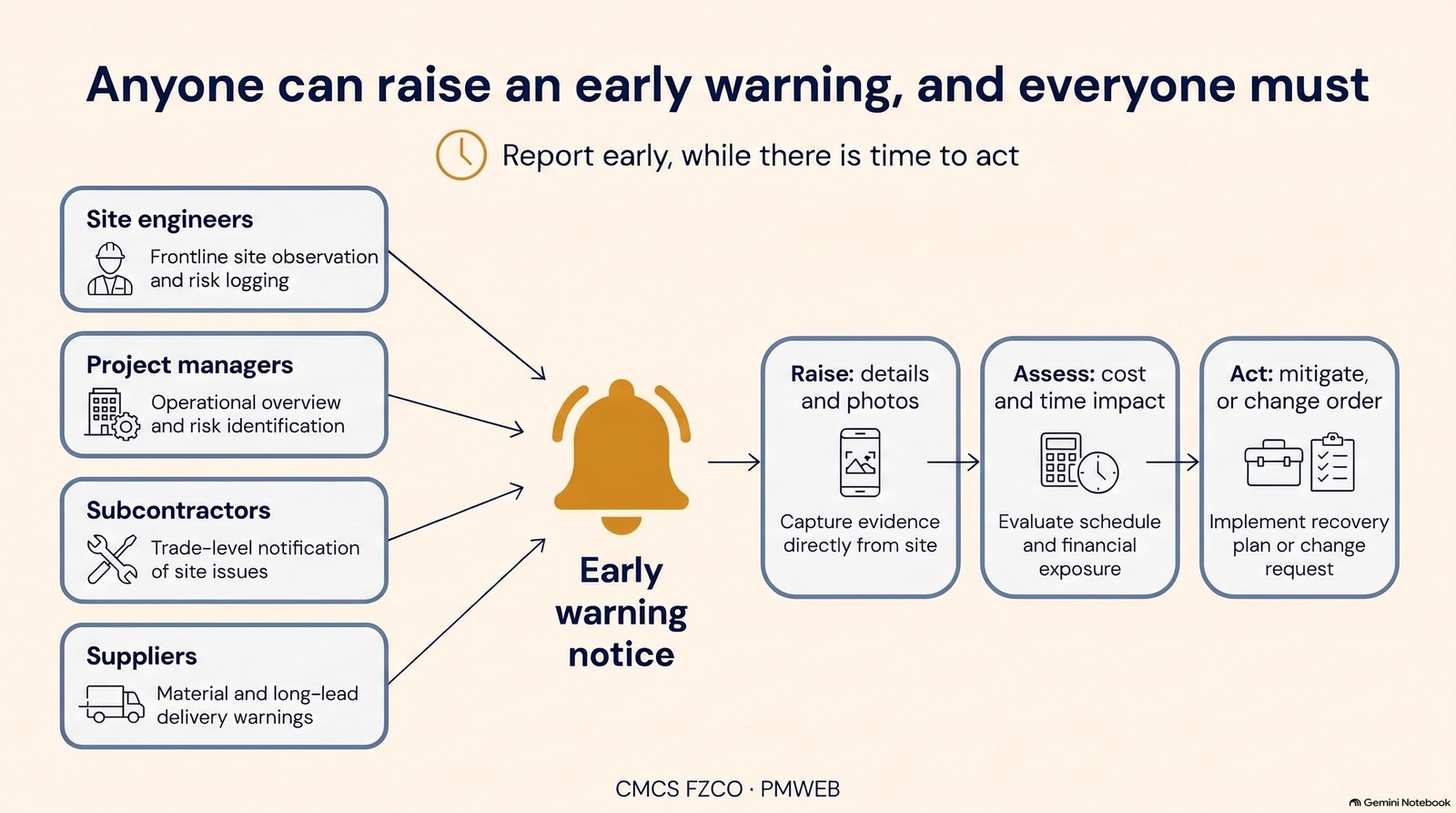
Everyone Reports, From Their Phone
An Early Warning Notice in PMWEB is a short form that takes a minute to complete: what was observed, where, the likely impact on cost, time or quality, and a photo. It can be raised from the PMWEB mobile interface by site engineers, project managers, and, through controlled portal access, by subcontractors and suppliers. The rule is simple: if you see it, you report it. Not reporting is the failure; reporting is never a failure.
| Who reports | Typical early warnings |
|---|---|
| Site engineers | Ground conditions, clashes between services, access restrictions, safety concerns |
| Project managers | Late information from the client, design changes, resource shortfalls |
| Subcontractors | Trade-level issues, late fronts, rework caused by others |
| Suppliers | Manufacturing delays, shipping disruptions, price increases on long-lead items |
Raise, Assess, Act
Each warning follows a workflow. It is raised with evidence, assessed by the project team for cost and time exposure, and acted on: mitigated within the project, escalated, or converted into a potential change. Due dates and escalation rules ensure no warning sits unanswered. Every warning shows on the project dashboard until it is closed.
The Risk Register
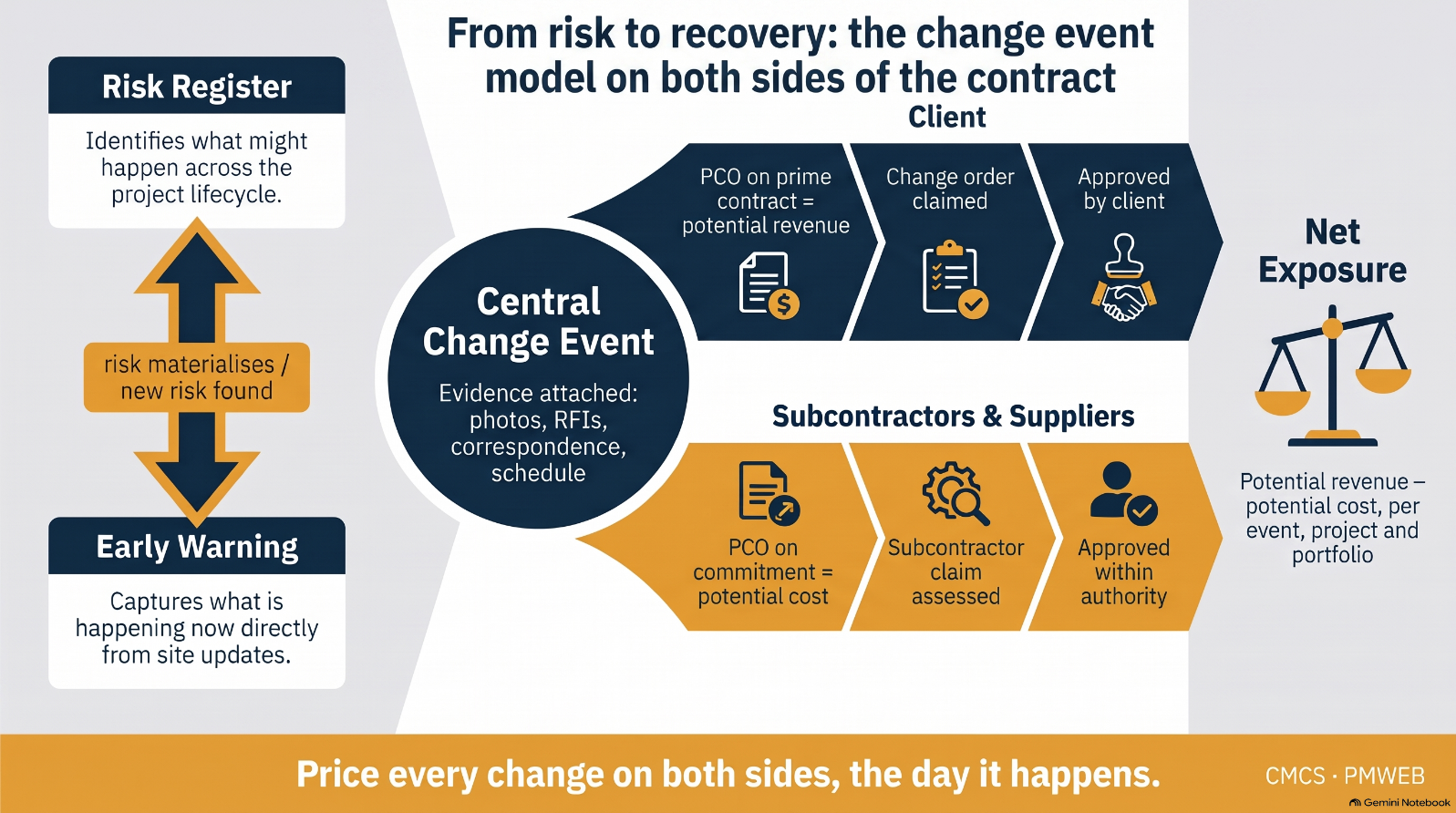
Early warnings report what is happening now; the risk register tracks what might happen. The tender risks identified at the bid/no-bid stage (Part 2) become the project's opening risk register. Each risk has an owner, a probability and impact, a response plan and a contingency allowance, and it is reviewed at every progress update. When a risk materialises, it becomes an early warning; when a warning reveals a new risk, it is added to the register.
Potential Change Orders on Both Sides
When a warning has a cost or time effect, PMWEB records it as a change event with potential change orders (PCOs) on both sides of the contract:
- A PCO on the prime contract is potential revenue: an entitlement the contractor will claim from the client.
- A PCO on a commitment is potential cost: a claim the subcontractor or supplier is likely to make.
- The net exposure is the difference, visible per event, per project and across the portfolio.
Because the PCOs are recorded when the event happens, not when the claim is prepared, the contractor meets contractual notice periods, keeps contemporaneous records and forecasts its final position honestly. The same discipline stops subcontractor claims from surprising the project at final account.
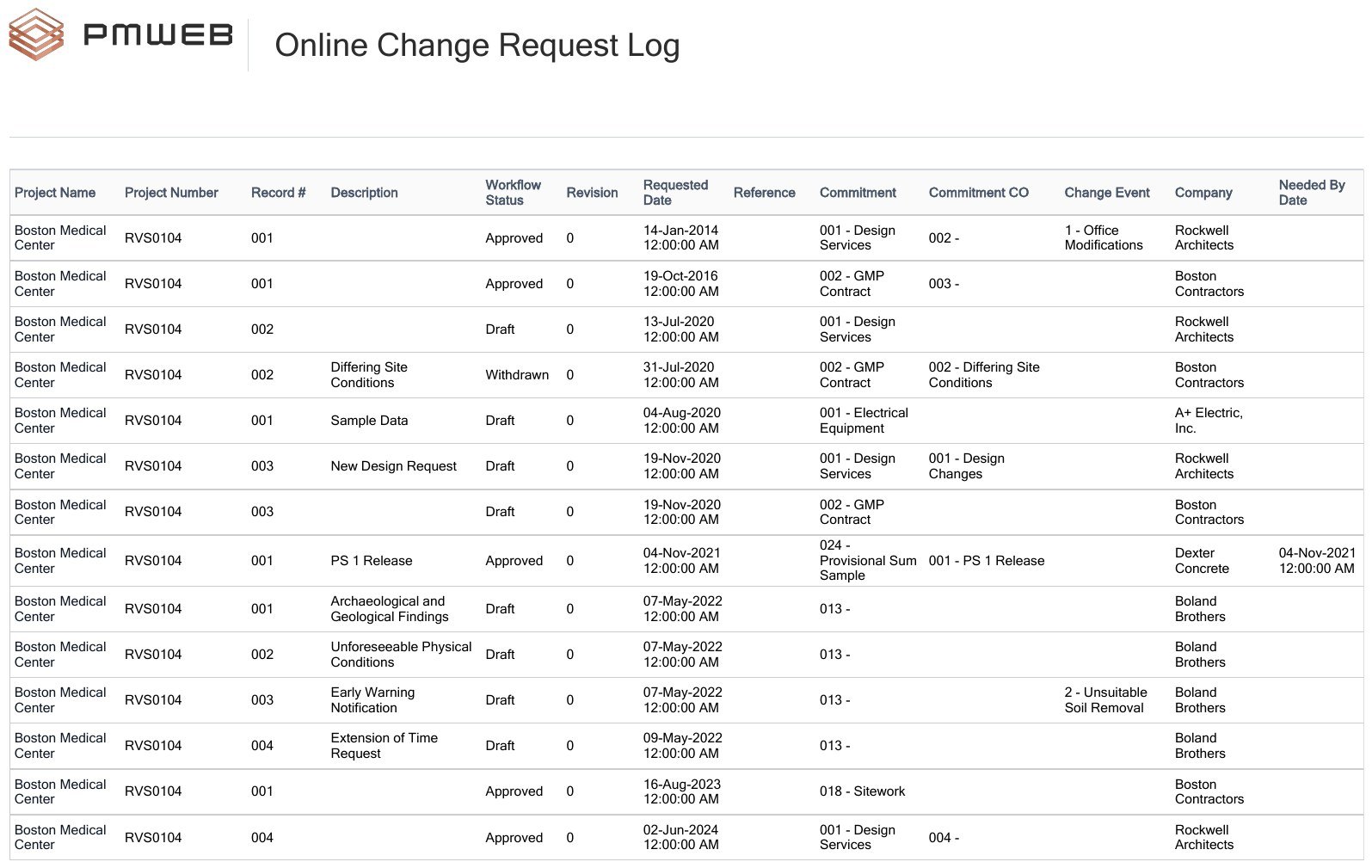
Evidence That Wins Claims
Early warnings, site photos, RFIs, correspondence and schedule updates are linked to the change event in PMWEB. When the claim is prepared, the evidence is already assembled, dated and attributed. This is the difference between a claim that is negotiated and one that is paid.
The Subcontractor's View
Specialist subcontractors are often the first to see a problem and the last to be paid for it. Raising early warnings to the main contractor through PMWEB, with notices on time and evidence attached, protects the subcontractor's entitlement. Internally, the same register shows which main contractors and projects generate the most unrecovered change.
Where AI Adds Value
PMWEB 2026 AI can scan open warnings and risks across all projects: "Which early warnings are open for more than 14 days?", "What is our net change exposure by project?", "Summarise the risks related to long-lead equipment across the portfolio." Management hears about problems while they are still small.
Key takeaway
Early warning is a culture, and PMWEB is how a contractor enforces it. Anyone can raise a warning from site, every warning is assessed and acted on through a workflow, risks are managed in a live register, and every potential change is priced against both the client and the subcontractors, with the evidence attached.
Next in the series, Part 8: From Site to Handover. Schedule, submittals, RFIs, inspections and a handover built from day one.

Next step
Bring this to your portfolio.
Tell us which processes matter most to you, and we will show them running in PMWEB.