
Article 5 of 9 · PMWEB for Contractors and Subcontractors
The Accountable Project Team
Most contractors hand a project to a project manager with a budget, a programme and a hope. When the project overruns, nobody can say with certainty whether the budget was unrealistic, the scope changed or the team underperformed. The fix is not more supervision. It is a clear agreement, recorded and tracked, between the company and the team that runs the project.
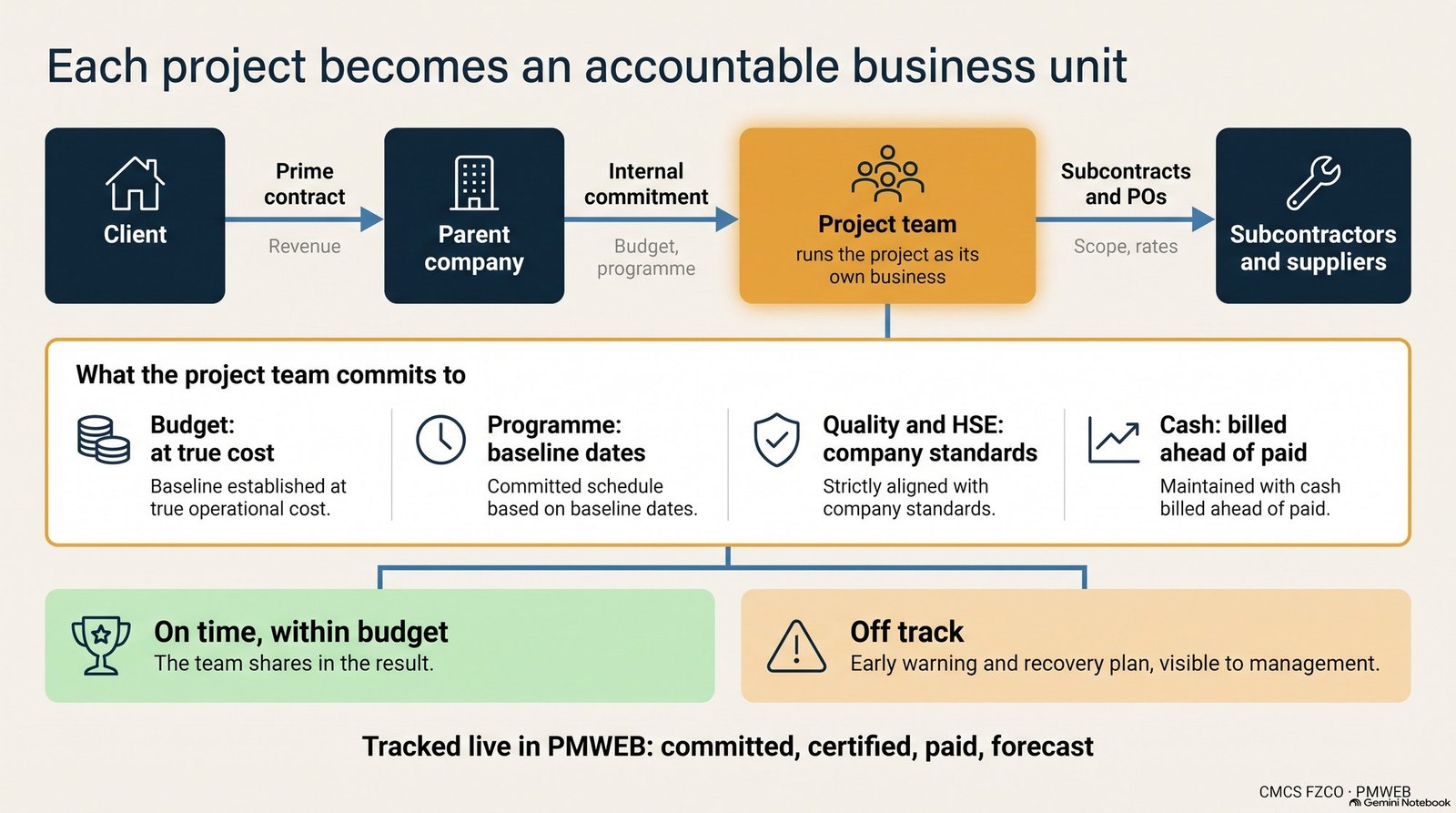
This article shows how contractors use PMWEB to formalise that agreement as an internal commitment between the parent company and the project team, achieve 100% buyout of the budget, and reward teams that deliver on time and within budget.
The Internal Commitment
When a tender is won, the company signs a prime contract with the client. In PMWEB it then issues an internal commitment to the project team, using the same Commitments module it uses for subcontractors. The internal commitment carries the true-cost budget from the estimate (Part 3), the baseline programme, the quality and HSE standards, and the cash targets. The project team accepts it through a workflow. From that moment the team runs the project as its own business.
| The team commits to | Defined as | Tracked in PMWEB through |
|---|---|---|
| Budget | Delivery at the true cost agreed at award | Commitments, actuals and forecast against the budget |
| Programme | Baseline dates for key milestones | Schedule updates linked to the commitment |
| Quality and HSE | Company standards, inspections passed, no major incidents | Inspections, NCRs and HSE records |
| Cash | Billing ahead of paying; collections on time | Progress invoices, payments received and made |
100% Buyout: Every Line of the Budget Has an Owner
Accountability is only real when the whole budget is converted into commitments. PMWEB lets the team issue commitments for every part of the budget: subcontracts and purchase orders to external parties, and internal commitments to company-owned units such as the plant department, the batching plant, the prefabrication workshop or head-office engineering. Each internal unit then works under the same rules as an external subcontractor, with a scope, a value and approved changes.

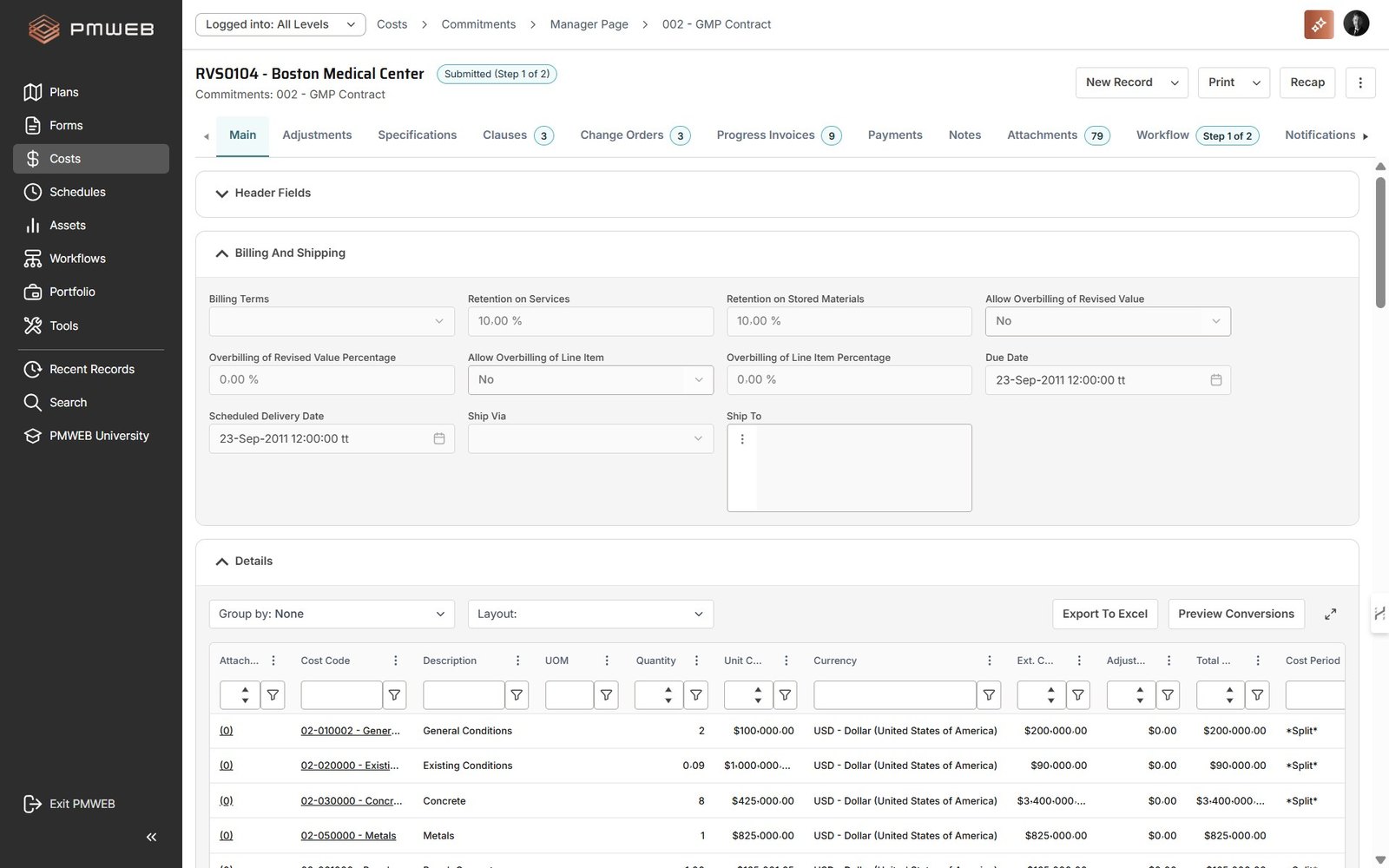
The uncommitted balance is visible at any time. Any amount still uncommitted is either an opportunity (scope not yet bought) or a risk (scope forgotten). Either way, management sees it.
Changes Only Through the Front Door
The internal commitment can only change through an approved change order, and PMWEB enforces that a change to the team's budget is only approved when it matches a change allowed under the prime contract or an approved transfer from contingency. Scope added by the client increases both sides. Overruns caused by the team do not. This is how accountability survives the first variation.
A Reward That Means Something
Because the budget, programme and quality commitments are agreed in advance and tracked in PMWEB, the company can link a reward to them without argument. When the project closes on time, within budget and to standard, the team shares in the result. When it does not, the early warning and recovery plan are visible to management long before the end (Part 7). The data that measures the outcome is the same data the team used to run the project, so the outcome is undisputed.
The Subcontractor's View
Specialist subcontractors run many small, fast projects at once, so the risk of an unowned budget is even higher. The same model applies: the subcontract received from the main contractor is the prime contract, the internal commitment goes to the site team or installation crew, and fabrication shops are committed internally. Small teams learn quickly when their numbers are visible.
Where AI Adds Value
With every project team operating under the same commitment structure, PMWEB 2026 AI can compare teams like for like: "Which teams delivered within their internal commitment last year?", "What share of the budget is still uncommitted on projects started in the last quarter?", "Which internal units most often exceed their commitments?"
Key takeaway
An internal commitment turns a project team into a business unit with a clear budget, programme, quality and cash agreement. With 100% buyout and changes allowed only when backed by the prime contract or approved contingency, accountability is measurable, and a reward can be tied to results that nobody disputes.
Next in the series, Part 6: Both Sides of Every Contract. Managing the prime contract and the commitments together, from change orders to payments and bank funding.

Next step
Bring this to your portfolio.
Tell us which processes matter most to you, and we will show them running in PMWEB.