
Article 2 of 9 · PMWEB for Contractors and Subcontractors
Winning the Right Work
The most expensive project a contractor ever does is the one it should never have bid for. Margins are decided long before mobilisation: at the moment someone says yes to an invitation to tender. Yet in most contracting firms that decision is made in a corridor conversation and recorded nowhere.
In Part 1 we argued that governance must be built into the way work moves. Governance starts at the front door. This article shows how contractors and specialist subcontractors use PMWEB to register every opportunity, assess it consistently and record a formal bid/no-bid decision before any estimating effort is spent.
Every Invitation Logged, Every Decision Recorded
Contractors receive far more invitations to tender than they can price well. A specialist MEP subcontractor may receive the same project from five different main contractors. Without a single register, nobody knows how many tenders are live, how much estimating capacity they consume, or why some were declined.
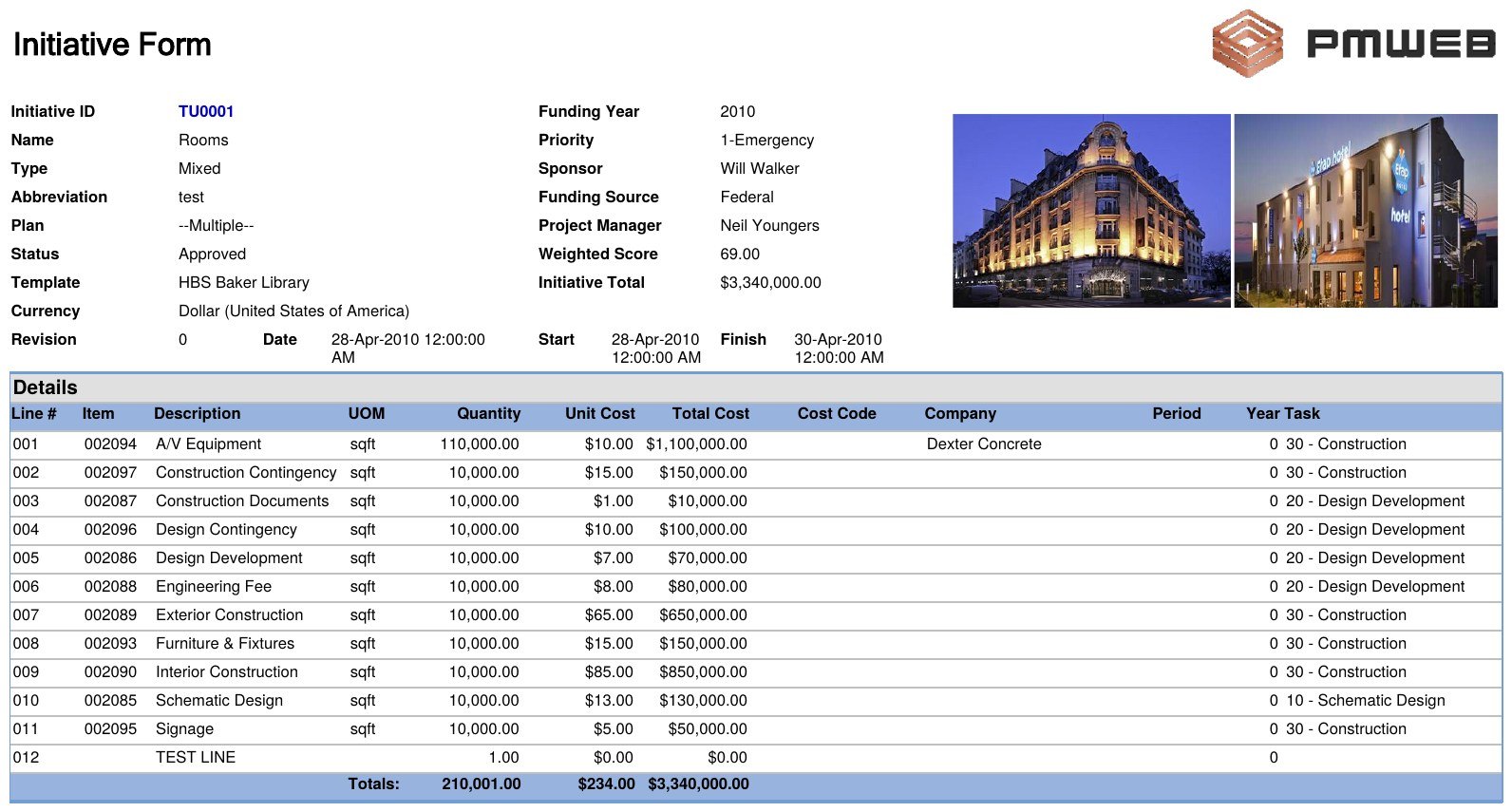
In PMWEB, each opportunity is captured as an Initiative: client, location, sector, estimated value, submission date, delivery period, contract form, and the source of the invitation. The Initiative is created at the moment an invitation arrives, not when estimating starts, so the pipeline is complete from day one.
A Formal Bid/No-Bid Gate
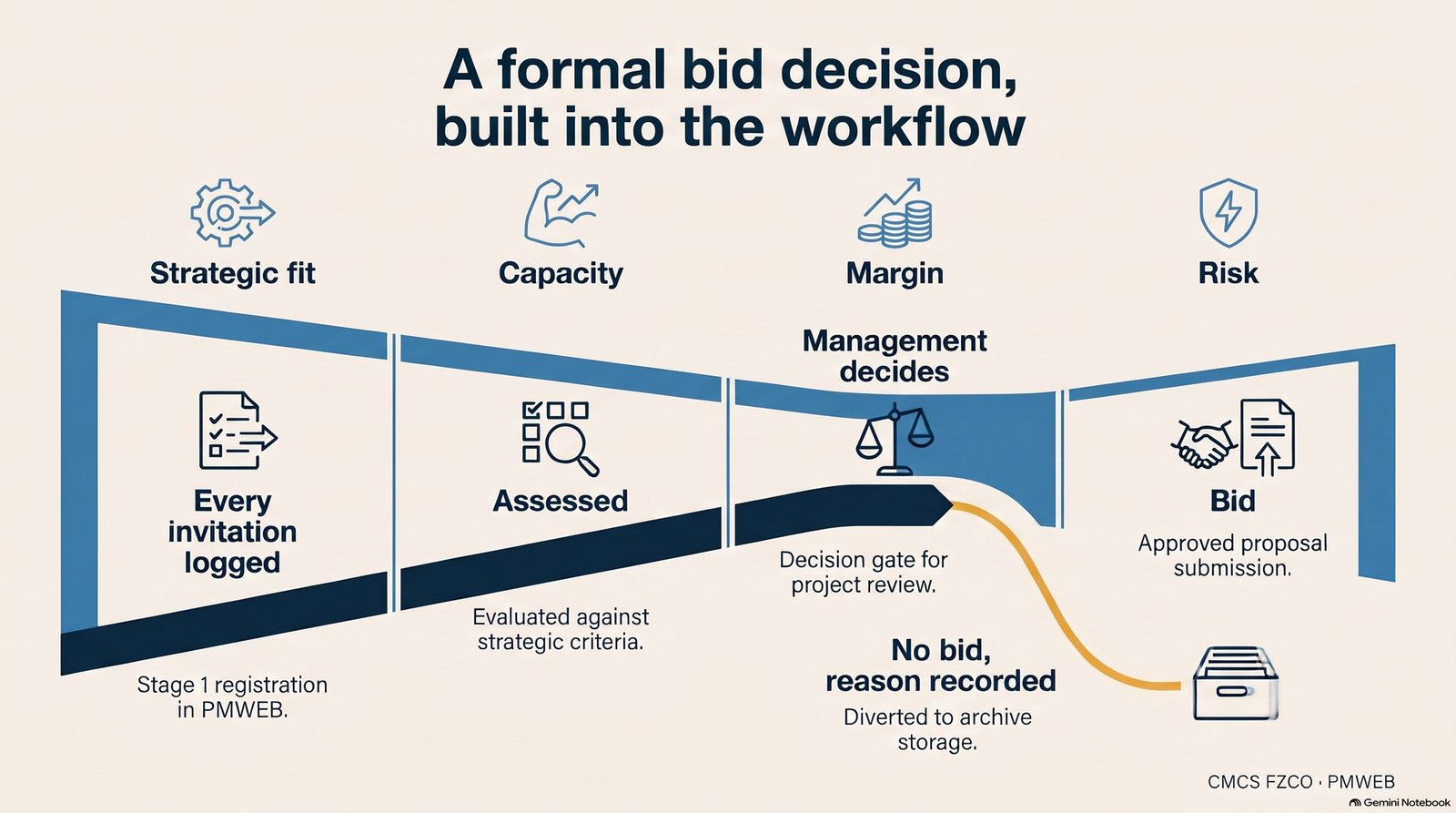
The Initiative is routed through a workflow that turns the bid decision into a governed step. Business development registers it; the estimating, operations and finance leads each assess it against agreed criteria; management decides. A declined opportunity is not deleted. It is archived with its reason, so the company learns which clients, sectors and contract forms it should stop chasing.
| Criterion | Questions the assessment answers | Captured in PMWEB as |
|---|---|---|
| Strategic fit | Is this the client, sector and region we want to grow in? | Scored field on the Initiative |
| Capacity | Do we have estimating time now and delivery resources when it starts? | Pipeline dashboard by start date and value |
| Margin | Can we win at a price that leaves an acceptable margin? | Target margin and historical margin for similar work |
| Risk | Contract form, payment terms, client track record, liquidated damages | Risk notes and an initial risk score |
| Cash | Advance payment, retention, payment cycle, bank guarantees required | Cash and bonding assumptions on the Initiative |
Because the scoring fields are standard, each assessment is consistent and comparable. Approval limits follow the company's delegation of authority: a small negotiated job may be approved by the operations director, while a large lump-sum tender with onerous terms goes to the managing director or the board.
The Pipeline as a Portfolio
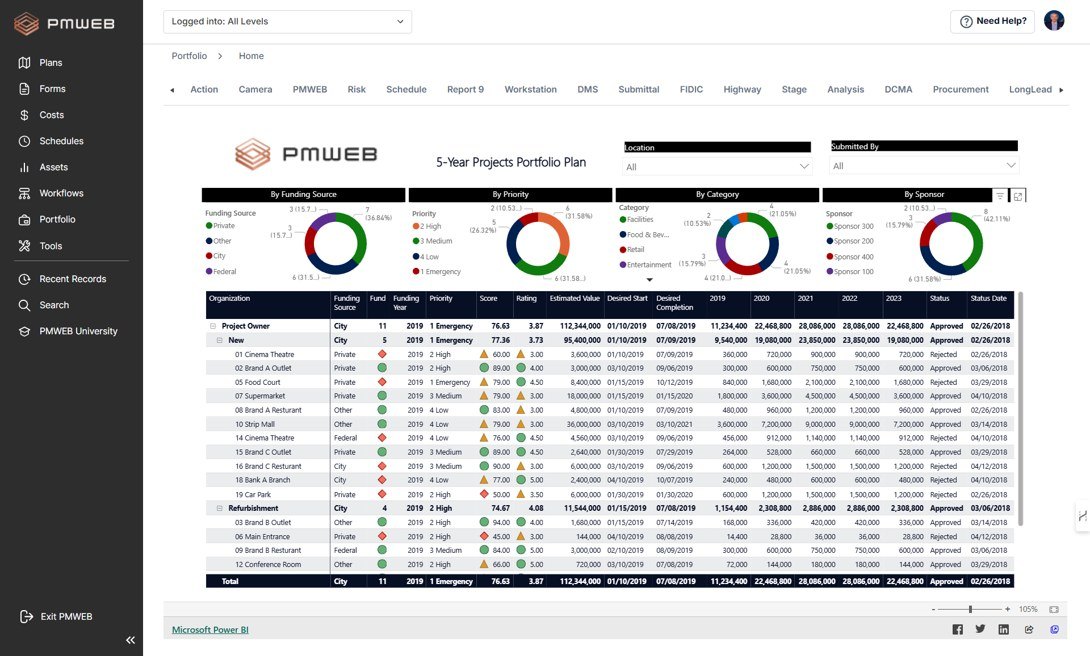
Once every opportunity is registered, the pipeline becomes a portfolio that management can steer. Dashboards built on the Initiatives show the value of work under pursuit by stage, client, sector and expected start date, and compare it with the company's capacity and growth targets.
- Hit rate by client, sector and contract form shows where the company actually wins.
- Estimating load by submission date shows when the team is overcommitted, before quality drops.
- Forward workload by expected start date shows whether the company is bidding for the right volume.
- Declined reasons show patterns, such as clients with poor payment records or contract forms that consistently carry unacceptable risk.
The Subcontractor's View
For a specialist subcontractor, the same project often arrives through several main contractors. PMWEB lets the subcontractor register the underlying project once and link each main contractor's invitation to it. The decision is then made at two levels: whether to pursue the project at all, and which main contractors to price for, based on their payment record, back-to-back terms and likelihood of winning.
From Decision to Estimate
When the decision is to bid, the approved Initiative becomes the parent of everything that follows: the cost estimate, the bid packages sent to subcontractors and suppliers, the proposal and, if the tender is won, the project itself. Nothing is retyped, and the history of how the project was won stays attached to it for its entire life.
Where AI Adds Value
With every opportunity, decision and outcome recorded in a structured way, PMWEB 2026 AI can answer the questions management actually asks: "Which clients have we declined most often, and why?", "What is our hit rate on design-and-build hospitals over the last three years?", "Which live tenders are due in the next two weeks and who is estimating them?" Those answers are only possible because the pipeline lives in one system.
Key takeaway
Winning the right work is a governance decision, not a sales reflex. PMWEB Initiatives capture every opportunity, a bid/no-bid workflow applies the same criteria and approval limits every time, and the pipeline dashboards let management steer the portfolio against capacity, margin and risk.
Next in the series, Part 3: One Estimate, Three Outputs. How the cost estimate in PMWEB drives procurement, the project budget and the selling price.

Next step
Bring this to your portfolio.
Tell us which processes matter most to you, and we will show them running in PMWEB.