
Article 1 of 9 · PMWEB for Contractors and Subcontractors
Governance, Built Into Every Project
Growth is the goal of every contractor. But growth that outpaces control turns into thin margins, late cash and disputes nobody saw coming. The contractors who scale well are not the ones with the best spreadsheets; they are the ones whose governance is built into the way work moves, from the first bid decision to the last handover document.
This article opens a nine-part series on how contractors and specialist subcontractors use PMWEB to manage their projects. Each part takes one stage of the bid-to-handover lifecycle and shows the forms, workflows and dashboards involved. Part 1 sets out the case: why governance has to be digitalised, and what it looks like in practice.
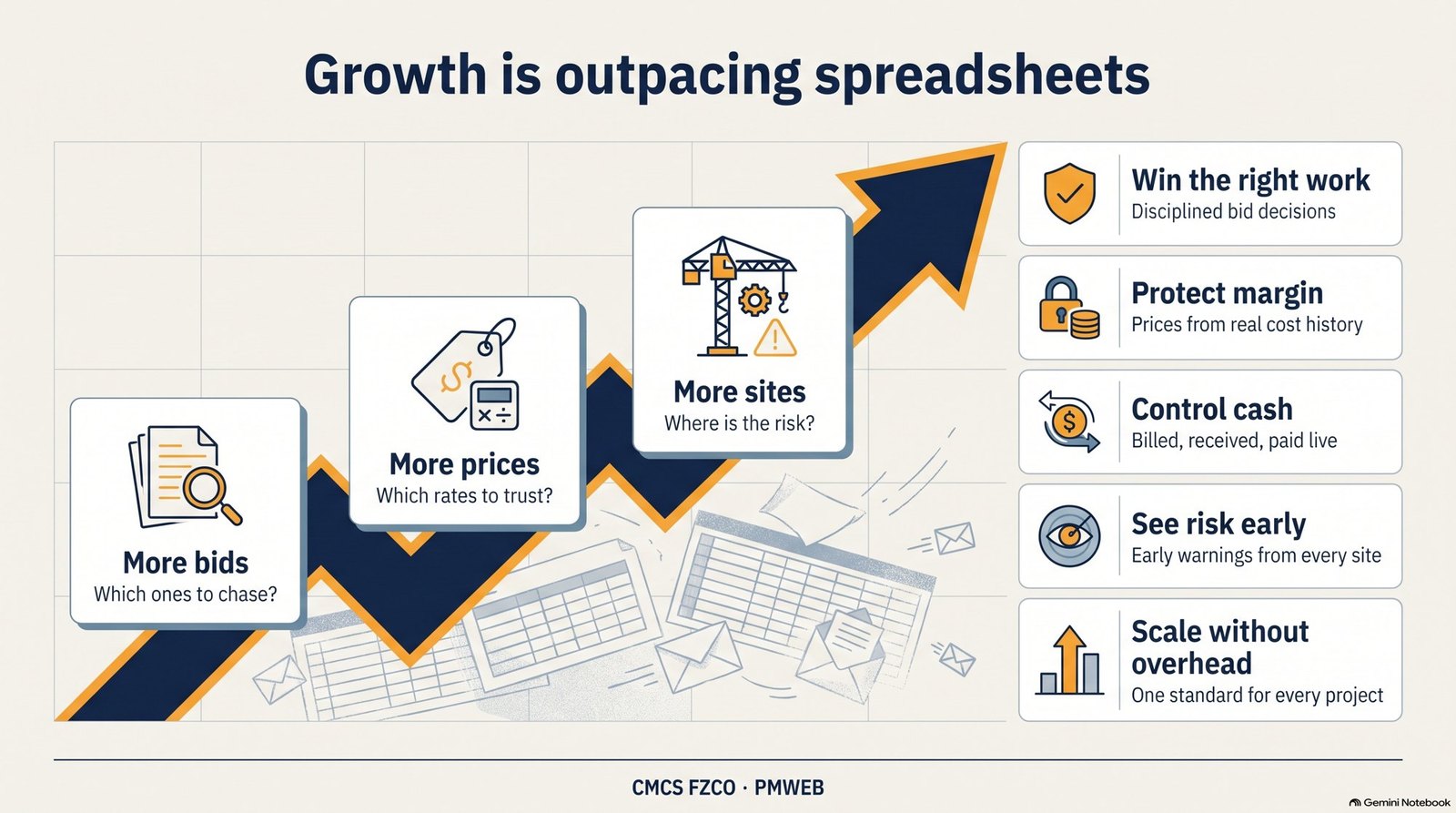
Why Growth Outpaces Spreadsheets
A contractor running five projects can hold most of the picture in a few heads and a shared drive. At twenty projects across several clients, the same approach starts to break, and it breaks in predictable places:
- Bids. Opportunities are pursued on instinct, without a consistent bid/no-bid test or a view of the whole pipeline against capacity.
- Prices. Every estimator keeps a private workbook. Unit rates and supplier quotes from past jobs are not reused, so each tender starts from zero.
- Contracts. Subcontract and client terms live in PDFs. Change orders, back-charges and disputes are tracked in email threads.
- Documents. Drawings, letters, instructions and site records sit in inboxes and shared drives. When a claim arises months later, the evidence cannot be found, or cannot be proved to be the version that was issued.
- Cash. Progress invoices, retention and subcontractor payments are reconciled at month-end, after the cash position has already moved.
- Sites. Submittals, RFIs and inspections are logged differently on every project, so nobody can compare performance across the portfolio.
- Knowledge. When a project manager leaves, the lessons, rates and supplier history leave too.
None of these problems is solved by working harder. They are solved by making the right way of working the only way of working, which is what a project management information system (PMIS) does.
Governance Is How Work Moves, Not a Policy Document
Most contractors have a procedures manual. Few can prove it is followed. In PMWEB, every process (a bid decision, a purchase order, a change order, an invoice) is a form with a workflow behind it. The form defines what must be captured; the workflow defines who reviews and approves it, within which limits and by when. Governance stops being something that is audited after the event and becomes the route that every transaction takes.
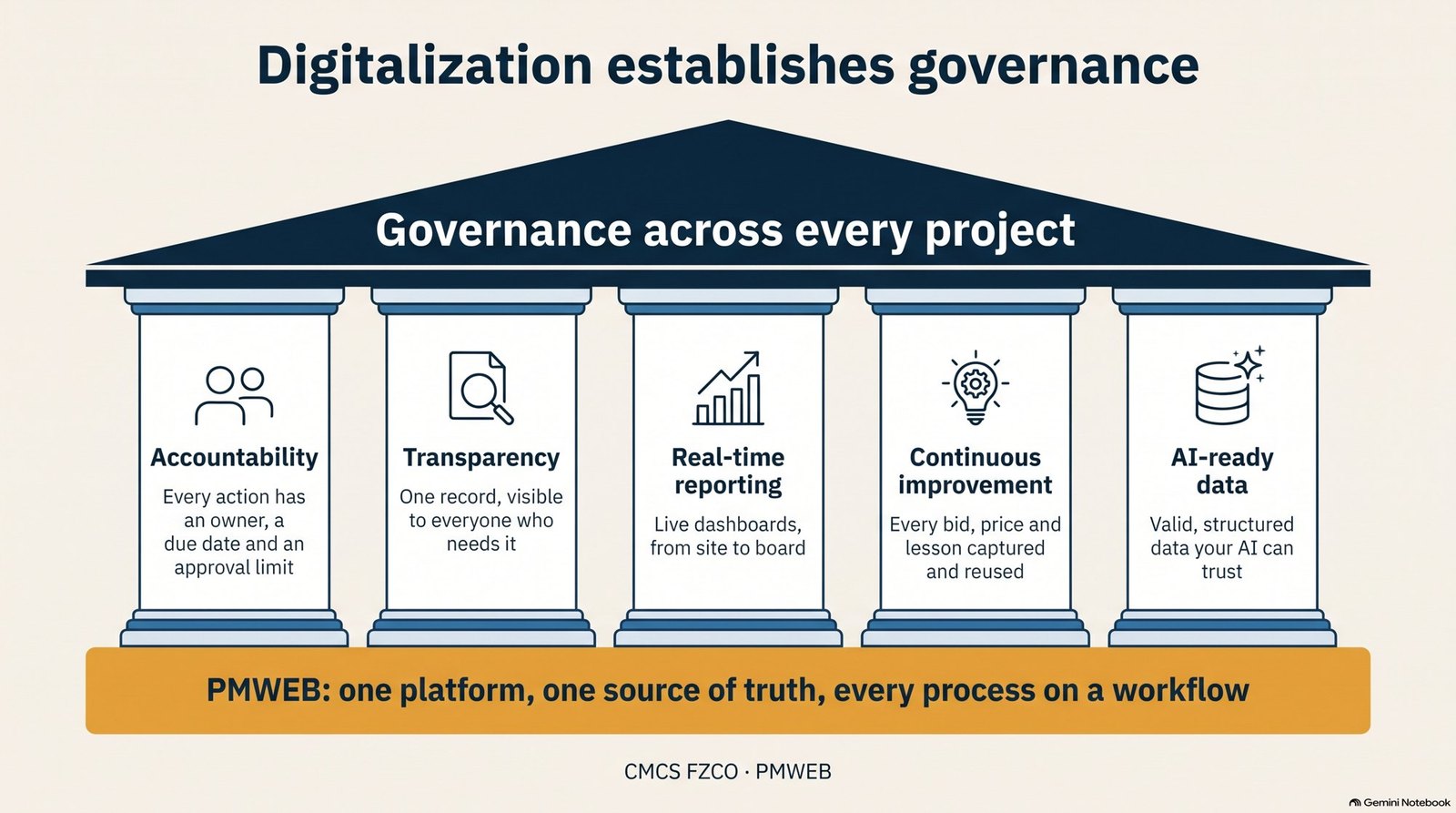
| Pillar | What it means for a contractor | How PMWEB enforces it |
|---|---|---|
| Accountability | Every commitment, change and payment has a named owner and an approver within delegated limits | Workflows with delegation of authority (DoA); every action timestamped and attributed in the audit trail |
| Transparency | Management, clients and partners see the same version of the truth | One database for all projects; role-based access for internal teams, clients, subcontractors and suppliers |
| Real-time reporting | Decisions are made on today's position, not last month's report | Dashboards and reports built directly on live transactions, from site level to the board |
| Continuous improvement | Each project makes the next bid and the next delivery better | Cost libraries, purchase history, lessons learned and risk registers reused across projects |
| AI-enabled | AI answers questions about the business with confidence | Structured, validated, connected data that PMWEB AI and third-party AI tools can work on |
Same Discipline, Different Seat: Contractors and Subcontractors
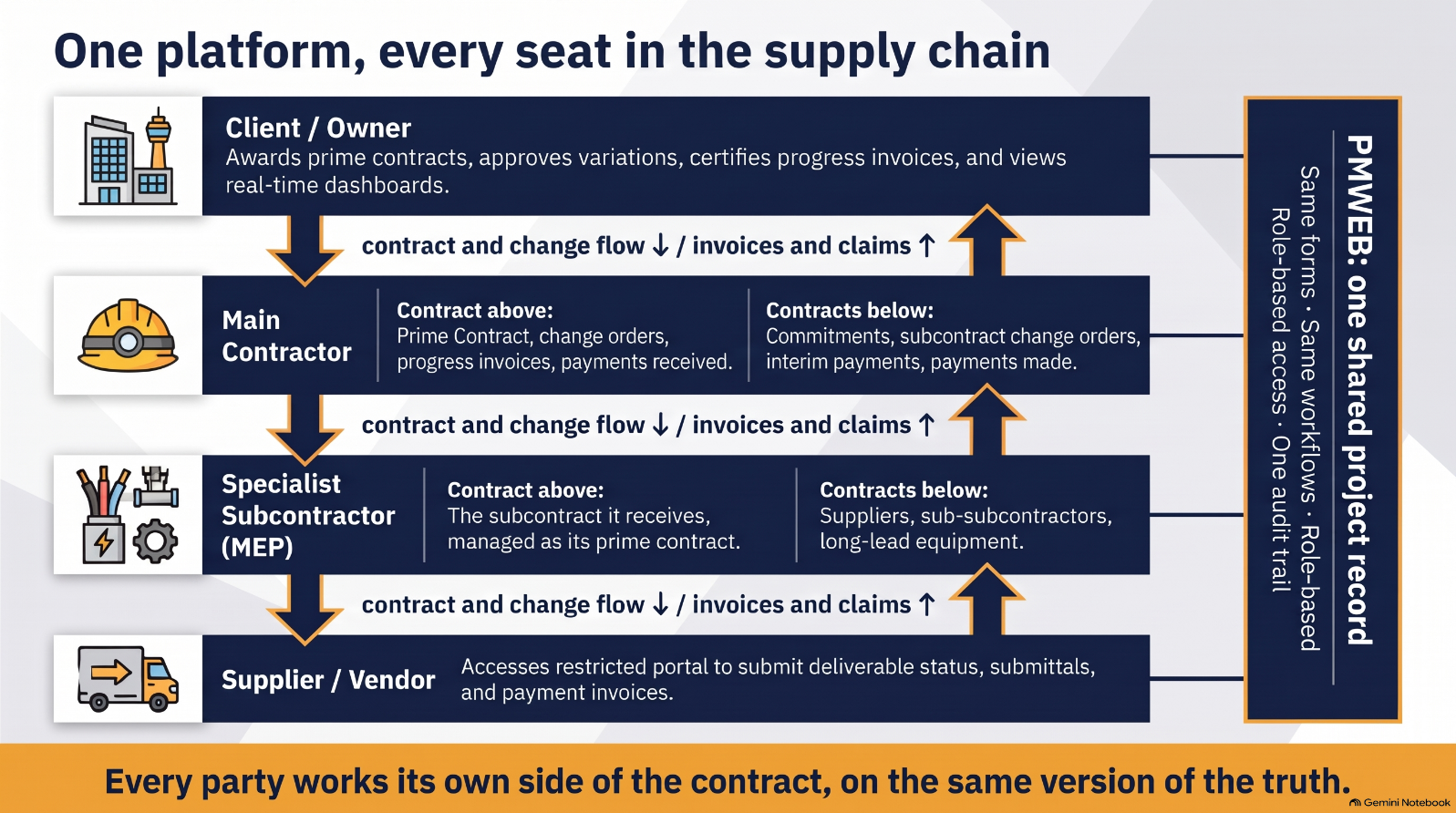
A main contractor and a specialist MEP subcontractor sit at different points in the supply chain, but they face the same two-sided problem: a contract above them that they must deliver and invoice against, and contracts below them that they must award, control and pay. PMWEB handles both sides in the same project record.
| Party | Contract above (income) | Contracts below (cost) | Core PMWEB modules |
|---|---|---|---|
| Main contractor | Prime contract with the client | Subcontracts and purchase orders | Prime Contract, Commitments, Change Orders, Progress Invoices, Payments |
| Specialist subcontractor | Subcontract received from the main contractor | Sub-subcontracts, suppliers and long-lead equipment | Same modules: the received subcontract is managed as its prime contract |
| Supplier / vendor | Purchase order | Its own manufacturing and logistics | Restricted portal access for submittals, delivery status and invoices |
For a subcontractor, this matters more than it first appears. The subcontract it receives is recorded in PMWEB as its prime contract, so every variation it claims, every progress invoice it submits and every payment it receives is tracked with the same rigour as the commitments it awards to its own suppliers. Back-to-back terms, retention and payment cycles can be compared side by side.
One Connected Lifecycle
The real value comes from connection. The estimate that won the bid becomes the budget. The budget is bought out through commitments. Commitments are paid against progress that is reported on the schedule. Changes on either side of the contract update the forecast immediately. Handover records are tagged to the same equipment that was estimated, procured and installed.
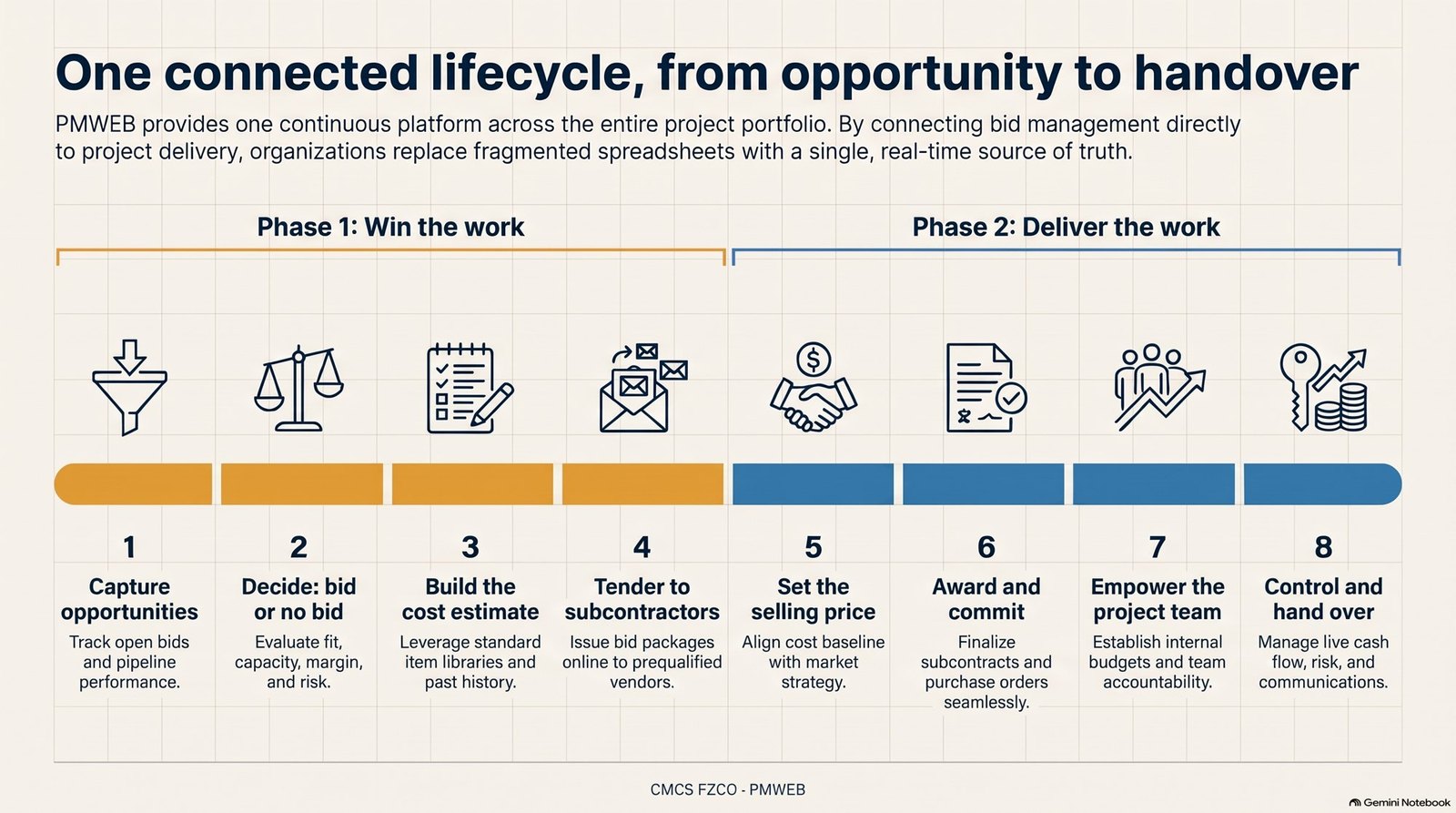
| Stage | What the business needs | PMWEB capability | Series part |
|---|---|---|---|
| Win | Pursue the right work, not all work | Initiatives (opportunity pipeline) with bid/no-bid workflow | Part 2 |
| Price | Fast, consistent estimates built on real costs | Cost estimate, item library, purchase history, Excel import | Part 3 |
| Buy | Competitive, compliant procurement | Vendor prequalification, bid packages, online sub-bids | Part 4 |
| Commit | A team accountable for the budget it receives | Internal commitment between company and project team | Part 5 |
| Contract | Control of income and cost on both sides | Prime Contract, Commitments, change orders, invoices, payments, funding | Part 6 |
| Protect | See problems early and settle claims during delivery | Early warning / PCOs, risk register, claims, document repository | Part 7 |
| Deliver | Site control and a clean handover | Schedule, submittals, RFIs, inspections, T&C, punch list, handover | Part 8 |
| Govern | Control at scale, insight on demand | DoA workflows, landing page, project and portfolio dashboards, controlled access, AI | Part 9 |
Where AI Fits
Every contractor is being told that AI will transform its business. It will, but only on top of data that is complete, structured and trustworthy. An AI assistant cannot tell you which subcontractor is most often late on submittals, or which trade has eroded margin across your last ten projects, if that information lives in email and personal spreadsheets. No data, no AI. Digitalising project management in PMWEB is what produces that data as a by-product of daily work. Part 9 shows PMWEB 2026 AI working on it.
Key takeaway
Contractors and subcontractors do not lose control because they lack procedures. They lose control because procedures are optional. PMWEB makes governance the path every transaction follows, so accountability, transparency, real-time reporting and continuous improvement happen by default, and the business becomes ready for AI on its own validated data.
Next in the series, Part 2: Winning the Right Work. How contractors use PMWEB Initiatives and a bid/no-bid workflow to manage the opportunity pipeline against capacity and risk appetite.

Next step
Bring this to your portfolio.
Tell us which processes matter most to you, and we will show them running in PMWEB.