
Article 3 of 9 · PMWEB for Contractors and Subcontractors
One Estimate, Three Outputs
In most contracting firms the estimate is the most valuable document nobody reuses. It is built under pressure, submitted, and then filed. If the tender is won, the budget is rebuilt from scratch; if it is lost, the prices it contained are forgotten. PMWEB turns the estimate into the starting point of everything that follows.
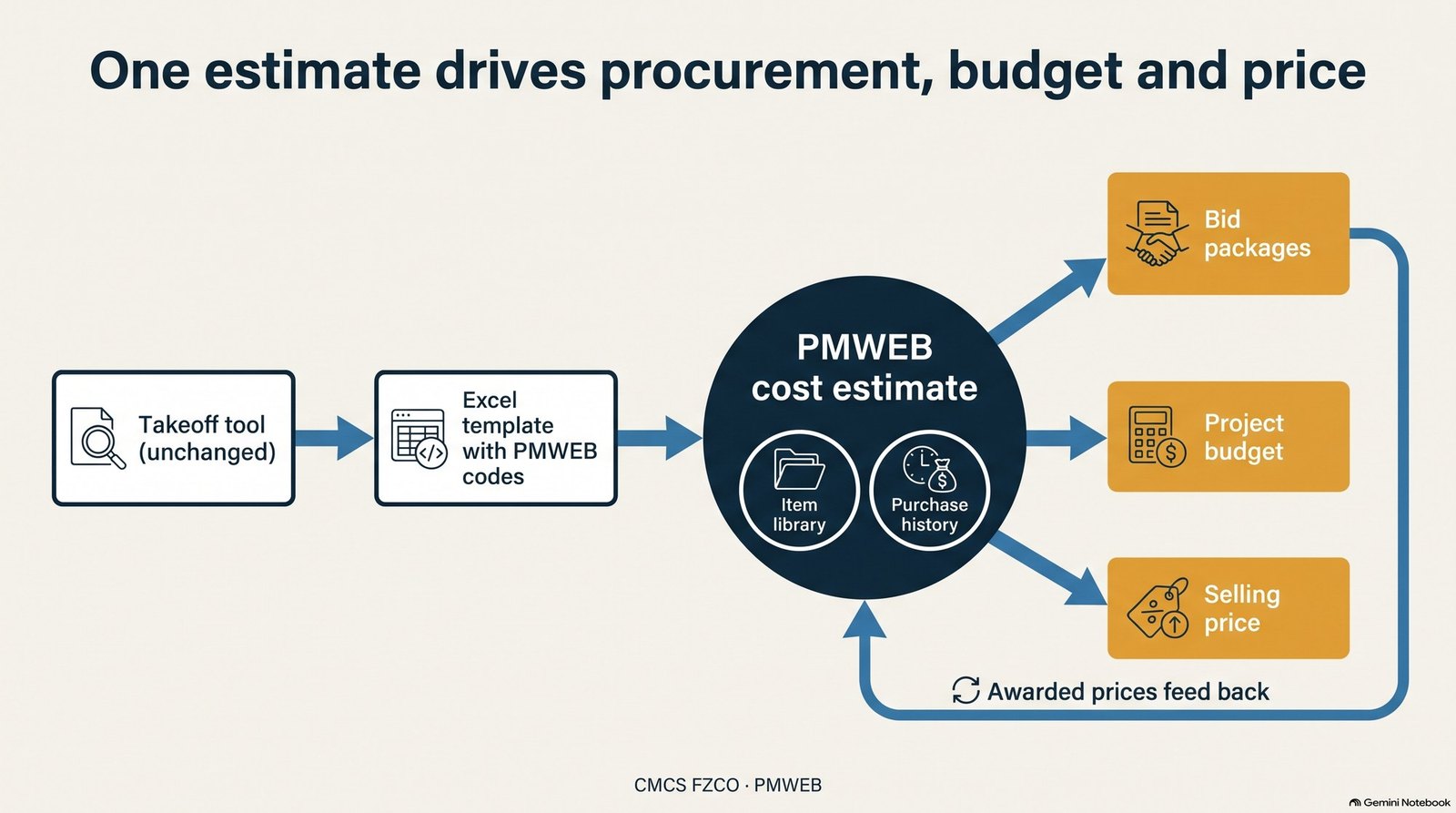
This article shows how contractors and subcontractors bring their estimates into PMWEB, build them on real purchase history, and use one estimate to generate three outputs: the bid packages for procurement, the project budget at true cost, and the selling price for the client.
Keep Your Estimating Tools, Standardise the Output
Estimators have their own takeoff tools and well-tested Excel workbooks, and changing them during a period of growth is a risk few contractors should take. PMWEB does not require it. The first stage of implementation keeps the existing tools and introduces a standard Excel template carrying the company's cost codes, so every estimate is imported into the PMWEB Cost Estimate in the same structure.
| Tag on each line | Why it matters | Used later for |
|---|---|---|
| Cost code (CBS) | Every estimate rolls up the same way | Budget, commitments, cost reports |
| Trade / package | Lines grouped into what will be bought together | Bid packages and procurement plan |
| Equipment tag | Major MEP items identified from day one | Submittals, delivery, T&C and handover |
| Resource type | Labour, material, plant, subcontract | Productivity and cash-flow analysis |
| Location / zone | Building, floor or system | Progress and variation pricing |

Price From Evidence: Item Library and Purchase History
An estimate is only as good as the rates in it. PMWEB holds a company-wide item library of standard items, units and rates, and every purchase order placed on every project becomes purchase history. When an estimator prices a line, the last prices paid for that item, by supplier, project and date, are available in the estimate itself. Every award made in Part 4 feeds back into the library, so each tender sharpens the next.
Budget Stays on True Cost, Strategy Lives in the Price
The estimate produces two different numbers that must never be confused. The project budget is the true cost of delivering the work. The selling price is cost plus overheads, risk allowance and margin, shaped by the commercial strategy. PMWEB keeps them separate: the approved estimate creates the budget, and the markups and pricing strategy create the schedule of values in the Prime Contract.
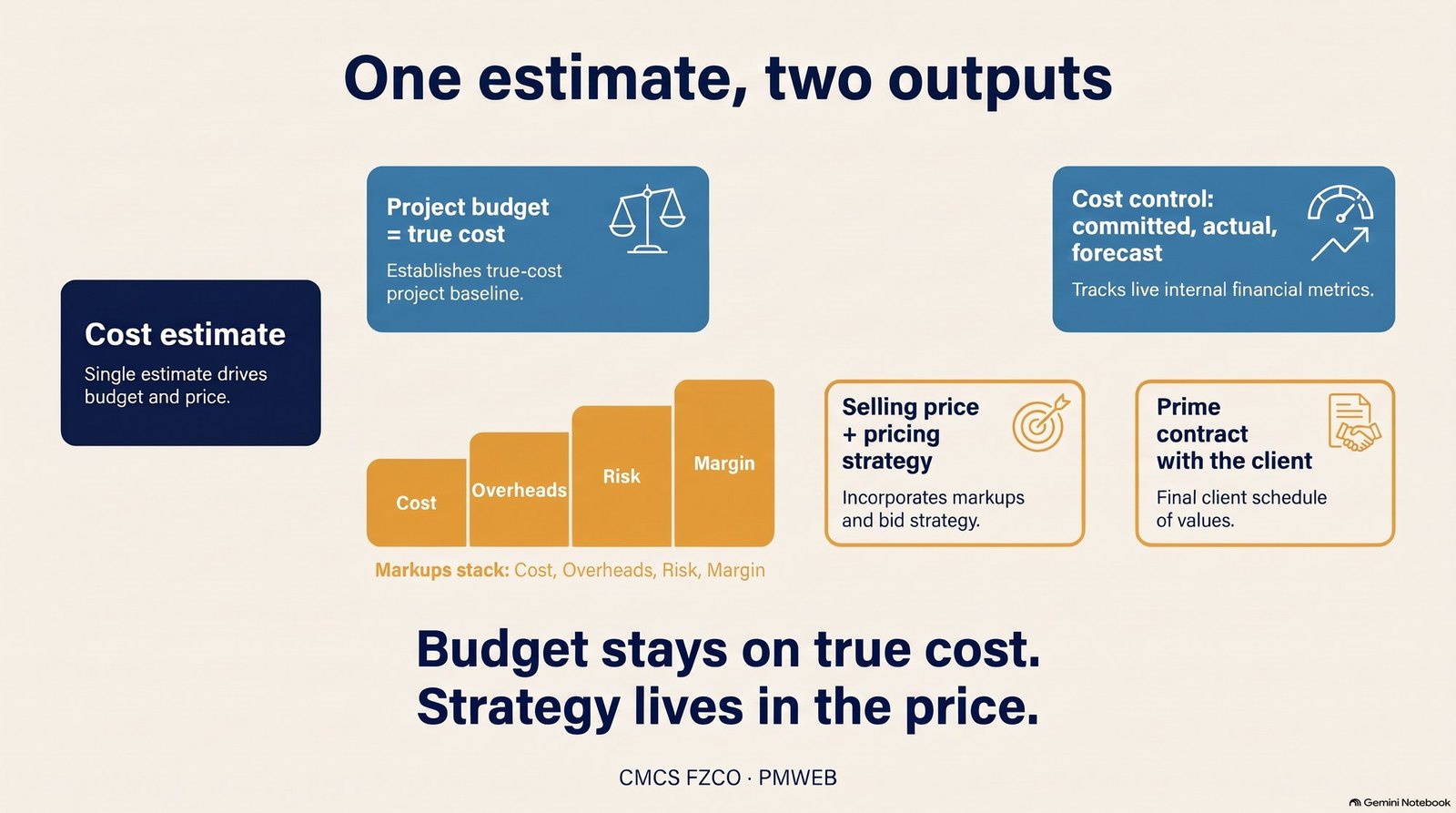
Selling price = Cost + Overheads + Risk + Margin
Project budget = Cost (what the project team is accountable for)
Planned margin = Selling price − Project budget
Unbalanced Bidding, Made Visible
In the Gulf it is common to load early items of the bill of quantities to improve cash flow, or to price items expected to grow more richly than those expected to shrink. Whatever the strategy, the danger is that the loaded prices leak into the budget and hide the real margin per item. Because PMWEB holds the true-cost budget and the selling price on the same cost codes, the planned margin of every line is visible, and management can see exactly where the strategy has front-loaded the cash and where it carries risk if quantities change.
The Subcontractor's View
A specialist subcontractor prices the same scope for several main contractors, often with different bills of quantities and commercial terms. In PMWEB it keeps one estimate per scope, with versions per main contractor. The true cost is consistent; only the price and terms change. When one main contractor wins, the matching version becomes the subcontractor's budget and its prime contract.
Where AI Adds Value
With estimates, awards and actual costs held on the same codes, PMWEB 2026 AI can compare a new estimate with what similar work actually cost: "Show me the last five chiller purchases and their unit prices", "Which trades were under-estimated on our last three hospital projects?" The estimator gets evidence, not opinion.
Key takeaway
Contractors do not need new estimating software to govern their estimates. A standard, tagged import brings every estimate into PMWEB, purchase history makes rates evidence-based, and one approved estimate drives procurement, a true-cost budget and a selling price whose strategy is visible line by line.
Next in the series, Part 4: Buying Out the Job. Vendor prequalification, bid packages and online sub-bids in PMWEB.

Next step
Bring this to your portfolio.
Tell us which processes matter most to you, and we will show them running in PMWEB.