
Article 5 of 10 · PMWEB for RICS Contract Administration
Certify on Time, Certify Fairly: Interim Valuations and Payment Certificates in PMWEB
Few things damage the relationship between employer and contractor faster than a late or unexplained payment certificate. RICS asks the contract administrator to prepare valuations "impartially and fairly", to follow the valuation intervals in the contract and to specify what the certified amount relates to and how it was calculated. PMWEB 2026 makes the calculation, the review and the timing visible on every certificate.
Interim valuation is the most repetitive task in contract administration and one of the most consequential. On a two-year contract the CA will certify twenty or more times, and each certificate builds on the last: work done to date, materials on site, retention, advance payment recovery, previous certificates, tax. An error in one carries into the next. A late certificate can breach the contract and, under many legal systems, entitle the contractor to suspend work or claim interest.
This article covers RICS services 6.1 (prepare periodic interim valuations) and 6.2 (certify interim payments and send the adjusted contract sum computations), the practical guidance in §4.1.10 and the Appendix A financial checklist of the RICS 2011 guidance note Contract administration (GN 69/2011, archived in 2022 and cited for its practical content). The current RICS Black Book titles Interim valuations and payment and Retention treat the subject in more depth. It shows how the PMWEB progress invoice handles each element of the valuation and how the certificate reaches the employer's ERP for payment.
Why this matters to you
- Commercial Directors: certificates issued on time, with a clear basis of calculation, reducing payment disputes and interest exposure.
- Contract Administrators: the valuation assembled automatically from the contract, change orders and previous certificates, so your time goes on assessment.
- Cost Managers: retention, advance recovery and materials on site tracked on every certificate, ready for cash flow forecasting.
- Finance teams: certified amounts posted to the ERP once, with payment status returned to the contract record.

What RICS Requires
The core obligations
GN 69/2011 §4.1.10 stated that the CA is required, under the contract and case law, to ensure that all valuations are carried out impartially and fairly, following the arrangements in the form of building contract. The contract will state the basis of valuation, what sums are included, against what elements retention is held, and the intervals at which valuations are made. The CA should adhere to those intervals, and where none are stated and statute applies, the statutory intervals must not be exceeded.
GN 69/2011 §4.1.2, citing JCT clause 4.6, adds that the CA should certify the amount of interim payments "while specifying to what the amount relates and the basis on which that amount was calculated", and that certificates are issued to the employer with a copy to the contractor. Where someone other than the CA prepares the valuation, typically the QS, "it is important that the CA is satisfied with the amount being certified".
The elements of the valuation
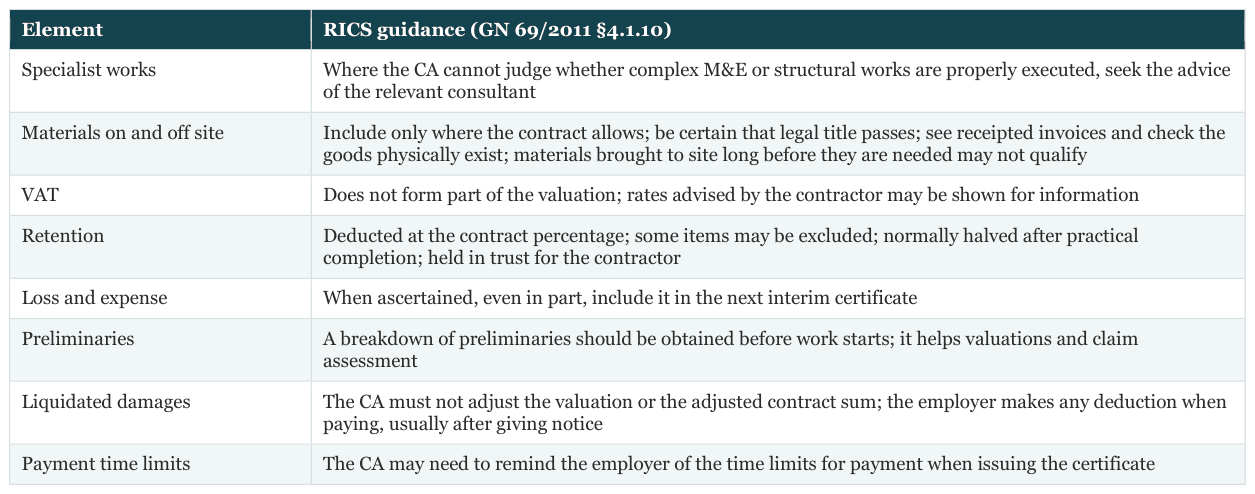
The construction-phase checklist adds the practical controls: certificates issued in the time stated in the building contract; procedures during holiday and sickness periods; valuation dates; the employer's payment procedures and payment dates; and an indemnity for payment of materials off site.
PMWEB Out of the Box: The Progress Invoice
In PMWEB the interim valuation is a Progress Invoice raised against the commitment. Because the commitment already holds the schedule of values, retention terms and advance payment terms (Article 2), and approved change orders are already lines on the commitment (Article 4), most of the valuation is assembled automatically. The CA and QS concentrate on assessment, not arithmetic.
valuation summary
Screenshot S1 shows interim certificate 19 for contract MC-001. Each line of the schedule of values shows its scheduled value, the amount valued previously, the amount this period and the value to date. Approved change orders and expended provisional sums appear as their own lines, so the employer can see that changes are being paid only once and only when executed.
How each RICS element is handled


The valuation summary in Screenshot S1 reads exactly as RICS expects: work executed to date of AED 268.40 million, plus materials on site of AED 4.10 million, gives a gross valuation of AED 272.50 million. Deducting retention at 5% and advance payment recovery at 10% leaves a net valuation of AED 231.63 million. Less AED 218.94 million previously certified, AED 12.69 million is due, with VAT at 5% shown separately.
Materials on and off site: a small Custom Form
RICS is specific about the evidence needed before materials are paid for. A Custom Form Builder form, "Materials on site evidence", holds one header per claim (location, supplier, invoice reference, insurance, title confirmation) and one detail table of items with quantities and values, plus a checklist: receipted invoice seen, goods physically checked, goods reasonably brought to site, title passes to the employer. The form is linked to the progress invoice line, so the certificate shows why the materials were included.
The Certificate the Employer Receives
The progress invoice produces the formal certificate through PMWEB's SSRS library. The out-of-the-box Application and Certificate for Payment and Progress Invoice Form outputs can be used as they are, or CMCS configures the certificate wording to the form of contract in use.
the basis of calculation
Screenshot S2 follows the RICS points closely. The computation is shown in full. The text states that the basis of calculation is set out in the attached valuation. It records that liquidated damages are not deducted in the certificate, because any deduction is the employer's decision and notice. The certificate is addressed to the employer with a copy to the contractor, and is shown here as a draft awaiting the CA's certification step, due by 3 October.
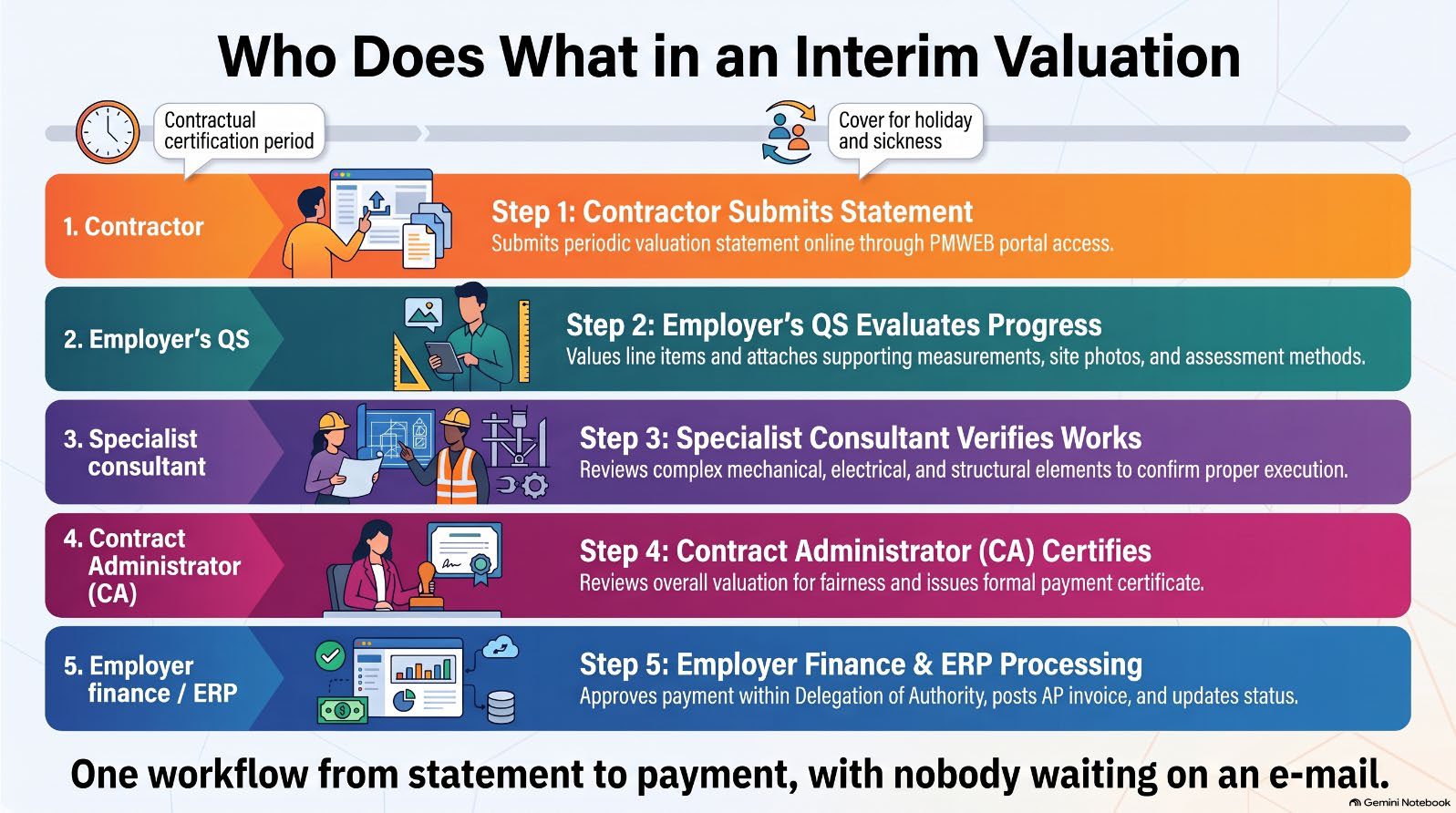
Certifying on Time: Workflow, Delegation and Deadlines
The commonest failure in payment certification is not the amount but the date. PMWEB addresses the Appendix A controls directly.
- Certification deadline. The progress invoice holds the date the contractor's statement was received and calculates the date by which the certificate must be issued under the contract. The same date appears in the notices and time-bar register (Article 3) and on the control centre dashboard.
- Allowed step durations. Each workflow step has an allowed number of days, and overdue steps are visible on the workflow dashboard (Article 9).
- Holiday and sickness. Workflow delegation lets the CA or an approver delegate to a named alternate for a defined period, so certificates are not held up because someone is away, which is exactly the "procedures during holiday and sickness periods" Appendix A asks for.
A typical certification workflow for MC-001:
- Contractor submits its statement (online, through the contractor's PMWEB access, or uploaded by the CA).
- QS values each line, attaches measurement and photographs, and records the method.
- Specialist consultant reviews M&E and structural lines where needed.
- CA reviews, is satisfied with the amount, and certifies.
- Employer's finance approves for payment within its DoA limit, and the certificate is posted to the ERP.
Other Costs: Miscellaneous Invoices and Payments
Not every cost on a project passes through a commitment. PMWEB's Miscellaneous Invoices capture other actual costs, such as authority fees or utility connection charges, against the cost breakdown structure, with their own workflow and attachments. Payments record amounts paid against progress and miscellaneous invoices, either entered in PMWEB or received from the ERP. Out-of-the-box outputs include the Commitment Invoices log, payment forms and logs for accounts payable and receivable, invoice detail reports and aging reports. Together they give the CA the "employer latest payment dates" and payment status that Appendix A asks the CA to know.
On approval for payment, the certificate is posted to the ERP as an accounts payable invoice against the purchase order created at commencement, with retention and advance recovery carried as separate amounts. The ERP returns payment status and payment date to PMWEB, so the CA can see whether the employer paid within the contractual period without asking finance. Article 10 covers the integration patterns for SAP, Oracle and Microsoft Dynamics.
What Changes for Your Organisation
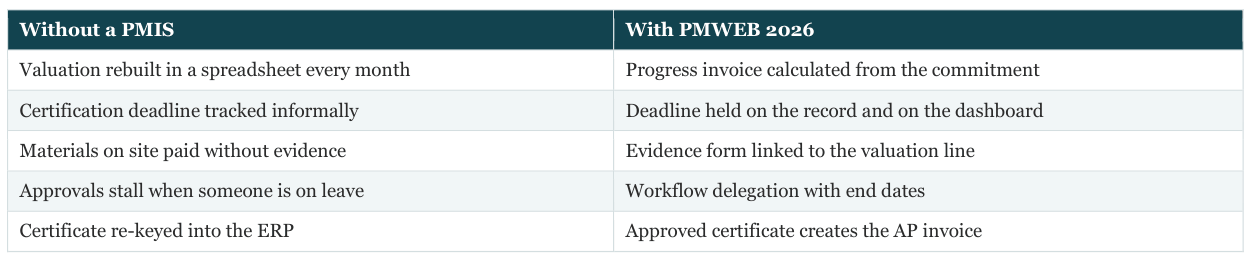
What the Owner and the CA Must Put in Place
- Load the schedule of values and preliminaries breakdown at commencement. RICS recommends the preliminaries breakdown before works start.
- Record the method of measurement on every line. Quantities, schedule percent complete or assessment.
- Pay materials on site only with evidence attached. Use the materials evidence form.
- Never deduct liquidated damages in the certificate. Configure the certificate so it cannot.
- Hold the certification deadline on the record. And show it on the dashboards the CA and employer both use.
- Set up delegation before the first holiday. Certificates must not wait for one person.
RICS references for this article
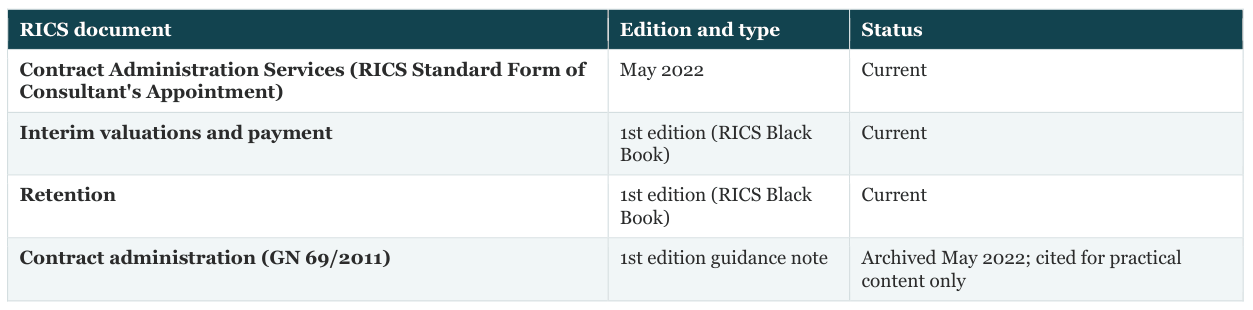
RICS documents are UK-based; apply them in the GCC subject to the governing law and the form of contract.

Next step
Bring this to your portfolio.
Tell us which processes matter most to you, and we will show them running in PMWEB.