
Article 7 of 10 · PMWEB for RICS Contract Administration
No Surprises at the End: Loss and Expense, Disputes and the Rolling Final Account in PMWEB
RICS describes the final account as the conclusion of the contract sum and the line drawn under both parties' financial obligations. It also says that if the final account meeting is the first time the parties see each other's positions, "the change control process has not been working properly". In PMWEB the final account is not prepared at the end; it accumulates, item by item, from the first instruction.
The final account is where every weakness in contract administration surfaces at once. Instructions that were never formalised, dayworks nobody signed, loss and expense claims parked until the end, extensions of time with no agreed quantum, contra charges with no notice. Each one turns a calculation into a negotiation, and some turn negotiations into disputes.
This article covers RICS services 5.7 (preliminary advice on client liability for contractor claims), 7.3 (agree the final account and obtain the client's authorisation) and 8.1 and 8.4 to 8.6 (loss and expense, and support in adjudication, mediation, arbitration or litigation), RICS Final account procedures, 1st edition (first published as a guidance note in 2015 and reissued as practice information in 2024 without material change to the text), and the practical guidance in §4.1.13 and §4.1.14 of the RICS 2011 guidance note Contract administration (GN 69/2011, archived in 2022). The current RICS Black Book titles Ascertaining loss and expense (2nd edition) and Conflict avoidance and dispute resolution in construction go further on those subjects.
Why this matters to you
- Commercial Directors: a final account that is largely agreed by practical completion, and a defensible position on loss and expense.
- Contract Administrators and QSs: a statement of final account generated from records, with items not formally instructed visible every month.
- Cost Managers: the last cost report and the final account reading from the same numbers.
- Legal and claims teams: an evidence pack already linked when adjudication timescales start.
What RICS Requires
The minimum level of service
Final account procedures
§1.1 sets out what the QS, or any consultant administering the contract with regard to final accounts, is expected to do regardless of the detailed terms of appointment: prepare the final account and report against the last cost or financial report engage in final account meetings with contractors value variations with the contractor to enable agreement advise on the cost implications of loss and expense claims, when instructed prepare the statement of final account advise on costs associated with defects advise the employer on calculations for withholding liquidated damages, when instructed prepare final account documentation for auditing purposes
Rolling final accounts
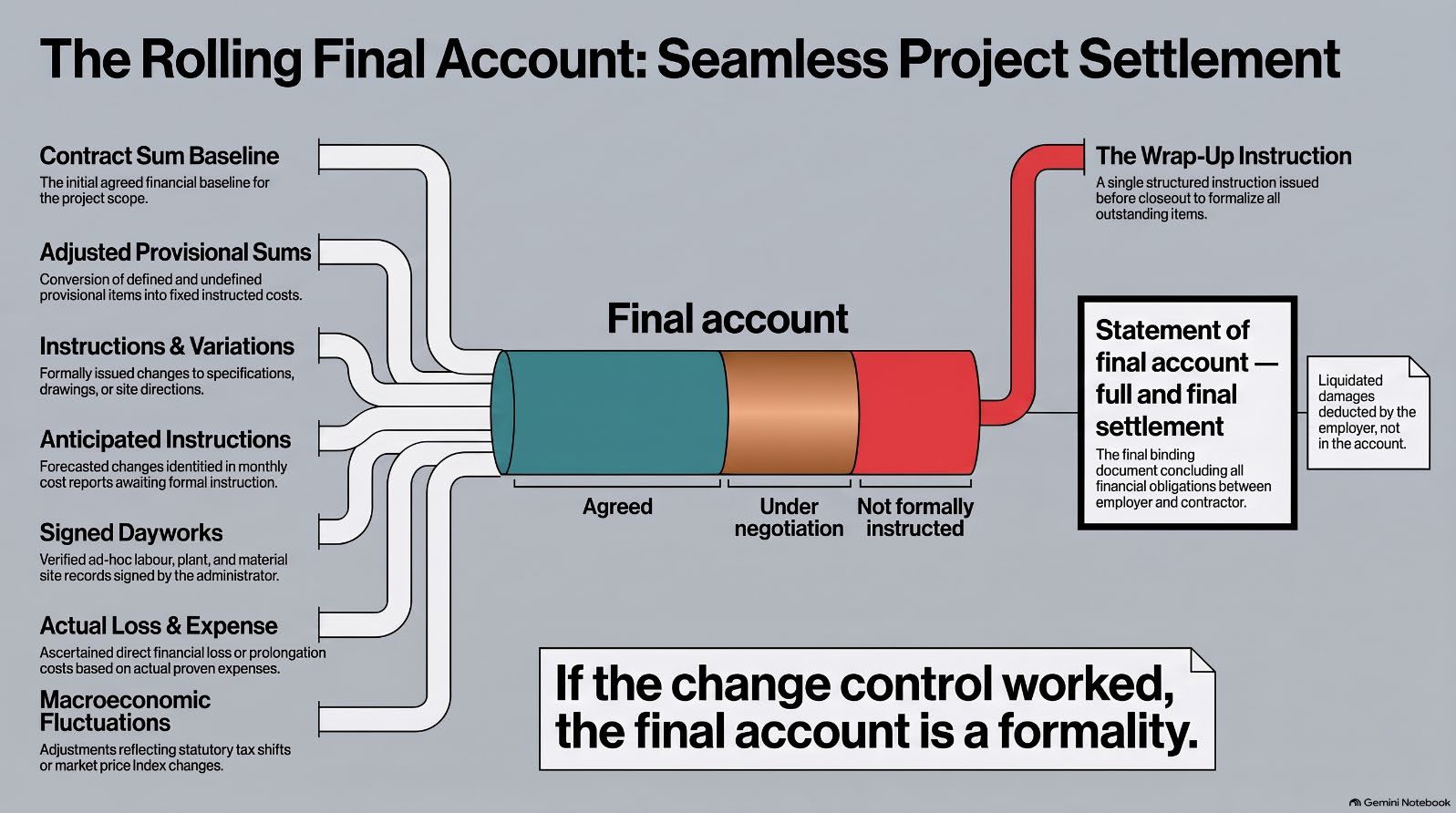
The guidance encourages rolling final accounts, which "ensure that all instructions and cost effects to a project are agreed and up-to-date at the point of the latest financial report". It adds that the last formal cost report "should provide a very good indication of where the final account is likely to be settled": if costs have been tracked properly, the only difference should be changes since that report.
What the final account contains
The principal content of a statement of final account, per §3.6, is the adjustment of provisional sums, prime cost sums and provisional quantities; contract instructions; anticipated instructions, which must be formalised before the account is agreed; fluctuations; and loss and/or expense. Liquidated damages are normally not in the statement: the employer deducts them from the final payment by notice. The statement typically closes with "full and final settlement" wording and signature spaces for both parties.
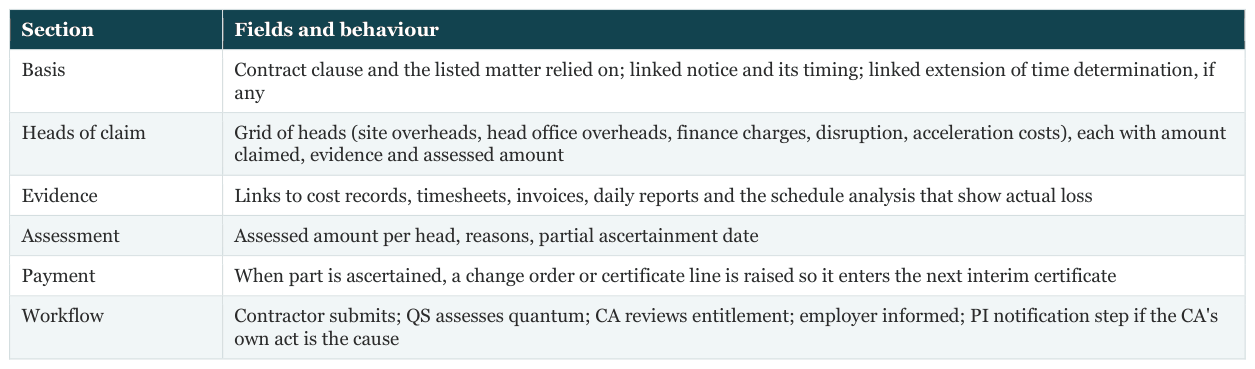
GN 69/2011 §4.1.13 sets the rules: the claim must fall within the matters the contract lists; the loss and expense must be actual, so the CA should "not estimate value but actually find out what the contractor has expended or lost"; the contractor's application must have been made as soon as the contract requires; and whenever even part is ascertained, it should be included in the next interim certificate. The CA should inform the employer of any claim received in writing and keep the employer updated. Final account procedures §3.10 advises isolating loss and expense from the rest of the account, agreeing it fairly, and then adding it at the end.
Disputes and audit
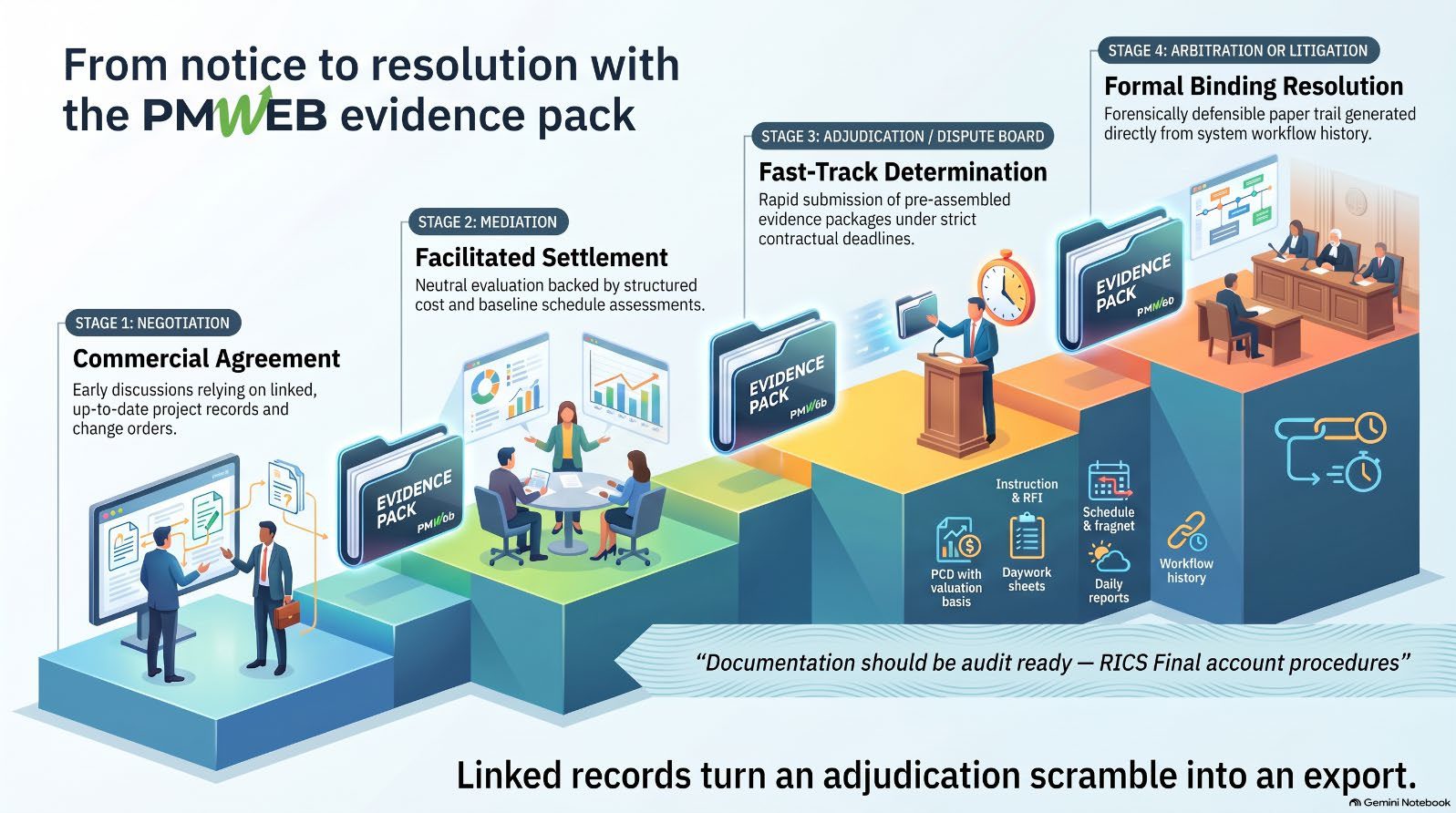
If adjudication is needed, "it would be almost impossible to pull together all necessary backup and evidence in the tight timescales of adjudication if it is not already in a good order. All companies should ensure that their documentation and files are 'audit ready'." The guidance also notes that the final account documentation can be "an important forensic tool" if the employer later pursues its design team, and that "all final account documentation should be treated as though it could be used as evidence in a court of law".
PMWEB Out of the Box: The Account Is Already Being Built
By the time a PMWEB contract reaches completion, most of the final account already exists as approved records:

The Cost Worksheet brings these together for every contract and cost code, and the Change Control Register (Article 4) shows the cumulative position. What remains is to present it in the RICS structure, track agreement item by item, and handle loss and expense and disputes with the same discipline.
Extend: The Loss and Expense Claim as an Adaptive Form
A loss and expense claim needs its own record, separate from the extension of time that may have triggered it, because RICS is clear that "there is no direct relationship between the two sets of provisions". CMCS builds it as an Adaptive Form.
The statement of final account is generated from a Custom Form that rolls up the PMWEB records into the RICS structure and tracks the agreement status of each item: agreed, under negotiation, or not yet formally instructed.
the status of items
Screenshot S1 shows the rolling statement for contract MC-001 at 30 September 2026, structured as RICS describes: the contract sum, less provisional sums included, plus their expenditure as instructed, plus agreed variations, plus anticipated instructions, fluctuations (deleted in the particular conditions) and assessed loss and expense. The anticipated final account is AED 437.94 million, the same figure the control centre shows in Article 1, because both read from the same records. The status table shows four items not yet formally instructed, worth AED 1.96 million, and the note confirms that liquidated damages are not included.
Dealing with items not formally instructed
Final account procedures
§4.3 recommends a single "wrap-up" instruction, categorised in subsections, to formalise outstanding items on a well-run project. In PMWEB the items are already visible as PCOs or records with no linked instruction, so the CA can issue the wrap-up instruction from the contract instruction form with each item as a line, closing the gap before the final account meeting rather than in it.
and audit readiness
Screenshot S2 gives the employer and the CA the readiness view. Thirty-eight of fifty-one final account items are agreed. Loss and expense claimed is AED 7.85 million against AED 2.40 million assessed on actual loss, across three claims linked to their extension of time determinations. Four items need a wrap-up instruction. The audit readiness measure counts agreed items with linked evidence, the "audit ready" files RICS asks for.
Disputes: The Evidence Pack Is Already Assembled
When a disagreement cannot be resolved, RICS services 8.4 to 8.6 ask the CA to support adjudication, mediation, arbitration or litigation. The contract's dispute route, whether negotiation, mediation, a dispute avoidance or adjudication board, adjudication or arbitration, is recorded in a dispute register Adaptive Form: parties, contract reference, subject, amount, stage, key dates and linked records.
Workflow and DoA
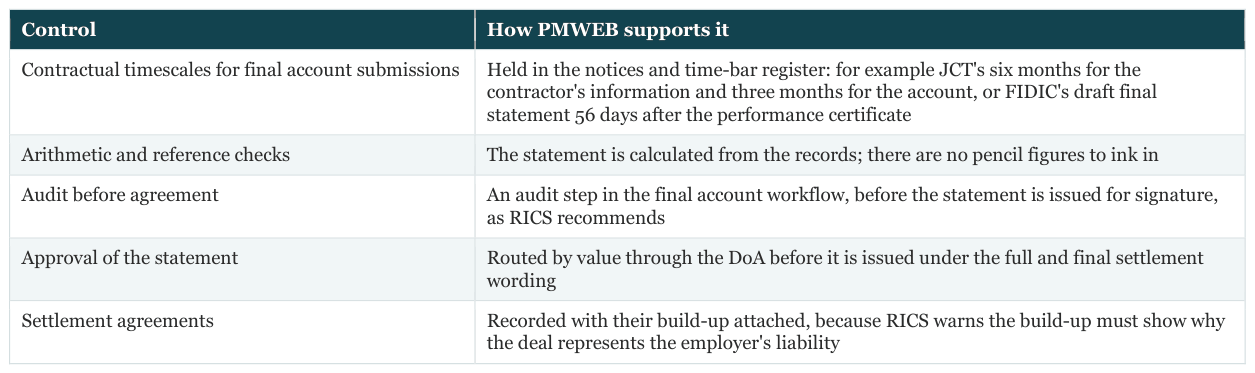
Loss and expense assessments, final account agreement and settlement agreements route through the DoA by value. RICS stresses that "it is not the role of the QS to agree variations or final accounts" and that the QS may negotiate a settlement only when instructed by the employer. The workflow makes that boundary explicit: the QS values and recommends; the authority to agree sits with the employer's approver at the right level.
What Changes for Your Organisation
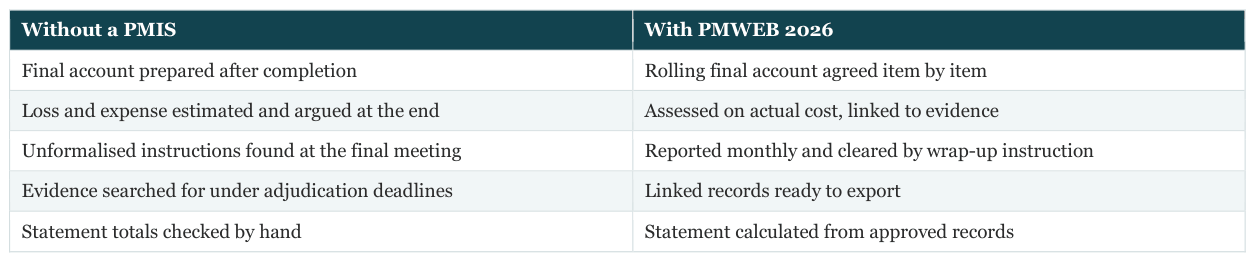
What the Owner and the CA Must Put in Place
- Run the final account from day one. Every instruction, PCO and daywork sheet is a line in the eventual statement.
- Separate loss and expense from extensions of time. Different provisions, different records, linked but not merged.
- Assess loss and expense on actual cost. Link the evidence; include partial ascertainments in the next certificate.
- Report items not formally instructed every month. And clear them with a wrap-up instruction before completion.
- Keep the dispute evidence pack as linked records. Adjudication timescales leave no time to assemble it.
- Audit before signature. Build the audit step into the final account workflow.
RICS references for this article


RICS documents are UK-based; apply them in the GCC subject to the governing law and the form of contract.
If your largest contract reached practical completion tomorrow, what share of its final account would already be agreed, and how many items would still need a formal instruction?

Next step
Bring this to your portfolio.
Tell us which processes matter most to you, and we will show them running in PMWEB.