
Article 8 of 10 · PMWEB for RICS Contract Administration
One Cost Language: Reporting the Adjusted Contract Sum and Capital Cost to ICMS 3 with PMWEB
RICS asks the contract administrator to keep a running record of the estimated final adjusted contract sum and to report to the employer on total project cost. The International Cost Management Standard, now in its third edition (ICMS 3), gives that report a common language. When the PMWEB cost breakdown structure is built to ICMS 3 from the first day, every budget line, commitment, change, valuation and forecast already speaks it.
Owners rarely complain that they lack cost data. They complain that the data from one project cannot be compared with the next: one cost consultant reports by trade package, another by elements, a third by the contractor's bill sections. Benchmarking becomes a re-coding exercise, and the monthly report becomes a spreadsheet assembled from several systems.
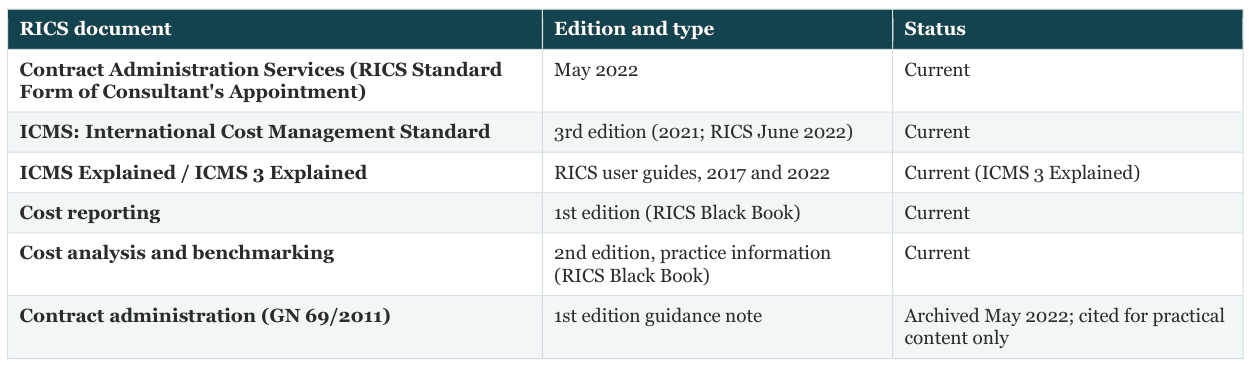
This article covers RICS service 1.3 (regular quality, progress and cost reports), ICMS: International Cost Management Standard, 3rd edition (2021, published by RICS in June 2022), and the related RICS Black Book titles Cost reporting and Cost analysis and benchmarking. It also draws on the practical reporting checklist in the RICS 2011 guidance note Contract administration (GN 69/2011, archived by RICS in May 2022 and retained for information). It shows how to set up the PMWEB cost structure to ICMS 3 and what the reports look like.
Why this matters to you
- Commercial Directors: a total project cost report that reconciles to the contract administrator's figures without manual adjustment.
- Cost Managers and QSs: ICMS-coded data that can be benchmarked across projects and markets without re- coding.
- Contract Administrators: the running record of the adjusted contract sum produced by the system, every month.
- Owners and investors: cost per square metre comparable from one project to the next.
What RICS Requires
The running record of the adjusted contract sum
The archived GN 69/2011 (§4.1.7) said the CA should "keep and manage a running record of the estimated final adjusted contract sum", including preliminaries, specified works, outstanding unspent provisional and contingency sums, additions, omissions, employer variations, anticipated variations, loss and expense, prolongation costs and potential contractor claims. The CA should provide regular reports on the likely final figure "so that effective decisions can be made by the CA and employer ahead of time, particularly with regard to keeping the cost of the project within budget".
Total project cost
It added (§4.2.2) that the employer is primarily interested in the total final cost of the project, including consultants' fees and VAT. The CA may not know the terms of other consultants' appointments and should advise the employer of any limitation in the total cost picture. Final account procedures §4.11 lists items outside the contractor's account that the QS may need to report: loose furniture, fittings and equipment; professional fees; authority contributions and levies; VAT; and the employer's internal costs.
ICMS 3: a framework for classifying and reporting cost
The first edition of ICMS (2017) covered capital costs. The second edition (2019) added life cycle costs, and the third edition (2021), now titled International Cost Management Standard, adds a common framework for reporting carbon emissions alongside cost. ICMS 3 is the edition RICS publishes today, and it is the one this series uses.
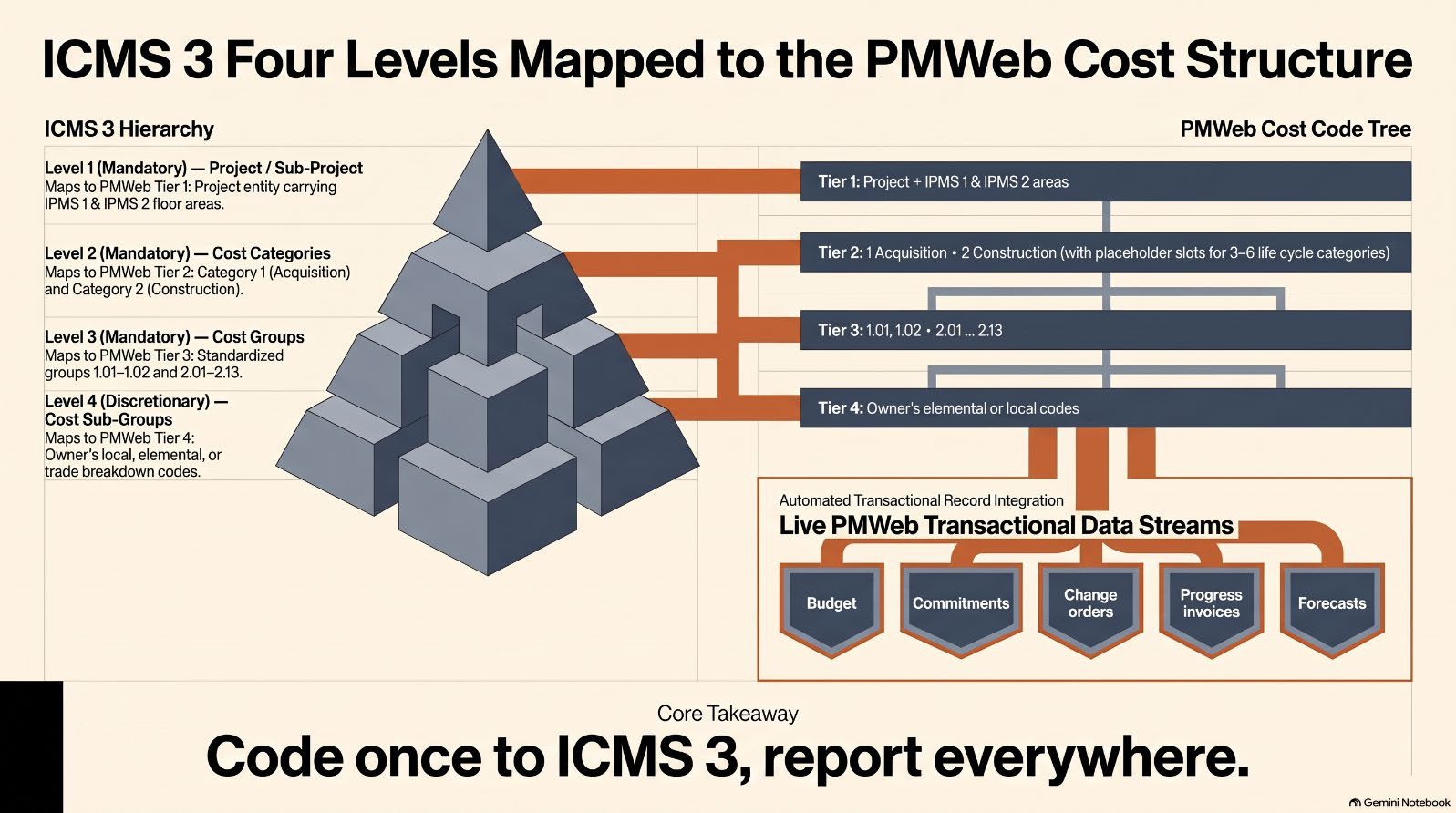
ICMS 3 keeps a four-level hierarchy:

Level 2 has six categories across the life cycle: 1 Acquisition costs, 2 Construction costs, 3 Renewal costs, 4 Operation costs, 5 Maintenance costs and 6 End of life costs. Contract administration and capital cost reporting work mainly in the first two:
1 Acquisition costs: 1.01 site acquisition; 1.02 administrative, financial, legal and marketing expenses
2 Construction costs: 2.01 demolition, site preparation and formation; 2.02 substructure; 2.03 structure; 2.04 architectural works or non-structural works; 2.05 services and equipment; 2.06 surface and underground drainage; 2.07 external and ancillary works; 2.08 preliminaries; 2.09 risk allowances; 2.10 taxes and levies; 2.11 work and utilities off-site; 2.12 production and loose furniture, fittings and equipment; 2.13 construction-related consultancies and supervision
Renewal and maintenance costs reuse the same group list (3.01 to 3.13 and 5.01 to 5.13), which is what lets an owner carry the capital cost structure into whole-life reporting later. ICMS 3 requires a cost or carbon report for a building to state both gross external floor area, IPMS 1 (EXTERNAL), and gross internal floor area, IPMS 2 (INTERNAL), so that cost per square metre is comparable across markets.
RICS's 2017 user guide ICMS Explained, written for the first edition and updated as ICMS 3 Explained (2022), describes the uses that matter to an owner: benchmarking, structuring tender pricing documents so returns can be compared on a common basis, and "quantum forensics", where a recognisably classified cost history supports a claim. It also expected that digital templates would be prepared by software vendors and organisations, which is what a PMIS set up to ICMS provides.
Groups 2.11 to 2.13, together with the acquisition costs in category 1, are where the items outside the contractor's account belong: off-site utilities, loose furniture and equipment, consultants' fees, and the client's own costs. ICMS 3 gives the total cost picture the employer wants a structure.
Setting Up the PMWEB Cost Breakdown Structure to ICMS
PMWEB's cost breakdown structure is a multi-level cost code hierarchy that every cost-bearing record posts to: budgets, budget requests, commitment lines, change orders, progress invoices, miscellaneous invoices and forecasts. CMCS sets it up as follows.

Two design choices make the structure work for contract administration as well as cost reporting.
- Dual coding. Many owners have an established local structure, for example NRM elements or an internal WBS. ICMS is designed as a framework into which locally prepared data can be allocated for comparison, not as a replacement for local standards. In PMWEB, the local code can be held as an attribute of each ICMS cost code, so reports can be produced in either structure from the same transactions.
- Contract lines coded at award. Each line of the contractor's schedule of values is coded to an ICMS cost group when the commitment is created (Article 2). Change order lines and progress invoice lines inherit or select codes from the same list. Nothing is re-coded at reporting time.
Risk allowances (group 2.09) are held as budget lines. Drawdowns move through approved budget requests (Article 4), so the movement of contingency into the cost groups that consumed it is itself reportable.
The Cost Worksheet: The CA's Live Cost Report
PMWEB's Cost Worksheet shows, for every cost code, the latest position from every cost process. The user chooses a saved layout, groups by any level of the cost breakdown structure, filters by period, and clicks any cell to see the transactions behind it. If multi-currency is enabled, the worksheet can be displayed in a selected currency.
pending changes, actuals and forecast at completion
Screenshot S1 shows the construction works for the Project Alpha development, groups 2.01 to 2.10. Columns combine the original budget, approved budget changes, current budget, committed value, pending changes, invoiced actuals, forecast at completion and variance. The forecast at completion column is where the CA's running record of the adjusted contract sum meets the owner's total project cost.
Out-of-the-box cost outputs that read from the same structure include the Cost Codes report, Budget Summary, Budget and Actual Cost Comparison, Projects Over/Under Budget, Forecast Details, Anticipated Cost per Month and Cash Flow Schedule.
The ICMS 3 Cost Report
Because every transaction is already coded to ICMS 3, the cost report is a standard SSRS output rather than a monthly spreadsheet.
2 and percentage of capital cost
Screenshot S2 shows the anticipated final capital cost of the development, AED 735.54 million, classified to ICMS 3. Acquisition costs are AED 104.40 million and construction costs AED 631.14 million. Each group shows its value, its cost per square metre on IPMS 1 and IPMS 2 areas, and its share of the total. Renewal, operation, maintenance and end-of-life categories are outside this capital cost report.
Groups 2.01 to 2.10 total AED 552.74 million, the sum of the anticipated final accounts of the four construction contracts, including MC-001 at AED 437.94 million, the figure the control centre and the statement of final account show in Articles 1 and 7. Group 2.11 holds the off-site utilities contract and group 2.12 the FF&E supply contract. The CA's adjusted contract sum and the owner's capital cost agree because they are built from the same records, not because someone reconciled them at month end.
returns, and quantum forensics in claims
When every project in PMWEB uses the same ICMS 3 Level 2 and Level 3 codes and records IPMS areas as project attributes, the owner can compare projects on a like-for-like basis with no re-coding. Portfolio reports and Power BI dashboards can show cost per square metre by cost group across completed and live projects, flag outliers early in design, and build the owner's own historic cost database, which is the use ICMS Explained anticipates and the subject of the RICS practice information Cost analysis and benchmarking.
The same structure helps at tender. ICMS Explained notes that the classification can be used to structure tender pricing documents so returns can be interrogated and compared on a common basis. PMWEB's Procurement module can issue bid forms built on the ICMS 3 groups, so bid levelling compares bidders group by group and the winning bid becomes a commitment that is already coded.
Quantum Forensics
ICMS Explained points out that cost advisers often need to prove entitlement to the recovery of costs incurred, and that using ICMS ensures project cost is classified in a recognisable manner, "thereby providing greater confidence over the validity of the claim". In PMWEB, the loss and expense records in Article 7 link to actual cost transactions that are already ICMS-coded, so a claimed prolongation cost can be traced to the preliminaries cost group and its invoices, and a disruption claim to the cost groups affected.
Workflow and DoA
The cost structure is controlled data. Adding or changing cost codes follows a workflow owned by the cost manager. Budget transfers between ICMS cost groups go through budget requests routed by value. Forecast submissions are approved monthly before they feed the employer's report, so the cost report the employer reads has been through the same governance as the transactions behind it.
ERP Touchpoint
The ICMS cost codes are synchronised with the ERP's project or WBS structure, so that purchase orders, invoices and payments posted in the ERP carry the same codes. Actual cost returned from the ERP lands in the right cost group in the PMWEB cost worksheet. Article 10 explains the integration in more detail.
What Changes for Your Organisation

What the Owner and the Cost Adviser Must Put in Place
- Adopt ICMS 3 Levels 1 to 3 as the mandatory top of the PMWEB cost structure. On every project, without exception.
- Record project attributes and IPMS areas. Without them, cost per square metre is not comparable.
- Code the schedule of values at award. Re-coding at reporting time is where consistency is lost.
- Hold the local structure as an attribute, not a separate system. Report in both from one set of transactions.
- Report risk allowances and their drawdown openly. Through budget requests, by cost group.
RICS references for this article
RICS documents are UK-based; apply them in the GCC subject to the governing law and the form of contract.
Could you compare the cost per square metre of structure, services or preliminaries across your last five projects today, on a like-for-like basis, without re-coding anything?

Next step
Bring this to your portfolio.
Tell us which processes matter most to you, and we will show them running in PMWEB.