
Article 3 of 10 · PMWEB for RICS Contract Administration
If It Isn't Recorded, It Didn't Happen: Records, Inspections, Meetings, Instructions and Notices in PMWEB
RICS asks the contract administrator to make sure that "the life of the building contract from inception to completion is accurately and completely recorded". On most projects that record is assembled after the event, from e-mails, site diaries and photographs on personal phones. In PMWEB it is the by-product of doing the work.
The construction phase is where the contract administrator spends most of the appointment, and where most of the evidence that will later decide claims, extensions of time and the final account is created. It is also where the record is most fragile. Site directions are given verbally and never confirmed. Meeting actions are minuted but never closed. A notice of claim arrives by e-mail to someone on leave, and the contractual period runs out unnoticed.
This article covers RICS services 1.1 and 1.2 (attend and chair meetings), 5.1 to 5.5 (administer the contract, visit site, record meetings, inspect site management) and the guidance on records, site inspections, meetings, instructions and notices in the RICS 2011 guidance note Contract administration (GN 69/2011), which RICS archived in May 2022 and retains for information. It remains the most detailed RICS description of the CA's day-to-day duties, and this series cites it for that practical content alongside the current RICS documents. It shows what PMWEB delivers out of the box and the two extensions CMCS adds for instructions and notices.
Why this matters to you
- Commercial Directors: fewer unpriced instructions and missed time bars, which are among the most expensive surprises in any final account.
- Contract Administrators: site directions confirmed in writing, notices logged on receipt and deadlines escalated before they expire.
- Cost Managers: every cost-bearing instruction opens a potential change order automatically, so the forecast is never behind the site.
- Project Directors: daily reports, inspections and minutes that stand up as contemporaneous evidence.
What RICS Requires
Records (GN 69/2011 §4.1.4)
The CA should keep accurate and accessible records, because on a longer project more than one person may act as CA. The guidance names three kinds:
- Notes of site inspections, recording the date, time and duration of the visit, the weather, persons on site, progress and status of the works, defects and the action taken, and instructions given, "particularly if verbal".
- Office files, collated so that letters, e-mails, notices, telephone notes, instructions and drawings can easily be found and tracked.
- Photographs, filed so that the location and date taken can easily be identified.
Records should be identifiable to the contract, dated, attributed to their author and, wherever possible, agreed between the parties. Appendix A adds the construction phase records to be agreed by all parties: weekly site staff, labour and plant; daily weather and its effect on progress; the as-built programme; progress photographs; test results and certificates; sub- contractors employed; and major material suppliers.
Site inspections (§4.1.5)
Inspections should be frequent enough for the CA to discharge the role, determined by project complexity, the calibre of the contractor, progress and predetermined stages, not by the value of the works. The inspection should cover progress against the programme, workmanship, materials, conformity with drawings and specification, measurement of work that will be covered up before valuation, and a general awareness of health and safety. The outcome should be confirmed in writing, ideally as a "site direction" that is later converted into a formal contract instruction.
GN 69/2011 §2.3.3 adds an important boundary: the CA's inspections are for reporting on progress and quality, and the CA should not allow them to become responsibility for checking that the works comply with the design. That obligation stays with the employer and is usually delegated to the design or supervision team.
Meetings (§4.1.6)
It is solely the CA's responsibility to issue instructions, in writing and promptly. Verbal instructions are not effective until confirmed in writing. Where an instruction issues drawings, it should itemise the variations shown on them so that cost and time can be considered. Confirmations of verbal instructions (CVIs) issued by the contractor are "not recognised by most forms of building contract"; if the CA issues site directions, "there should be no need for CVIs".
Notices (§4.1.3)
Notices and certificates must be issued by the correct party, sent to the correct party and follow the procedure the contract specifies. If a notice must be issued by the employer, it must not be issued by the CA, although the CA will usually advise on its form and timing.
PMWEB Out of the Box: The Construction-Phase Record
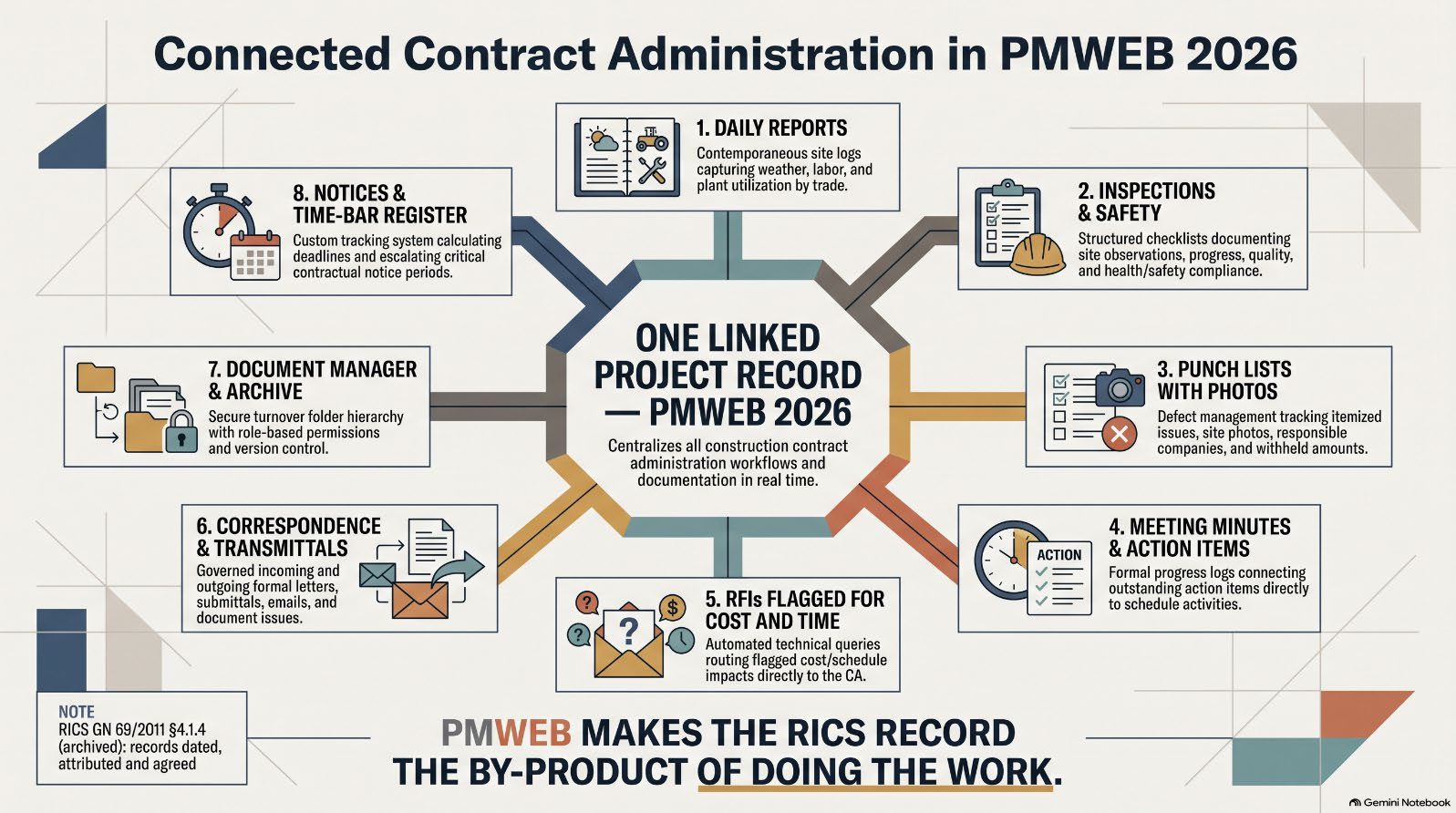
PMWEB 2026 already provides a native module for almost every record RICS describes. Each one has defined fields, attachments, links to other records, a workflow and standard SSRS outputs.

Document Manager and the turnover structure
RICS Appendix A lists what must be archived at the end of the contract, from the signed contract and certificates to as-built drawings, test results and technical queries. CMCS recommends setting up the PMWEB Document Manager folder structure at commencement so that it already mirrors that turnover format. Documents uploaded during the project land in the folder they will be handed over in, and the Archive module exports the structure at close-out. Version control and access by role are built in.
Daily Reports, Inspections and Punch Lists
The daily report captures exactly what Appendix A asks the parties to agree: weather, labour and plant by trade and company, work in progress, visitors and incidents. Because each daily report is a dated, approved record, it becomes contemporaneous evidence for extensions of time and loss and expense (Articles 6 and 7).
Inspection checklists can be configured per work type. Defects found during the CA's periodic inspection are logged in Punch Lists with photographs, location, responsible company, due date and, where the contract allows, an amount to be withheld. The CA's inspection report to the employer is generated from these records rather than written from memory.
Meeting Minutes and Action Items
The RFI module shows how workflow enforces the CA's involvement. Each RFI carries fields indicating whether the response could result in work outside the scope, additional cost or additional time. The RFI business process includes a conditional step: when any of those flags is set, the CA is added to the review. Nobody has to remember to copy the CA. The record routes itself.
Extend: Site Directions and Contract Instructions as a Custom Form
No standard module enforces the RICS instruction discipline, so CMCS builds it as a Custom Form with two linked record types: the site direction, issued on site at the end of an inspection, and the formal contract instruction that confirms it.
drawing, and the employer's authority above the CA's limit
Screenshot S1 shows instruction CI-047 for contract MC-001. It confirms site direction SD-112 in writing two days after it was given. Because the estimate of AED 386,000 exceeds the CA's spending authority of AED 250,000, the form records the employer's prior authority (EA-031) before issue. The grid itemises the three variations shown on the drawings, each with its drawing revision, estimate and cost code, exactly as GN 69/2011 §4.1.11 asks.
Recommended design
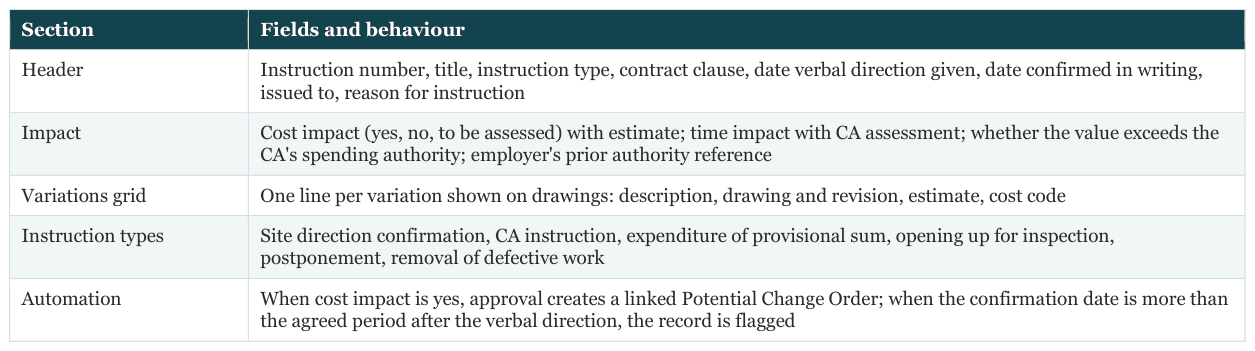

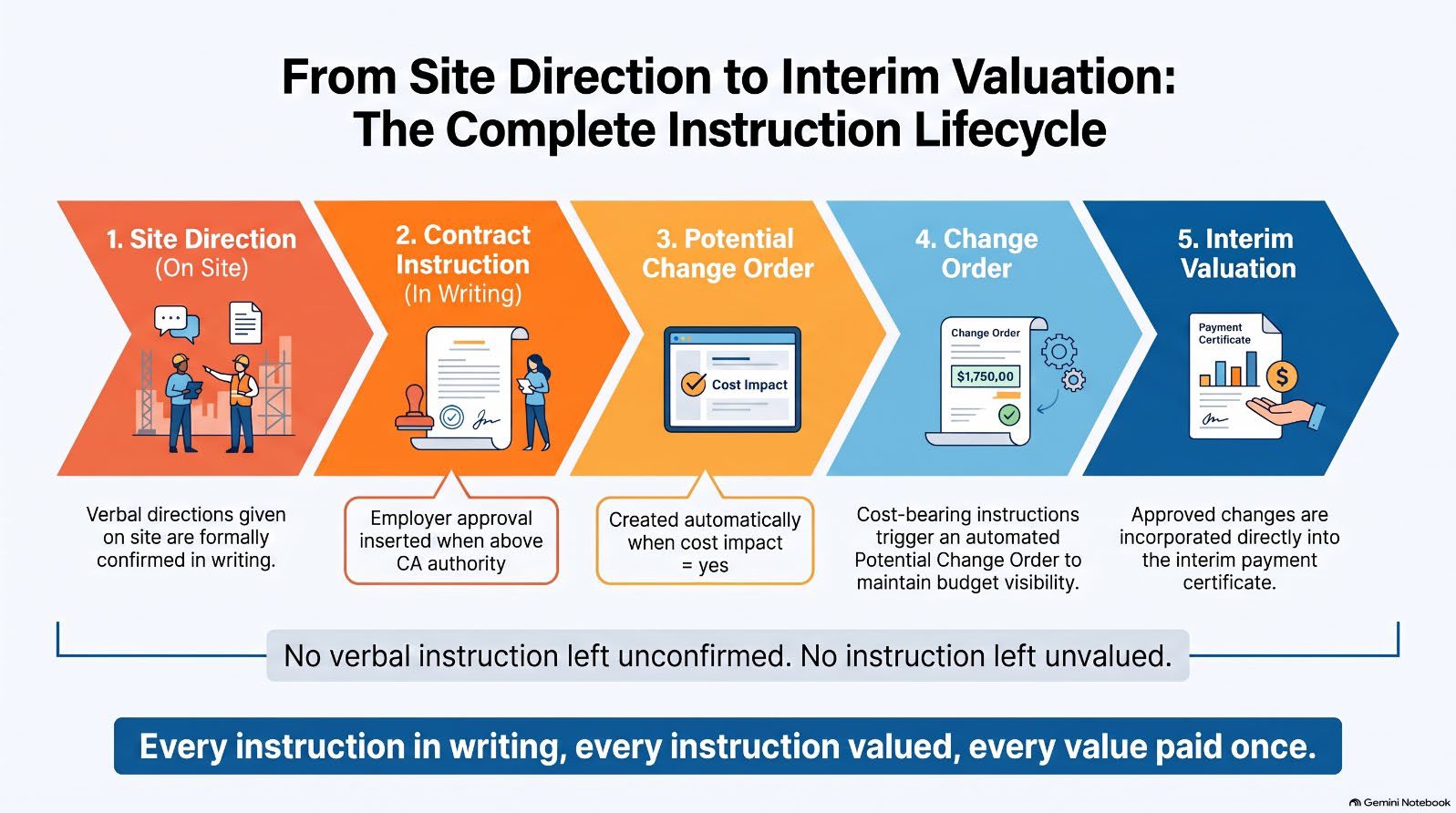
Two consequences follow. First, with every instruction issued this way there is nothing for a CVI to fill, so the register of instructions is complete by construction. Second, because a cost-bearing instruction automatically opens a Potential Change Order, nothing instructed is left unvalued. Both points matter at the final account, where RICS Final account procedures identifies items "not formally instructed" as one of the commonest reasons accounts cannot be agreed.
Extend: The Notices and Time-Bar Register with the Custom Form Builder
Notices are short records with a fixed shape: who gave notice to whom, under which clause, when it was received, and the contractual period that starts running. The Custom Form Builder handles this well.
- The notice type and clause come from a lookup that also holds the contractual period, for example 28 days for a notice of claim or 28 days for certification after a statement.
- The deadline is calculated from the received date.
- The workflow escalates to the CA seven and two days before expiry.
- Workflow roles restrict who may issue each notice type, so a notice reserved to the employer cannot be issued under the CA's name, which is precisely the point GN 69/2011 §4.1.3 makes.
and days remaining
In Screenshot S2, the statement for interim payment certificate 19 must be certified within three days, and the CA's response to the fully detailed claim under NC-011 falls due on 3 November. The same deadlines feed the time-bar table on the contract administration control centre shown in Article 1, so the CA and the employer see the same dates.
Workflow and DoA
Instructions route by value. Within the CA's authority, the CA issues directly. Above it, the workflow inserts the employer's approval step before the instruction can be issued, and the approval reference is stored on the record. RFIs, submittals and inspections carry allowed durations per step, so response times against contractual periods become measurable rather than argued. The RFI Summary Workflow Dates report and the workflow task dashboard show who is holding which record, and for how long.
Reports the CA and Employer Use Every Week

What Changes for Your Organisation

- Set up the Document Manager in the turnover structure on day one. Filing at the end of the project is too late.
- Make Daily Reports compulsory and approved. They are the contemporaneous record that later decides time and money.
- Issue every instruction through the instruction form. Site directions on site, confirmed as contract instructions within the agreed period.
- Refuse CVIs as a contractual channel. If an instruction exists, it exists in PMWEB.
- Log every notice on receipt. The time-bar register is only as good as the date received.
- Keep the CA's inspection role clear. Configure CA inspections for progress and quality reporting, and supervision inspections for design compliance.
RICS references for this article

RICS documents are UK-based; apply them in the GCC subject to the governing law and the form of contract.
How many of the instructions on your projects last month started as a verbal direction on site, and how many of those were confirmed in writing within the contractual period?

Next step
Bring this to your portfolio.
Tell us which processes matter most to you, and we will show them running in PMWEB.