
Article 4 of 10 · PMWEB for RICS Contract Administration
One Change, One Chain: RICS Change Control and Variations in PMWEB
RICS treats change control as the backbone of a defensible final account: "Any potential changes should go through this process before an instruction is given so that the employer feels they are able to make informed decisions." PMWEB 2026 ships that process as connected native modules, so the contract administrator configures change control rather than building it.
Change is where a building contract either stays under control or drifts. Every instruction that adds, omits or alters work changes the contract sum, often the programme, and sometimes the contractor's entitlement to loss and expense. RICS expects the contract administrator to value change by the contract rules, to keep the employer informed of its consequences before committing, and to keep a running record of where the adjusted contract sum is heading.
This article covers RICS services 1.4 (set up change control procedures), 6.2 (certify interim payments and send the adjusted contract sum computations) and 8.3 (advise on acceleration), the change control principles in RICS Final account procedures (1st edition, practice information), and the guidance on employer's instructions and contract instructions in the RICS 2011 guidance note Contract administration (GN 69/2011, archived in 2022 and cited for its practical content). The current RICS Black Book titles Change control and management, Valuing change and Acceleration (2nd edition) cover the same ground in more depth. It shows the four-record change chain PMWEB provides out of the box and how it enforces the money rules RICS sets.
Why this matters to you
- Commercial Directors: the probable value of change, not only the submitted value, so the anticipated final account can be trusted.
- Contract Administrators: one chain from change event to change order, with employer approval enforced above your authority.
- Cost Managers: contingency drawdowns through approved budget requests, and omissions that genuinely reduce the contract sum.
- Finance teams: purchase orders updated automatically when change orders are approved.
What RICS Requires
Change control as a process, not a document
RICS Final account procedures §3.3 defines change control as "the administrative process that implements the contract mechanisms for instructing change". It must adhere to the contract's requirements for notification and approval, and it is "a critical part of a well-run and audited project". Two warnings follow:
- Potential changes should go through the process before an instruction is given, so the employer can make informed decisions and the contractor does not act on changes it believes were instructed but were never communicated to the employer.
- The system "should not be too cumbersome so that it deters the project team from using it". All parties should want to use it because it provides security, auditability and clarity.
The guidance adds that the final account meeting should never be the first time the parties see each other's positions. Article 7 returns to that point.
Valuing change
GN 69/2011 §4.1.11 says the cost of instructions must be calculated in accordance with the rules in the building contract. Final account procedures adds that variations "should be calculated using bill rates and star rates wherever possible", with daywork used where valuing by contract rates would be inappropriate, and only on daywork sheets signed off by the contract administrator.
The employer's money rules (GN 69/2011 §4.1.8)
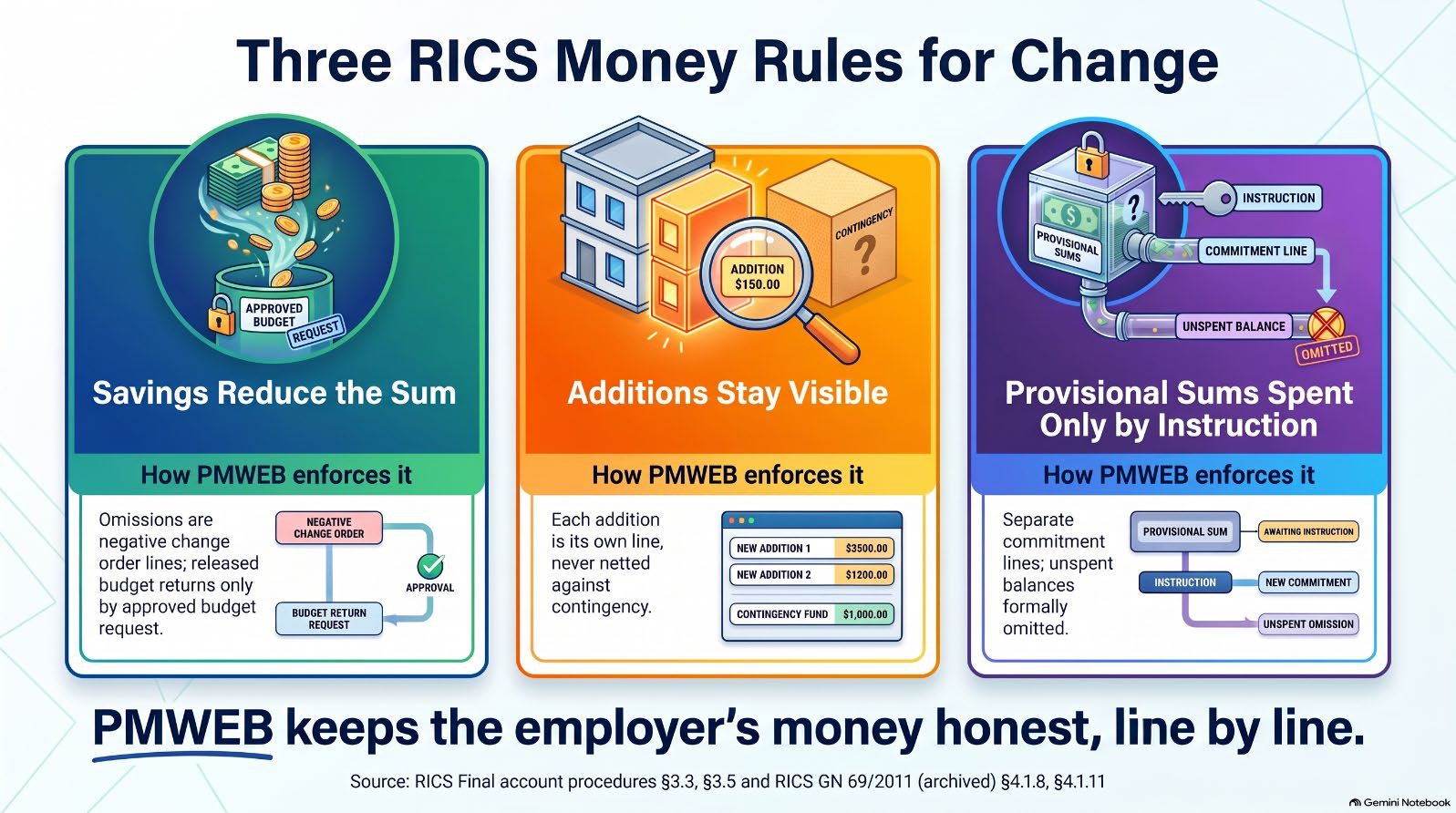
- Cost savings. Where works are omitted or varied to give a saving, "the monies released are not available to spend on other works and therefore the 'notional' contract sum is reduced by the sum saved".
- Additional costs. An addition should be added to the contract sum, not taken out of other omissions or of contingencies intended for the works in general.
- Authority. Where an instruction would cost more than the building contract or the CA's appointment allows, the employer's approval must be sought before the instruction is given.
RICS distinguishes defined and undefined provisional sums (now set out in NRM 2). A defined provisional sum assumes the contractor has allowed for it in programming and preliminaries; an undefined one does not. Provisional sums can only be spent by instruction, and any unused sums "should be formally omitted by instruction". Good practice is to agree design deliverable dates so provisional sums are converted into fixed prices during the contract.
PMWEB Out of the Box: One Chain, Four Records
PMWEB 2026 implements change as four connected record types. Each has its own fields, workflow and SSRS outputs, and each links to the one before and after it.

Every record carries attachments and links. The change order points back to the contract instruction, RFI, drawings and meeting minute that caused it (Article 3), and forward to the budget transfer that funded it and the interim valuation that paid for it (Article 5).
to the change event, contract instruction and RFI
Why the Change Event matters to owners
A single event often affects more than one contract and more than one budget line. A client brief change might affect the main contractor, a nominated façade contractor and an FF&E supplier, and might need budget moved from contingency to three cost groups. The Change Event holds that whole picture in one record, so the employer sees the full consequence of a decision before it is made, which is the informed decision RICS asks for.
How PMWEB Enforces the RICS Money Rules

The daywork sheet
The daywork sheet is a good example of where the Custom Form Builder is enough. The header holds the date, location, instruction reference and the CA's signature; one detail table lists labour, plant and materials with hours, quantities and rates. Approved sheets are linked to the PCO that values them. Final account procedures says it "would not be acceptable to reach final account stage and only then be presented with the extent of the day worksheets", and with this form the daywork position is visible every month.
The Register the Employer Reads
GN 69/2011 §4.1.7 asks the CA to keep a running record of the estimated final adjusted contract sum, including additions, omissions, employer variations and anticipated variations. The Change Control Register gives the employer that view from the PMWEB records.
to revised contract sum and pending PCOs
In Screenshot S2, fourteen approved change orders take contract MC-001 from AED 412.50 million to AED 431.14 million. Additions and omissions are shown separately. Nine pending PCOs are carried at their probable value of AED 6.2 million as
instruction
Extend Only Where the Contract Demands It
The native chain covers most forms of contract. Two extensions are common.
Variation proposals and value engineering
Many contracts, including FIDIC's value engineering and variation-by-request procedures, let the contractor or the employer propose a change before it is instructed. An Adaptive Form holds the proposal, the CA's technical and commercial evaluation, the programme effect and the employer's decision. Only an accepted proposal creates a PCO, so rejected ideas do not clutter the commercial record but remain on file.
Acceleration
RICS service 8.3 asks the CA to advise on the cost and contractual effect of an acceleration instruction. An Adaptive Form records the target dates, the contractor's quotation, the schedule fragnet showing how the dates will be achieved, the CA's advice on cost and contractual effect, and any interaction with pending extension of time applications. On approval it creates a change order and a revised schedule baseline request.
Workflow and DoA
The change order business process routes by net value through the employer's DoA matrix: CA technical review, QS valuation, then the approver whose limit covers the amount, with the higher levels added automatically by condition (Article 9 shows the configuration). Budget Requests route separately by the value of the transfer, so the authority to spend contingency and the authority to vary the contract are controlled independently, as they should be.
ERP Touchpoint
An approved commitment change order updates the purchase order value in the ERP, and an approved budget request updates the ERP budget. Finance and the CA therefore never hold different contract sums or different budgets, and the ERP will not accept an invoice above the revised commitment value.
What the Owner and the CA Must Put in Place
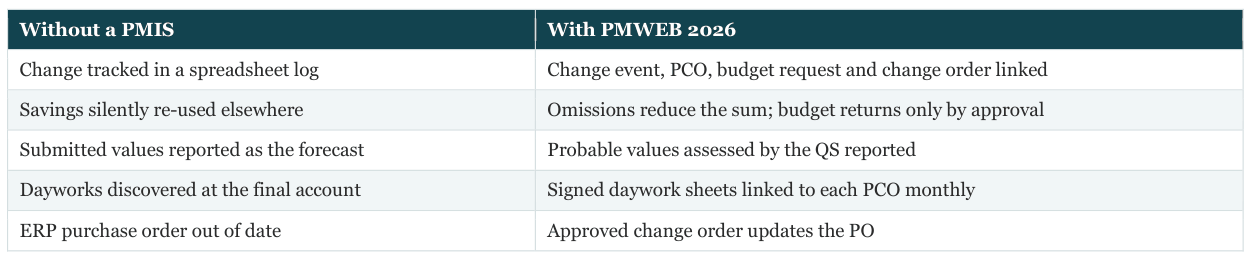
- Configure the four-record chain on every contract. Change Event, PCO, Budget Request and Change Order, with links enforced.
- Record the basis of valuation on every PCO line. It is what the final account negotiation will turn on.
- Report probable values, not submitted values. The employer needs the QS's view of where change is heading.
- Keep omissions out of contingency. Released budget returns only through an approved budget request.
- Track provisional sums and dayworks monthly. RICS expects both to be visible long before the final account.
- Keep the process light. Configure only the steps the DoA requires, so the team uses the system rather than working around it.
RICS references for this article

RICS documents are UK-based; apply them in the GCC subject to the governing law and the form of contract.
On your projects, can every change order be traced back to the instruction that caused it and forward to the budget that funded it and the certificate that paid it?

Next step
Bring this to your portfolio.
Tell us which processes matter most to you, and we will show them running in PMWEB.