
Article 6 of 10 · PMWEB for RICS Contract Administration
Time Is the Contract: Programme, Extensions of Time and Practical Completion in PMWEB
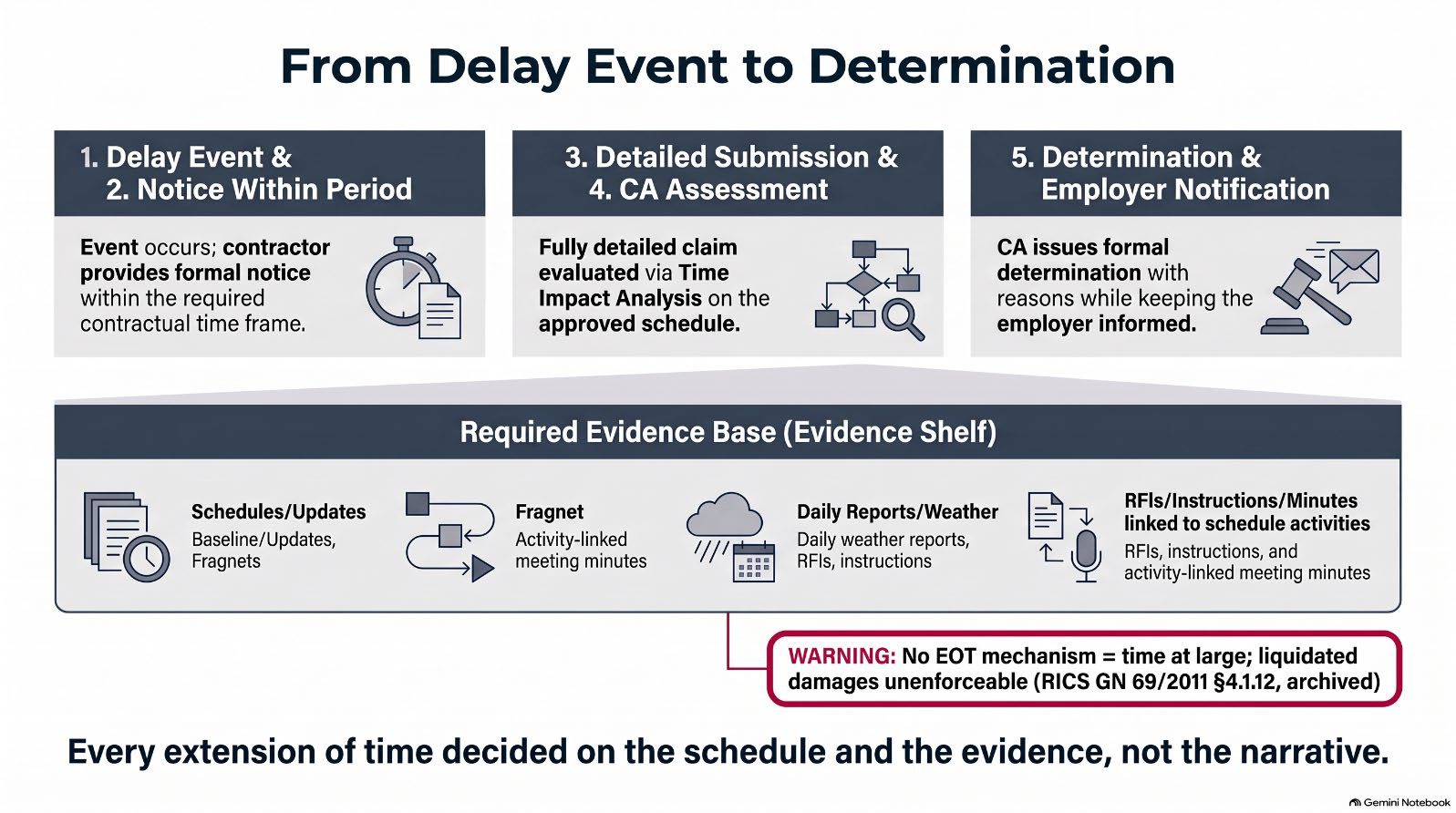
RICS guidance has long reminded contract administrators that without proper extension of time and liquidated damages procedures, time can become "at large" and liquidated damages unenforceable. Every determination, every certificate of non-completion and every completion certificate is a contractual act with money attached. PMWEB 2026 ties each of them to the approved schedule, the site record and a workflow that keeps the employer informed.
Time is where contract administration and project controls meet. The CA must monitor progress against the contractor's programme, warn the employer of delay risk, determine extensions of time fairly and in writing, issue the notices that preserve the employer's right to liquidated damages, and certify completion, sometimes section by section. Each of those duties needs a reliable schedule and contemporaneous records, and each produces a decision that may later be tested in adjudication.
This article covers RICS services 4.1 to 4.4 (programme), 7.1 and 7.2 (practical completion and certification obligations) and 8.2 (extensions of time), the practical guidance in §4.1.9 and §4.1.12 and the Appendix A post-construction checklist of the RICS 2011 guidance note Contract administration (GN 69/2011, archived in 2022 and cited for its practical content). The current RICS Black Book titles Extensions of time, Defining completion of construction works, Damages for delay to completion and Defects and rectifications cover these topics in more depth.
Why this matters to you
- Commercial Directors: liquidated damages rights preserved by timely notices, and extension of time exposure visible before it is conceded.
- Contract Administrators: determinations built on the approved schedule, linked site records and a documented method.
- Planning and controls teams: baselines, updates and fragnets in one place, linked to the records that explain delay.
- Project Directors: practical completion certified only when the prerequisites are met, with notifications sent automatically.
What RICS Requires
Programme and progress (services 4.1 to 4.4, GN 69/2011 §4.1.9)
The CA should obtain and monitor the contractor's construction programme and its revisions, advise the employer of any risk of delay "at the earliest opportunity", and advise on progress, expected completion and risks. The CA should review the programme to make sure all major elements are included and sensibly sequenced, and should use it "as an active document recording how each element of the project progresses".
The guidance lists the ways progress can be monitored, including the contractor's programme, the portion of the works valued to date and "bespoke project planning computer software". It asks the CA to consider weather, the effect of contract instructions, and the timing of instructions in relation to progress, and to keep weather records where weather may be a concern.
Extensions of time (GN 69/2011 §4.1.12)
- Without extension of time and liquidated damages provisions, if the contractor is prevented from completing for reasons beyond its control, time would become at large and liquidated damages unenforceable. The standard forms therefore give the CA power to extend time.
- The CA assesses whether a delay has affected the contract completion date and by how much. The assessment must be "reasonable", recognising it "is not an exact science".
- The CA should check the contract for the eligible reasons ("relevant events"), which fall broadly into circumstances beyond either party's control and delays caused by the employer or the CA.
- The CA should identify the time limits in the process and "if necessary set up a system to ensure that the time limits imposed by the building contract are met".
- The employer must be kept informed of extensions and of further delays that are the contractor's responsibility.
- Some building contracts require a certificate of non-completion to preserve the employer's right to liquidated damages, and its time limits must be met.
Partial possession and practical completion Appendix A post-construction checklist
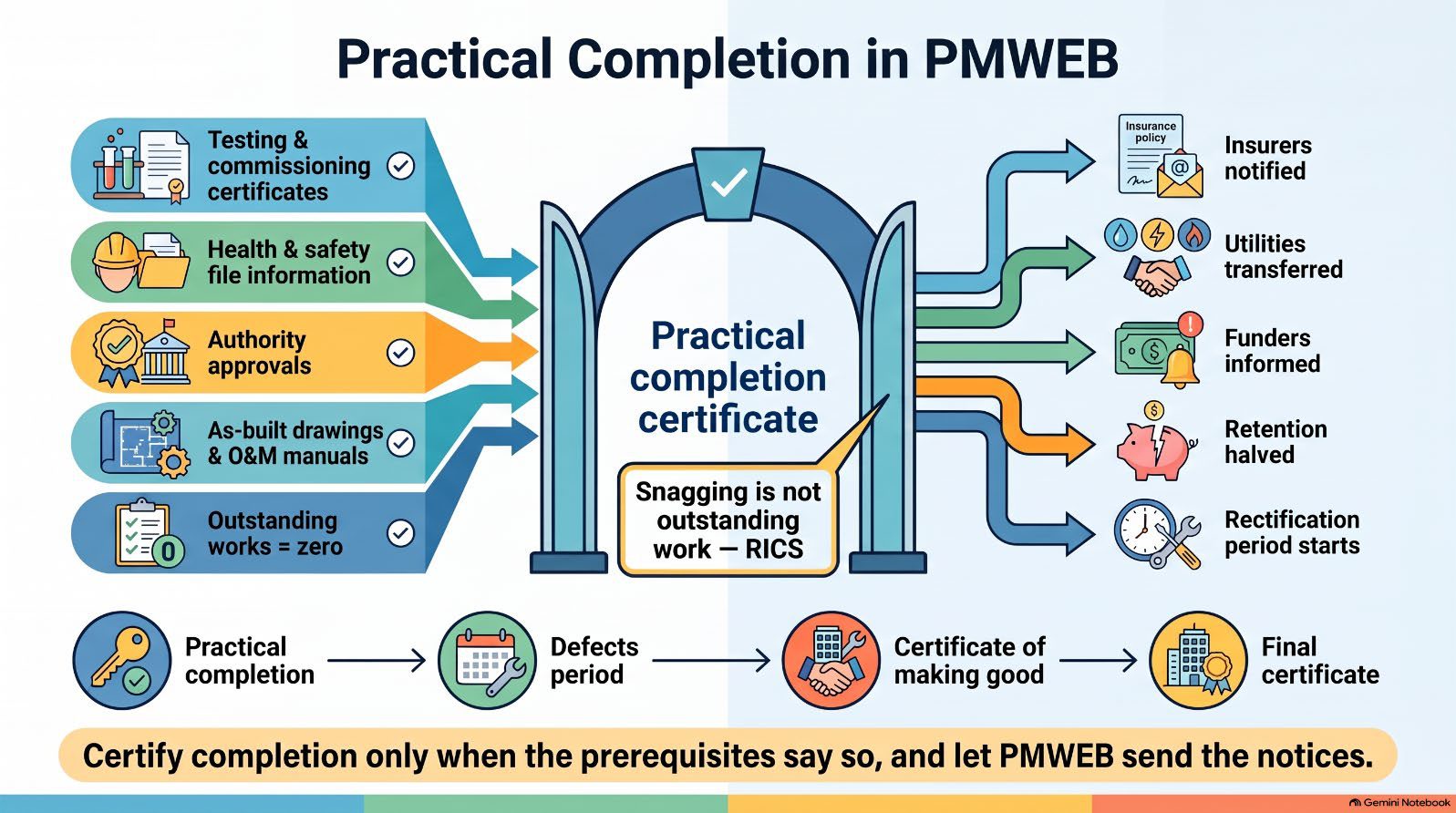
At practical completion the CA notifies the employer's insurers, utilities, the local authority and funders, and sets a date for inspection before the end of the rectification period. When the contractor leaves site, the CA records contact details and the procedure for dealing with defects. The CA then archives the signed contract information, including the certificates of practical completion, sectional completion, partial possession, revisions to the date for completion, completion of making good defects and the final certificate.
PMWEB Out of the Box: Scheduling
PMWEB's Scheduling module imports the contractor's programme from Primavera P6 or Microsoft Project, or builds it natively. Each submission is kept as a revision, and accepted programmes are saved as baselines, so the CA always knows which programme the contract is measured against. Schedules can be cost-loaded from the commitment's schedule of values, linking time and money for earned value.
The out-of-the-box scheduling outputs give the CA the views RICS describes:

Other PMWEB records link to schedule activities: meeting actions, RFIs, submittals and daily reports. That link is what lets the CA show that a late response or a late instruction affected a particular activity, which GN 69/2011 asks the CA to consider.
Extend: a programme review checklist
RICS asks the CA to review each programme for completeness and sequencing. A Custom Form Builder checklist does this consistently: header for the programme submission and revision, and one table of checks (all contract sections and milestones present, logic complete, no open ends, calendars and weather allowances stated, resources and cost loading consistent, interfaces with other contracts shown), each with a finding and status. The workflow returns the programme to the contractor or recommends acceptance as a baseline.
Extend: The Extension of Time Application as a Custom Form
An extension of time application has more structure than any native module provides: the relevant event, the notice and its timing, the contractor's submission, a checklist of supporting evidence, the delay analysis, the CA's assessment and the determination. CMCS builds it as a Custom Form, with view and edit rights to the assessment sections limited to the employer and the CA.
and the submission checklist
Screenshot S1 shows EOT-03 on contract MC-001: a delay in utility diversion caused by the authority (FIDIC 2017 sub- clause 8.6), notified within 28 days through notice NC-011, with 38 days claimed. The fully detailed claim arrived on 22 September, so the CA's determination is due by 3 November. The contractor's time impact analysis was prepared in Primavera P6 on update UP-18 with fragnet FN-03, and the planning review checks it against the imported schedule. The checklist shows what the contractor has provided and what the CA has verified, including 46 contemporaneous records linked from daily reports and correspondence, and flags that the statement of mitigation measures is missing.
Recommended design
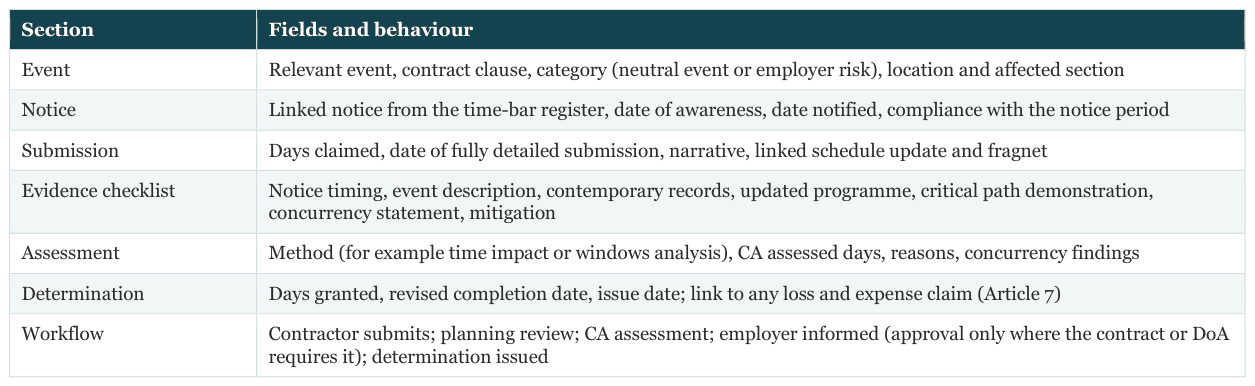
The determination updates the contract completion date on the commitment, and the EOT log on the record keeps the cumulative position: original completion, each extension granted and the current date.
The Time and Completion Dashboard
GN 69/2011 asks the CA to warn the employer of delay at the earliest opportunity and to keep the employer informed of extensions and contractor delays. A Power BI dashboard inside PMWEB gives the employer that view from the schedule and EOT records.
and the sectional completion watch list
In Screenshot S2, contract MC-001 has moved from an original completion date of 30 June 2027 to 14 August 2027 after two extensions of 21 and 24 days, with 62 days pending determination. Progress is 63.2% against a planned 67.0%. The sectional completion table is the CA's watch list for certificates of non-completion: sections 1 and 3 are forecast to miss their contract dates, so the CA can prepare the notices that preserve the employer's right to liquidated damages before the dates pass.
Completion, Partial Possession and Defects
Completion certificates as an Adaptive Form
Practical completion, sectional completion, partial possession and the certificate of non-completion share a pattern: a checklist of pre-requisites, a decision and a formal certificate. CMCS configures one Adaptive Form with a certificate type field.
- Outstanding works test: a count of punch list items classified as "outstanding works" rather than "snagging". If any outstanding works remain, the workflow requires the CA to record why completion can still be certified.
- Notifications: on approval, the workflow notifies the employer's insurers, the facilities team for utilities, and funders, reflecting the Appendix A post-construction list.
- Letter: the certificate itself is generated from a PMWEB Word template.
Punch lists: snagging, outstanding works and defects
PMWEB Punch Lists already hold location, description, photographs, responsible company, due date and status. Adding a classification field (outstanding works, snagging, defect during rectification period) lets one module support all three stages RICS distinguishes. During the rectification period, the same module records defects notified to the contractor, the period allowed and whether they were made good. The inspection before the end of the period, which Appendix A asks the CA to schedule, is a dated action linked to the punch list.
Retention release
At practical completion the progress invoice applies the contract's retention release, typically halving the retention held, and the balance is released at the end of the rectification period when the certificate of making good defects is issued. Because retention has been calculated on every certificate (Article 5), the release amount is already known.
Workflow and DoA
Extension of time determinations are decisions in the CA's impartial function, so under the standard forms the workflow informs the employer rather than asking for approval. Many GCC particular conditions, however, require the employer's prior approval before the Engineer grants an extension above set limits; PMWEB adds that approval step by condition, for example above 30 days, so the contract as amended is the contract the workflow runs. Completion certificates route to the employer for acknowledgement because they transfer insurance and maintenance responsibility. Each step's allowed duration reflects the contractual period for the determination.
What Changes for Your Organisation

What the Owner and the CA Must Put in Place
- Baseline the accepted programme in PMWEB. Every later assessment is measured against it.
- Link records to activities. Actions, RFIs, submittals and daily reports linked to activities are the evidence base for any delay analysis.
- Use one EOT Adaptive Form per application. With the notice, evidence checklist, method and determination in one record.
- Watch sectional dates, not just the final date. Certificates of non-completion have their own time limits.
- Classify punch list items. Outstanding works and snagging are not the same, and RICS says the difference decides whether completion can be certified.
RICS references for this article

RICS documents are UK-based; apply them in the GCC subject to the governing law and the form of contract.
When your contract administrator determines an extension of time, is the decision built on the approved schedule, contemporaneous site records and a documented method, or on the contractor's narrative?

Next step
Bring this to your portfolio.
Tell us which processes matter most to you, and we will show them running in PMWEB.