
Article 7 of 10 · FIDIC Compliance by Design
Change under Scrutiny: Variations, Employer Approvals and Bank No-Objection
On a development-bank-funded contract, a Variation is not only a commercial decision between the Parties. It changes a contract the lender reviewed and is financing, so it has to pass two approval chains: the Engineer and Employer under FIDIC, and the Bank under the financing agreement. The trigger for the Bank's no-objection is usually cumulative, so no single change crosses the line, but together they do. A PIU's change process in PMWEB has to read the running total from the first Change Event, not discover it at the mid-term review.
This article looks at change control through the Bank’s eyes, and at how PMWEB makes the Bank’s scrutiny a built-in step of the change process rather than an after-the-fact reconciliation. It uses the sample programme P-2100, Urban Water & Roads: eight works contracts with an original value of USD 412.6 million, financed by Bank A and Bank B.
Two approval chains, one change
Every construction contract changes. Ground conditions differ from the site data, designs evolve, authorities impose new requirements and end users discover needs they did not express at tender. FIDIC accepts this. Under the 2017 Red Book the Engineer may vary the Works under Sub-Clause 13.1, the Variation Procedure is set out in Sub-Clause 13.3, and Sub-Clauses 13.4 and 13.5 govern Provisional Sums and Daywork.
A Bank-financed contract has two approval chains sitting on top of those clauses:
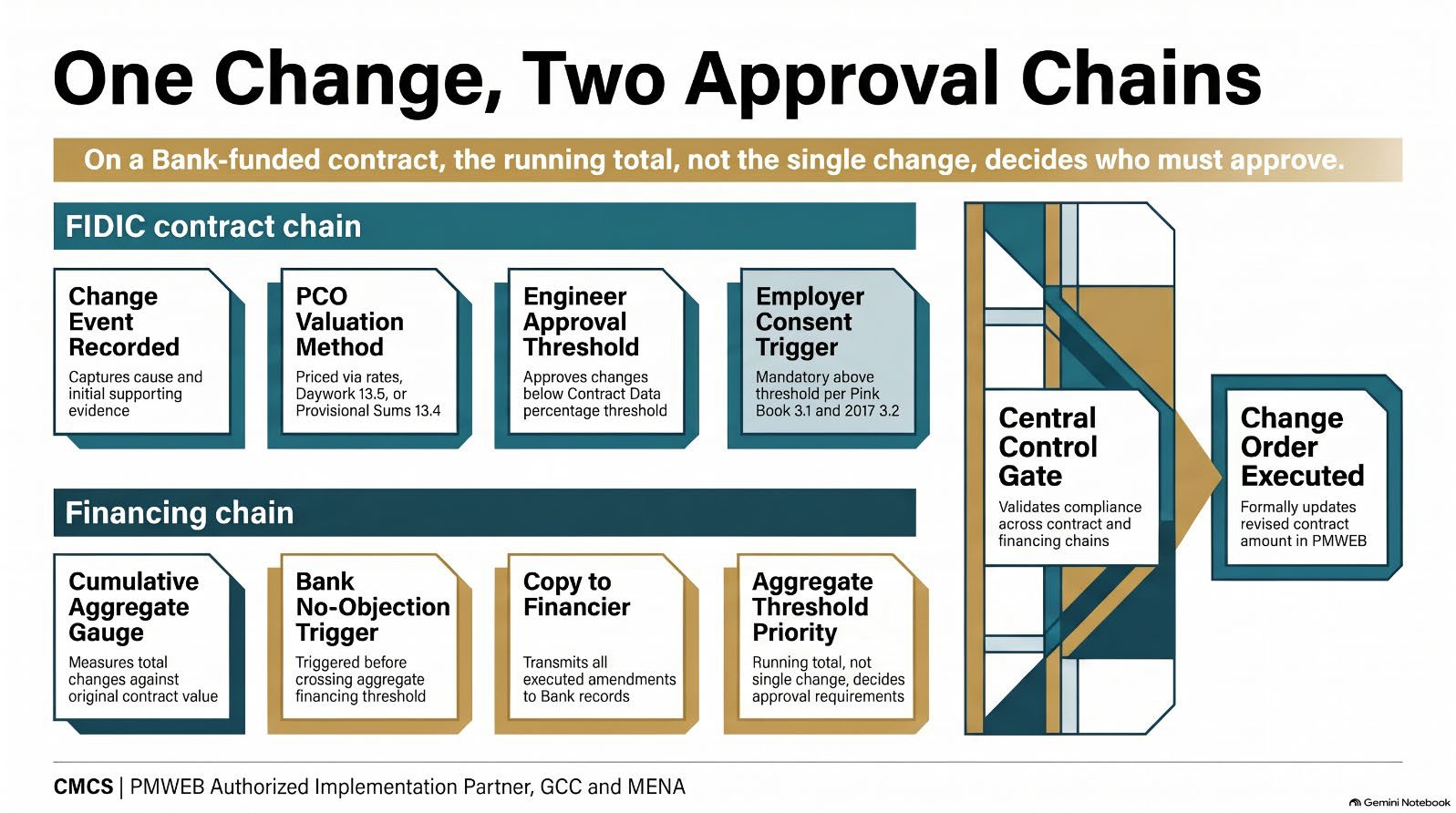
- The contract chain. Under the FIDIC MDB Harmonised Edition (the “Pink Book”), Sub-Clause 3.1 requires the Engineer to obtain the Employer’s specific approval before instructing a Variation, except in an emergency or where it would increase the Accepted Contract Amount by less than the percentage stated in the Contract Data, and before approving a Contractor’s Variation proposal. The 2017 Red Book reaches the same point differently: under Sub-Clause 3.2, the Engineer obtains the Employer’s consent wherever the Particular Conditions require it, and Bank-financed contracts use that hook.
- The financing chain. Development banks review certain contract modifications before they take effect. The Sri Lanka Ministry of Finance’s Guide to Project Management and Contract Management (GPMCM), prepared under ADB technical assistance for Pink Book contracts, gives a clear example. Citing ADB’s Procurement Guidelines, it notes that the Borrower must seek ADB’s no-objection in advance, except in extreme urgency, where changes would in aggregate increase the original contract amount by more than 15 percent, and that a copy of every amendment must be sent to ADB for its records. Other banks set their own prior-review rules in the financing agreement and the procurement plan, and the thresholds differ.
The critical word is aggregate. No single Variation needs to cross the line; the running total does. A contracts engineer approving Variation number 23 rarely has an up-to-date cumulative figure in front of them. By the time someone notices that the contract has grown by 17 percent, the works are built and the no-objection request has become a request for forgiveness.
The change chain in PMWEB
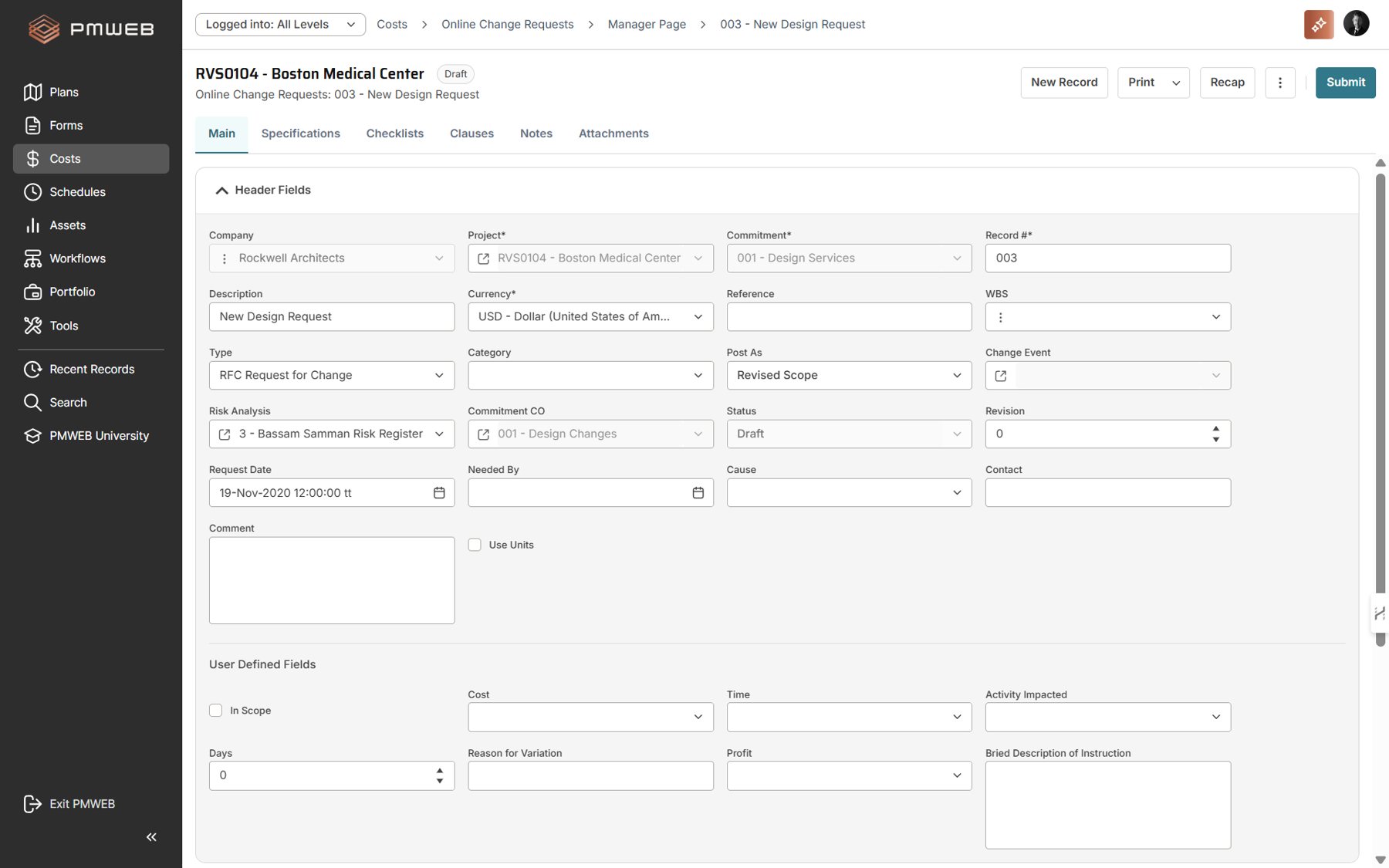
PMWEB manages change as a linked sequence of records, not as isolated letters. The same chain carries the FIDIC approval and the Bank approval, and every link is coded to the commitment, the WBS and the cost codes.
Nothing reaches the commercial stage without a recorded cause. Once a PCO is approved and becomes a Change Order, the revised contract value, the approved and pending changes and the remaining balance update immediately. That is the “updating of contract amount and forecast cost” that GPMCM procedure CA46 asks a PIU to keep every month, produced as a by-product of approving the change rather than as a separate spreadsheet.
The cumulative tracker that asks for no-objection
The decisive feature for a Bank-financed contract is a rule that reads the running total, not only the value of the current change.
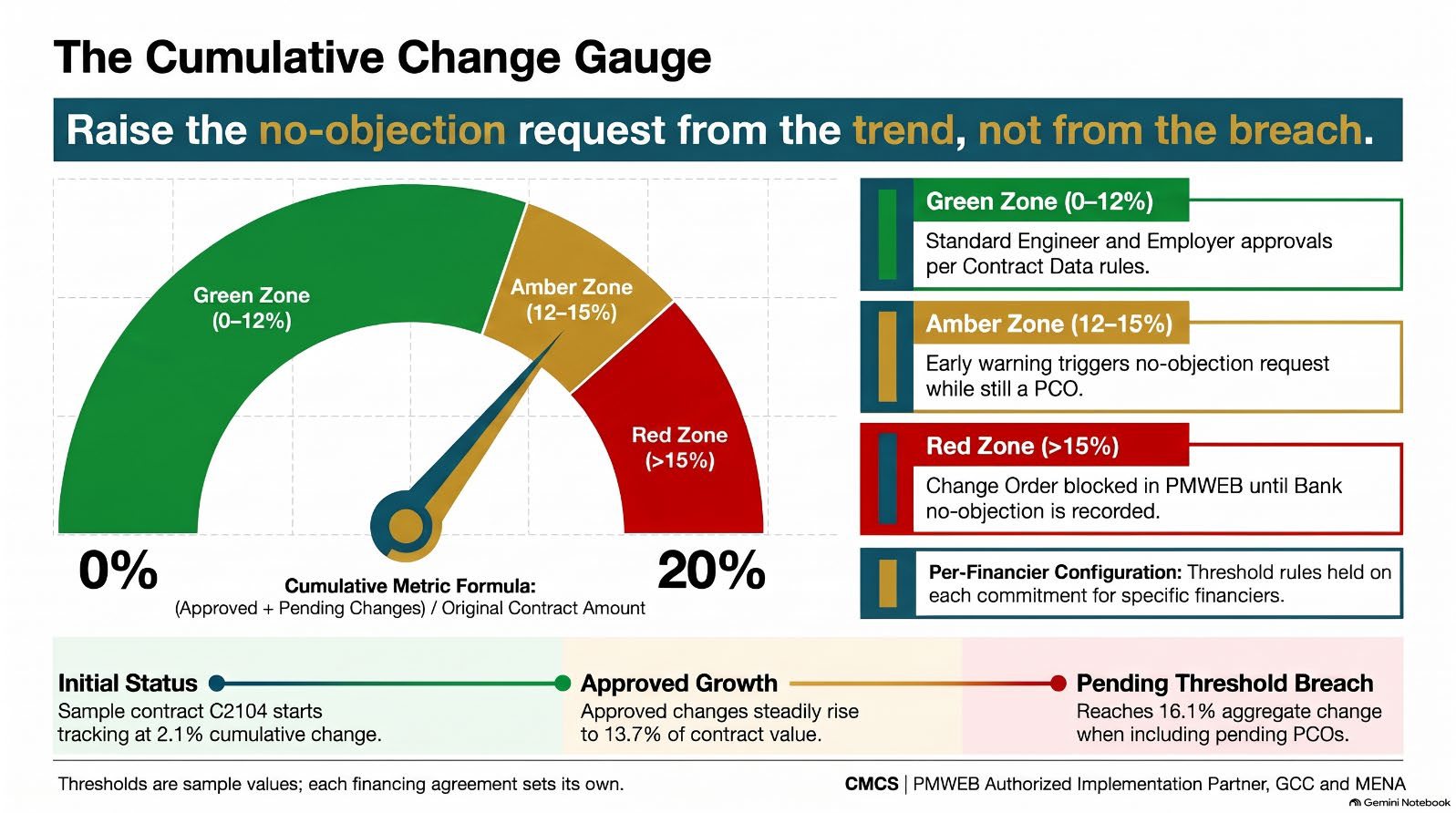
In PMWEB the commitment holds the original contract amount. Every approved and pending Change Order is summed against it, so the cumulative percentage change is a live, calculated field. Workflow conditions can test that field:
- Early warning. When approved plus pending changes reach 80 percent of the prior-review threshold, the PIU’s contracts manager and the Bank liaison officer are notified, so the request is prepared while the change is still a PCO.
- Automatic no-objection step. When a proposed Change Order would take the cumulative change past the threshold set for that contract, the workflow inserts a step to prepare the no-objection request, with the justification, valuation, schedule impact and the list of earlier changes attached.
- Hard stop. Until the Bank’s no-objection is recorded on the record, with its reference and date, the Change Order cannot move to final approval.
- Per-financier rules. The threshold and its basis (original amount, currency, treatment of price adjustment and Provisional Sums) are set per commitment, so one programme can hold different rules for Bank A and Bank B contracts.
Not every change is agreed. Where the Parties disagree, the matter moves into the claims procedure under Clause 20 and the Engineer’s agreement or determination under Sub-Clause 3.7, covered in our earlier Digital FIDIC Project series. What matters for the Bank is the link: a determined claim that becomes a Change Order counts in the cumulative tracker exactly like an agreed Variation. A contract cannot slip past the threshold because the increase came through a determination rather than an instruction.
Sub-Clause 21.3 of the 2017 Red Book lets the Parties ask the DAAB to help resolve an issue informally before it becomes a dispute, and the GPMCM recommends reporting any contract dispute to the funding agency. In PMWEB, a disagreement logged as an Issue can carry a “report to financier” step, so the Bank hears about it from the PIU, with the facts attached, rather than from the Contractor’s escalation letter.
The Variation and No-Objection Control dashboard
The dashboard below is built in PMWEB’s embedded Power BI reporting for the sample programme P-2100, with values in USD millions.
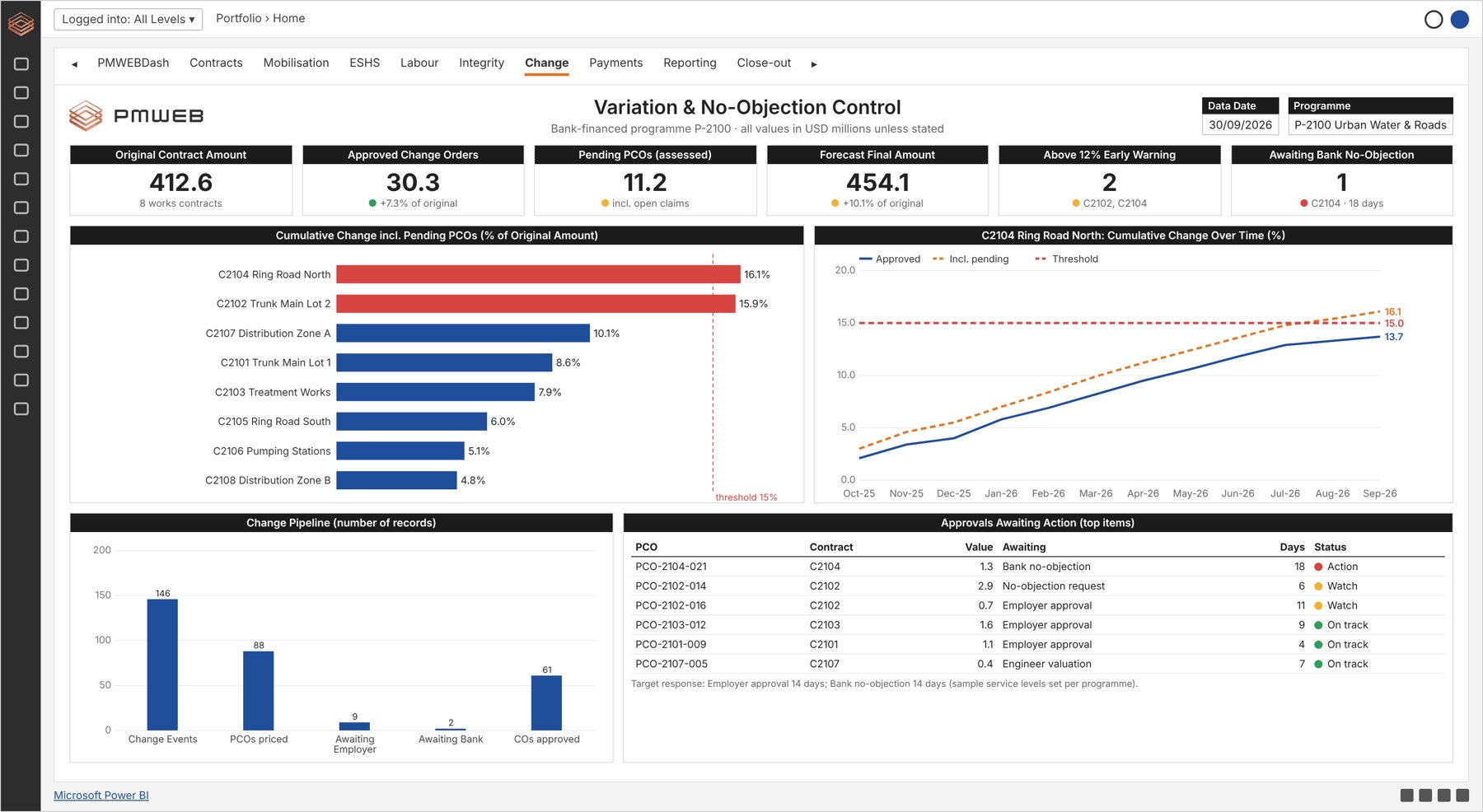
- The programme has grown 7.3 percent, but that is not the real number. Approved Change Orders total 30.3 on an original 412.6. With pending PCOs of 11.2 at their assessed value, the forecast final amount is 454.1, or 10.1 percent above the original.
- Two contracts will cross the threshold on pending changes alone. C2104 Ring Road North stands at 16.1 percent including pending PCOs and C2102 Trunk Main Lot 2 at 15.9 percent, both above the sample prior-review threshold of 15 percent.
- The trend gave months of warning. Including pending PCOs, C2104 passed the 12 percent early warning in May 2026; its approved changes alone reached 13.7 percent by September. The no-objection request was raised from the trend, not from the breach.
- One item is already late. PCO-2104-021 has waited 18 days for Bank B’s no-objection against a 14-day service level. PCO-2102-014, worth 2.9, is the next request in preparation.
- The pipeline shows where effort is stuck. Of 146 Change Events, 88 have been priced as PCOs and 61 approved as Change Orders. Nine are with the Employer and two with the Bank.
The Contract Amount and Forecast dashboard
A task team also asks where each contract is heading, because a contract that will outgrow its financing allocation is a financing problem before it is a contractual one. The second dashboard compares the forecast final value with the works allocation of each financier.
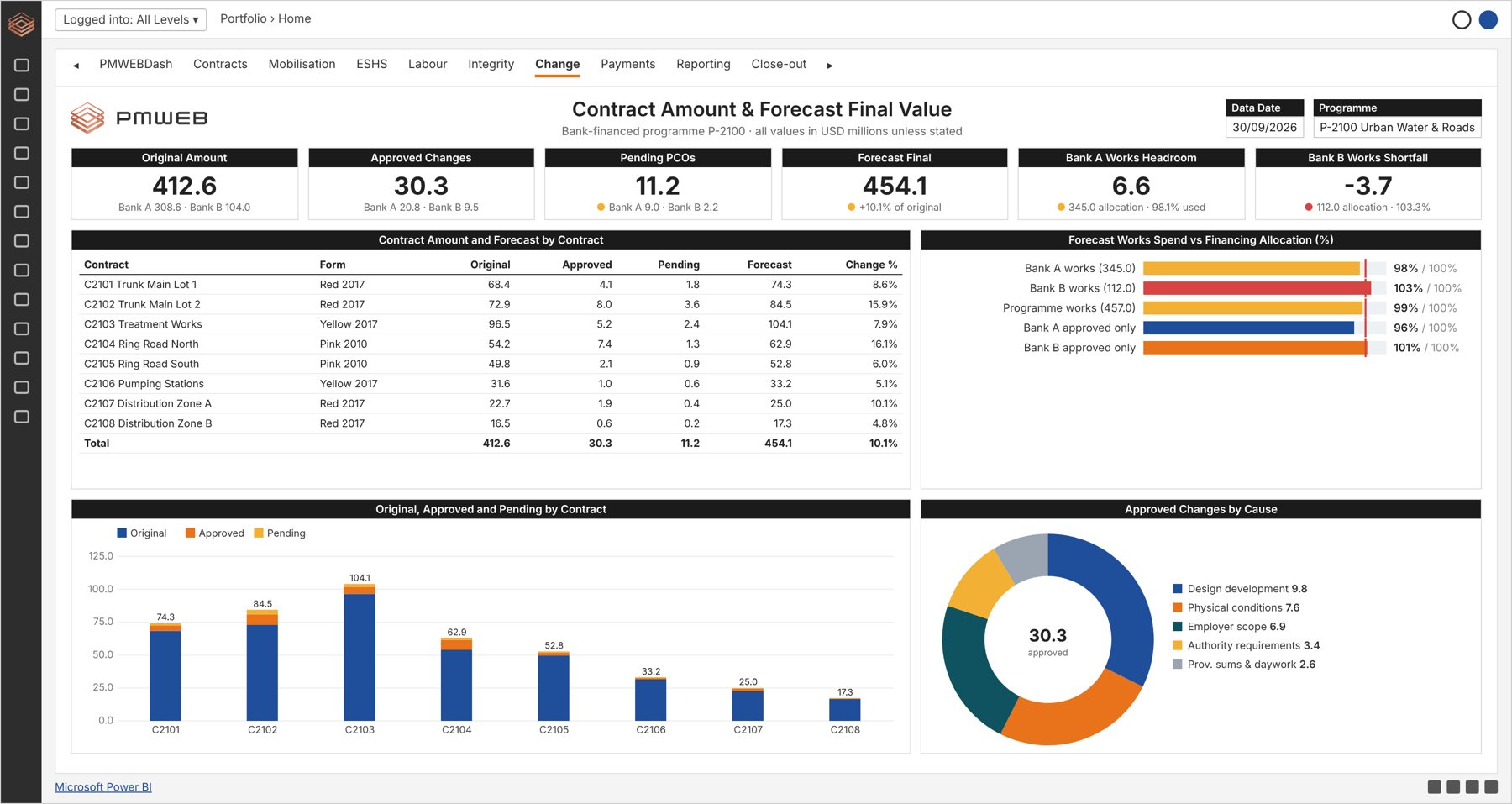
- Bank B’s works allocation is already short. The two Pink Book road contracts are forecast at 115.7 against a Bank B works allocation of 112.0, a shortfall of 3.7, or 103.3 percent. Even approved changes alone take Bank B to 101.3 percent.
- Bank A has little headroom. Its six contracts are forecast at 338.4 against an allocation of 345.0, leaving 6.6, or 98.1 percent used. Pending PCOs of 9.0 are already inside that forecast, so any new change above 6.6 on Bank A contracts would exceed the allocation.
- Design development drives the largest share of change. Of the 30.3 approved, 9.8 comes from design development, 7.6 from physical conditions, 6.9 from Employer-requested scope, 3.4 from authority requirements and 2.6 from Provisional Sums and Daywork.
- The largest contract is not the largest risk. C2103 Treatment Works, at 96.5 the biggest contract, has grown 7.9 percent. The highest risks are the mid-sized road and trunk-main contracts.
- The PIU can act now. With the shortfall visible 33 months before loan closing, the PIU can seek a reallocation, re-scope the works or arrange counterpart funding while there is still time.
PMWEB 2026 AI on change data
Action is taken only with the user’s approval, and PMWEB AI honours security settings, so change and commercial data is visible only to the roles permitted to see it.
What the PIU must put in place
- Thresholds held as data. The Contract Data percentage for Employer approval and each financier’s prior-review rule recorded on every commitment, not in a separate guidance note.
- One chain for every change. Change Event → PCO → Change Order for instructions, Contractor proposals, determinations and Provisional Sum draw-downs alike.
- Cumulative tracking including pending items. The early warning reads approved plus assessed pending changes, so the no-objection request starts while the change is still a PCO.
- A no-objection step that cannot be skipped. The Bank’s reference and date recorded on the record before final approval.
- An amendments register the Bank receives automatically. A scheduled Change Order register sent to the task team, matching the contract file.
- Forecast against allocation. Forecast final value per contract compared monthly with each financier’s category allocation.
- Disputes reported early. Disagreements logged as Issues with a step that notifies the funding agency.
Over to you: on your last development-bank-funded contract, did anyone know the cumulative change percentage on the day each Variation was approved, or was it discovered at the mid-term review?
The series: Article 1, Funding Comes with Conditions; Article 2, From Particular Conditions to Platform; Article 3, The First 90 Days; Article 4, ESHS as Evidence; Article 5, People on Site; Article 6, Integrity by Design; Article 7, Change under Scrutiny; Article 8, Paying through the Loan; Article 9, Reporting to the Bank; Article 10, Closing the Contract, Closing the Loan.

Next step
Bring this to your portfolio.
Tell us which processes matter most to you, and we will show them running in PMWEB.