
Article 8 of 10 · FIDIC Compliance by Design
Paying through the Loan: IPCs, Currencies, Price Adjustment and Disbursement Traceability
On a development-bank-funded contract, an Interim Payment Certificate is only half the story. The other half is which loan category, which currency and which funding source paid it, and whether the money can still be drawn before the financing closes. A PIU that cannot show that trace for every certificate meets it later as rejected withdrawal applications, ineligible expenditure refunded from the national budget, and audit findings. PMWEB carries the trace inside the payment records themselves.
Our earlier Digital FIDIC Project series covered the Clause 14 payment cycle itself: the Statement under Sub-Clause 14.3, the Engineer’s Interim Payment Certificate under Sub-Clause 14.6 and payment under Sub-Clause 14.7. This article covers the Bank layer that sits on top of that cycle, using the sample programme P-2100, Urban Water & Roads, financed by a Bank A loan of USD 450 million, Bank B co-financing and government counterpart funds.
Where a Bank-financed payment comes from
The Employer pays the Contractor, but the money comes from a loan or grant with its own rules. Four features make a Bank-financed payment different from a privately funded one:
- Categories. The financing agreement allocates funds to categories such as works, consultancy, goods and project management. The GPMCM, prepared under ADB technical assistance for the Sri Lankan Ministry of Finance, tells PIU staff to keep the financing agreement and the Project Administration Manual (PAM) at hand. The financing agreement sets the amount financed, the expiry date and the allocation of funds per category, and the guide notes that category allocations may be modified as needed.
- Shares. Some expenditure is financed by the Bank, some by a co-financier and some by the government’s counterpart budget, often in fixed percentages per category.
- Disbursement methods. Depending on the financing agreement and the Bank’s disbursement rules, the Bank may pay the Contractor directly at the Borrower’s request, reimburse eligible expenditure the Borrower has already paid, or advance funds to a designated account that is documented later. Each needs a withdrawal application supported by evidence of eligibility.
- A closing date. After the loan closing date the Bank does not finance new expenditure. An extension is possible but not guaranteed.
If the PIU cannot show, for every certificate, how it was split and where the money came from, the problems arrive in three forms: withdrawal applications returned for missing support, ineligible expenditure the government must refund from its own budget, and audit findings that follow the Borrower into its next operation.
The financing agreement is a budget, so treat it like one
That structure is a budget, and PMWEB is built around budgets. The PIU sets up each financing source as a funding source in PMWEB: the Bank A loan, the Bank B co-financing and the counterpart funds. It maps the project budget, by WBS and cost code, to the financing categories each source covers. Every commitment, and every line within a commitment where needed, carries its funding allocation: for example 80 percent Bank loan and 20 percent counterpart funds on civil works, or 100 percent counterpart on land acquisition and taxes.
From that point every financing category has a live position: allocated, committed, certified, paid and disbursed. A category heading for over-commitment shows up in the Cost Worksheet long before the Bank’s disbursement desk notices. That leaves time to request a reallocation under the financing agreement, rather than discovering the gap when a withdrawal is refused.
Splitting every certificate by currency and source
FIDIC already requires part of the split. Under Sub-Clause 14.15 of the 2017 Red Book, the Contract Price is paid in the currency or currencies named in the Contract. International competitive bidding on Bank-financed works routinely produces contracts with a local-currency portion and one or more foreign-currency portions, each with its own proportions and exchange-rate basis.
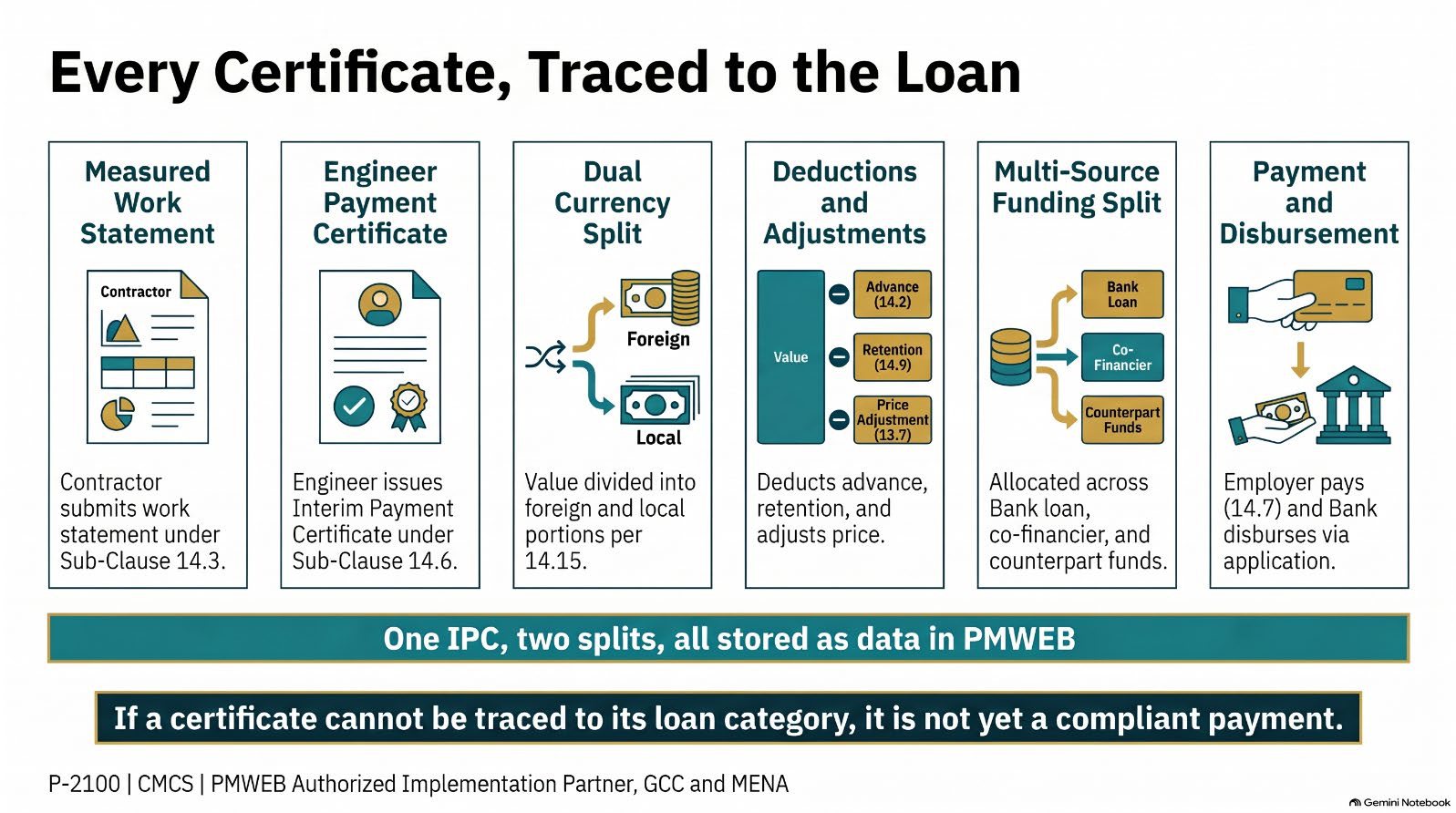
In PMWEB the commitment carries its currency structure, and the Progress Invoice that becomes the IPC applies it automatically. Deductions follow the same structure:
- Advance payment recovery. The advance under Sub-Clause 14.2 is recorded against the commitment, with its guarantee in the Bonds & Insurance details. Each IPC deducts the amortisation at the contract rate and in the currencies of the advance, and the outstanding balance is always visible. A guarantee that expires before the advance is recovered is an unsecured exposure, so its expiry is tracked against the balance.
- Retention. Retention is deducted per certificate and accumulated per currency, ready for release under Sub-Clause 14.9 at taking-over and at the end of the Defects Notification Period.
- Funding split. Once the net amount is known per currency, the funding allocation divides it between the Bank, the co-financier and the counterpart budget. The IPC carries both splits at once, by currency and by source, and both are stored as data rather than typed into a cover letter.
Price adjustment and changes in law
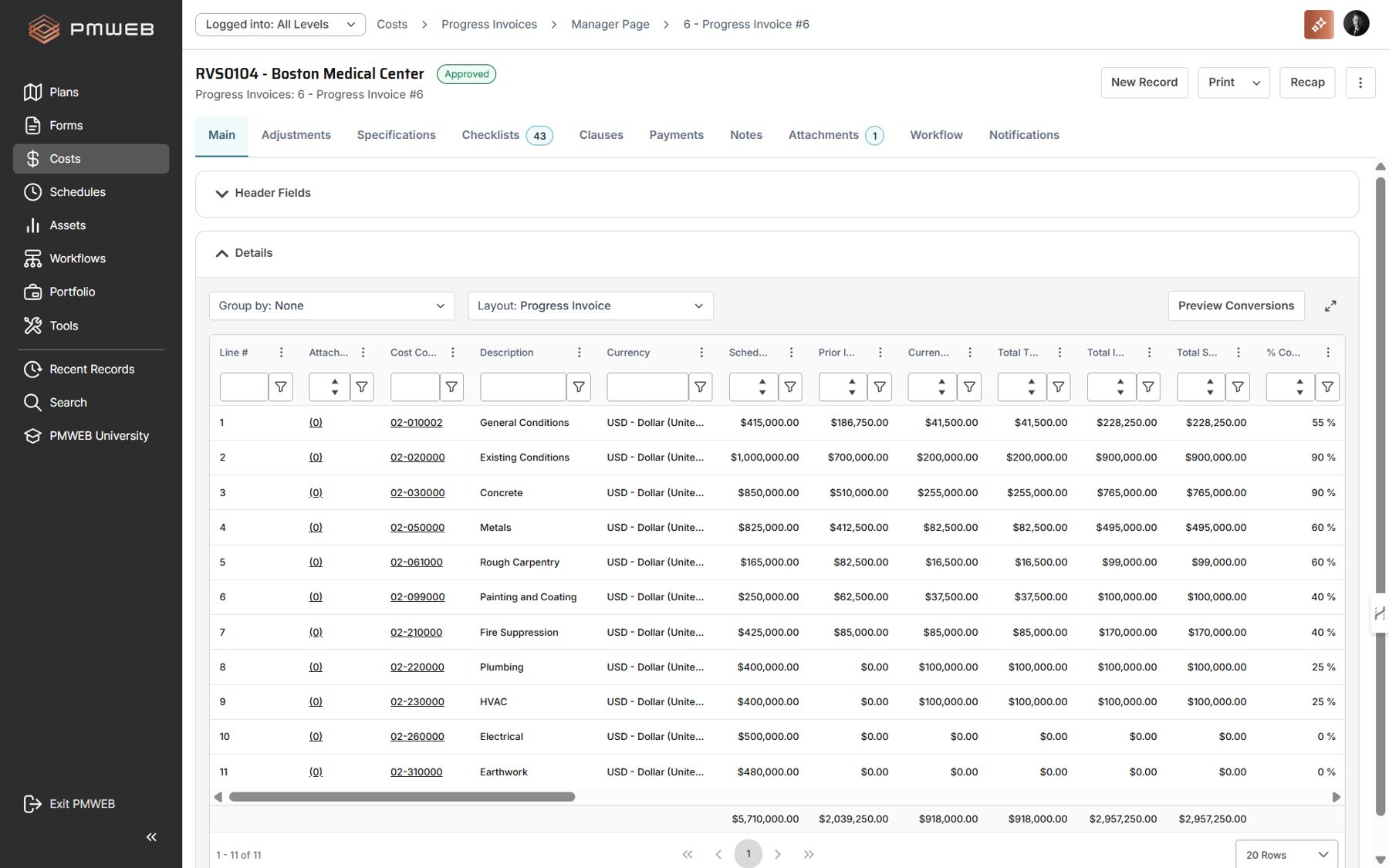
Bank-financed contracts of any length usually include price adjustment. Under Sub-Clause 13.7 of the 2017 Red Book, the amounts payable are adjusted for rises or falls in the cost of labour, goods and other inputs, typically through a formula in the Contract Data that applies published indices to fixed and adjustable proportions per currency.
This is one of the most error-prone calculations on any project. It depends on the right index values for the right months and the right base date. Where the works run late through the Contractor’s fault, the contract formula normally prevents delay from earning extra inflation. PMWEB holds the formula, the coefficients and the index table against the commitment, with each index value entered once and its publication source attached. The adjustment is calculated on each Progress Invoice per currency and shown as its own line, so the Engineer checks the inputs rather than rebuilding a spreadsheet. Keeping price adjustment as a distinct line also keeps disbursement claims clean where it has its own financing treatment.
Adjustments under Sub-Clause 13.6 for Changes in Laws, such as a new tax rate or labour regulation, follow a different route. They are valued and approved through the change chain described in Article 7, and they enter the IPC only once approved, with a trace back to the legal change that caused them.
From certificate to disbursement
What every disbursement method has in common is a document chain, and PMWEB holds it. The disbursement request is an adaptive form linked to the IPCs it covers. It pulls the certified amount, the category, the currency and the financed share from the certificates themselves. The IPC, the Contractor’s Statement, the measurement and the supporting records are already attached through the record links. When the Bank’s reference and value date come back, they are recorded on the same form. Payment data flows back from the ERP through the API, so each Progress Invoice shows certified, paid and disbursed values side by side.
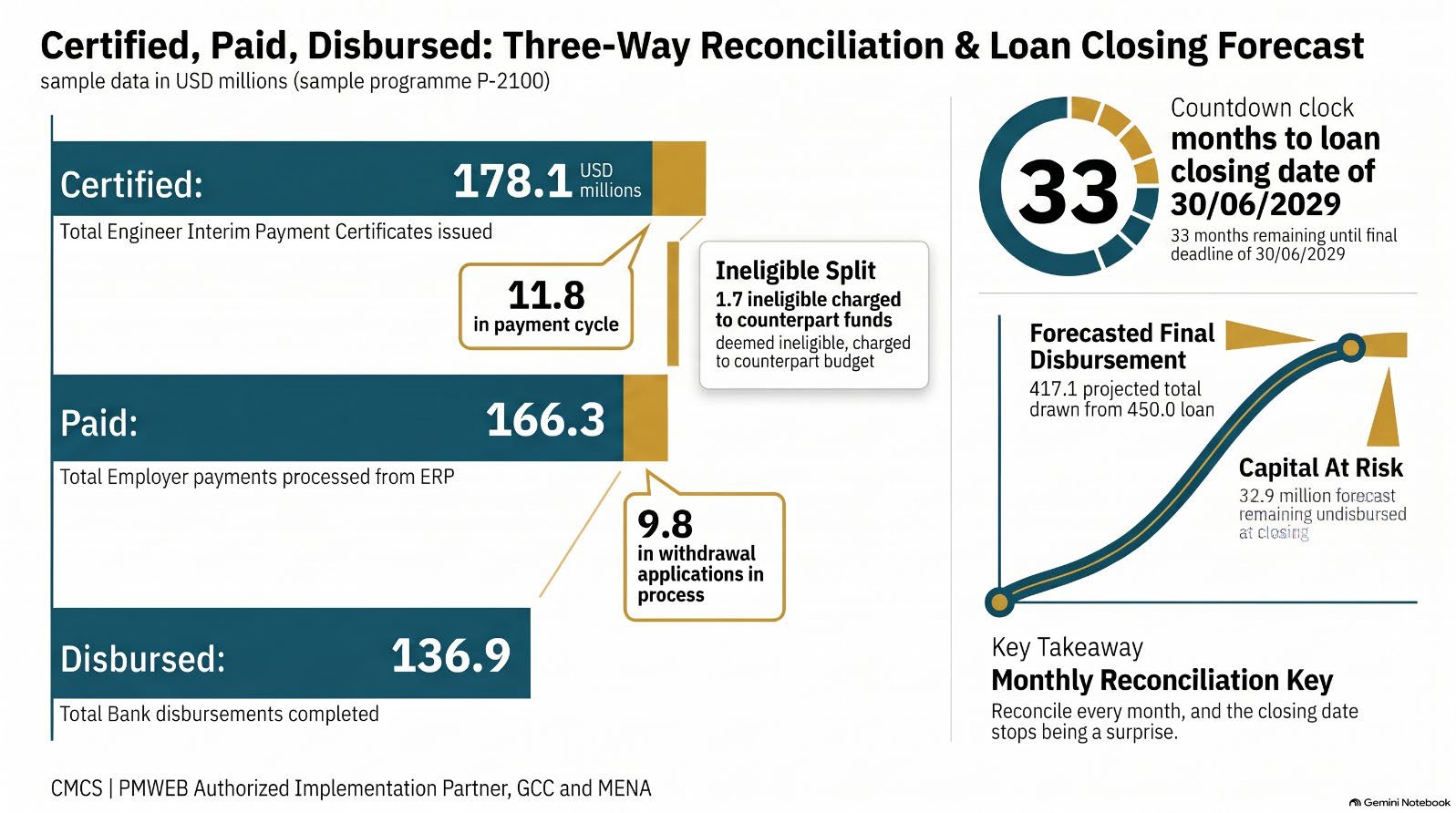
The result is a three-way reconciliation run continuously, not at year-end: what the Engineer certified, what the Employer paid and what the Bank disbursed. Every difference is a named item: an IPC paid from counterpart funds awaiting reimbursement, a withdrawal application in process, or an amount found ineligible and charged to the government budget.
The Payment and Disbursement Traceability dashboard
The dashboard below is built in PMWEB’s embedded Power BI reporting for the sample programme P-2100, with values in USD millions.
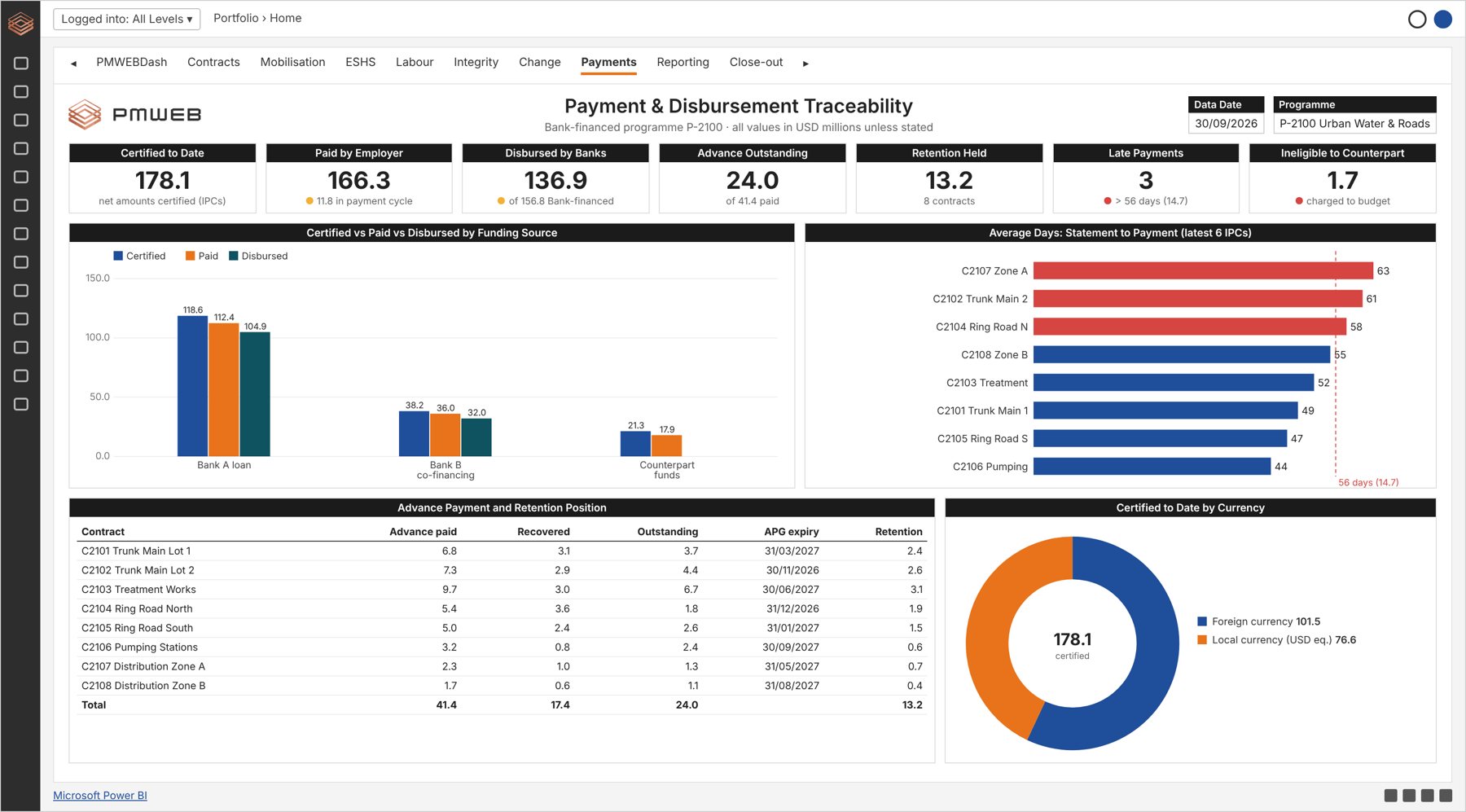
- Certified is not disbursed. IPCs worth 178.1 have been certified across the eight works contracts, 166.3 has been paid by the Employer and 136.9 has been disbursed by the two banks, out of 156.8 certified as Bank-financed.
- Every gap is named. Of the 11.5 the Employer has paid but the banks have not yet disbursed (7.5 for Bank A, 4.0 for Bank B), 9.8 sits in three withdrawal applications in process and 1.7 was found ineligible and charged to the counterpart budget.
- Three contracts are paid late. C2107, C2102 and C2104 average 63, 61 and 58 days from Statement to payment, beyond the 56 days of Sub-Clause 14.7. Late-payment financing charges are often not eligible for Bank financing, so they become a budget cost.
- One guarantee needs action now. C2102 still has 4.4 of advance outstanding, but its Advance Payment Guarantee expires on 30/11/2026. Across the programme, 24.0 of the 41.4 advanced remains to be recovered.
- Currency exposure is visible. Of the 178.1 certified, 101.5 was paid in foreign currency and 76.6 in local currency, so the PIU can forecast exchange needs per financier.
- Retention is a future obligation. Retention of 13.2 is held across eight contracts and will be released under Sub-Clause 14.9, so it has to be planned within the loan period.
The closing date is a deadline, so give it a clock
Every loan has a closing date. Delays on the works, slow certification and late withdrawal applications all push eligible expenditure towards it, and anything certified or claimed too late may fall to the government budget. PMWEB treats the closing date the way our earlier series treated FIDIC time-bars: as a deadline the data can see. The forecast final contract value from the Cost Worksheet, the cash-flow forecast from the programme and the undisbursed balance per category sit on one dashboard.
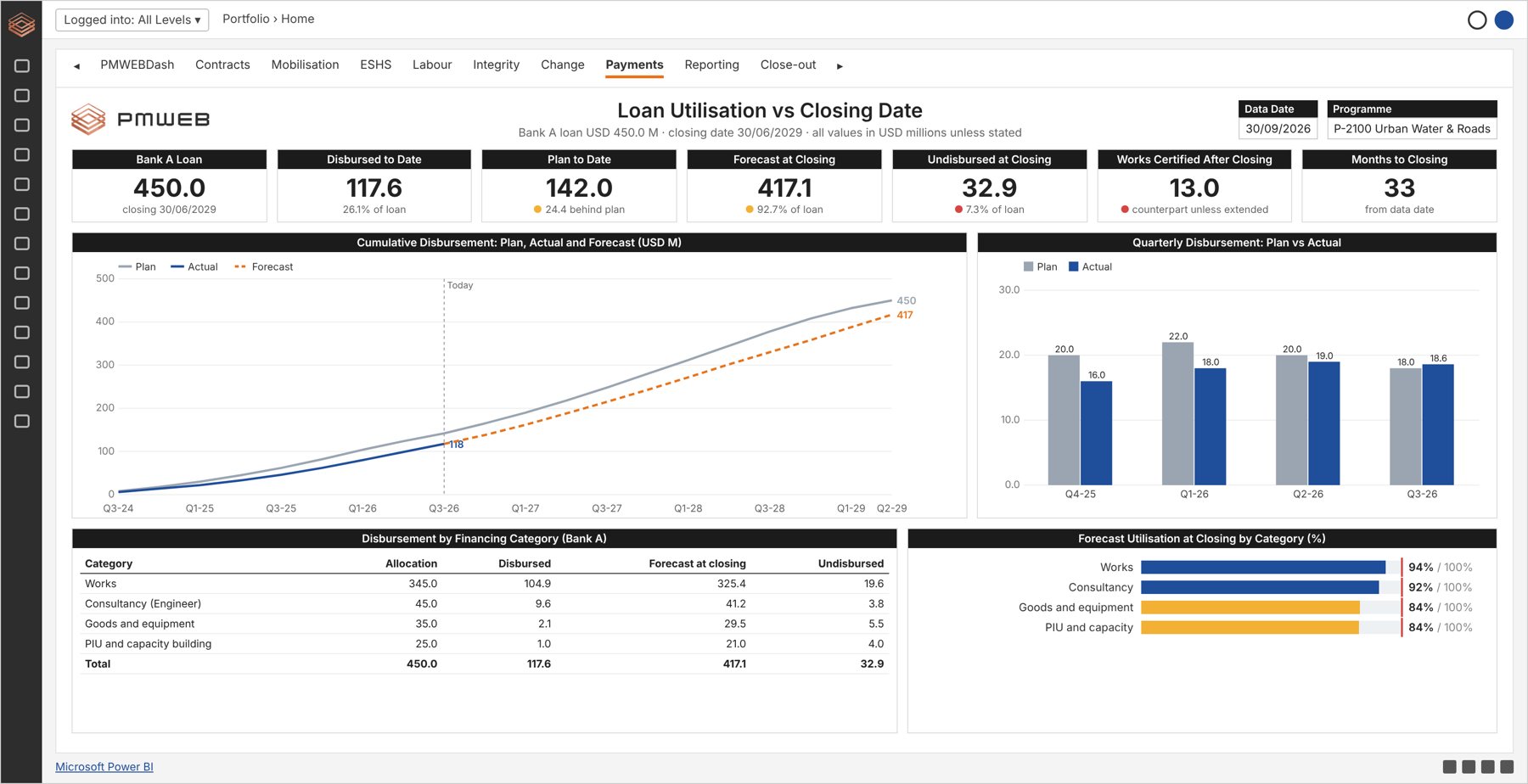
- The loan is a quarter drawn and behind plan. Bank A has disbursed 117.6 of 450.0, or 26.1 percent, against a plan of 142.0 to date: 24.4 behind.
- The gap has stopped growing, but has not closed. Quarterly disbursement was 16.0 against a plan of 20.0 in Q4-25 and 18.6 against 18.0 in Q3-26. The trend is now on plan, but the earlier shortfall remains.
- The forecast leaves money on the table. At the current certification rate, disbursement reaches 417.1 by 30/06/2029, leaving 32.9 (7.3 percent of the loan) undisbursed.
- Works are the largest exposure. The works category is forecast to disburse 325.4 of its 345.0 allocation; 13.0 of works is forecast to be certified after closing and would fall to the counterpart budget unless the loan is extended.
- Goods and PIU categories are under-used. Goods and equipment are forecast at 84 percent of allocation and PIU and capacity building at 84 percent, candidates for reallocation to works.
- There are 33 months to act. The PIU can accelerate certification, request a reallocation or plan an extension while it still has options.
PMWEB 2026 AI on payment data
Action is taken only with the user’s approval, and PMWEB AI honours security settings, so payment and financing data is visible only to the roles permitted to see it.
What the PIU must put in place
- Funding sources that mirror the financing agreement. Each loan, grant, co-financing and counterpart source set up with its categories, shares and closing date.
- Currency and funding split on every commitment. Applied automatically to every Progress Invoice, never re-entered.
- Advance, retention and price adjustment as data. Recovery schedules, guarantee expiries, retention balances and index tables held on the commitment.
- A disbursement request linked to its certificates. Category, currency and financed share pulled from the IPCs; the Bank’s reference and value date recorded on return.
- Payment data from the ERP. Certified, paid and disbursed shown side by side through the API, with every gap named.
- A closing-date forecast every month. Forecast certification and disbursement by category against the closing date, with expenditure after closing flagged.
Over to you: how many days does it take on your projects to answer a simple question from the lender: how much of this certificate has been disbursed, and from which category?
The series: Article 1, Funding Comes with Conditions; Article 2, From Particular Conditions to Platform; Article 3, The First 90 Days; Article 4, ESHS as Evidence; Article 5, People on Site; Article 6, Integrity by Design; Article 7, Change under Scrutiny; Article 8, Paying through the Loan; Article 9, Reporting to the Bank; Article 10, Closing the Contract, Closing the Loan.

Next step
Bring this to your portfolio.
Tell us which processes matter most to you, and we will show them running in PMWEB.