
Article 5 of 10 · FIDIC Compliance by Design
People on Site: Labour, Workforce Records and Worker Welfare
On a development-bank-funded project, the way the Contractor treats its workforce is not a site matter. It is a contract obligation, a financing condition and a metric reported to the Bank every month. The Bank does not want a labour policy; it wants evidence that every worker was recruited fairly, verified, inducted, housed decently and given a safe way to complain. That evidence can only come from records kept every day, by every company on site, in one system.
Walk onto almost any construction site and ask how many people are working today. The answer usually comes quickly. Ask how many of them signed the Code of Conduct, how many were inducted before they started, how many are employed by subcontractors two tiers down, and how long last month’s grievances took to close, and the answer usually takes a week, a spreadsheet and several phone calls. On a Bank-financed project, that week is a compliance gap.
What the contract and the Bank require
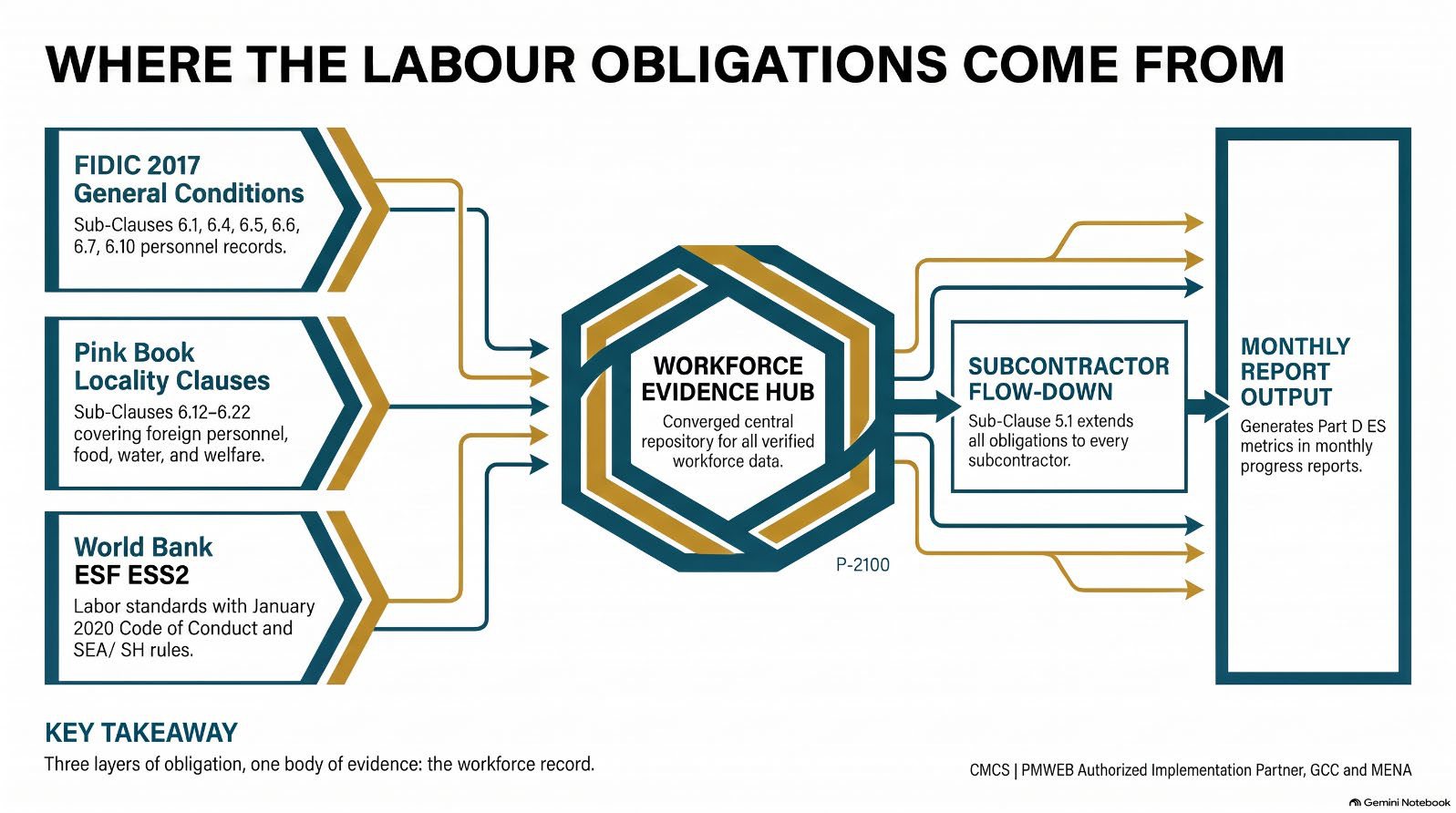
Labour obligations on a Bank-funded FIDIC contract come from three layers, and the PIU must be able to evidence all three.
- The FIDIC General Conditions. Under the 2017 Red Book, Sub-Clause 6.1 places the engagement, payment, housing, feeding and transport of staff and labour on the Contractor. Sub-Clause 6.4 requires compliance with labour laws, Sub-Clause 6.5 governs working hours, Sub-Clause 6.6 requires facilities for staff and labour, and Sub-Clause 6.7 places the health and safety of personnel on the Contractor. Sub-Clause 6.9 lets the Engineer require the removal of personnel who misconduct themselves, and Sub-Clause 6.11 requires the Contractor to prevent disorderly conduct.
- The record obligation. Sub-Clause 6.10, Contractor’s Records, requires records of the number of each class of Contractor’s Personnel and each type of Contractor’s Equipment on site. It is the contractual root of the monthly labour and equipment return, and of the personnel records that Sub-Clause 4.20 requires in every progress report.
- The Bank layer. The MDB Harmonised Edition, the “Pink Book” that still governs many Bank-financed contracts, adds locality and personnel clauses at Sub-Clauses 6.12 to 6.22, covering matters such as foreign personnel, foodstuffs and water. Newer World Bank-financed contracts sit under the Environmental and Social Framework, in effect since 1 October 2018, whose ESS2 on Labour and Working Conditions requires no forced labour, no harmful child labour, non-discrimination, respect for workers’ organisations, safe working conditions and a grievance mechanism for all workers. Since the January 2020 Standard Procurement Document for Works, bidders also submit a Code of Conduct for Contractor’s Personnel covering Sexual Exploitation and Abuse and Sexual Harassment (SEA/SH), and progress reports carry the environmental and social metrics set out in Part D of the Particular Conditions.
None of these obligations stops at the Contractor’s own payroll. Under Sub-Clause 5.1 the Contractor is responsible for the acts and defaults of its Subcontractors as if they were its own. A labour violation by a third-tier subcontractor is the Contractor’s violation and, in the Bank’s eyes, the project’s.
Why the spreadsheet fails the audit
Most projects respond to these requirements with paper. The labour return is a monthly spreadsheet. Induction attendance sheets are scanned into a folder. Age verification sits with the subcontractor’s HR clerk. The grievance box is emptied by the site HSE officer and the outcome written in a notebook. Each piece exists; none of them connects.
The weakness shows when the Bank’s supervision mission or an independent ES monitor asks a simple question: show me that every worker on site in August had completed induction and signed the Code of Conduct before starting work. Answering it means reconciling the daily manpower count, the subcontractor rosters, the training records and the site access list. That is four sources, kept by four parties, in four formats. The answer, when it arrives, is an assertion rather than evidence.
Our book, Digitalization of Construction Contract Administration Under FIDIC Contracts, draws the line between digitization and digitalization. Scanning the attendance sheet is digitization: the paper becomes a file. Digitalization means the induction is a record, linked to a named worker, linked to that worker’s employer, linked to the days the worker appears in the daily report. The compliance question is then answered by a query, not by a reconciliation exercise.
The workforce as structured data in PMWEB
PMWEB gives a Bank-funded project connected building blocks for the workforce, all coded to the contract and to the company that employs each worker.
| PMWEB process | What it captures | Example on a Bank-financed contract |
|---|---|---|
| Daily Reports | Manpower by trade and company, equipment, weather, narrative and photographs, every day | 655 workers on C2102 Trunk Main Lot 2, of which 214 belong to Sub-A Pipe Laying |
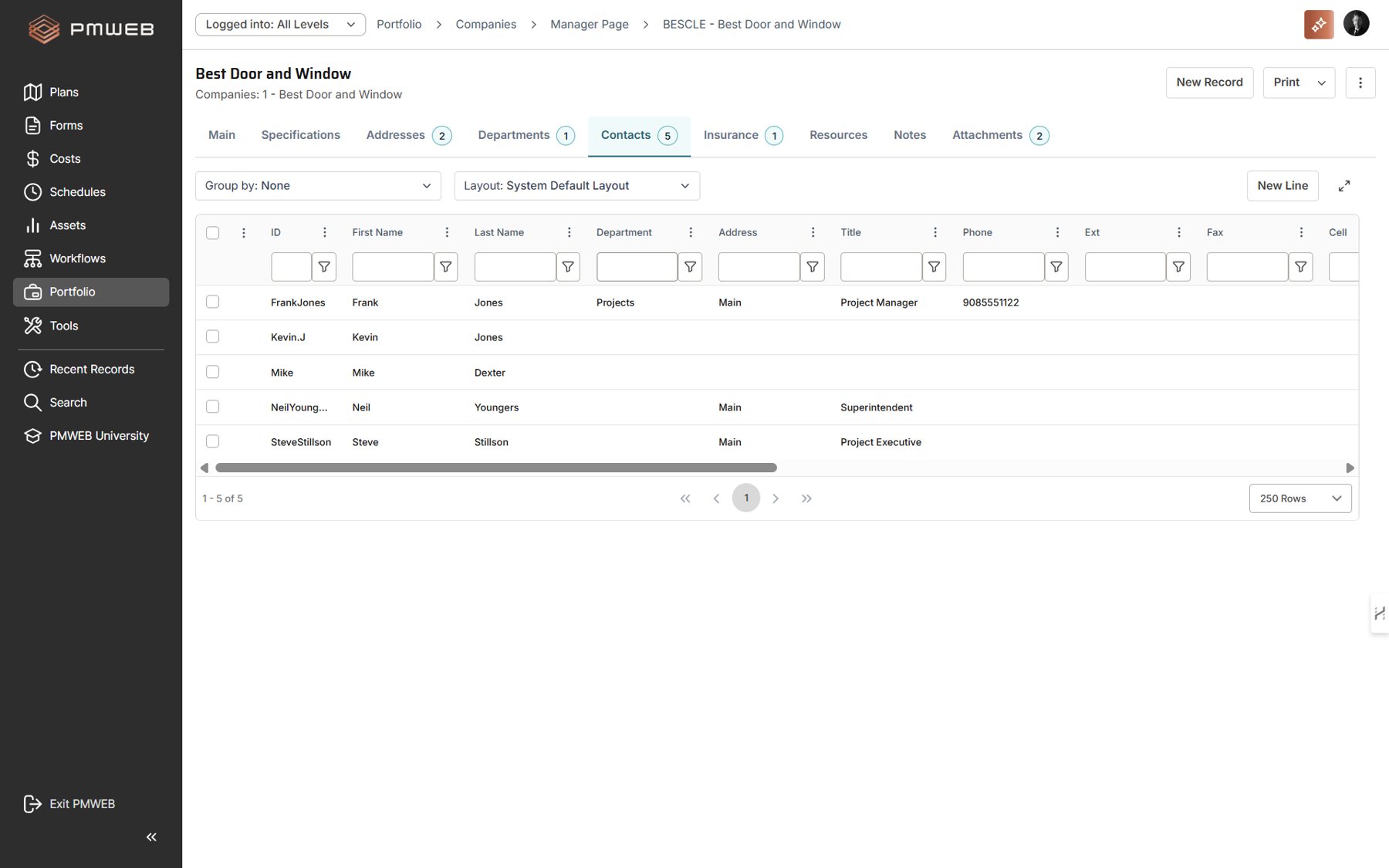
| Personnel register (custom form) | One record per worker: employer, trade, nationality category, engagement date, age verification, employment contract, permit validity, Code of Conduct acknowledgement | A worker cannot be marked “active” until age verification and the signed Code of Conduct are attached |
| Training matrix (custom form) | Induction, SEA/SH awareness, task safety training and toolbox talks, linked to the worker | SEA/SH awareness at 94.1% of the programme workforce against a 100% target |
| Timesheets | Hours worked by worker or crew, by activity | Working-hours exceptions under Sub-Clause 6.5 flagged weekly |
| Inspections | Camp, welfare, water and sanitation checklists with photographs | Accommodation inspection at C2104 Ring Road North failed; corrective action tracked |
| Grievance log (custom form) | Date received, category, acknowledgement, actions, closure, with confidential routing for sensitive categories | 64 grievances received in Q3, 57 closed, average 6.2 workdays to close |
| Commitments | Each subcontract, with the labour flow-down documents required before approval | Sub-D Labour Supply on C2105 at 85% document completeness |
The daily manpower record. Daily Reports are the contemporaneous record that Sub-Clause 6.10 demands. They roll up automatically into the labour and equipment return in the format the Engineer accepts at mobilisation, the procedure the Sri Lanka Ministry of Finance’s ADB-supported Guide to Project Management and Contract Management (GPMCM) calls CA36, Acceptance of Formats for Returns of Labour/Equipment. Because each entry names the company, the return is no longer a single number but a breakdown of who is on site under whose responsibility.
The personnel register. Built with the PMWEB Custom Form Builder, the register carries the standard adaptive form tabs: Main for the worker’s details, Notes, Attachments for the signed documents, and Workflow where review is required. Permit and document expiry dates become alerts rather than surprises. Projects can hold one record per worker or per crew, depending on the privacy rules that apply.
The training matrix. For each company and trade, the matrix shows who completed which training and when. Cross-checked against Timesheets, it makes a worker booked to a task without the required training visible on the day, not at the quarterly ES audit. For the contractor this is the discipline the CIDB (South Africa) Contractor Management Guidelines recommend for time cards and site records, held in one system instead of a site office drawer.
The workers’ grievance log. ESS2 requires a grievance mechanism for all workers, and SEA/SH allegations require a survivor-centred, confidential channel. The grievance form uses conditional workflow: ordinary workplace grievances route to the Contractor’s labour officer and the Engineer’s social specialist; sensitive categories route only to a restricted group, with record-level security so that names are never visible to general project users or on dashboards.
Mapping the labour obligations to PMWEB
| Bank / FIDIC requirement | Evidence the Bank or auditor expects | PMWEB process |
|---|---|---|
| Sub-Clause 6.10: records of Contractor’s Personnel and Equipment | Daily counts by class of personnel and type of equipment, reported to the Engineer | Daily Reports rolled up into a monthly labour and equipment return |
| Sub-Clauses 6.1, 6.4, 6.5: engagement, labour laws, working hours | Employment contracts, wage payment evidence, hours within legal limits | Personnel register with attachments; Timesheets; working-hours exception report |
| ESS2: no forced labour, no harmful child labour | Age verification and voluntary employment evidence for every worker, including subcontractors | Mandatory personnel register fields and retained documents before a worker is “active” |
| ESS2: non-discrimination, workers’ organisations | Recruitment and termination records, policy acknowledgements | Engagement and termination history; Document Management for policies |
| Code of Conduct and SEA/SH (World Bank SPD, January 2020) | Signed Code of Conduct and SEA/SH training before work starts | Training matrix linked to the personnel register |
| ESS2: workers’ grievance mechanism | Log of grievances, response times, outcomes; confidential SEA/SH handling | Grievance custom form with restricted workflow routing and record-level security |
| Sub-Clauses 6.6, 6.7 and Pink Book 6.12 to 6.22: facilities, welfare, foreign personnel | Inspections of accommodation, water and sanitation; permits for foreign personnel | Inspections (camp and welfare checklists); permit expiry alerts |
| Sub-Clause 5.1: Subcontractor responsibility | Evidence that every labour requirement is flowed down and met | Subcontract approval workflow; all records tagged by company |
| Part D ES metrics in the Sub-Clause 4.20 progress report | Workforce, training and grievance figures in the agreed format | Progress report output form pulling live metrics from the records above |
Flowing the obligations down the supply chain
The hardest labour compliance problem on Bank-funded works is rarely the main contractor. It is the subcontractor that mobilises fifty workers on a Monday for a three-week package, and the labour-only gang hired through an agent. These are the workers most exposed to the risks ESS2 is written to prevent.
PMWEB handles this through the same commitment structure used for cost. Every subcontract is a commitment record, and the approval of the Subcontractor under Sub-Clause 5.1 is a workflow that will not complete until the labour flow-down documents are attached: the subcontractor’s Code of Conduct, its acknowledgement of the labour management procedure and its list of key personnel. Once approved, the subcontractor’s workers can only be entered in the personnel register against that commitment, and its manpower appears in Daily Reports under its own name.
For the main contractor this is protection as much as compliance. When the Engineer raises a concern under Sub-Clause 6.9, or the Bank’s monitor finds a gap, the contractor sees immediately which company and which records are involved, acts on it, and shows the corrective action as a dated record. Workflow tasks inside the process, such as acknowledging a grievance, are measured in workdays, while the contract periods themselves remain in calendar days, a distinction we recommend in the book for every digitalised contract administration function.
The Workforce & Labour Compliance dashboard
The dashboard below is built in PMWEB’s embedded Power BI reporting for the sample programme P-2100, with values in USD millions.
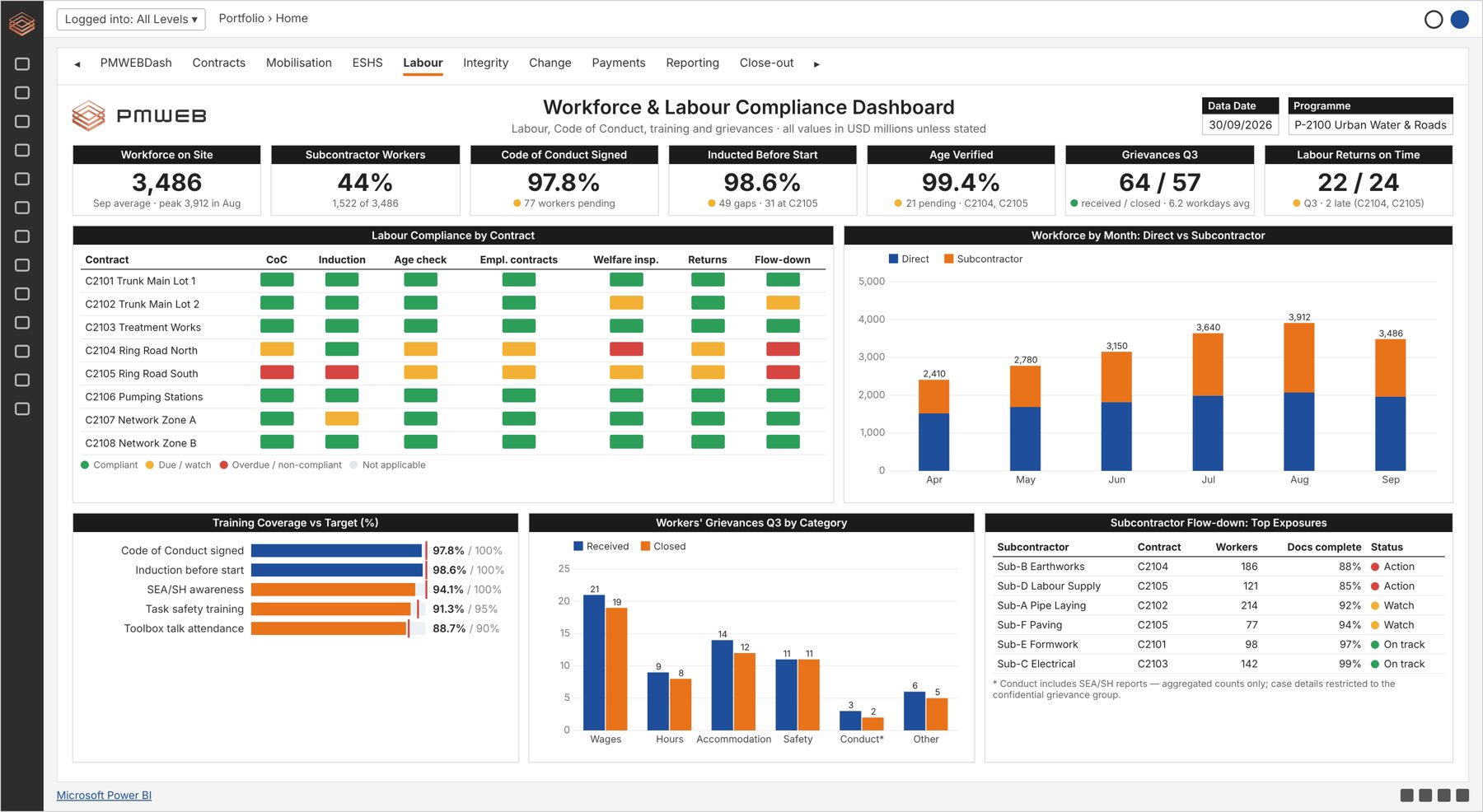
- The workforce is large and increasingly subcontracted. September averaged 3,486 workers across eight contracts, down from a peak of 3,912 in August. 1,522 of them, or 44%, are employed by subcontractors, which is where compliance risk concentrates.
- The gaps are small in percentage and large in consequence. Code of Conduct coverage is 97.8% and induction before start 98.6%, but that still leaves 77 workers without a signed Code of Conduct and 49 who started work before induction, 31 of them at C2105 Ring Road South.
- Two Pink Book road contracts carry most of the exposure. C2104 Ring Road North failed its accommodation inspection and has incomplete flow-down at Sub-B Earthworks (88% of documents complete). C2105 Ring Road South is red on Code of Conduct, induction and flow-down, driven by Sub-D Labour Supply at 85%. All 21 workers still awaiting age verification are on these two contracts.
- Training lags where it matters most. SEA/SH awareness stands at 94.1% against a 100% target, and task safety training at 91.3% against 95%. Both are visible by company and trade, so the Contractor knows exactly whom to train this week.
- The grievance mechanism is working, and it is measured. 64 grievances were received in Q3 and 57 closed, at an average of 6.2 workdays. Wages (21) and accommodation (14) are the largest categories, the latter linked to the C2104 camp. Conduct reports, including SEA/SH, appear only as aggregated counts.
- Reporting discipline is visible too. 22 of 24 monthly labour returns were submitted on time in Q3; the two late returns were C2104 in July and C2105 in August.
PMWEB 2026 AI on workforce data
| AI Assistant mode | Example request from the PIU |
|---|---|
| Find | “Find all workers on C2105 who started work before completing induction” |
| Open | “Open the August labour and equipment return for C2104” |
| Create | “Create a corrective action for the failed accommodation inspection at the C2104 camp” |
| Help | “How do I record a Code of Conduct acknowledgement on a personnel register record?” |
Action is taken only with the user’s approval, and PMWEB AI honours security settings, so workforce data, and above all grievance and SEA/SH records, is visible only to the roles permitted to see it.
What the Employer, Engineer and Contractor must put in place
- One personnel register for the programme. Every worker of every company recorded against an approved commitment, with age verification and the signed Code of Conduct as mandatory fields before the worker is active.
- Daily Reports by company. Manpower and equipment recorded daily by the party on site, so the Sub-Clause 6.10 return is generated, not compiled.
- A training matrix with gates. Induction and SEA/SH awareness required before a worker appears on a timesheet or in a daily report.
- A confidential grievance mechanism. Conditional routing, restricted access for sensitive categories, and response times measured in workdays.
- Flow-down at approval, not after. Subcontractor approval under Sub-Clause 5.1 blocked until labour documents are attached.
- Welfare inspections as records. Camp, water and sanitation checklists with photographs and tracked corrective actions.
- Bank metrics from live data. The labour section of the monthly progress report and the Part D ES metrics drawn directly from the records above.
Over to you: On the Bank-funded projects you have worked on, where did labour compliance break down first: at the main contractor, at the subcontractors, or in the reporting to the Bank?
The series: Article 1, Funding Comes with Conditions; Article 2, From Particular Conditions to Platform; Article 3, The First 90 Days; Article 4, ESHS as Evidence; Article 5, People on Site; Article 6, Integrity by Design; Article 7, Change under Scrutiny; Article 8, Paying through the Loan; Article 9, Reporting to the Bank; Article 10, Closing the Contract, Closing the Loan.

Next step
Bring this to your portfolio.
Tell us which processes matter most to you, and we will show them running in PMWEB.