
Article 3 of 10 · FIDIC Compliance by Design
The First 90 Days: Mobilisation Compliance on a Bank-Funded FIDIC Contract
On a development-bank-funded contract, the most expensive compliance failures are rarely made in year three. They are seeded in the ninety days after the Letter of Acceptance, when securities, guarantees, insurances, ES plans and approvals move between four parties, each with its own deadline. The Bank will later ask whether every precondition was actually in place on the Commencement Date, and who verified it. A PIU that runs mobilisation as a PMWEB process answers with one record per contract, not a reconstruction from email.
This article follows a Bank-financed works contract from the Letter of Acceptance to the Commencement Date and the first weeks on site. It uses the sample programme P-2100, Urban Water & Roads, with eight works contracts worth USD 412.6 million.
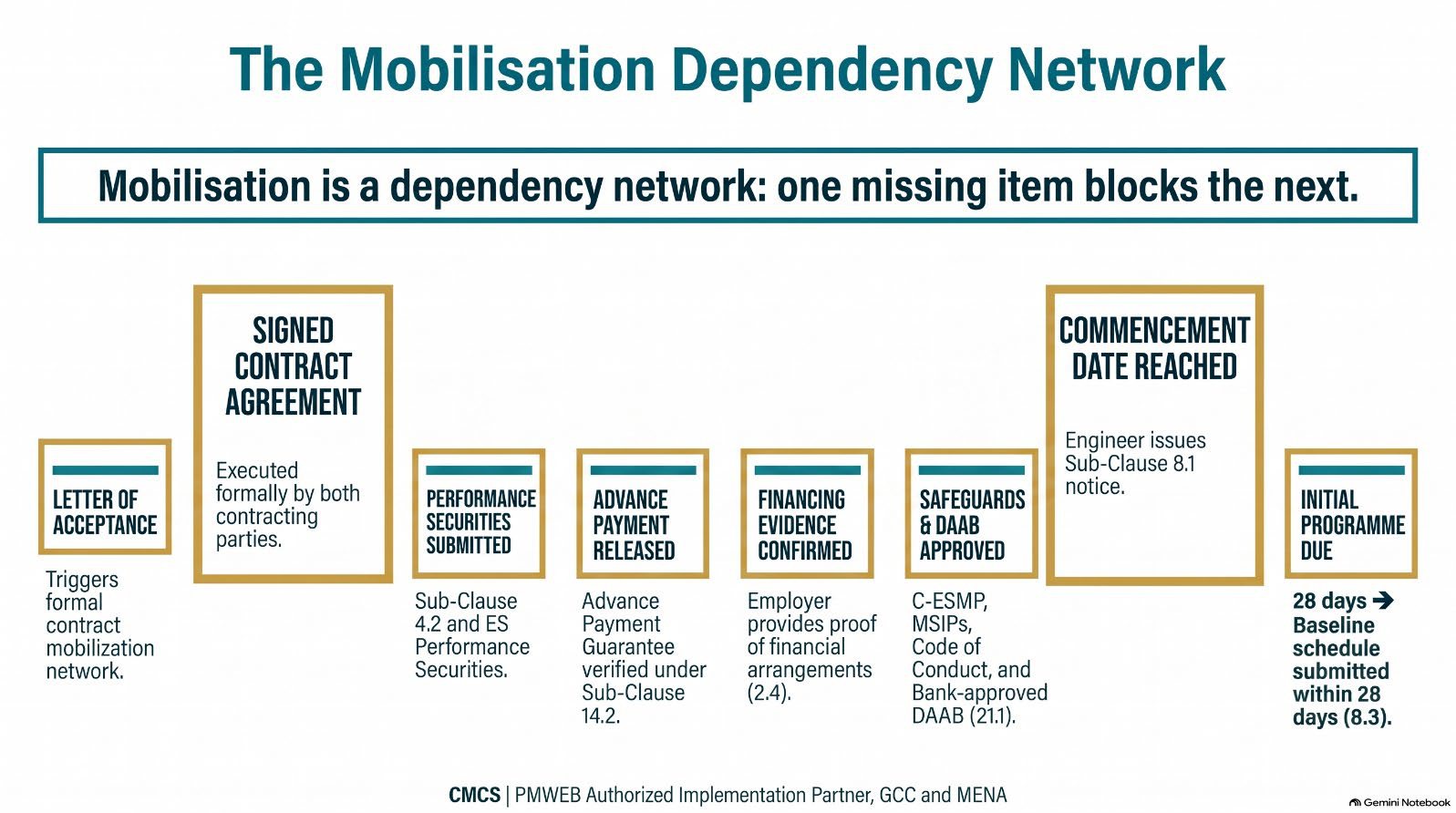
Mobilisation is a dependency network, not a to-do list
The obligations of the first ninety days are interlocked. A delay in one blocks the next:
- Performance Security. The Contractor delivers it under Sub-Clause 4.2, in the form and amount stated in the Contract Data.
- Advance payment. Under Sub-Clause 14.2 the advance is paid only after the Advance Payment Guarantee and the Performance Security are in place.
- Employer’s financial arrangements. Under Sub-Clause 2.4 the Employer must provide reasonable evidence that it can pay the Contract Price.
- Commencement. The Engineer gives notice of the Commencement Date under Sub-Clause 8.1, which starts the Time for Completion and the 28-day period for the initial Programme under Sub-Clause 8.3.
The MDB Harmonised Edition (the Pink Book), still used on many Bank-financed contracts, makes the dependency explicit. Its Sub-Clause 8.1 ties commencement to three preconditions: the Contract Agreement signed by both Parties, reasonable proof of the Employer’s financing, and receipt of the advance payment by the Contractor. Its Sub-Clause 2.4 requires the Employer to evidence its financial arrangements before the Commencement Date.
On top of either form, the World Bank’s Standard Procurement Document for Works adds a mobilisation layer of its own:
- An Environmental and Social (ES) Performance Security: , normally required where ES risks are high.
- A Code of Conduct for Contractor’s Personnel: covering Sexual Exploitation and Abuse and Sexual Harassment (SEA/SH), submitted at bid stage and binding from day one.
- Management Strategies and Implementation Plans (MSIPs): for the project’s ES risks, which become the Contractor’s ES Management Plan (C-ESMP) on site.
- DAAB nominees: that are subject to the Bank’s no-objection.
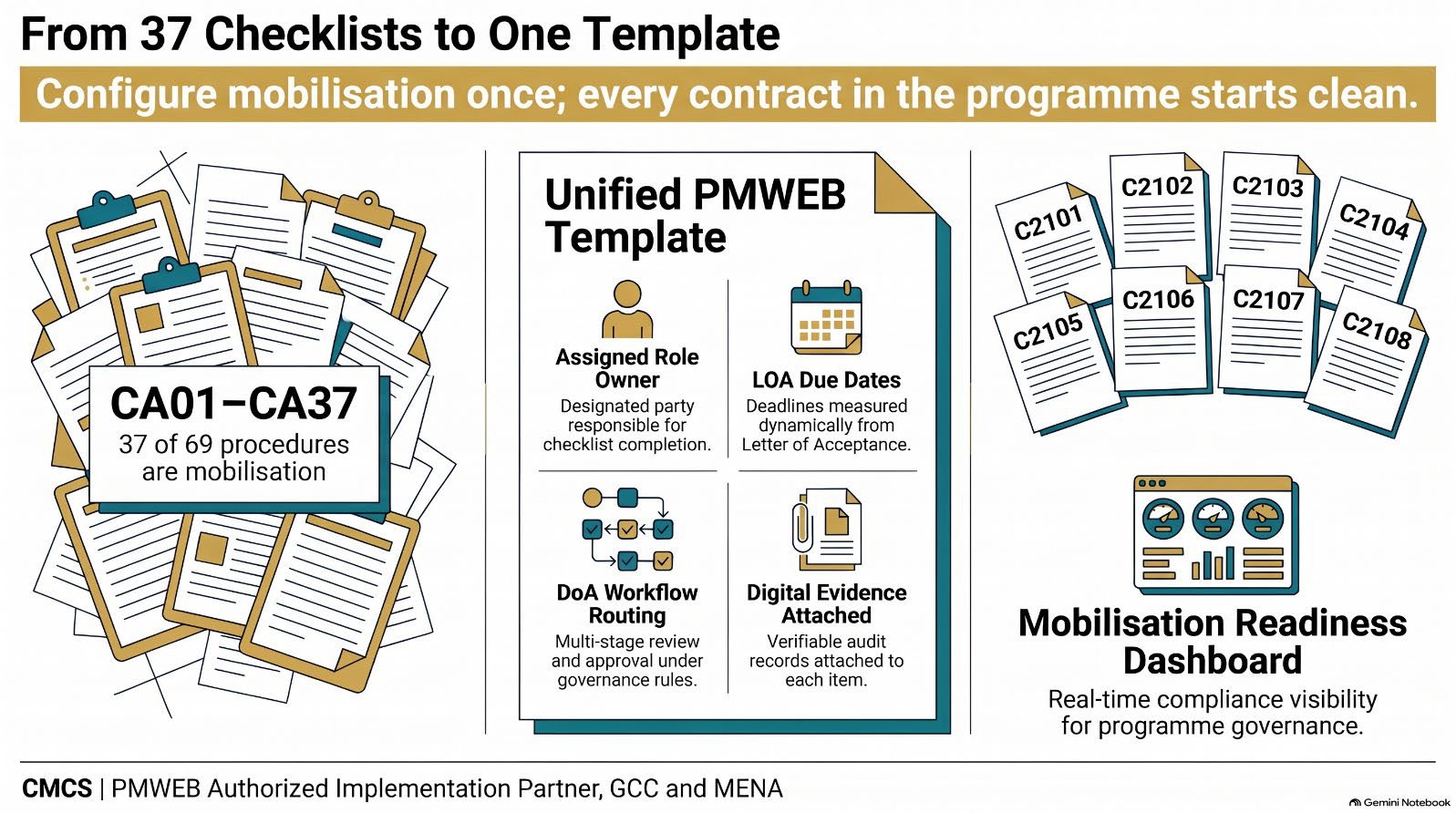
The Government of Sri Lanka’s Guide to Project Management & Contract Management (GPMCM), developed in 2017 under ADB Technical Assistance for Pink Book contracts, gives thirty-seven of its sixty-nine procedures, CA01 to CA37, to the mobilisation stage alone. That proportion is the lesson. Mobilisation is where the contract’s compliance record is built.
A spreadsheet can list these items. It cannot enforce the order in which they must be satisfied, warn that one is blocking another, or prove who approved what and when. That is the job of a process engine.
Securities, guarantees and insurances as live records
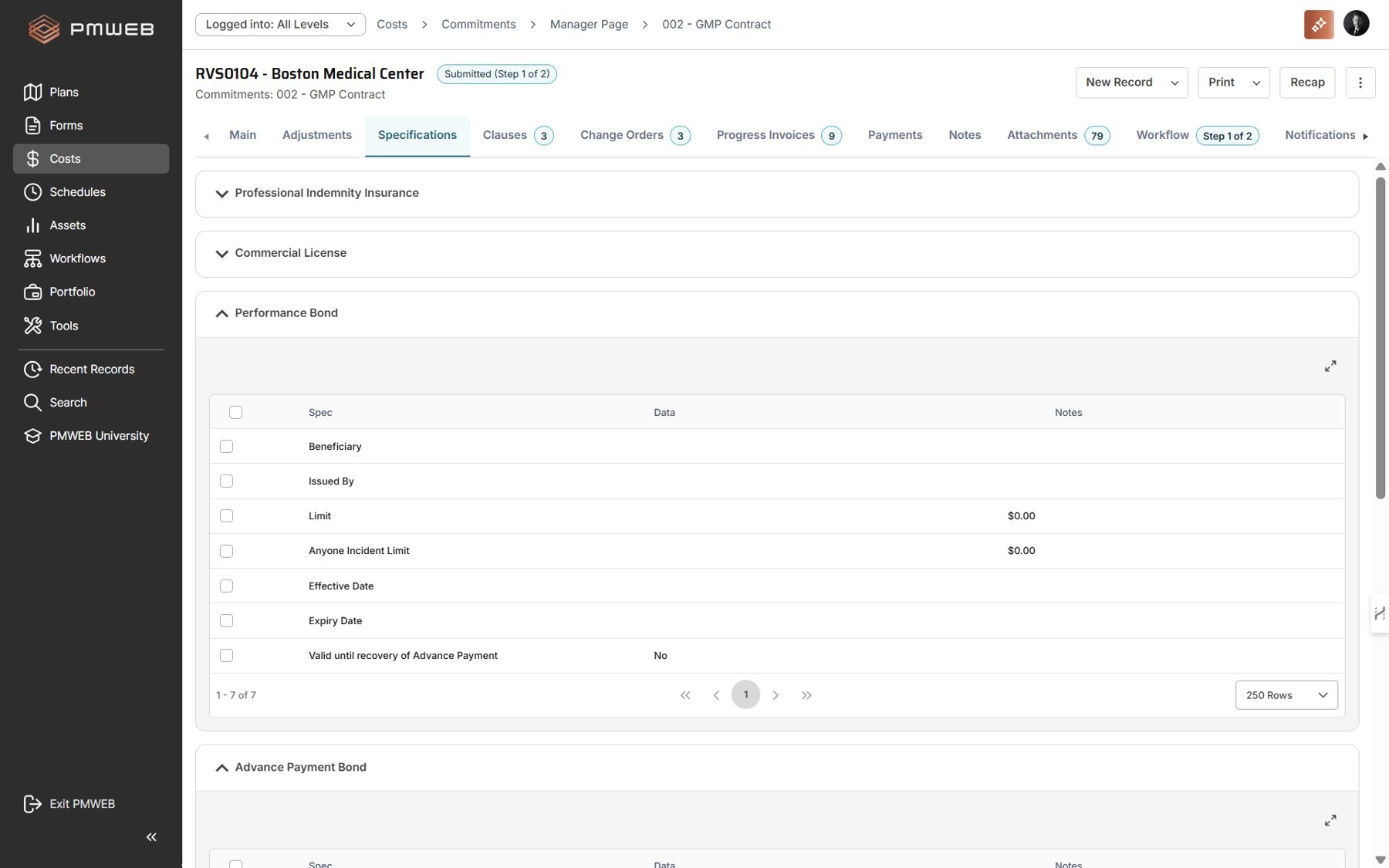
In PMWEB the awarded contract is created as a Commitment, and its Bonds and Insurance details become structured records rather than scanned PDFs in a folder. Each instrument is recorded with its issuer, amount, currency, form, effective date and expiry date, and the original is attached:
- Performance Security: (Sub-Clause 4.2) and, where required, the ES Performance Security.
- Advance Payment Guarantee: , reconciled against the advance recovered through Progress Invoices.
- Insurances: under Clause 19: Contractor’s All Risks, third-party liability and the other policies in the Contract Data.
That structure changes what the PIU can see. Expiry is a field the system watches, not a date the contract administrator remembers. A scheduled register, emailed weekly to the Employer’s finance team, lists every instrument expiring within sixty or ninety days, so renewal is requested before the Employer’s protection lapses. The Advance Payment Guarantee is compared with the unrecovered advance, so the PIU knows at any point whether the guarantee still covers the balance.
Acceptance becomes a workflow. GPMCM provides acceptance checklists for the Performance Security (CA20), insurance (CA21) and the Advance Payment Guarantee (CA23). In PMWEB each checklist is built once with the Custom Form Builder and routed under the Delegation of Authority (DoA): the contracts engineer checks the form and wording against the bidding documents, finance confirms the issuing bank, and the authorised signatory accepts. The Workflow tab records every step, so the evidence that the security was checked, and not merely received, exists from day one.
The PMWEB processes behind mobilisation
Every precondition has a natural home in PMWEB. Most use out-of-the-box processes; the rest are adaptive forms built once at programme level.
Plans, people, the Programme and the DAAB
ES plans. For the Bank, the ES documents submitted at mobilisation are the operational form of the project’s environmental and social commitments. The C-ESMP, the MSIPs and the health and safety manual run through PMWEB Submittals: submission, review, comments, resubmission and approval with a status code. The Engineer’s ES specialist reviews within the agreed period, the workflow escalates if the review stalls, and the approved version sits in Document Management, so the site team always works to the current plan.
The Code of Conduct. The Contractor’s signature is not enough. The Bank expects every worker, including subcontractors’ workers, to have been informed and to have acknowledged it. An acknowledgement form linked to each subcontractor’s Commitment turns a commitment on paper into a record that can be counted.
Commencement and the Programme. Once the preconditions are met, the Engineer issues the notice of the Commencement Date through PMWEB Correspondence, and the Transmittal fixes the service date, as covered in our earlier Digital FIDIC Project series. The date becomes a milestone in Schedules, and the 28-day deadline for the initial Programme under Sub-Clause 8.3 is calculated from it. The Programme is imported from Primavera P6 or MS Project, reviewed through a Submittal workflow, and the accepted baseline is preserved.
Key Personnel. Under Sub-Clause 6.12, Key Personnel are recorded against the contract with their positions, CVs and approval status. Any replacement follows the same consent route, so the PIU can prove that the people offered at bid stage are the people on site, a frequent question in Bank supervision missions.
The DAAB. The board is constituted under Sub-Clause 21.1. On World Bank-financed contracts the nominees are subject to the Bank’s no-objection, so the appointment has an external approval step that must be planned. PMWEB models it as a workflow with a “Bank no-objection” stage, the no-objection letter attached and the DAAB Agreement linked to the contract.
Subcontractors. Approval under Sub-Clause 5.1 closes the loop. Each proposed subcontractor is submitted with its scope and value, checked for eligibility and approved under the DoA. Its own Commitment is then created, so its workforce, ES obligations and Code of Conduct acknowledgements are tracked like the main Contractor’s.
From GPMCM checklists to a mobilisation template
The practical step is to turn the mobilisation procedures into a configured PMWEB template. GPMCM’s CA01 to CA37 run from the pre-award checklist through site possession, survey control points and the kick-off meeting, to the formats for daily reports, monthly statements and labour returns and the quality plan review. Each maps to a PMWEB checklist form with an owner, a due date measured from the Letter of Acceptance or the Commencement Date, and a workflow. The same sequence underpins Chapter 3 of our book, Digitalization of Construction Contract Administration Under FIDIC Contracts. Configured once at programme level, the template is copied to every new contract the PIU awards.
The Mobilisation Readiness dashboard
The dashboard below is built in PMWEB’s embedded Power BI reporting for the sample programme P-2100, with values in USD millions.
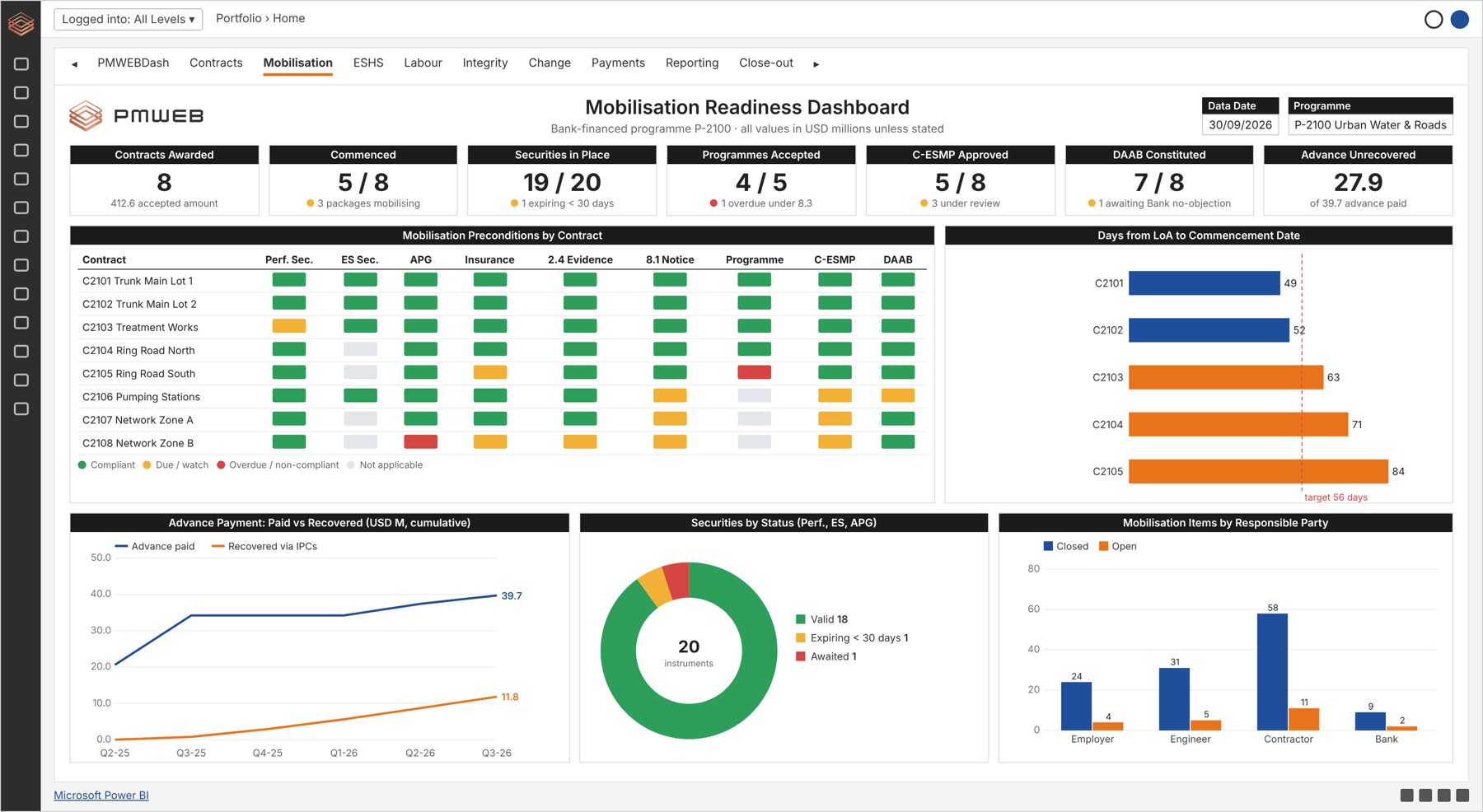
- Five contracts have commenced; three are still mobilising. C2106, C2107 and C2108 are waiting on their Commencement Date notices under Sub-Clause 8.1, and none of them yet has an approved C-ESMP.
- One missing guarantee is blocking commencement. C2108’s Advance Payment Guarantee has not been received. Until it is, the advance cannot be paid under Sub-Clause 14.2, and the PIU is holding the Commencement Date notice while the counterpart-funding evidence under Sub-Clause 2.4 is also still pending. The dashboard shows it red before anyone asks.
- Nineteen of twenty securities are in place, but one is about to lapse. C2103’s Performance Security expires within thirty days. Renewal has to be requested now, while the Employer still holds a valid instrument.
- A Programme is overdue. C2105 has not submitted an acceptable initial Programme within the 28 days required by Sub-Clause 8.3. Four of the five commenced contracts have an accepted baseline.
- The DAAB is nearly complete. Seven of eight boards are constituted; C2106’s nominees are awaiting the Bank’s no-objection.
- Late commencement is concentrated on the Pink Book roads. C2104 and C2105 took 71 and 84 days from the Letter of Acceptance to commencement against a 56-day target, and C2103 took 63. The advance paid so far is 39.7, of which 11.8 has been recovered, so 27.9 remains covered by Advance Payment Guarantees.
The same view tells the ministry of finance who owes what. Of 22 open mobilisation items, 11 sit with the Contractors, 5 with the Engineer, 4 with the Employer and 2 with the Bank. Not every delay is the Contractor’s.
PMWEB 2026 AI on mobilisation data
Action is taken only with the user’s approval, and PMWEB AI honours security settings, so mobilisation data is visible only to the roles permitted to see it.
What the PIU must put in place
- One mobilisation template for the programme. GPMCM-style checklists CA01 to CA37 configured once, with owners and due dates measured from the Letter of Acceptance, and copied to every new contract.
- Securities as records, not files. Every Performance Security, ES Performance Security, APG and insurance captured with its value and expiry, and a weekly expiry register sent to finance.
- Acceptance under the DoA. Each instrument checked, verified and accepted through a workflow, so receipt and acceptance are never confused.
- Preconditions before the notice. The Commencement Date notice under Sub-Clause 8.1 issued only when the dashboard shows the preconditions are met.
- ES plans approved before the works they govern. C-ESMP, MSIPs and Code of Conduct acknowledgements tracked by contract and by subcontractor.
- External approvals planned. Bank no-objection steps, for the DAAB and anything else the financing agreement requires, built into the workflow with their own due dates.
Over to you: on the Bank-funded contracts you have worked on, which mobilisation item most often turned out to be missing or expired when someone finally checked it?
The series: Article 1, Funding Comes with Conditions; Article 2, From Particular Conditions to Platform; Article 3, The First 90 Days; Article 4, ESHS as Evidence; Article 5, People on Site; Article 6, Integrity by Design; Article 7, Change under Scrutiny; Article 8, Paying through the Loan; Article 9, Reporting to the Bank; Article 10, Closing the Contract, Closing the Loan.

Next step
Bring this to your portfolio.
Tell us which processes matter most to you, and we will show them running in PMWEB.