
Article 10 of 10 · FIDIC Compliance by Design
Closing the Contract, Closing the Loan: Completion, Close-out and a 180-Day Roadmap
A Bank-financed contract is not finished when the works are taken over. It is finished when the final account is settled, the securities are released, the records survive the audit and the loan closes cleanly. That stage is often reached after the people who ran the contract have moved on. A PIU needs PMWEB so that close-out is the final state of records kept from the first day, not a reconstruction exercise in the last months before the closing date.
This final article of the series covers the closing stage of a FIDIC contract on a Bank-financed programme, from the Taking-Over Certificate to the release of the last security. It then sets out a 180-day roadmap for a Borrower or PIU to put the full compliance model of this series in place on PMWEB.
The long tail of completion
Most attention on a FIDIC contract goes to the years of construction. The months after completion get much less, and this is where Bank-financed projects tend to lose control quietly:
- Taking-Over Certificates: are issued with long lists of outstanding work that live in an appendix nobody tracks.
- Defects: notified during the Defects Notification Period are followed up by email.
- Retention and securities: are released without a clear record of what was still outstanding, or are left to lapse unnoticed.
- The final account: drags on long after the contract team has been demobilised.
- The audit: arrives, or the loan closing date approaches, and the PIU has to rebuild a contract history from scattered files.
The 2017 Red Book sets out the closing sequence precisely. Under Clause 10, the Contractor applies for and the Engineer issues the Taking-Over Certificate, which may list minor outstanding work and defects. Clause 11 governs defects after taking over, through the Defects Notification Period, ending with the Performance Certificate under Sub-Clause 11.9, which marks completion of the Contractor’s obligations. The financial close runs in parallel: release of retention money under Sub-Clause 14.9, the Statement at Completion under 14.10, the Final Statement under 14.11 and the Final Payment Certificate under 14.13. Performance and advance payment securities must be released or expire in line with the contract, and on a World Bank-financed contract any ES Performance Security follows the same discipline.
The GPMCM, the ADB-supported guide for FIDIC Pink Book contracts issued by the Sri Lanka Ministry of Finance, gives this stage its own procedures: CA61 Taking Over, CA62 as-built drawings, CA63 the Defects Notification Period, CA64 the Performance Certificate, CA65 contract close-out and CA66 handover of completed works and information to the operation and maintenance team. Each has checklists. Each depends on records created years earlier.
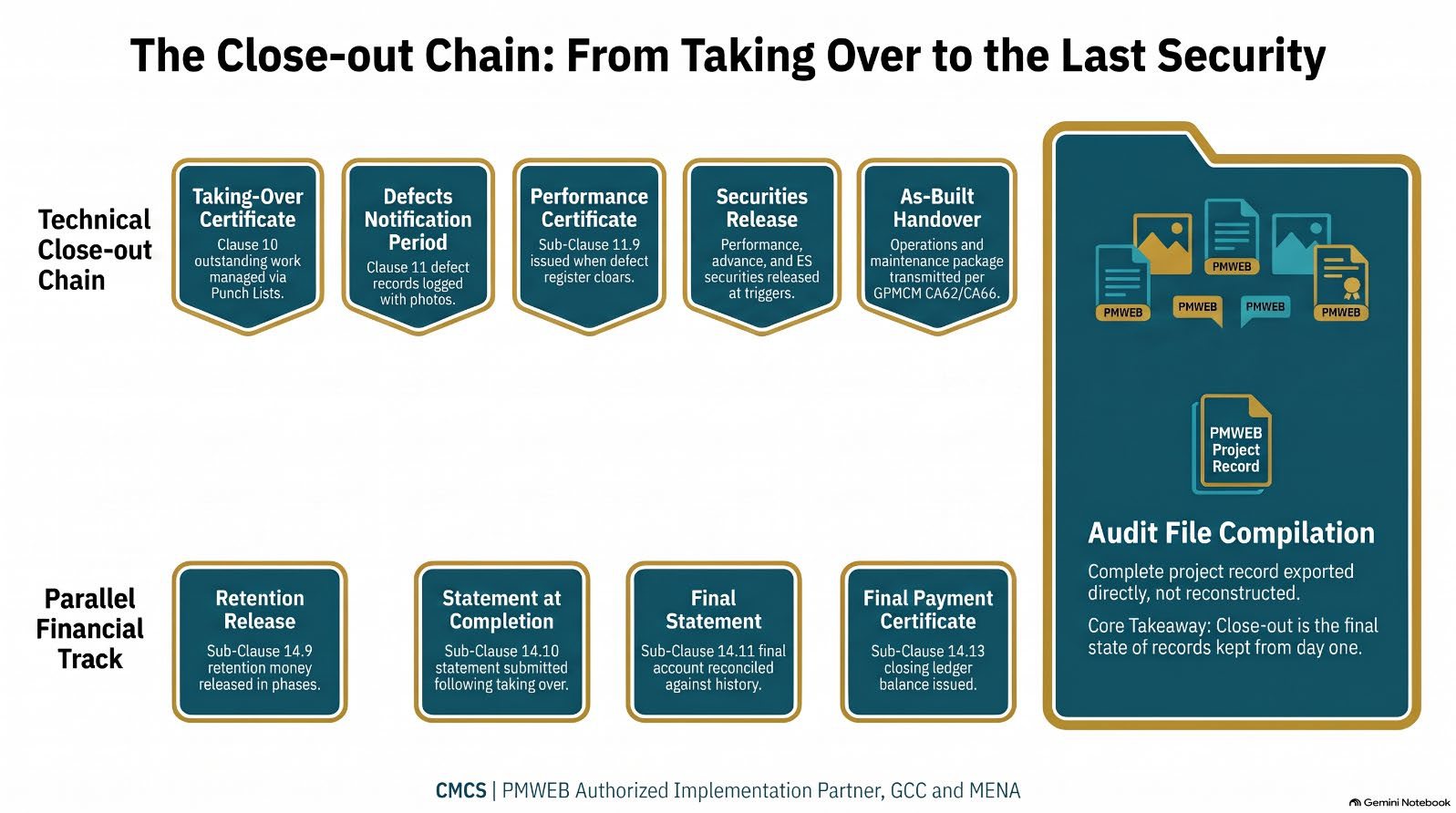
Close-out as a set of linked records
In PMWEB, close-out is not a separate project. It is the final state of records the contract has kept from the start:
Taking over. The application for the Taking-Over Certificate is an adaptive form linked to the works or Section, with the Engineer’s inspection and the certificate attached. Outstanding items become Punch List entries with owners and target dates, so they do not disappear into an appendix.
Defects Notification Period. Each defect is a record with its location, photographs, notification date, the Contractor’s response and the Engineer’s sign-off. The DNP end date is calculated from the taking-over date, so the Employer sees, before the Performance Certificate is due, which defects are still open and which may justify extending the period.
Final account. The Statement at Completion and the Final Statement are reconciled against the contract’s whole cost history: the original Commitment, every Change Order, every certified Progress Invoice, retention held and released, advance payment recovered, price adjustment applied and any amounts agreed or determined under Sub-Clause 3.7. The Final Payment Certificate is the closing balance of a ledger that has been up to date all along.
The Contract Close-out and Audit Readiness dashboard
The dashboard below is built in PMWEB’s embedded Power BI reporting for the sample programme P-2200 Rural Roads, a second Bank-financed programme in the same ministry portfolio that is now in its closing stage, with values in USD millions.
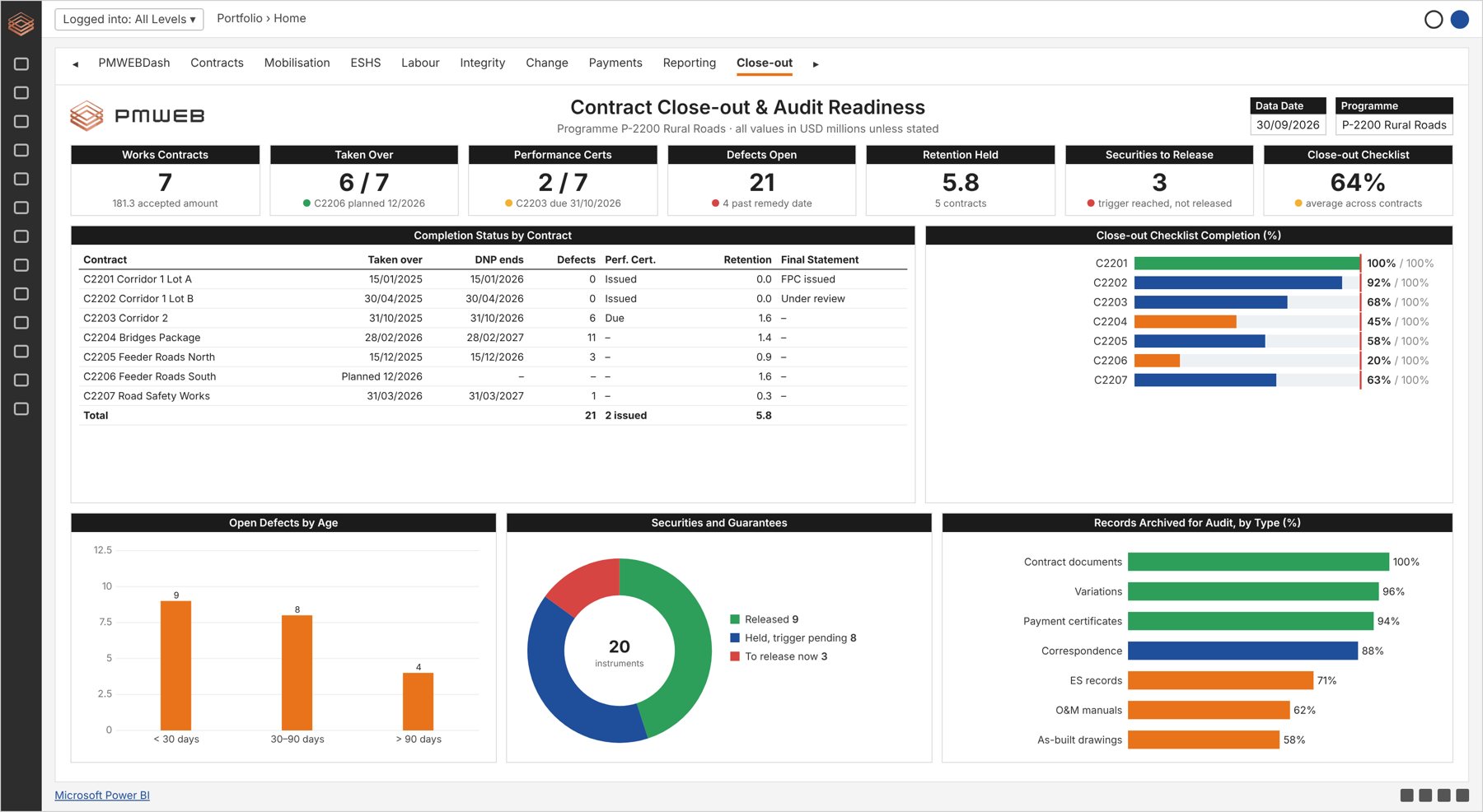
- Taken over is not closed. Six of the seven works contracts (181.3 accepted amount) have been taken over, but only two Performance Certificates have been issued, and only C2201 has a Final Payment Certificate.
- Defects decide the next certificate. 21 defects are open, 11 of them on C2204 Bridges Package. Four are older than 90 days and past the remedy date set by the Engineer. C2203’s Performance Certificate is due on 31/10/2026 but cannot be issued while its 6 defects remain open.
- Three securities should already have been released. Their trigger has been reached but the instrument is still held: the C2202 performance security after its Performance Certificate, the C2201 ES Performance Security, and the C2203 advance payment guarantee after full recovery of the advance. Holding securities beyond their trigger is a contractual exposure, not a safe default.
- Retention is still a liability to plan for. 5.8 of retention money is held across five contracts, and its release has to be scheduled against the remaining certificates and the financing still available.
- Close-out is uneven. The average checklist is 64% complete, from 100% on C2201 to 20% on C2206, which has not yet been taken over.
- The audit file has gaps where it matters. Contract documents, variations and payment certificates are 94–100% archived, but ES records (71%), O&M manuals (62%) and as-built drawings (58%) are not. These are exactly the records an ex-post review and the operator will ask for.
Ready for the audit that comes later
Development-bank projects are reviewed after the event. The Bank may carry out post reviews of procurement and contract management, and Bank-financed contracts give the Bank inspection and audit rights over accounts and records, as in Sub-Clause 1.15 of the FIDIC MDB Harmonised Edition and in the World Bank’s Specific Provisions. National audit institutions add their own scrutiny. These reviews often take place after the PIU team that ran the contract has been demobilised.
The test is simple: for any payment, variation or determination, can the Borrower show who approved it, on what evidence, and under which contractual and Bank authority? In PMWEB, every record keeps its workflow history, attachments and links. Records are retained for the period the financing agreement or national law requires, with role-based read-only access for auditors. The audit trail is not reconstructed. It is exported.
Close-out is also the moment to capture lessons learned while the evidence is still at hand. Which notices were late, and why? Which variations approached their no-objection threshold? Where did ES incidents cluster? Because the data is structured, lessons are analysis rather than anecdote, and they can be applied to the next contract in the programme, as GPMCM intends when it aims to “prevent recurrence of problems/weaknesses through amending of procedures”.
A 180-day roadmap for Borrowers and PIUs
The articles in this series describe a complete compliance model, but it does not have to be built all at once. PMWEB is programme-scoped: a Borrower or PIU can start it on a new Bank-financed programme, or on the next contracts to be awarded, without first migrating every legacy project. Hosting can be SaaS or on-premise, to suit the Borrower’s data-residency and security requirements.
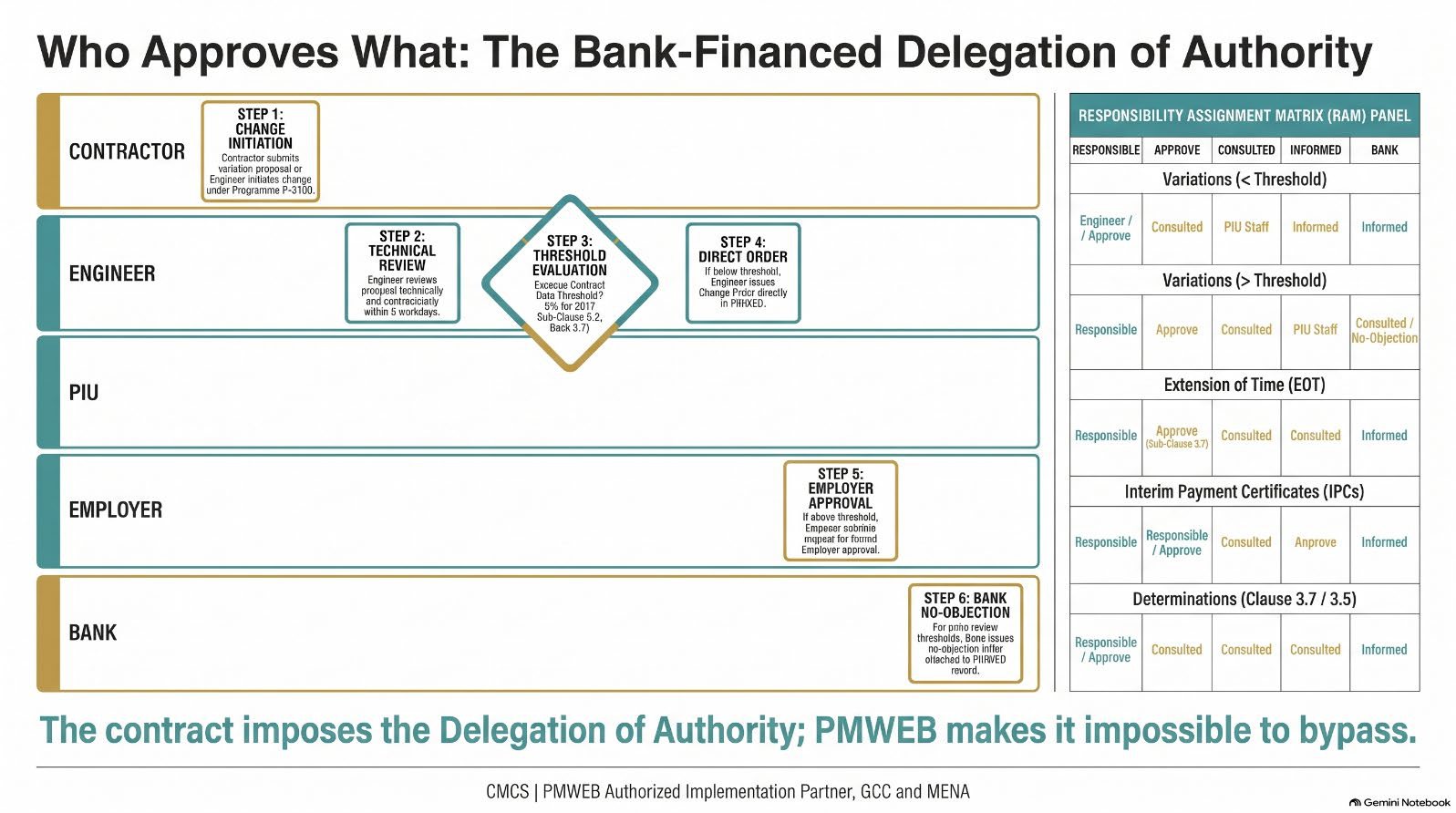
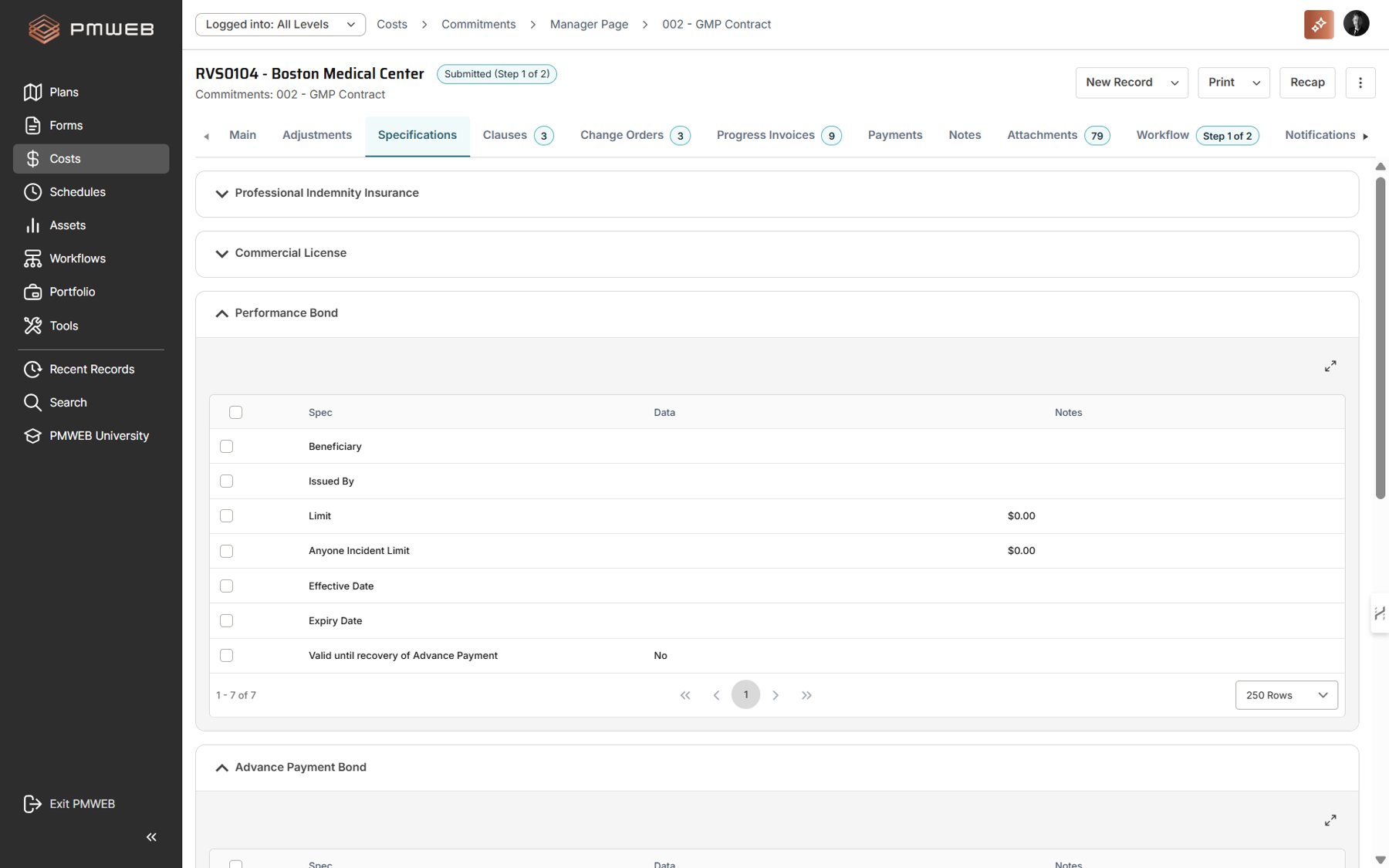
- Days 0–30: contract baseline and configuration. Load the financing agreement’s financiers, components and categories, the procurement plan and the contract documents. Configure the Contract Data and the Bank’s Specific Provisions as structured parameters: periods, thresholds, currencies, securities and approval requirements. Build the Responsibility Assignment Matrix and the Delegation of Authority, including the steps where the Engineer needs the Employer’s approval and the Employer needs the Bank’s no-objection (Articles 1 and 2).
- Days 31–90: mobilisation, ESHS and integrity. Put the mobilisation records in place: securities, advance payment guarantee, insurances, evidence of the Employer’s financial arrangements, commencement, programme and DAAB (Article 3). Configure the ESHS and labour processes: incidents, inspections, grievances, Codes of Conduct, training and workforce records (Articles 4 and 5). Configure the integrity controls: subcontractor approval with eligibility checks, conflict-of-interest declarations and an audit-ready trail (Article 6).
- Days 91–180: payment, change, reporting and the control tower. Run Progress Invoices with currencies, price adjustment, retention and disbursement traceability (Article 8). Run the change cycle from Change Event to Change Order with no-objection thresholds (Article 7). Turn on the generated progress reports, the ES metrics and the PIU and ministry control towers, with external sharing for the Bank’s task team (Article 9).
By day 180, the programme has one source of truth running from the financing agreement to the last certificate, and close-out becomes the natural end of records the PIU has kept all along.
CMCS FZCO is the PMWEB Authorized Implementation Partner for the GCC and MENA region and PMWEB Global Partner of the Year 2025, with a track record of more than 170 PMIS implementations, more than 40 years of PMIS experience in the region, and offices in Dubai, Abu Dhabi and Riyadh. What each audience gains:
PMWEB 2026 AI on close-out data
Action is taken only with the user’s approval, and PMWEB AI honours security settings, so close-out and audit data is visible only to the roles permitted to see it.
What the PIU must put in place
- Outstanding work and defects as records,: with owners, photographs and remedy dates, never as appendices to a certificate.
- The Performance Certificate gated by the defect register,: so it is issued when obligations are fulfilled and not before.
- Every security tied to its release trigger,: with alerts before expiry and a workflow to release it once the trigger is reached.
- A final account that is a reconciliation, not a negotiation from memory:: Commitment, Change Orders, Progress Invoices, retention, advance recovery and price adjustment in one ledger.
- A controlled handover package: of as-built drawings, O&M manuals, warranties and test certificates, transmitted and acknowledged.
- Record retention and read-only auditor access: for the period the financing agreement and national law require.
- A lessons-learned review from data,: applied to the next contract in the programme.
Over to you: On the last Bank-financed contract you closed, how long did it take to reconcile the Final Payment Certificate with every variation and certificate behind it, and how many people who knew the contract were still on the team?
The series: Article 1, Funding Comes with Conditions; Article 2, From Particular Conditions to Platform; Article 3, The First 90 Days; Article 4, ESHS as Evidence; Article 5, People on Site; Article 6, Integrity by Design; Article 7, Change under Scrutiny; Article 8, Paying through the Loan; Article 9, Reporting to the Bank; Article 10, Closing the Contract, Closing the Loan.

Next step
Bring this to your portfolio.
Tell us which processes matter most to you, and we will show them running in PMWEB.