
Article 4 of 10 · FIDIC Compliance by Design
ESHS as Evidence: Environmental, Social, Health and Safety Compliance under the Bank's Conditions
On a development-bank-funded contract, environmental and social performance is three things at once: a contractual obligation, a reporting obligation and a condition of the financing. All three are judged on evidence. When ESHS lives in notebooks, phone photos and monthly spreadsheets, the evidence is reconstructed after the fact and rarely reconciles. PMWEB captures it where the work happens, so every figure in the monthly ES report drills down to a dated, assigned and closed record.
Ask a contractor what makes a World Bank-financed contract different from a commercially financed one, and the answer comes quickly: the environmental and social requirements. They are more detailed, reported more often, supervised more closely and increasingly backed by financial consequences. This article shows how a PIU manages them as structured evidence, using the sample programme P-2100.
Where ESHS lives in the contract
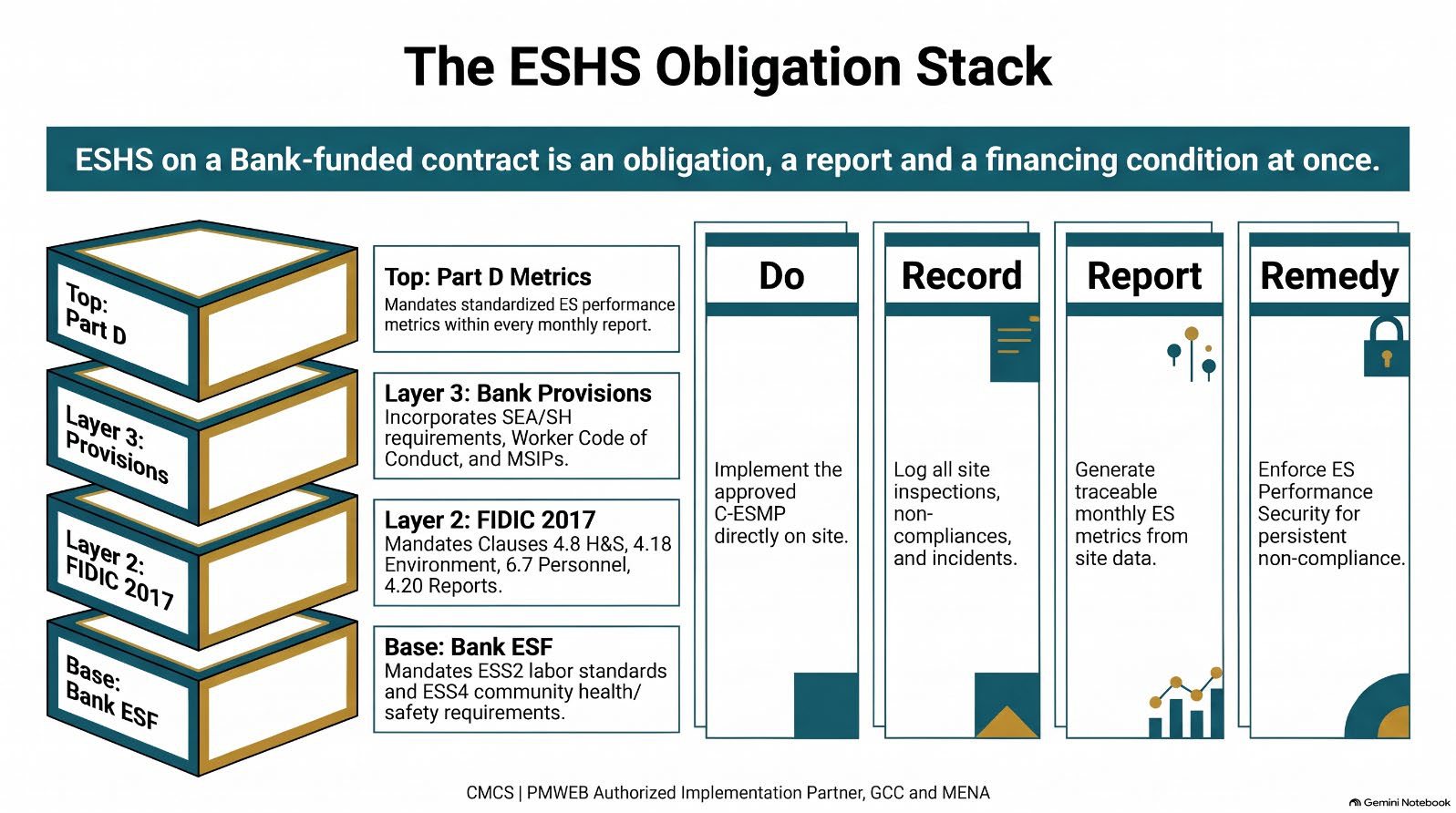
The Bank’s Environmental and Social Framework (ESF) has been in effect since 1 October 2018. The commitments a borrower makes to the Bank under it must flow down into the works contracts that deliver the project. Environmental and Social Standard 2 (ESS2) covers labour and working conditions; ESS4 covers community health and safety.
The FIDIC 2017 Red Book provides the backbone:
- Sub-Clause 4.8, Health and Safety Obligations. The Contractor’s safety obligations, including a health and safety manual and site safety arrangements.
- Sub-Clause 4.18, Protection of the Environment. Protecting the environment and limiting damage and nuisance from pollution, noise and other results of the Contractor’s operations.
- Sub-Clause 6.7, Health and Safety of Personnel. The health and safety of the Contractor’s Personnel on and around the Site.
- Sub-Clause 4.20, Progress Reports. Monthly reports that include safety statistics and environmental and public-relations matters.
The Bank’s Specific Provisions (Particular Conditions Part B) build on that backbone. They strengthen the ESHS obligations, add SEA/SH requirements and tie them to the Code of Conduct for Contractor’s Personnel and the MSIPs submitted at bid stage. The January 2020 update of the Bank’s Standard Procurement Document for Works added the SEA/SH provisions. Part D of the Particular Conditions defines the environmental and social metrics the Contractor must include in its progress reports. Where ES risks are high, an ES Performance Security gives the Employer a financial remedy if the Contractor fails to meet its ES obligations.
For a PIU, ESHS compliance therefore has four dimensions at once: what the Contractor must do on site, what it must record, what it must report, and what the Employer can do if it does not.
From site observation to structured record
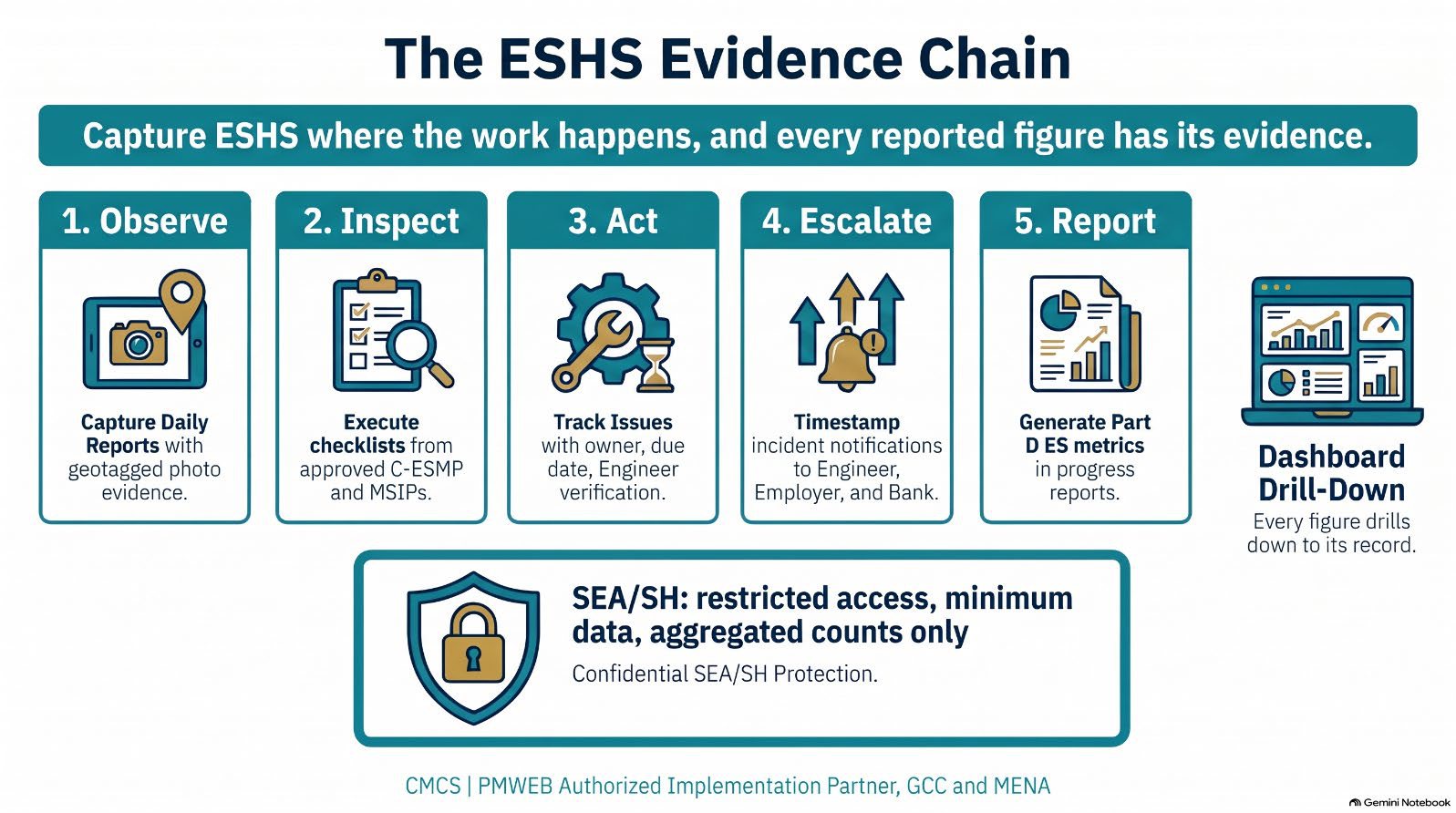
Most ESHS non-compliance is visible long before it becomes serious. A missing silt fence. A fuel store without bunding. Work at height without edge protection. A blocked community access route. A workers’ camp without adequate water. Site engineers, ES officers and supervision staff see these things every day. The problem is that the observation goes into a notebook, a messaging-app photo or a weekly email, and never becomes an item that someone owns and closes.
PMWEB closes the gap with processes the site team already uses:
- Daily Reports. Manpower, equipment, weather and narrative, with geotagged photographs attached at the moment of observation.
- Inspections. Scheduled and ad-hoc ESHS inspections against checklists derived from the approved C-ESMP and MSIPs. Each failed item generates a corrective action.
- Issues. Non-compliances tracked to closure with an owner, a due date and a verification step by the Engineer.
- Risk Register. The ES risks identified in the ESMP, linked to the mitigation measures and inspections that control them.
- Document Management. Environmental permits, quarry and borrow-pit licences, traffic management plans and workers’ accommodation approvals, each with an expiry date and version control.
The point is not more paperwork. The record becomes a by-product of the inspection itself. When the Bank’s mission asks how many non-compliances were raised last quarter and how quickly they were closed, the answer is a report, not a research exercise.
Incidents: notification, investigation and learning
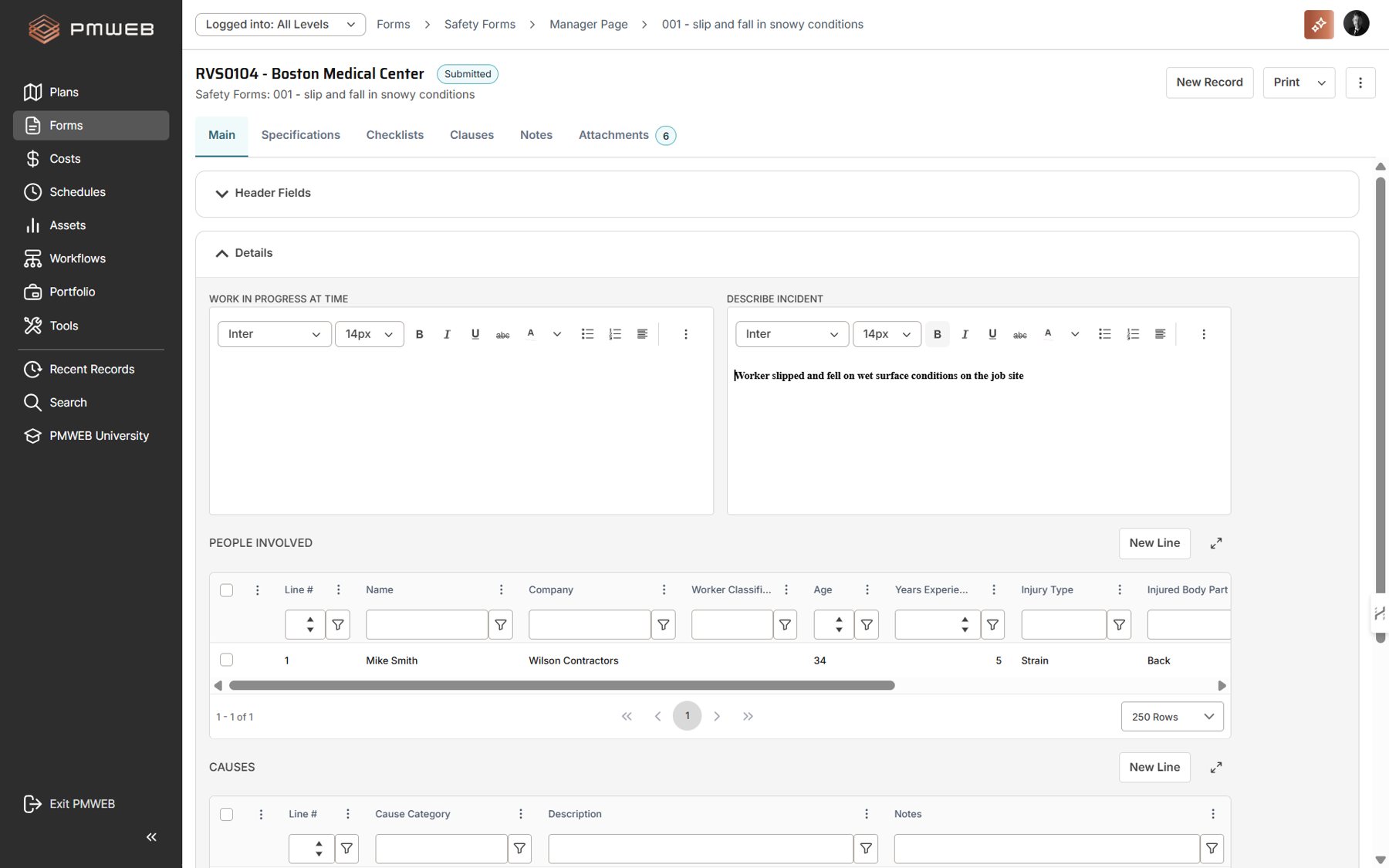
Serious incidents are where ESHS compliance is tested hardest. On Bank-financed projects, significant incidents must be notified promptly through the Employer to the Bank, then investigated, with root causes and corrective actions documented. These include fatalities, serious injuries, major environmental releases, harm to the community and SEA/SH allegations.
A custom Incident form built with the PMWEB Custom Form Builder gives every incident the same structure:
- Classification. Incident type and severity, date, time and location, persons and assets affected.
- Immediate actions: taken on site.
- Notification timestamps: to the Engineer, the Employer and the Bank, driven by the Workflow tab and escalated if a step is overdue.
- Investigation. Findings, root cause, and corrective and preventive actions, each assigned and tracked.
- Evidence. Photographs, witness statements and the investigation report on the Attachments tab; the running record on the Notes tab.
Because each incident is a record rather than a letter, the PIU can trend incidents by type, contractor, subcontractor and location, measure the time to notification against the required window, and verify that every corrective action was closed. That is the difference between reporting incidents and learning from them.
SEA/SH: compliance that must protect people
SEA/SH needs a different approach from every other ESHS topic, and any system that handles it must be configured with that in mind. The principle is survivor-centred: confidentiality, safety and consent come before process efficiency.
- Never in general registers. SEA/SH allegations are never recorded in Correspondence, Daily Reports or shared logs.
- A restricted form. A dedicated adaptive form, with access limited by role to the small group designated under the project’s SEA/SH response arrangements.
- Minimum data. Identifying details stay with the designated service provider. The project record holds what the contract and the Bank need: that an allegation was received, referred and handled within the agreed protocol, and any contractual action taken.
- Aggregated reporting only. Dashboards show counts and timeliness indicators, never names, identifying locations or case narratives.
Training records for the Code of Conduct sit alongside, so the PIU can show that every worker received SEA/SH awareness training and acknowledged the Code. That is the preventive side of the obligation, and the Bank will review it too.
The ESHS compliance map
The ESHS Compliance dashboard
The dashboard below is built in PMWEB’s embedded Power BI reporting for the sample programme P-2100, with values in USD millions.
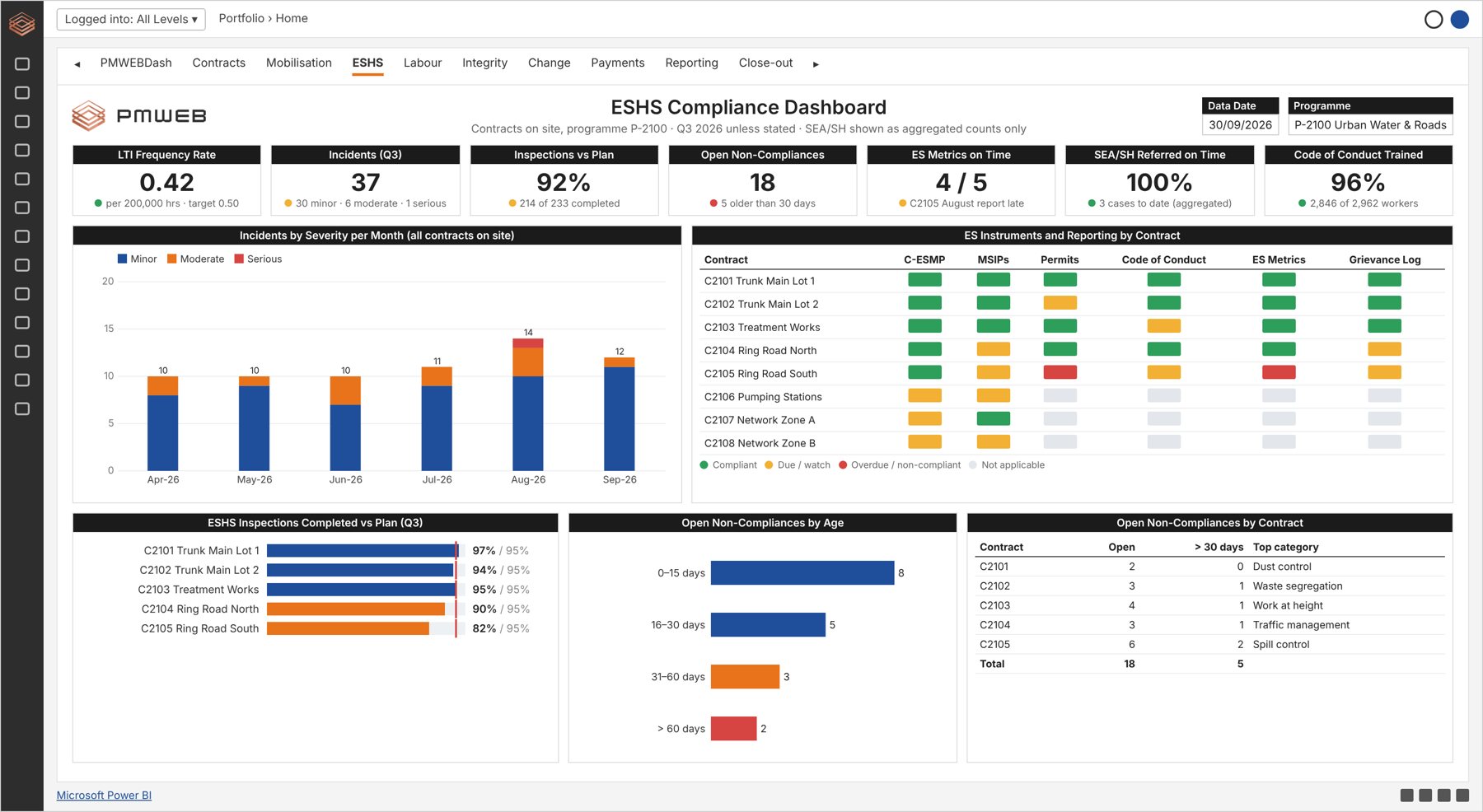
- Safety performance is within target, but not everywhere. The lost-time injury frequency rate is 0.42 per 200,000 hours against a target of 0.50. Q3 recorded 37 incidents: 30 minor, 6 moderate and 1 serious, in August.
- One contract accounts for a third of the open non-compliances. C2105 Ring Road South has 6 of the 18 open items, 2 of them older than 30 days, led by spill control. It is also the contract with a lapsed permit and a late August ES report.
- Inspections are slipping where they matter most. The programme completed 214 of 233 planned inspections (92%). C2101 to C2103 are at or near the 95% target; C2104 is at 90% and C2105 at 82%.
- Ageing is the warning sign. Five non-compliances are more than 30 days old, two of them more than 60. An item that old is no longer a site observation; it is a pattern the Bank will ask about.
- The mobilising contracts have ES plans still under review. C2106, C2107 and C2108 show amber for the C-ESMP, which is the gate before their works can start.
- SEA/SH is visible without exposing anyone. Three cases have been received to date, all referred within the agreed time, shown only as an aggregated count. Code of Conduct training covers 2,846 of 2,962 workers (96%).
PMWEB 2026 AI on ESHS data
Action is taken only with the user’s approval, and PMWEB AI honours security settings, so ESHS data, and SEA/SH data above all, is visible only to the roles permitted to see it.
What the Employer, Engineer and Contractor must put in place
- Checklists from the approved plans. Inspection checklists built from the C-ESMP and MSIPs, so every inspection tests what the Contractor committed to.
- One owner per non-compliance. Every failed item raised as an Issue with a due date and closed only after the Engineer verifies it.
- A single incident form. Severity classification and a notification workflow that timestamps each step to the Engineer, the Employer and the Bank.
- A confidential SEA/SH channel. A restricted form, role-based access, minimum data and aggregated reporting only.
- Permits with expiry dates. Every permit and consent in Document Management, with alerts before it lapses.
- ES metrics generated, not typed. The Part D metrics in the monthly report pulled from the records, with drill-down to each one.
Over to you: on the Bank-financed projects you know, is the ES section of the monthly report built from site records, or reconstructed every month for the report?
The series: Article 1, Funding Comes with Conditions; Article 2, From Particular Conditions to Platform; Article 3, The First 90 Days; Article 4, ESHS as Evidence; Article 5, People on Site; Article 6, Integrity by Design; Article 7, Change under Scrutiny; Article 8, Paying through the Loan; Article 9, Reporting to the Bank; Article 10, Closing the Contract, Closing the Loan.

Next step
Bring this to your portfolio.
Tell us which processes matter most to you, and we will show them running in PMWEB.