
Article 1 of 10 · FIDIC Compliance by Design
Funding Comes with Conditions: Why FIDIC Compliance Is Now a Development-Bank Requirement
When a development bank finances the works, the FIDIC contract stops being an agreement between two parties. It becomes a condition of the loan, administered under the eyes of a third party that was never at the negotiating table. Every notice, approval, payment and safety record must be capable of being shown to the Bank. A borrower that cannot produce that evidence on request does not have a documentation problem; it has a financing risk.
This series is written for the people who deliver works financed by multilateral development banks: ministries of finance and planning, implementing agencies and their project implementation units (PIUs), Engineers and supervision consultants, and contractors. It explains what the banks add on top of FIDIC, and how PMWEB turns each added obligation into a record that can be evidenced.
FIDIC has become the language of development finance
On a privately funded project, a poorly administered FIDIC contract costs money. On a Bank-financed project, it can cost the financing. A late notice, an unapproved variation, an unreported safety incident or a certificate issued without supporting records becomes a finding in a supervision mission, a query in a procurement post-review, a qualification in an audit report, or a reason to delay a disbursement.
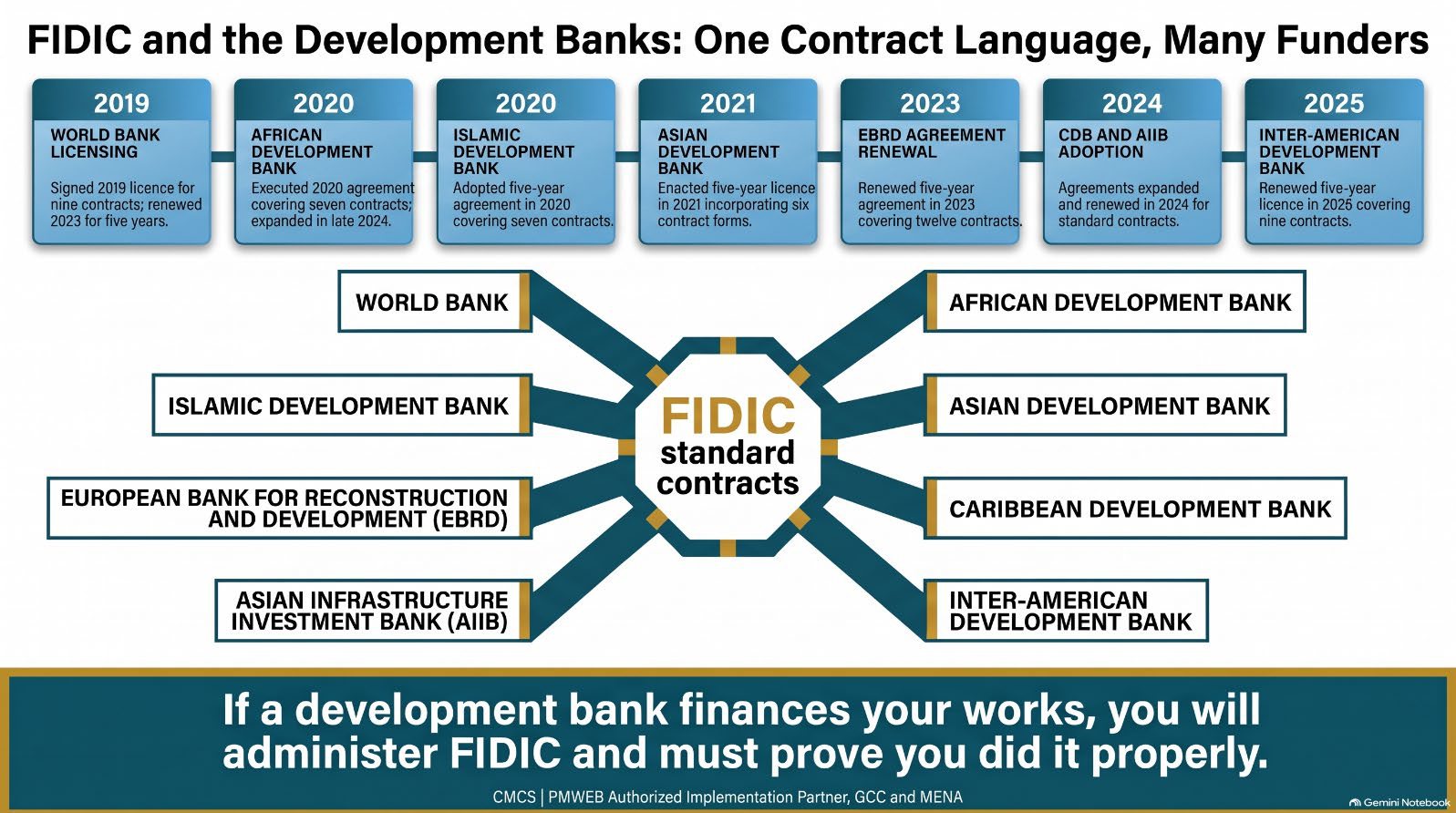
Over the past seven years almost every major development bank has signed a formal agreement with FIDIC. Each grants the bank a non-exclusive licence to reference FIDIC contracts in its standard bidding and procurement documents:
The consequence is simple. If your country, agency or company works on infrastructure financed by any of these institutions, you will administer FIDIC, and you will be asked to prove that you administered it properly.
What the Bank adds on top of FIDIC
The banks do not adopt FIDIC unchanged. The World Bank uses the 2017 General Conditions with its own Conditions of Particular Application, which address environmental, social and integrity risks. In its Standard Procurement Document for Works, the Particular Conditions have four parts: Part A Contract Data, Part B Specific Provisions, Part C the Bank’s policy on corrupt and fraudulent practices, and Part D the environmental and social (ES) reporting metrics for the Contractor’s progress reports.
Many contracts financed by other banks still run on the FIDIC MDB Harmonised Edition, the “Pink Book” of June 2010, based on the 1999 Red Book. It carries its own bank-driven amendments: the Bank’s right to inspect and audit the Contractor’s accounts and records (Sub-Clause 1.15), evidence of the Employer’s financial arrangements before the Commencement Date (2.4), the Employer’s specific approval before the Engineer acts on defined matters (3.1), provisions on corrupt or fraudulent practices (15.6), and additional Contractor termination grounds, including suspension of the loan or credit (16.2).
Whatever the edition, the bank layer adds obligations that a private Employer would rarely impose:
- Particular Conditions. Project-specific periods, percentages, currencies, approval thresholds and amended clauses.
- Engineer’s authority limits. Employer approval before the Engineer instructs certain Variations or agrees time and cost.
- Environmental, social, health and safety (ESHS). A Code of Conduct for Contractor’s Personnel, Sexual Exploitation and Abuse / Sexual Harassment (SEA/SH) prevention, Management Strategies and Implementation Plans (MSIPs), and possibly an ES Performance Security.
- Integrity and audit. The Bank’s inspection and audit rights, its anti-corruption policy and sanctions.
- Prior review and no-objection. The Bank’s no-objection for defined decisions, such as DAAB members and contract amendments above agreed thresholds.
- Disbursement. Payments drawn against loan categories and the financing agreement’s closing date.
- Reporting. Monthly, quarterly and annual progress reports, procurement plan updates and implementation status.
Why borrower PIUs struggle
The banks know where the weakness lies. PIUs are often staffed quickly, rotate frequently, and must master FIDIC and the Bank’s procurement and safeguard rules at the same time. Delays, cost overruns and disputes on development-financed infrastructure are repeatedly traced to insufficient project and contract management capacity, not to the contract forms.
The Government of Sri Lanka’s Guide to Project Management and Contract Management (GPMCM), issued by the Ministry of Finance in February 2017 under ADB Technical Assistance TA-8562, is one of the most serious responses to that problem. It sets out 69 procedures, CA01 to CA69, that follow a Pink Book contract from Letter of Acceptance through mobilisation, execution, completion and dispute resolution, with forms, templates and specimen letters for each action. It also records the funding-agency layer: the financing agreement and the Project Administration Manual, the annually updated procurement plan, ADB’s prior no-objection for contract modifications that in aggregate increase the original contract amount by more than 15%, copies of all amendments to be furnished to ADB, and the recommendation to report contract disputes to the funding agency.
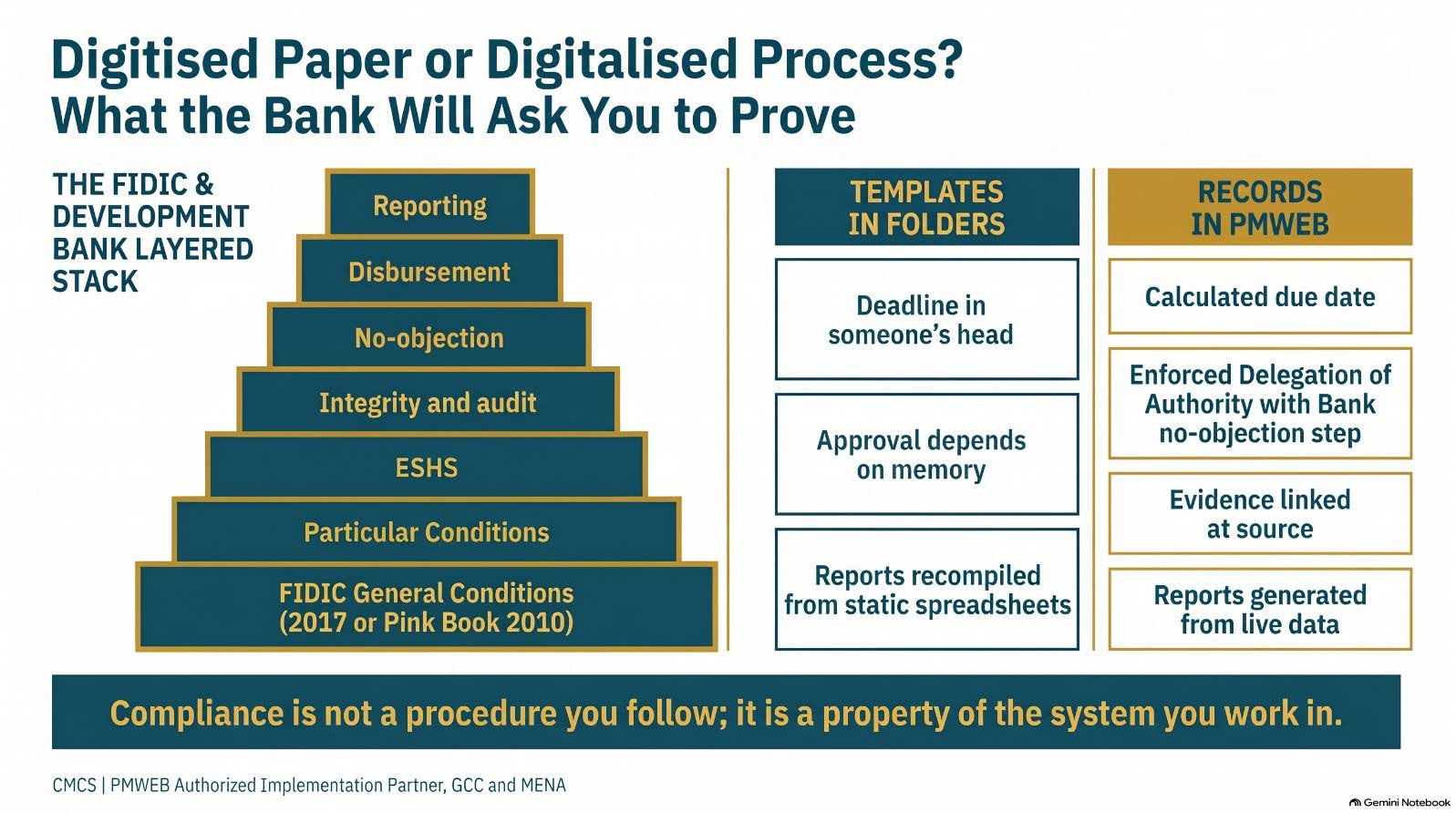
It is an excellent body of practice. But the templates were placed in tools built on Microsoft SharePoint, and that is the critical distinction. A template in a document library digitises the paper. The letter becomes a file, but the deadline still sits in someone’s head, the approval still depends on someone remembering to ask, and the link between a variation, its Employer approval, the Bank’s no-objection, the revised contract amount and the payment certificate has to be rebuilt by hand whenever an auditor asks.
Our book, Digitalization of Construction Contract Administration Under FIDIC Contracts, makes the same distinction: digitization converts documents into electronic files, while digitalization converts the process itself into structured, rule-driven data. Bank-financed projects need the second.
Compliance must be a property of the system
The thesis of this series is that, on a Bank-financed project, compliance cannot depend on individuals working around their tools. It has to be a property of the system they work in. That means four things:
- Every obligation is a structured record. Each contractual and Bank obligation has mandatory fields, a calculated due date and an owner, rather than living in an attachment.
- Every approval follows the imposed DoA. Employer approval and Bank no-objection steps are enforced by workflow and cannot be bypassed.
- Every record carries its evidence. Daily reports, photographs, inspections, transmittals and correspondence are linked at source, not collected later.
- Every report is generated from live data. The Employer, Engineer, Contractor, ministry of finance and the Bank’s task team see one version of the truth.
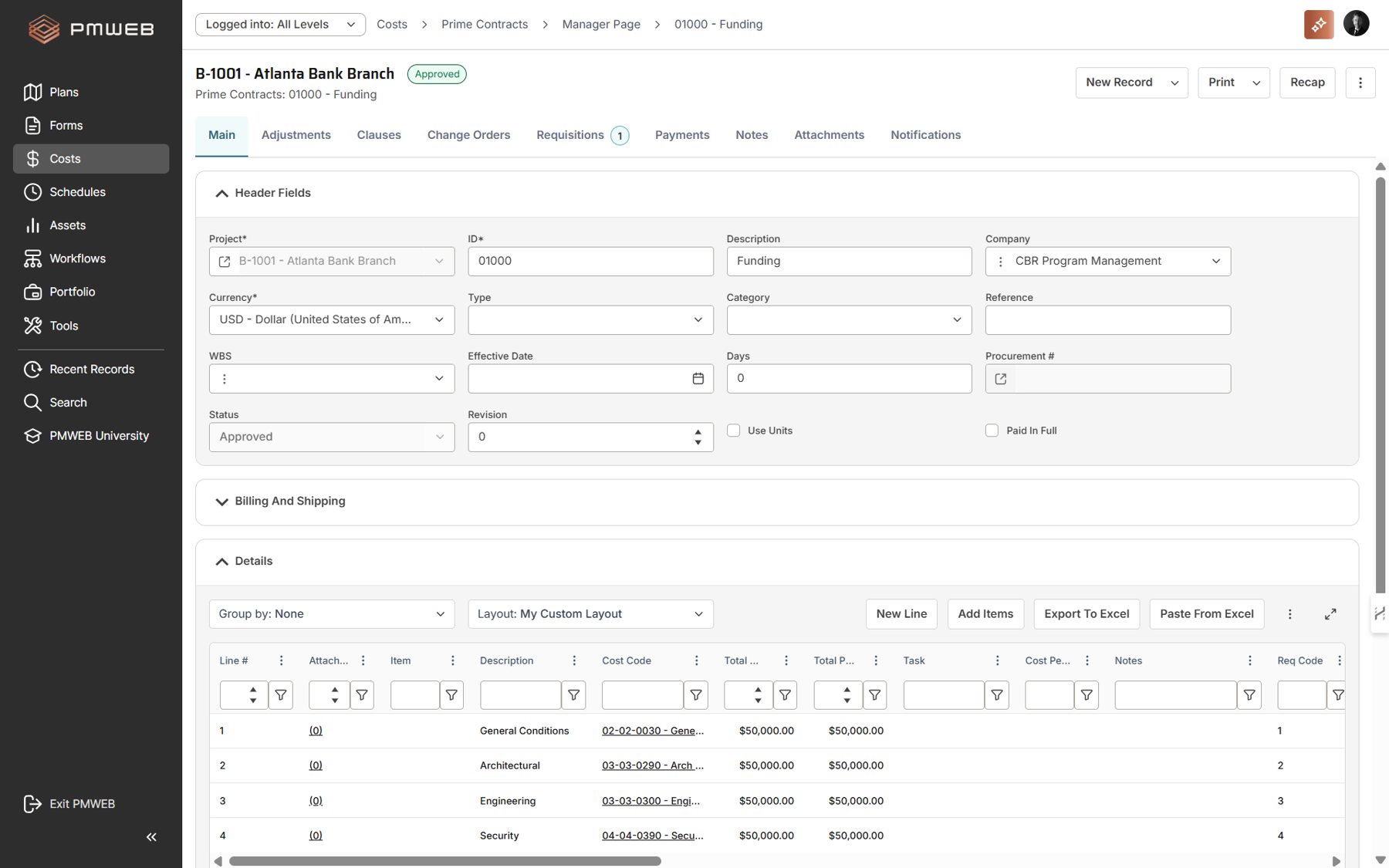
PMWEB comes with most of the processes needed to administer FIDIC contracts out of the box: contracts and commitments, change events, potential change orders (PCOs) and change orders, progress invoices, budgets and funding sources, schedules, daily reports, meeting minutes, correspondence, transmittals, RFIs, submittals, inspections, risk registers and document management. Where a Bank requirement has no standard process, the PMWEB Custom Form Builder creates it as an adaptive form, and the workflow engine routes it through the right approvals.
The Programme Compliance Overview dashboard
The dashboard below is built in PMWEB’s embedded Power BI reporting for the sample programme P-2100, with values in USD millions. The programme is financed by a Bank A loan of 450.0, Bank B co-financing of 120.0 and counterpart funds of 60.0, and runs eight works contracts on three generations of FIDIC form.
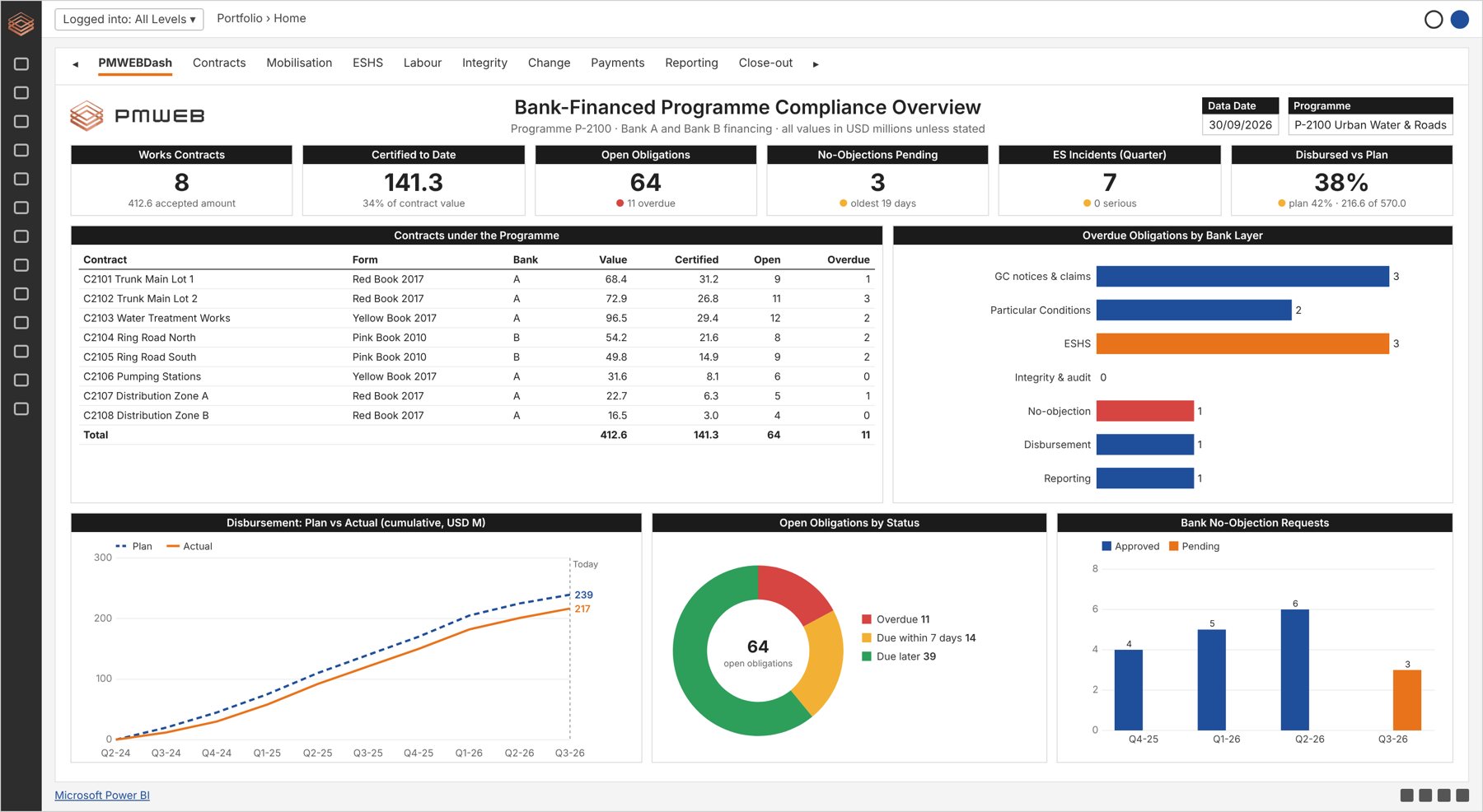
- One programme, three contract forms. The eight works contracts, worth 412.6, run on the Red Book 2017, the Yellow Book 2017 and the Pink Book 2010 side by side. A single register only works if each contract carries its own rules.
- Disbursement is behind the money already earned. 141.3 has been certified, but disbursement stands at 38% of the 570.0 Bank financing (216.6) against a plan of 42% (239.4). The gap is a conversation the PIU must have with the Bank before the next mission, not during it.
- Eleven of the 64 open obligations are overdue. Contractor-side notices and ESHS items account for six of them. C2102 Trunk Main Lot 2 alone holds three.
- ESHS is where overdue items cluster. Three of the eleven overdue obligations are ESHS items, the same number as General Conditions notices and claims, despite ESHS having fewer obligations in total.
- No-objections are now on the critical path. Fifteen no-objection requests have been received in the last four quarters; three are pending, the oldest for 19 days.
- Integrity and audit show zero overdue items. This is the result of controls built into the workflow, not of a separate audit exercise.
The FIDIC–Bank Obligation Register
Behind the overview sits the obligation register: every notice, approval, submission and Bank requirement as a dated record, classified by layer, contract and owner.
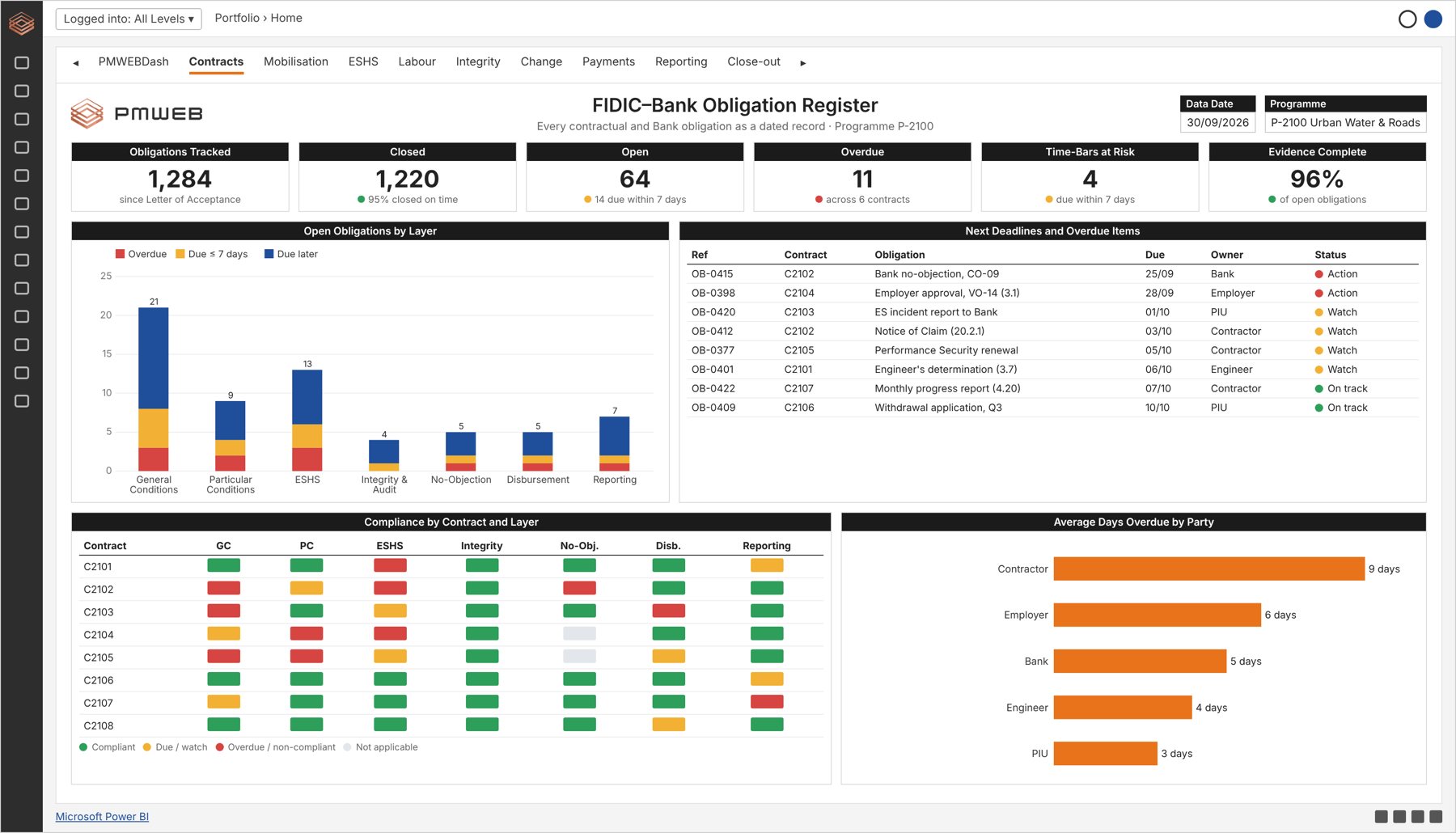
- 1,284 obligations tracked since the Letters of Acceptance. 1,220 are closed, 95% of them on time. The register is a by-product of administering the contracts, not a spreadsheet maintained beside them.
- The two oldest overdue items sit with the Employer and the Bank. The Bank’s no-objection on CO-09 (C2102) was due on 25/09, and the Employer’s approval of VO-14 under Pink Book Sub-Clause 3.1 (C2104) on 28/09. Contractors are not the only parties who must be chased.
- Four time-bars fall due within seven days. These include C2102’s Notice of Claim under Sub-Clause 20.2.1, due on 03/10.
- The heat map shows where to intervene. C2102, C2104 and C2105 carry the most red cells. Reporting is green everywhere except C2107, whose monthly progress report is overdue.
- Contractors are the slowest parties on average. They run nine days overdue against six for the Employer, five for the Bank, four for the Engineer and three for the PIU.
- 96% of open obligations already have their evidence attached. The audit file is assembled as the work is done.
PMWEB 2026 AI on Bank-financed contract data
Action is taken only with the user’s approval, and PMWEB AI honours security settings, so contract and Bank data is visible only to the roles permitted to see it.
What the PIU must put in place
- One register of forms in force. A record for each contract of its FIDIC edition, the Bank’s Particular Conditions and its financing source.
- Every obligation as a record. General Conditions, Particular Conditions and Bank obligations held as dated records with owners, not as reminders.
- The imposed DoA, enforced. Employer approvals and Bank no-objection steps built into the workflow.
- Evidence at source. Daily reports, inspections, transmittals and correspondence linked to the obligation they support.
- Disbursement linked to certification. Each certificate traced to its funding source and loan category.
- Reports generated, not compiled. One data set serving the Employer, the ministry and the Bank’s task team.
Over to you: on the Bank-financed projects you have worked on, which Bank requirement caused the most rework or the most uncomfortable supervision-mission finding, and could better records have avoided it?
The series: Article 1, Funding Comes with Conditions; Article 2, From Particular Conditions to Platform; Article 3, The First 90 Days; Article 4, ESHS as Evidence; Article 5, People on Site; Article 6, Integrity by Design; Article 7, Change under Scrutiny; Article 8, Paying through the Loan; Article 9, Reporting to the Bank; Article 10, Closing the Contract, Closing the Loan.

Next step
Bring this to your portfolio.
Tell us which processes matter most to you, and we will show them running in PMWEB.