
Article 9 of 10 · FIDIC Compliance by Design
Reporting to the Bank: Progress Reports and the PIU Control Tower
On a Bank-financed project, the progress report is not the end of the month's work. It is the Borrower's evidence that it is in control. When that report is assembled by hand from a dozen spreadsheets, every figure the Bank's task team questions sends the PIU back into the files. A PIU needs PMWEB to generate its reports from the project's own records, so every figure reconciles and every figure has its evidence one click away.
This article applies the reporting discipline to every level of a Bank-financed programme: the Contractor’s monthly progress report, the PIU’s programme reports and Steering Committee, and the ministry of finance that oversees several programmes financed by more than one development bank.
The reporting calendar of a Bank-financed programme
Every development-bank-financed programme runs on a reporting calendar:
- Monthly. The Contractor submits its progress report under Sub-Clause 4.20. The Engineer reviews it and reports to the Employer on progress, payment, quality and contractual matters.
- Quarterly and annually. The PIU consolidates contract-level information into programme reports for its ministry and for the Bank: physical and financial progress, disbursement, procurement and environmental and social performance.
- Steering Committee. Senior officials review the reports, take decisions and assign actions.
- Missions. Between reports, the Bank’s task team carries out implementation support missions and asks the questions the reports did not answer.
The Sri Lanka Ministry of Finance’s Guide to Project Management & Contract Management (GPMCM), developed under ADB Technical Assistance TA-8562, gives this calendar procedures of its own: CA39 for monthly progress reports, CA40 for quarterly reports, CA41 for annual reports and CA42 for Steering Committee meetings. It is clear about what each report must contain. But it assumes, like most procedure manuals, that someone will compile it.
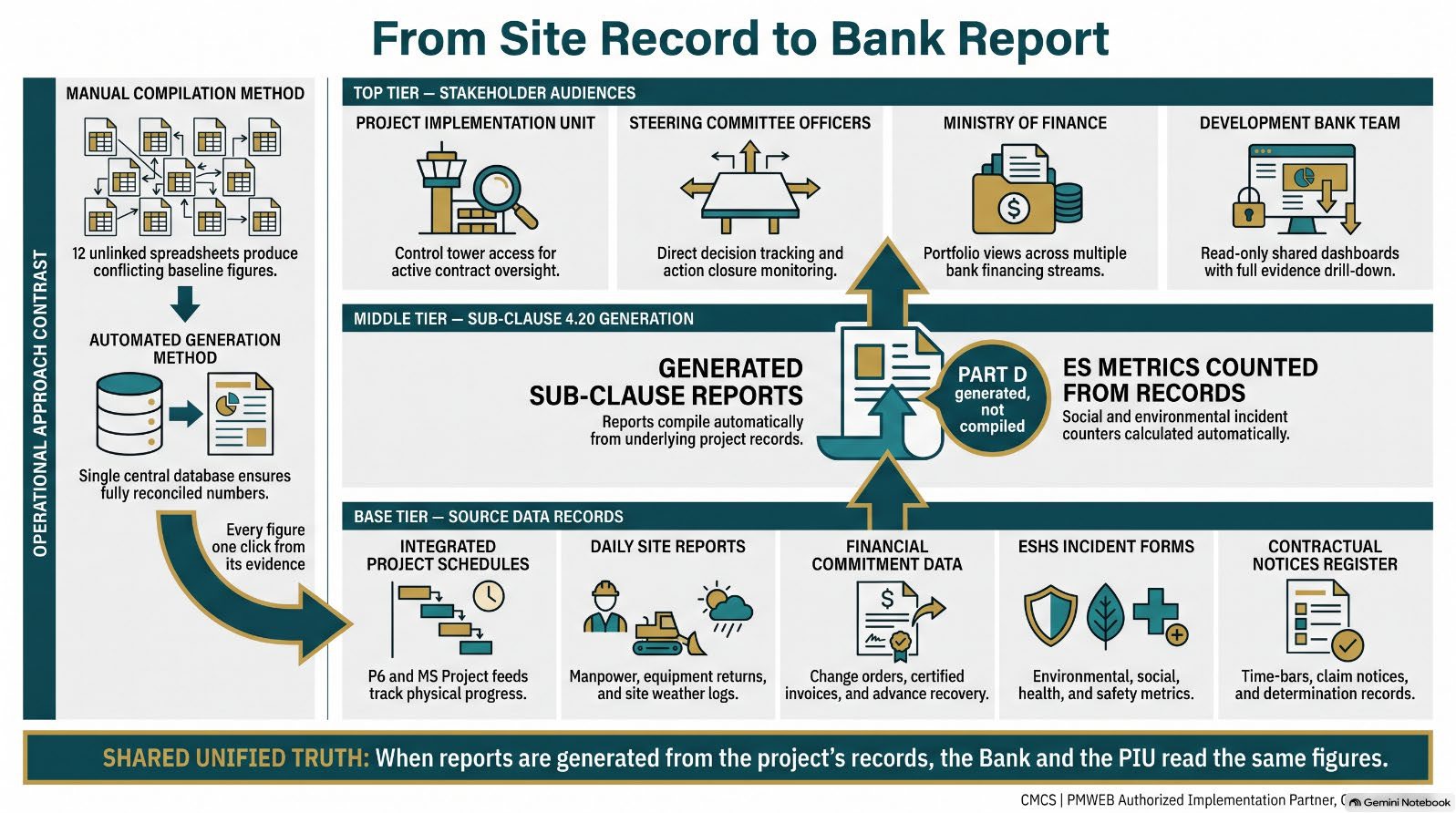
Compilation is where reporting breaks. The physical progress figure comes from the Engineer’s measurement, the financial figure from the payment register, the disbursement figure from the finance department, the ES incident count from the safety officer’s spreadsheet and the variation total from a log kept by the contracts team. Each number is correct in its own file. Put together, they rarely agree, and the reporting week is spent reconciling them instead of acting on them.
What Sub-Clause 4.20 and the Bank now ask for
Under the 2017 Red Book, the monthly progress report is already a substantial document. Sub-Clause 4.20 requires charts and detailed descriptions of progress, photographs, the status of manufacture of key Plant, records of Contractor’s Personnel and Equipment, quality documents and test results, a list of Variations and notices given, health and safety statistics, environmental and public-relations activities, and a comparison of actual and planned progress with the measures being taken to recover delays.
The Bank adds to this. The World Bank’s Standard Procurement Document for Works includes, in Particular Conditions Part D, a set of environmental and social (ES) reporting metrics that the Contractor must include in its progress reports. That brings incidents, non-compliances, grievances, training, worker numbers and ES performance against the Contractor’s plans into every monthly report. The ESHS and labour obligations covered in Articles 4 and 5 of this series are only as credible as the report that evidences them each month.
A Bank-financed progress report is therefore a compliance instrument. It records what the Contractor did, what the Engineer verified and what the Employer knows. When it is a Word document built from other documents, its compliance value is only as good as the last copy-and-paste.
Generating the report instead of compiling it
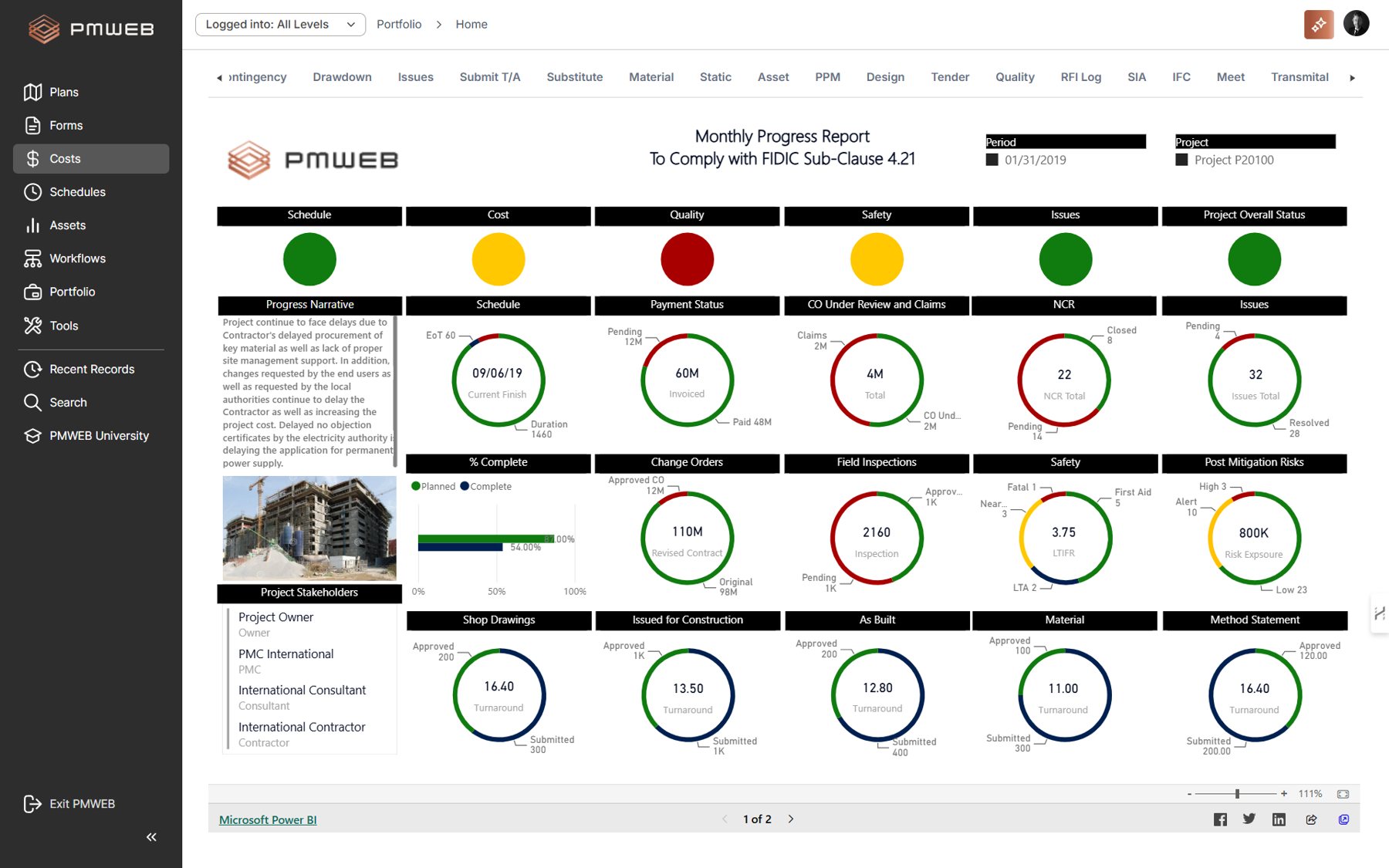
PMWEB turns the reporting calendar around. The monthly progress report is generated from records the project already keeps, rather than written as a separate document. Every figure has a source process:
The report template is configured once per contract and branded for the Employer, the programme or the Bank’s required layout. It is produced on demand or on a schedule. The narrative is still written by people, because judgement cannot be automated. But it sits on figures that already reconcile, because they all come from the same database.
The PIU Control Tower dashboard
A PIU rarely manages one contract. It manages a programme of works, goods and consulting contracts, often with several Contractors, a supervising Engineer and a financing agreement that allocates funds by financier and category. The control tower is the single view above all of them, with drill-down from programme to contract, certificate and source record.
The dashboard below is built in PMWEB’s embedded Power BI reporting for the sample programme P-2100, with values in USD millions.
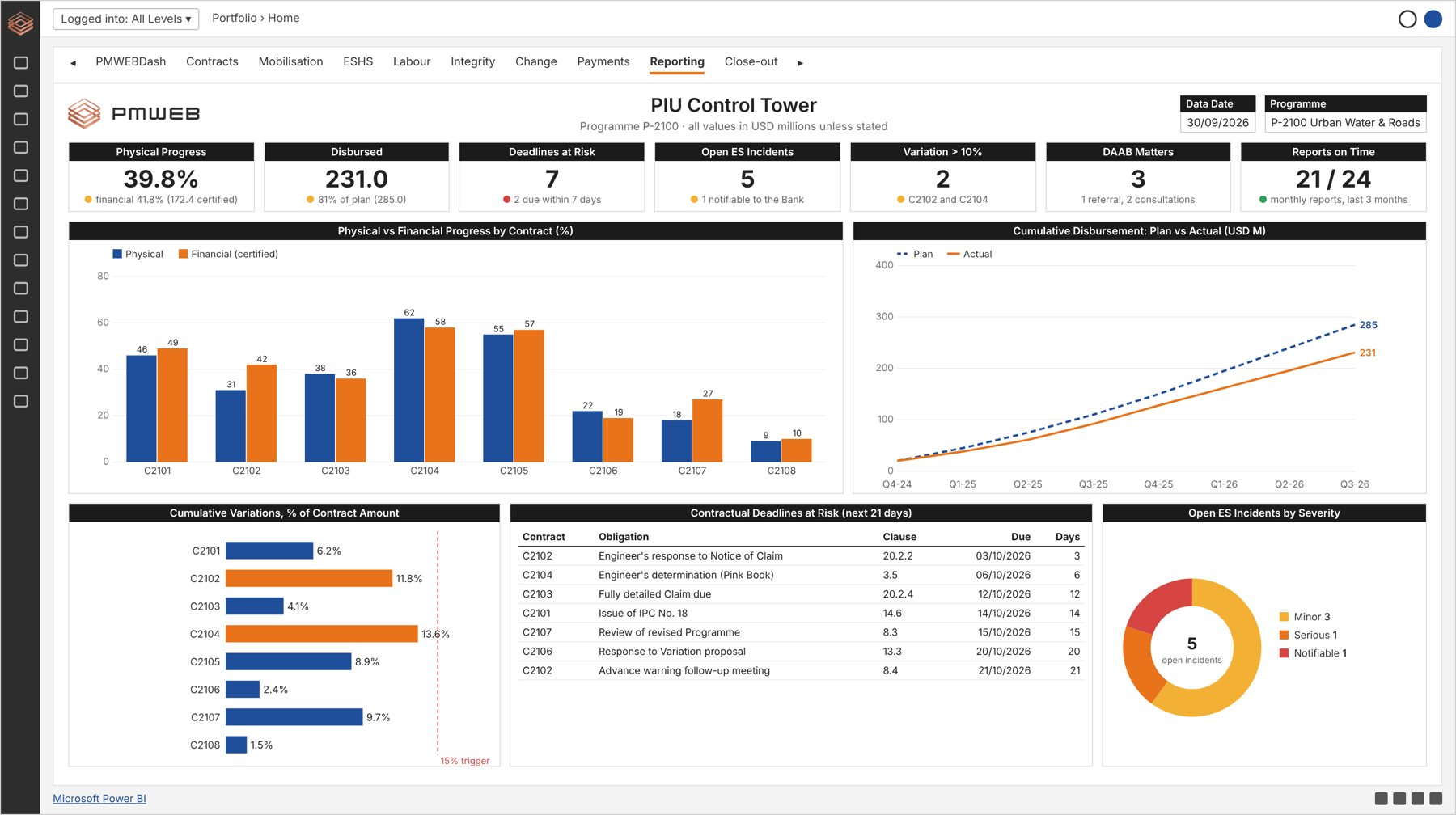
- Paid ahead of the work on two contracts. Programme physical progress is 39.8% against financial progress of 41.8% (172.4 certified of 412.6). The gap is concentrated on C2102 (31% physical, 42% certified) and C2107 (18% physical, 27% certified), where certification has moved ahead of the work.
- Disbursement is behind the financing plan. Cumulative disbursement is 231.0 against a plan of 285.0, or 81% of plan. With 33 months to the loan closing date of 30/06/2029, the gap is recoverable, but it widens every quarter.
- Two contracts are approaching the no-objection trigger. Cumulative variations on C2104 reach 13.6% and on C2102 11.8% of the contract amount. The next Variation on either may cross the 15% aggregate trigger referenced in GPMCM Annex 4 and require the Bank’s prior no-objection (Article 7).
- Seven contractual deadlines fall in the next 21 days. Two are within a week: the Engineer’s response to a Notice of Claim on C2102 under Sub-Clause 20.2.2 (3 days) and the Engineer’s determination on C2104 under the Pink Book’s Sub-Clause 3.5 (6 days).
- Five ES incidents are open, one of them notifiable. Three minor, one serious and one notifiable to the Bank. Each count is a record with its investigation, actions and evidence, not a typed figure.
- Reporting itself is measured. 21 of the last 24 monthly reports across the programme were submitted on time, and three DAAB matters (one referral, two consultations) are visible with their exposure.
A GIS map can add the same status to every financed site, so a PIU running water and road works in different districts sees where the risk is, not just how much there is.
The ministry of finance portfolio view
A ministry of finance or planning usually oversees several PIUs, financed by more than one development bank, each with its own reporting expectations, financing plan and closing date. Its question is not how one contract is doing, but where the national portfolio of Bank-financed investment is at risk.
The same PMWEB records roll up into that view. The dashboard below shows six sample programmes across three financiers.
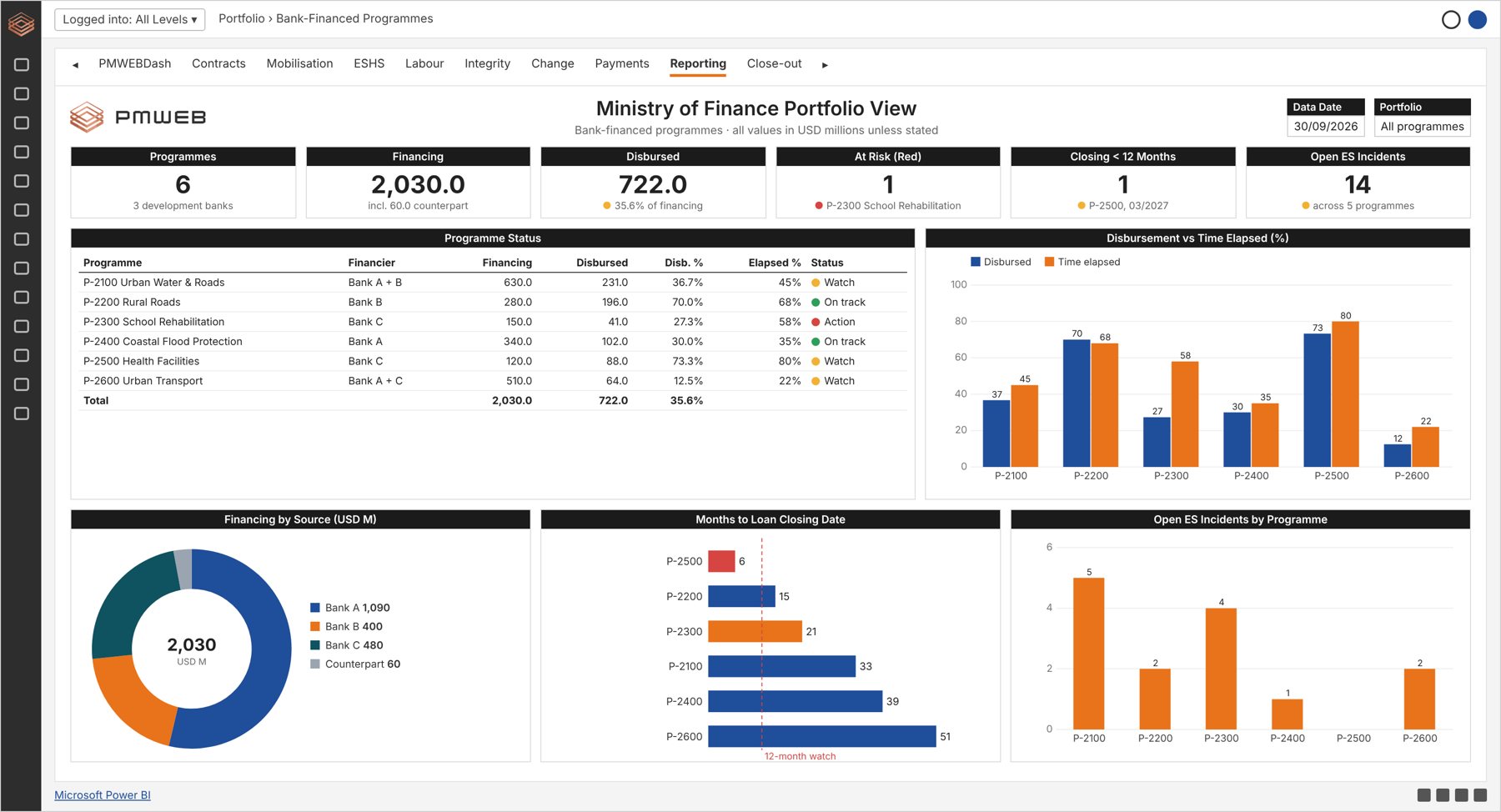
- The portfolio has disbursed 722.0 of 2,030.0. That is 35.6% of total financing, including 60.0 of counterpart funds, across Bank A (1,090), Bank B (400) and Bank C (480).
- P-2300 School Rehabilitation is the red programme. It has disbursed 27.3% of its 150.0 while 58% of its implementation period has elapsed. It needs a recovery plan before the Bank raises the question.
- P-2500 Health Facilities closes in 6 months. At 73.3% disbursed and 80% of time elapsed, the remaining 32.0 must be committed and certified before 03/2027, or reallocated.
- P-2100 and P-2600 are behind their clocks. P-2100 has disbursed 36.7% with 45% of time elapsed; P-2600 has disbursed 12.5% with 22% elapsed.
- ES incidents are concentrated. Of 14 open incidents across the portfolio, 9 sit in P-2100 (5) and P-2300 (4).
Because every programme uses the same configured processes, the ministry compares like with like. A disbursement ratio, an incident count or a variation percentage means the same thing in every programme.
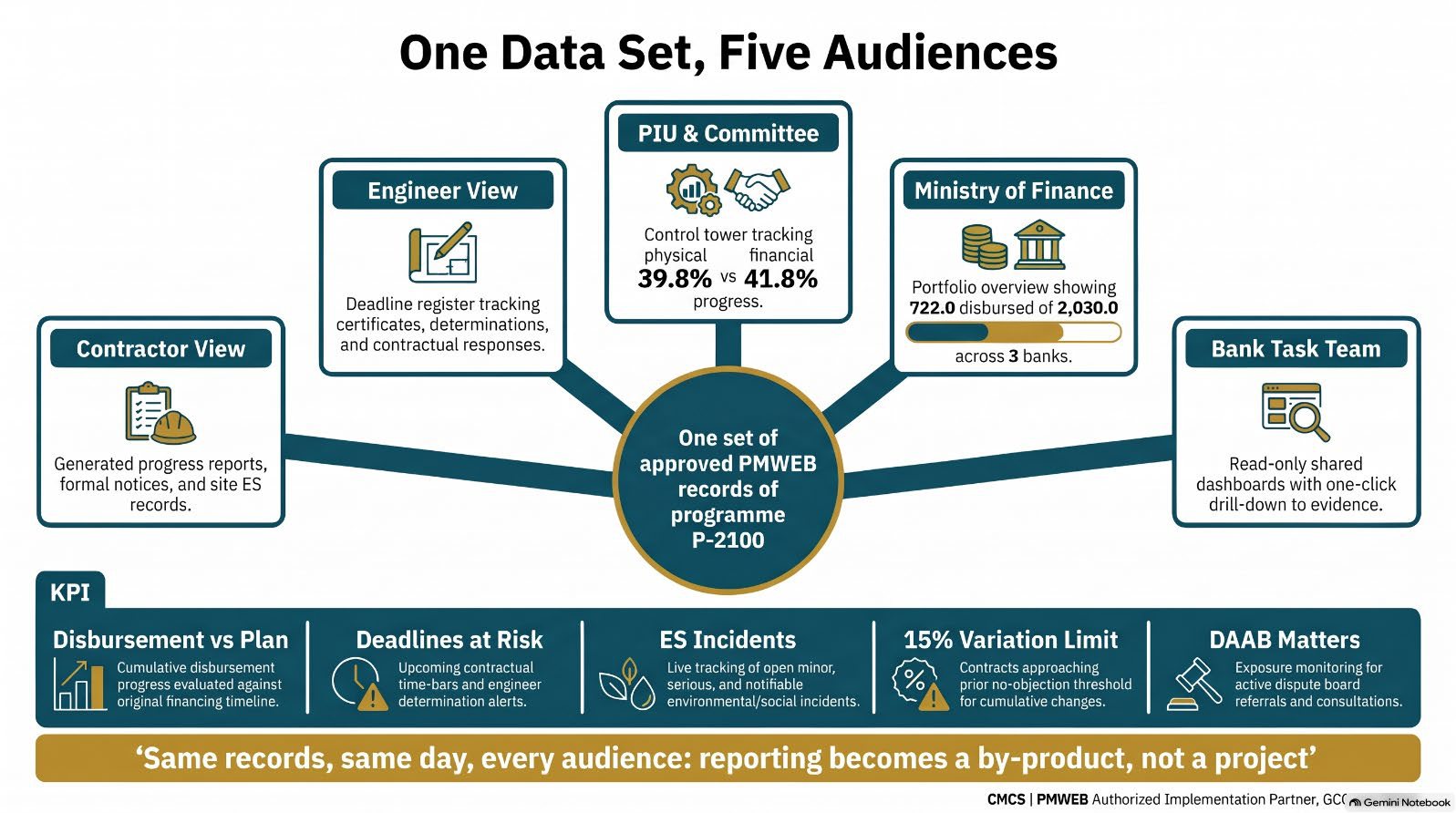
Who receives what
The control tower serves several audiences from the same approved records:
External sharing. PMWEB can share selected reports and dashboards with authorised external users without giving them access to working records. The Bank sees the figures the PIU manages by, on the same day, instead of a PDF that was out of date when it was sent.
Bilingual outputs. Many Bank-financed programmes in the MENA region report in two languages. As discussed in our book Digitalization of Construction Contract Administration Under FIDIC Contracts, contract administration outputs can be Arabized: the same record produces an English report for the Bank and an Arabic report for the ministry, without retyping.
PMWEB 2026 AI on reporting data
PMWEB 2026, rebuilt on Angular with AI embedded, works over the structured records behind each report. It can only do this reliably because the data is structured; a folder of PDF reports gives it nothing to reason over.
Action is taken only with the user’s approval, and PMWEB AI honours security settings, so reporting data is visible only to the roles permitted to see it.
What the PIU must put in place
- One report template per contract,: configured from Sub-Clause 4.20, the Bank’s Part D ES metrics and GPMCM CA39, and generated from records rather than typed.
- Every figure traceable to a process:: progress to Schedules, workforce to Daily Reports, cost to Progress Invoices and Change Orders, ES metrics to their adaptive forms.
- Disbursement tracked by financier and category: against the financing plan and the loan closing date, not only certified amounts.
- A deadline register calculated from the Contract Data,: so time-bars, determinations and responses at risk appear before they lapse.
- Steering Committee decisions recorded as actions: with owners and due dates, and reviewed at the next meeting.
- Read-only external access for the Bank’s task team and the ministry,: so missions start from shared figures instead of requests for data.
Over to you: When a development-bank mission asks for a figure your progress report does not show, how long does it take your PIU to produce it, and from how many files?
The series: Article 1, Funding Comes with Conditions; Article 2, From Particular Conditions to Platform; Article 3, The First 90 Days; Article 4, ESHS as Evidence; Article 5, People on Site; Article 6, Integrity by Design; Article 7, Change under Scrutiny; Article 8, Paying through the Loan; Article 9, Reporting to the Bank; Article 10, Closing the Contract, Closing the Loan.

Next step
Bring this to your portfolio.
Tell us which processes matter most to you, and we will show them running in PMWEB.