
Article 14 of 14 · PMWEB for PMC Firms: Digitalising the CMAA Standards of Practice
AI for PMC Firms: How PMWEB 2026 Turns a Structured Practice into Better Delivery
Every PMC firm is being asked how it will use AI. The honest answer is that AI can only work with the practice a firm has already captured. A PMC that runs the CMAA functions in PMWEB is not starting its AI journey. It has already built the foundation.
Over the last thirteen articles, this series has walked through the functions of construction management described in the CMAA Construction Management Standards of Practice: delivery methods, project management, cost, time, quality, contract administration, safety, risk, sustainability, programme management and technology management. In every one of them, the same pattern held. The CMAA Standard describes what the construction manager must do, each PMC firm executes it in its own way, and PMWEB captures the result as structured, linked and approved records.
This final article asks what that pattern makes possible. Owners across the GCC now ask their PMC firms the same question in every interview and every proposal clarification: how will you use AI on our projects? Many firms answer with a tool. The better answer is a foundation.
AI is only as good as the information under it. A PMC firm whose practice lives in email, spreadsheets and scanned PDFs gives AI nothing reliable to work on: the same figure appears in three versions, approvals cannot be traced, and nobody can say which document is current. A firm whose practice runs in PMWEB holds something very different: budgets, commitments, changes, schedules, RFIs, submittals, inspections, non- conformance reports, risks, safety records and decisions, each one structured, validated at entry, linked to the records around it and approved under the delegation of authority.
That is why the value of AI for a PMC firm is not a separate topic from the rest of this series. It is the return on everything the series has described.
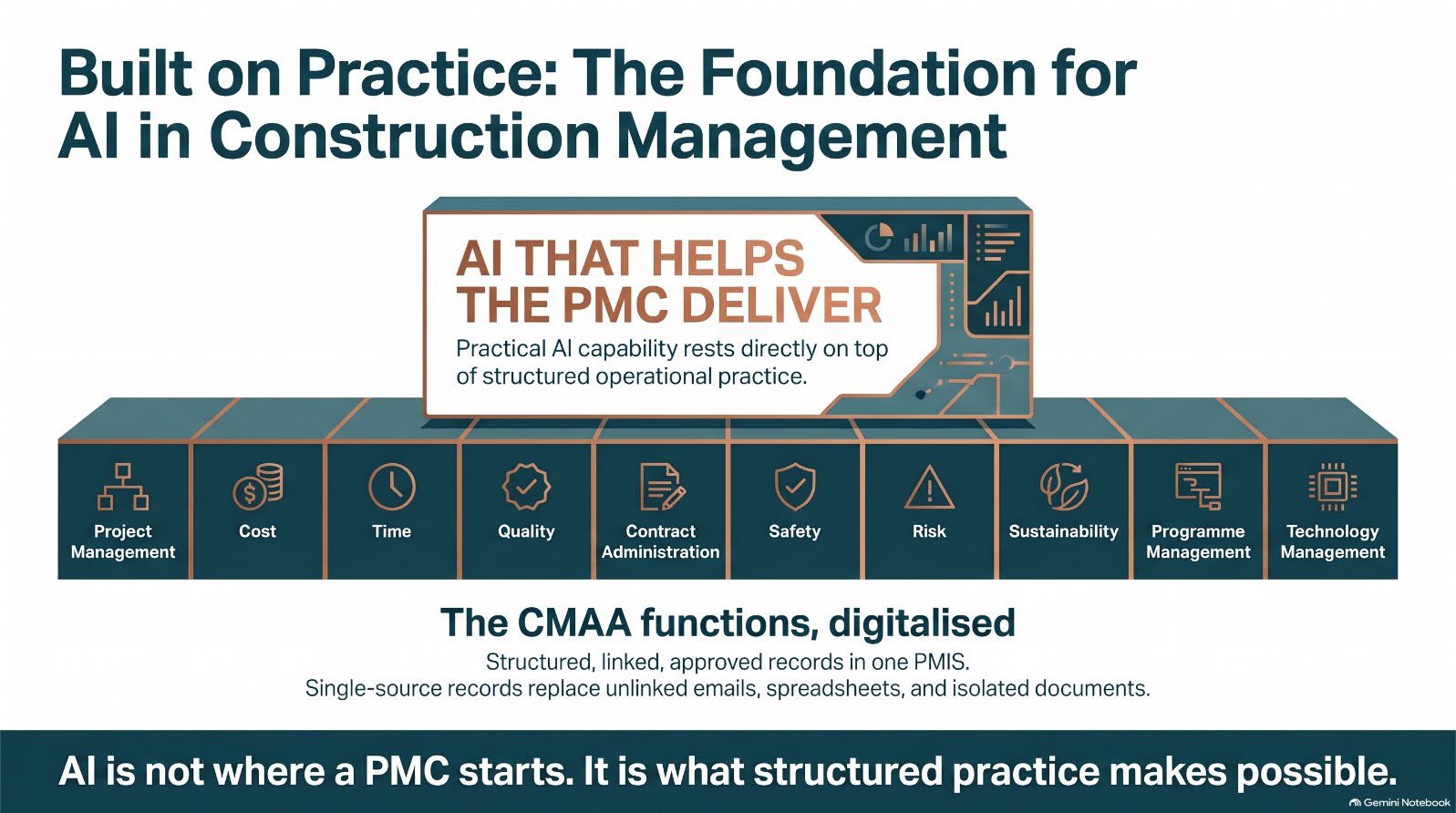
The difference between a document and a record is the difference between what AI must guess and what it can read. A change order stored as a PDF is a document: an AI tool can search its text, but it cannot know whether it is the approved version, whether it breached an approval threshold or which contingency it consumed. A change order stored in PMWEB is a record: its value, status, approver, approval date, cost code, linked RFI and schedule impact are fields the system already knows.
Across the thirteen functions in this series, PMWEB captures the CMAA practice in exactly that form. The table below summarises what each function contributes to the foundation.

Two features of this foundation matter more than any single module.
- It is consistent. Because PMWEB is configured once for the firm, and then adapted per client, the same process produces the same fields on every project. AI can compare one project with another only when the data means the same thing in both.
- It is connected. Records are linked: the RFI to the change order, the change order to the commitment and the schedule, the risk to the contingency it consumed. AI can follow a chain of cause and effect only when the chain exists in the data.
Project Level and Programme Level: Where the Value Multiplies
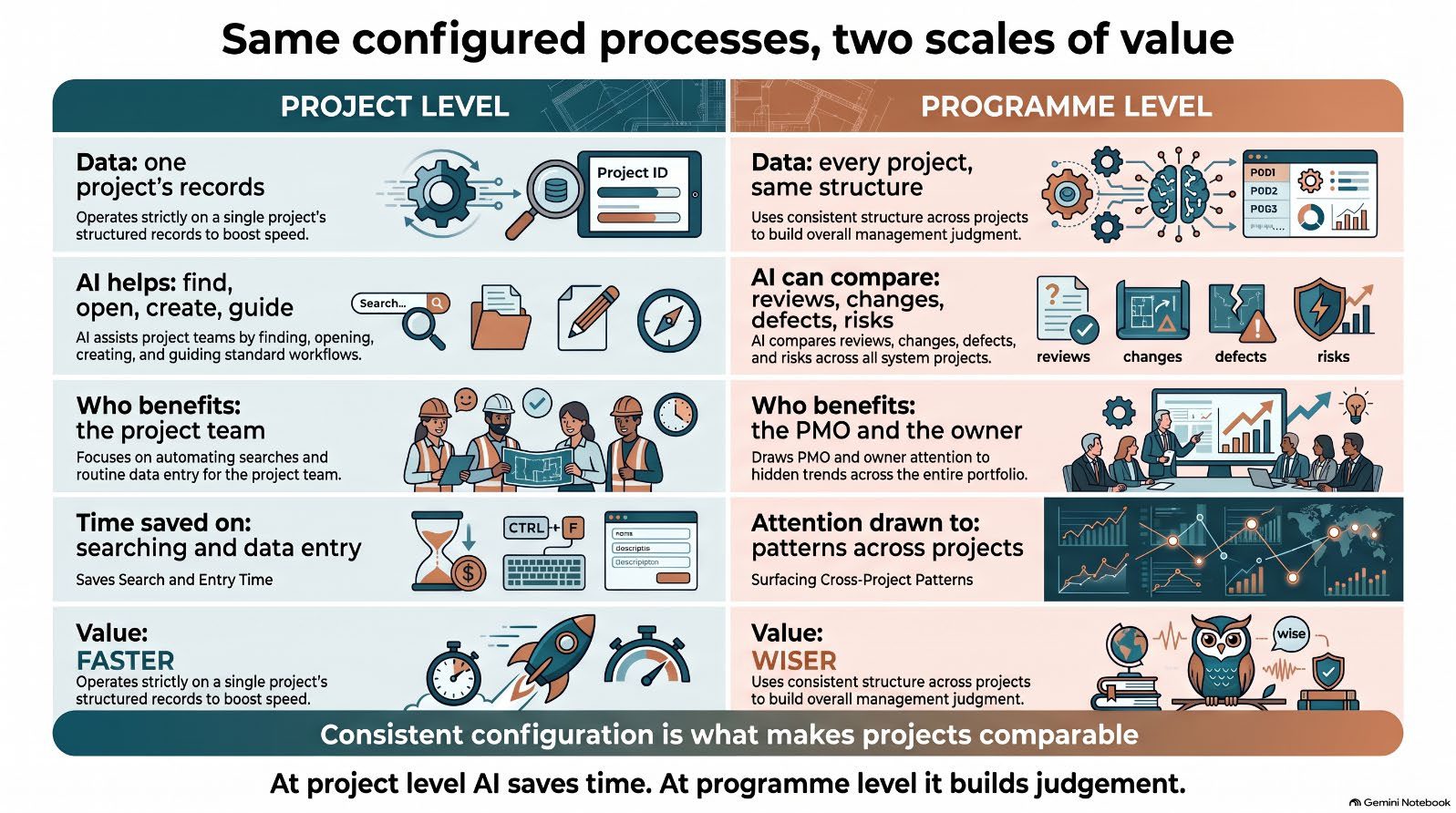
At project level, structured records let a PMC team find what it needs in seconds, prepare routine records faster and spend more of its time on judgement. That is valuable, but it is the smaller prize.
At programme level, the value multiplies. Many PMC firms in the GCC act as the owner's PMO, running dozens of projects for a master developer, a PIF-backed giga-project or a government programme. When every one of those projects runs the same configured processes in PMWEB, the programme holds a body of structured experience that no individual project manager can see: how long reviews really take, where changes cluster, which packages generate recurring non-conformance, which risks keep turning into issues. That body of experience is what AI can learn from, compare across and surface for attention.
This is also why the CMAA's addition of technology management to the construction manager's role matters for AI. The CMAA Technology Management Guidelines include data and ethics among the topics a CM must address when managing project technology. A PMC that governs its data well, with clear coding structures, value lists, ownership and access rules, is the PMC that will be able to use AI responsibly.
Available in PMWEB 2026: The AI Assistant
The PMWEB 2026 release introduces the PMWEB AI Assistant. In this first release the Assistant works in four modes, each designed around the way project teams already work in PMWEB.
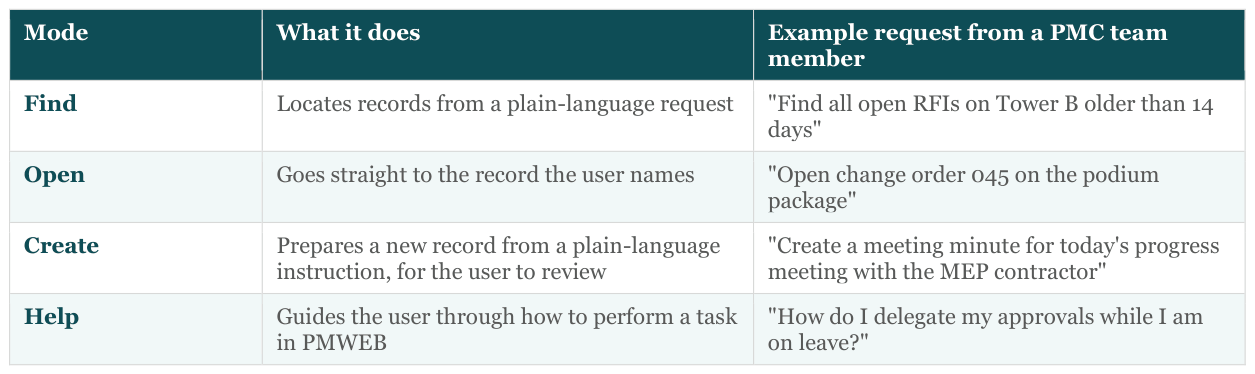
For a PMC firm, each mode answers a real cost of running the CMAA practice:
- Find removes the time spent filtering logs and spreadsheets to answer the questions owners ask every week: what is overdue, what is pending, what is waiting on whom.
- Open takes a reviewer straight to the record under discussion, in a meeting or on site, without navigating menus.
- Create lets engineers and inspectors start routine records such as meeting minutes, RFIs, observations and non-conformance reports from a plain instruction, so they spend less time on forms and more on the content.
- Help shortens onboarding. PMC firms rotate staff across projects and clients, and each owner's configuration is slightly different. Guidance inside the system means new team members follow the configured process from their first day.
Guardrails: Why Owners Can Trust It
Owners in the GCC rightly ask how AI will be controlled on their projects. Two principles built into PMWEB AI answer that question directly.
- Action taken only with your approval. The Assistant prepares; the user decides. Nothing is created, routed or approved without the user confirming it, so the delegation of authority configured for the project remains the only route to a decision.
- PMWEB AI honours security settings. The Assistant sees and acts only on what the user's role permits. A contractor's user cannot reach the owner's internal budget through the Assistant, and confidential commercial records stay confidential.
For a PMC firm, these guardrails matter because its professional accountability does not change when AI is used. The CMAA Standard expects the CM to act in the owner's interest and to keep accurate records. An AI that respects approvals and access rights supports that accountability rather than blurring it.
Where the Next Releases Are Heading
Later releases on the PMWEB AI roadmap are planned to move from helping users work with records to helping them understand what the records mean, with risk identification as the direction already signalled. For a PMC firm, that is where AI begins to support the practice itself, not just the people using the system.
The direction is easy to see in the functions this series has covered. A cost manager would want early sight of pending changes accumulating against remaining contingency. A planner would want to notice float eroding across successive updates. A quality manager would want recurring defects by package or contractor brought forward. A PMO would want risks that keep becoming issues across several projects drawn to its attention. These are directions, not dated features, and the professional judgement of the PMC remains the decision-maker.
What is certain is the dependency. Every one of those capabilities will be only as good as the structured records captured today. A PMC firm that digitalises its practice now will be ready to benefit from each release as it arrives; a firm that waits will first have to rebuild its data.
Preparing Your Practice for AI
The practical steps are the same ones this series has recommended function by function. Seen together, they form an AI readiness plan for a PMC firm.
- Standardise the forms and value lists. Configure each CMAA process once for the firm, with consistent fields, categories and status values, then adapt it per client.
- Standardise the coding structures. Use a common cost breakdown structure, work breakdown structure, location codes and document numbering, so records from different projects can be compared.
- Link the records. Make the links between RFIs, changes, commitments, schedule activities, risks and inspections part of the process, not an afterthought.
- Enforce the workflow. Keep approvals inside PMWEB under the delegation of authority, so every decision is a record with an approver and a date.
- Close out properly. Capture lessons learned and closeout data as structured records, so each project adds to the firm's experience instead of disappearing into an archive.
- Govern access and data. Define roles, security levels and data ownership, so AI can be switched on with confidence that it will respect them.
Configuring PMWEB AI to Your Firm's Procedures
As with every process in this series, each PMC firm and each client will make its own choices about how AI is used. PMWEB is configured to those choices.

Evidence That the Practice Is AI-Ready
A PMC firm can measure its readiness for AI with indicators drawn from its own PMWEB data:
- Process coverage: the share of the firm's CMAA processes that run as configured PMWEB workflows rather than outside the system.
- Data completeness: the share of key fields completed at entry on records such as RFIs, changes, inspections and risks.
- Link density: the share of change orders linked to an originating RFI or instruction, and of risks linked to the contingency or issues they affected.
- Approval traceability: the share of commitments and changes approved through the workflow with a recorded approver and date.
- Cross-project consistency: the number of projects in the programme using the same forms, value lists and coding structures.
- Lessons captured: closed projects with structured lessons learned and closeout records.
Key takeaway
AI will not fix a PMC firm's practice. It will amplify whatever practice the firm has already captured. A firm that runs the CMAA functions in PMWEB, as structured, linked and approved records at project and programme level, has already built what AI needs.
The PMWEB 2026 AI Assistant puts that foundation to work today, and the releases that follow will build on it. The firms that digitalise their practice now will be the ones ready to benefit.
Next in the series: This concludes the series — thank you for following it. If you lead a PMC practice in the GCC, the best next step is an honest assessment of your practice against the CMAA Standard, function by function, to see where your processes already run as structured records and where they still live in email and spreadsheets.

Next step
Bring this to your portfolio.
Tell us which processes matter most to you, and we will show them running in PMWEB.