
Article 12 of 14 · PMWEB for PMC Firms: Digitalising the CMAA Standards of Practice
Programme Management: The PMC as the Owner's PMO
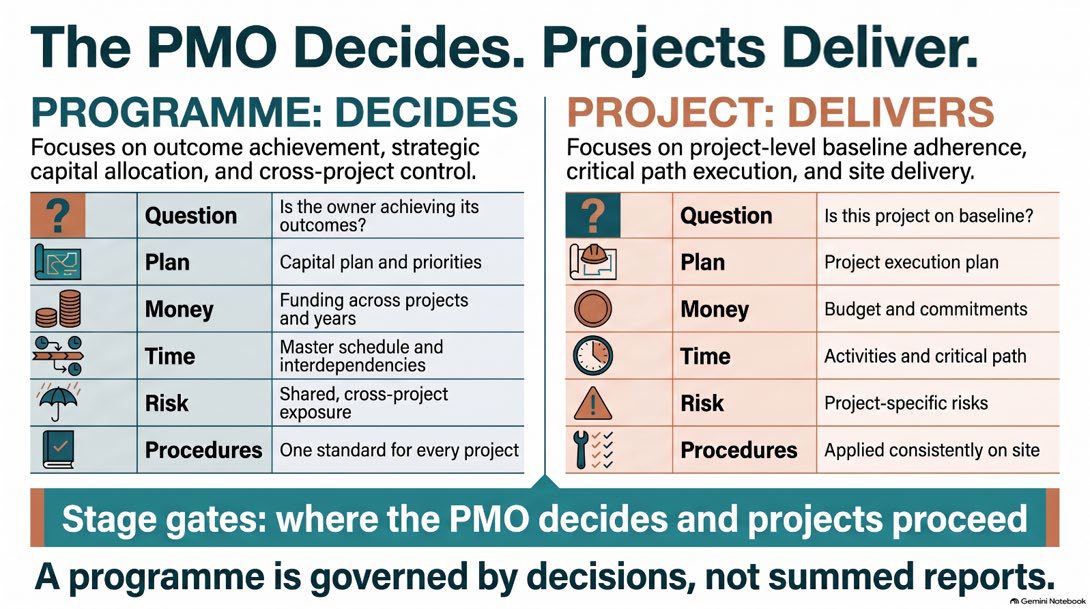
When a GCC owner appoints a PMC to act as its PMO, the question changes from "is this project on track?" to "is this programme delivering what the owner set out to achieve?" Answering it needs one set of rules, one set of data and one version of the truth across every project.
Many of the largest PMC appointments in the GCC are no longer for a single project. A PIF-backed giga-project appoints a PMC to run the delivery office across dozens of packages. A Kuwaiti ministry wants one to manage its schools programme. An Abu Dhabi infrastructure owner wants every road and utility project reported on one screen.
In each case the PMC is doing a different job. Programme management is about benefits, priorities, funding, interdependencies and governance: which projects proceed, in what order, with what money, under what rules. Project management then delivers each approved project within that framework.
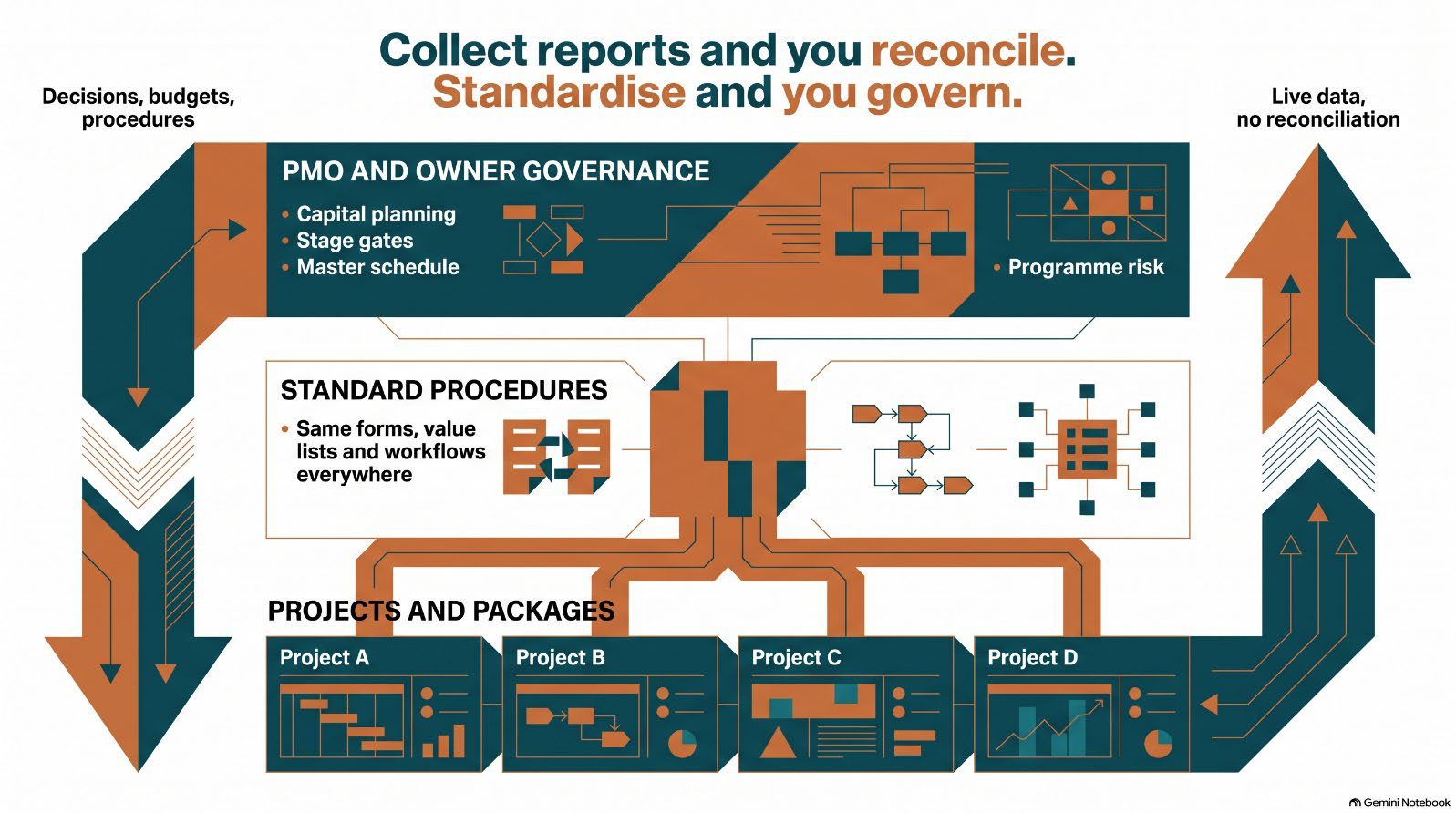
The problem is that many PMC firms run a programme with project tools. Each project keeps its own spreadsheet, reporting format and interpretation of the procedures. The PMO spends its week reconciling data rather than analysing it, and leadership receives a consolidated report that is out of date on the day it is issued.
What the CMAA Standard Expects
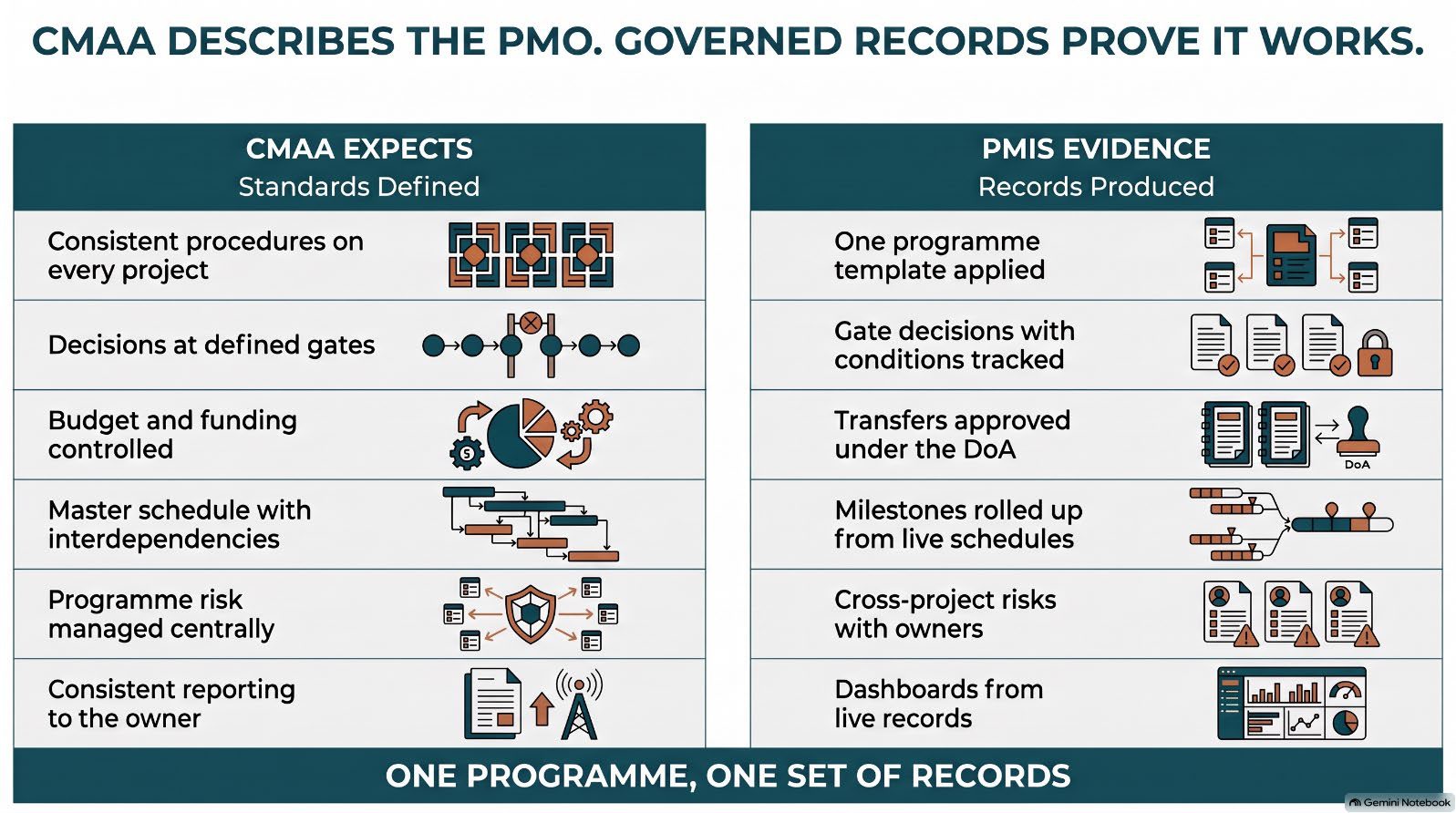
The CMAA Standard recognises that CM services can be delivered at programme level, managing a group of related projects for the owner. In general terms, it expects the programme manager to define objectives and priorities with the owner, establish consistent procedures and controls, maintain the programme budget and master schedule, coordinate resources and interfaces, manage programme risk, and report status consistently.
Programme execution and control
The programme manager is expected to apply the same procedures, controls and reporting across all projects, make or recommend decisions at defined gates, reallocate resources and funds within the owner's authority, and manage shared risks such as common contractors, utility connections or funding timing centrally.
Programme closeout and benefits
As projects complete, the programme manager is expected to make sure they are closed consistently, lessons learned are captured and applied to later projects, and the programme's intended outcomes are tracked beyond individual handovers.
At programme level the CMAA phases still apply, but they run in parallel across many projects at once. The PMO's job is to govern each phase the same way on every project.
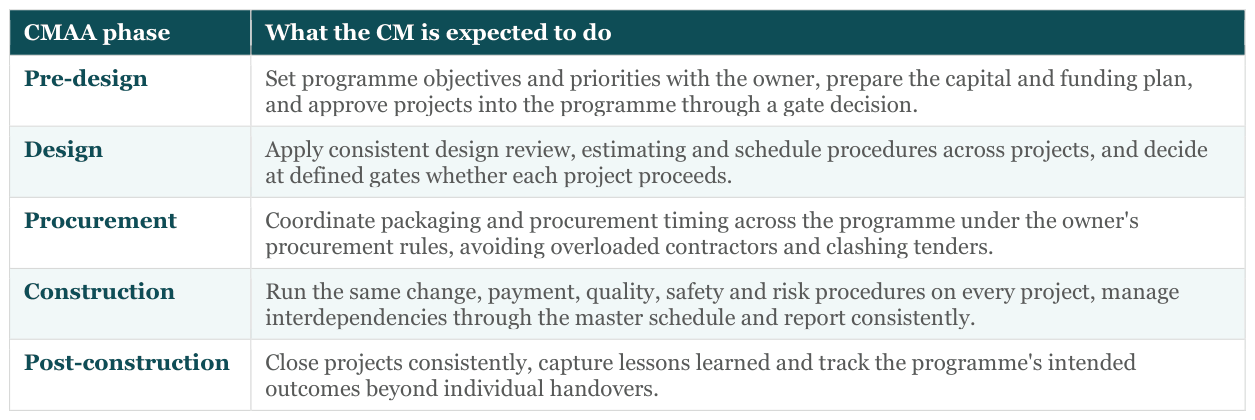
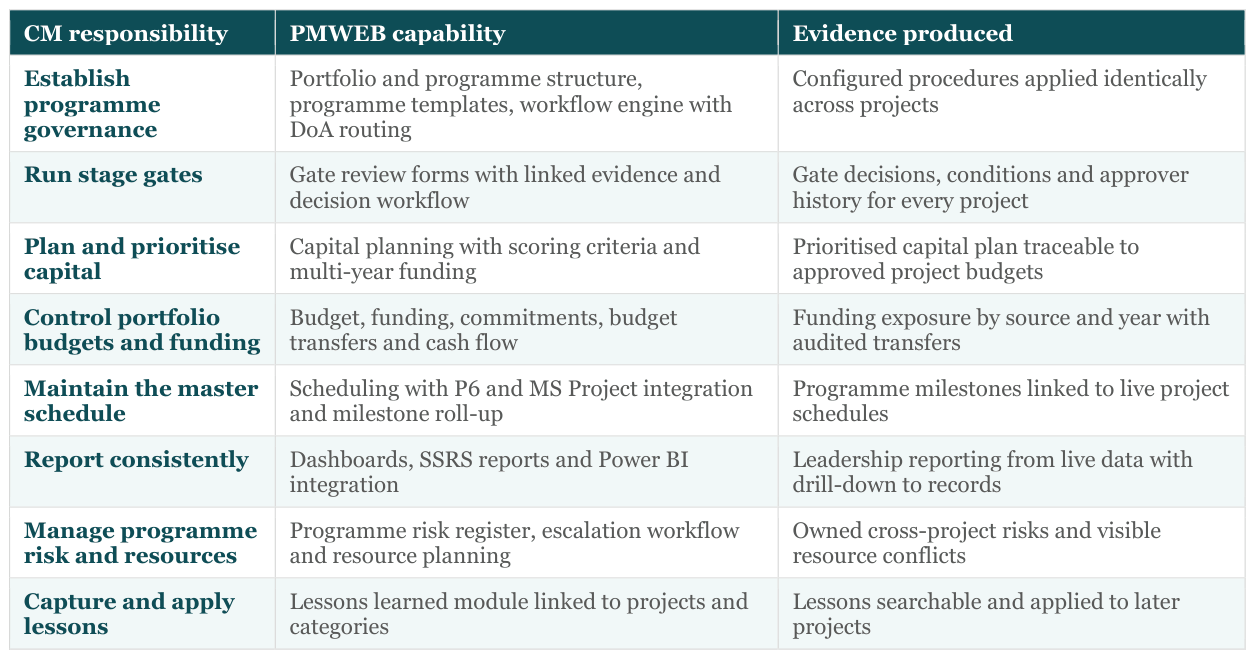
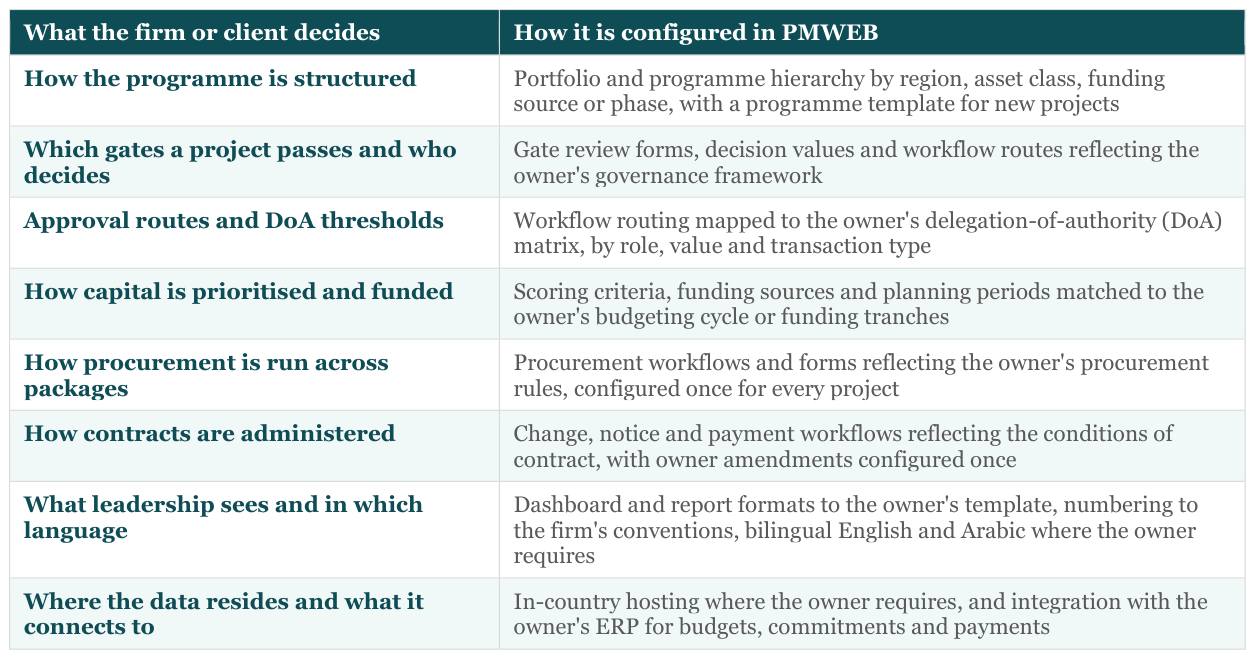
Every PMC firm has its own PMO methodology, and every owner its own governance culture. One owner wants gate recommendations; another delegates certain decisions to the PMC. One PMC uses a short gate sequence; another a longer one. The CMAA Standard stays the reference. PMWEB is configured to the firm's methodology and the owner's governance, then applied identically across every project.
How GCC PMC Firms Typically Do It Today
The pain points of running a PMO without a single system are familiar:
- Reporting by collection. Project managers submit reports in their own formats, and the PMO spends days reconciling them into a deck leadership questions immediately.
- Procedures that drift. Each team interprets the procedures manual differently, so change approvals, payment certification and RFI turnaround vary by project.
- Capital plan disconnected from delivery. Funding allocations live in finance spreadsheets and commitments in project cost reports; nobody sees funding exposure in real time.
- Master schedule as a drawing. The master programme schedule is a summary bar chart updated by hand, with no live link to the project schedules beneath it.
- Stage gates by email. Gate submissions are emailed packs; the decision, conditions and approvers are recorded in minutes, if at all.
- Programme risk invisible. Risks that span projects, such as a shared utility connection or a contractor overloaded across several packages, sit in no single register.
How PMWEB Digitalises It
PMWEB is built around a portfolio and programme structure, so the PMO is not an overlay on top of project tools. Programmes, projects and packages sit in one hierarchy, with the same modules, forms, value lists and workflows available at every level.
Where procedures differ legitimately, for example a design-build project alongside a traditional one, the variation is configured deliberately rather than improvised by the project team.
Stage gates
Each project's life cycle is configured as a series of gates. A gate review form collects the business case, estimate, schedule, risk assessment and procurement strategy as linked records. The workflow routes it to the reviewers, captures the decision (proceed, proceed with conditions, hold or stop) and records conditions as action items with owners and due dates. A project cannot move to the next phase until the gate is passed: a hard control, not a soft reminder.
Capital planning, prioritisation and portfolio budgets
Capital planning lets the PMO register candidate projects, score them against the owner's prioritisation criteria and model funding across years. Approved projects move into the programme with their budgets, giving a direct line from capital decision to project baseline. Commitments and forecasts roll up to show funding exposure by source and year, and budget transfers are governed by workflow under the DoA.
Master programme schedule
Project schedules in Primavera P6 or MS Project are integrated with PMWEB, and key milestones roll up into the master programme schedule. Interdependencies, such as a utility connection needed before several buildings can be energised, are visible at programme level the moment a project schedule is updated.
Standard procedures, templates and consolidated dashboards
Because every project uses the same forms and value lists, programme dashboards need no reconciliation. The PMO sees cost, schedule, change, quality, safety and risk across the programme on one screen, with drill-down to the record. SSRS reports and Power BI produce the leadership pack from live data, and the monthly report becomes a review rather than a collection exercise.
Resource planning and programme-level risk
Resource planning shows where the PMC's staff and the owner's approvers are allocated across projects, so conflicts surface before they become delays. Programme-level risks sit in a programme risk register linked to the
Two operating models: the PMC's instance or the owner's
PMC firms act as the owner's PMO in one of two ways. The PMC may run the programme on its own PMWEB instance, bringing a proven configuration to mobilisation and giving the owner, designers and contractors role- based access; this suits owners without their own PMIS. Or the PMC may operate inside the owner's PMWEB instance, within the owner's configuration, data standards and hosting; this suits owners who want continuity when PMC appointments change.
Both models work. What matters is that the decision is explicit in the appointment: who owns the configuration, who owns the data, how the data transfers at the end of the appointment, and which party's procedures prevail where they differ. In either case, the owner's data remains the owner's record.
The CMAA Standard describes what a programme manager does; the PMC's methodology and the owner's governance decide how. PMWEB is configured once to those decisions and then applied the same way on every project.
Evidence That the Practice Is Working
A PMC acting as the owner's PMO can test whether its programme management is working as the CMAA Standard intends by tracking indicators such as:
- Procedure consistency: the proportion of projects running on the programme template without unapproved local variations.
- Reporting latency: the time between a project event and its appearance in the programme dashboard.
Key takeaway
When a PMC acts as the owner's PMO, its value lies in governance, consistency and foresight across the programme, not in the volume of reports it produces. The CMAA Standard describes that role clearly; the challenge is executing it the same way on every project.
PMWEB lets each PMC firm bring its own PMO methodology, configured once and applied everywhere, whether on its own instance or inside the owner's. Standardised programme data gives leadership one version of the truth, gate by gate and project by project.
Next in the series: Article 13 — Technology Management: Governing the PMIS as the CM's System of Record

Next step
Bring this to your portfolio.
Tell us which processes matter most to you, and we will show them running in PMWEB.