
Article 4 of 14 · PMWEB for PMC Firms: Digitalising the CMAA Standards of Practice
Cost Management: From Budget to Final Cost Reconciliation
Owners do not hire a PMC to report what was spent. They hire it to know, at any moment, what the project will cost at completion and why. That answer only exists if every cost event, from budget to final account, is linked in one record.
Cost management is where a PMC firm's credibility with its client is won or lost. A Kuwaiti ministry wants to know whether the approved budget will hold. A Dubai master developer wants to know how much contingency remains across a phase before releasing the next. A PIF-backed giga-project wants a forecast it can take to its board with confidence. In each case the question is the same: what is the estimate at completion, and how do we know?
In most PMC practices the answer is assembled rather than retrieved. The budget sits in one workbook, the commitments in another, the change log in a third, and the payment position in the contractor's application. Forecasts are built by the cost manager each month by reconciling these sources, and the reconciliation itself becomes the work. When a variation is disputed or an auditor asks how contingency was used, the trail has to be reconstructed.
The CMAA Standard describes cost management as a continuous discipline running from the first budget to the final cost reconciliation, with each stage building on the last. The challenge for a PMC firm is not understanding that discipline; it is executing it across dozens of projects, with different contract forms and different client approval chains, without losing the thread.
This article follows the cost life cycle from budget to final account and shows how PMWEB executes and evidences each step. Each PMC firm and each client manages cost in its own way, with its own cost breakdown structure, approval thresholds and reporting formats. PMWEB is configured to the firm's procedures; the CMAA Standard stays the reference.
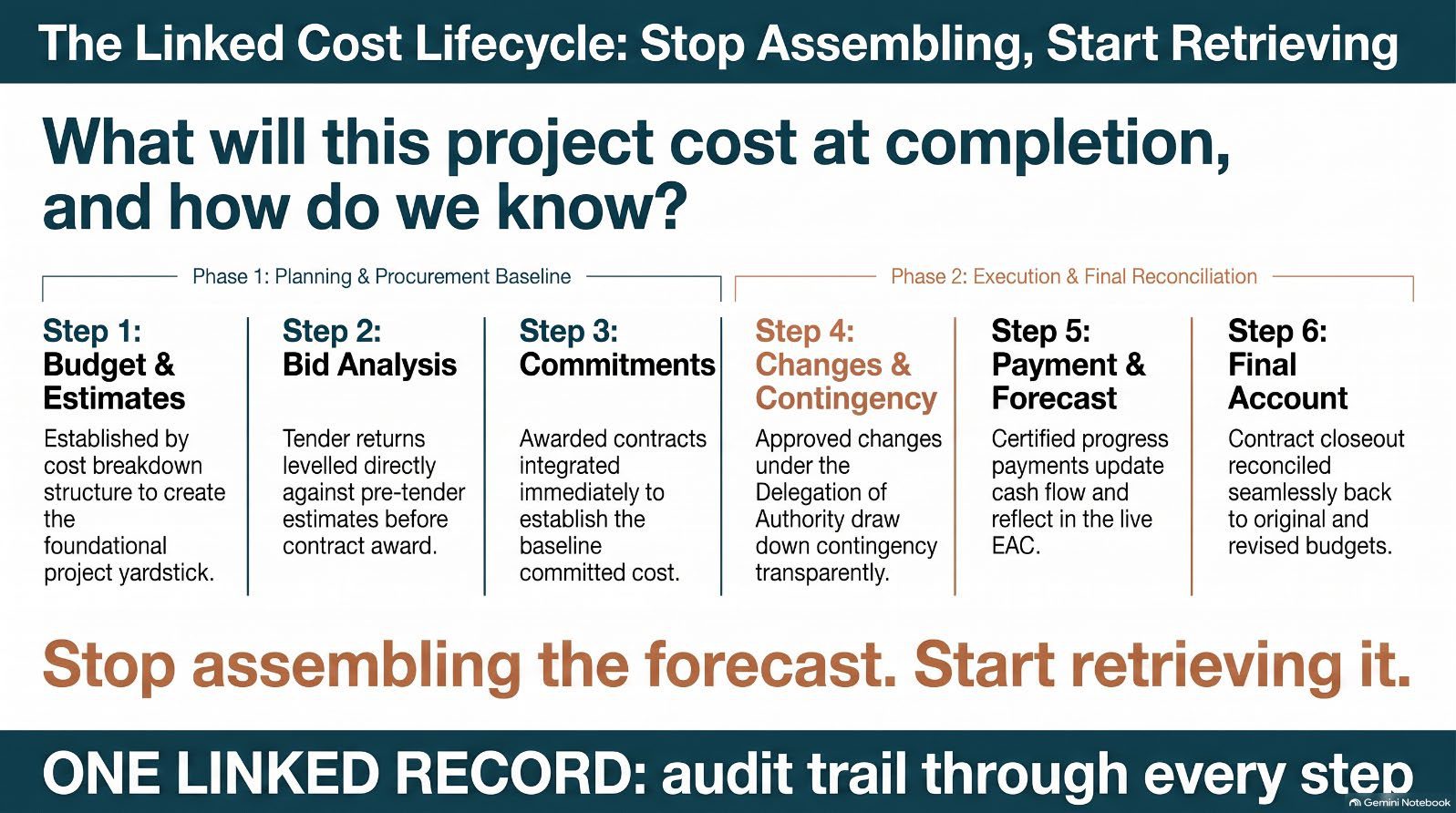
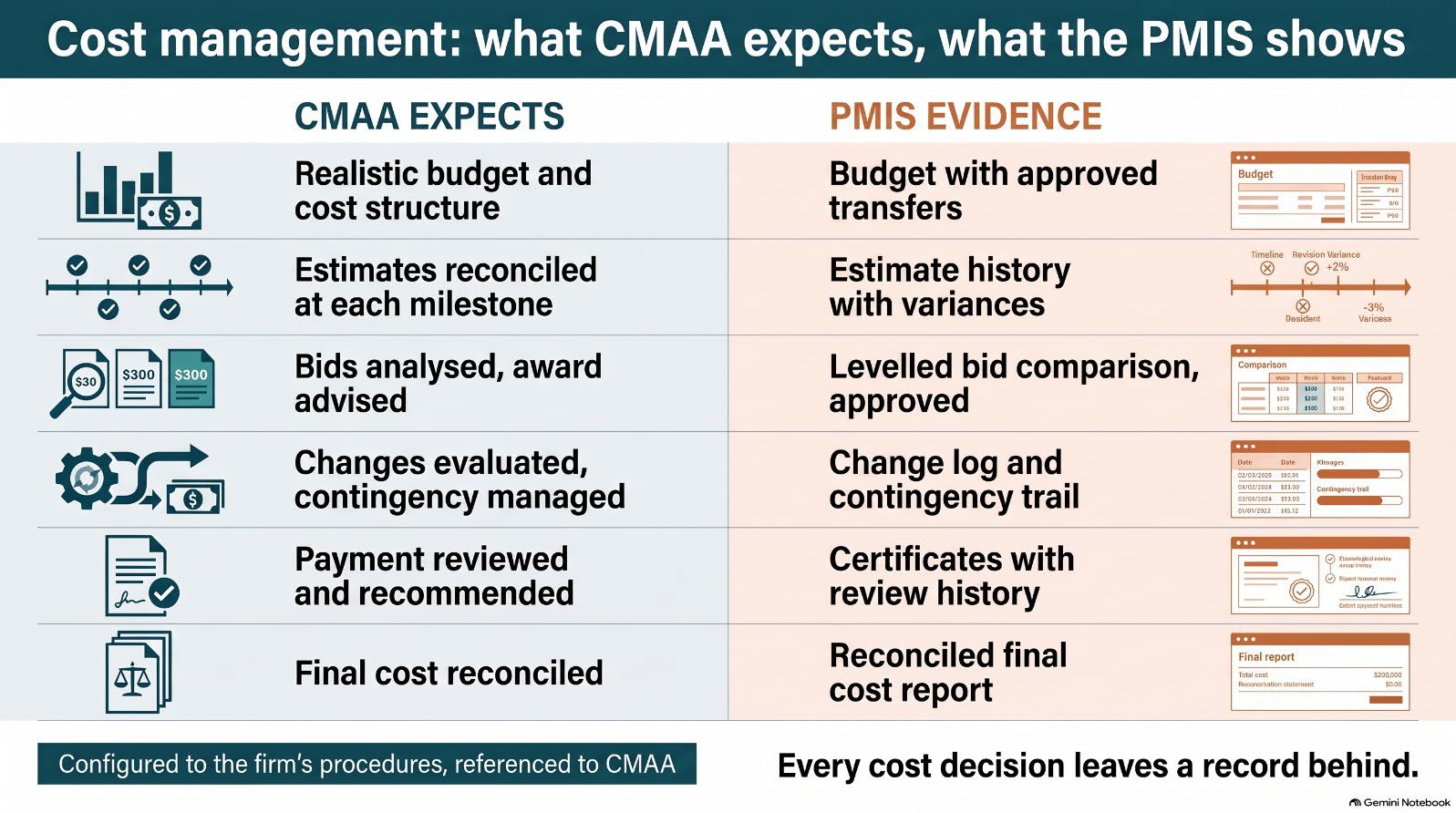
The CMAA Standard expects the CM to manage cost across every phase of the project and to be the owner's independent source of cost truth throughout. The expectations build on each other: the budget set in pre-design is the yardstick for every estimate in design, the estimates inform the evaluation of bids, the awarded contracts become the committed baseline, and every change, payment and forecast during construction is measured against it until the final cost is reconciled.

How GCC PMC Firms Typically Do It Today
- Budget, commitments and changes live in separate files. The cost report is a monthly reconciliation exercise rather than a live view.
- Estimates are disconnected from the budget. Design-stage estimates are produced in estimating tools or workbooks and compared to the budget by hand, so the estimate history is hard to trace.
- Pending changes are invisible until approved. Potential exposure is held in the cost manager's head or a private log, so forecasts understate risk.
- Contingency drawdown is not traceable. It is difficult to show which approved change consumed which part of the contingency, and under whose authority.
- Payment reviews are paper-based. Contractor applications are checked against spreadsheets, and the payment certificate is issued as a document with no structured link to the schedule of values or retention balance.
- The finance system and the cost report disagree. Commitments and payments in the client's ERP do not match the PMC's report, and month-end is spent explaining the difference.
How PMWEB Digitalises It
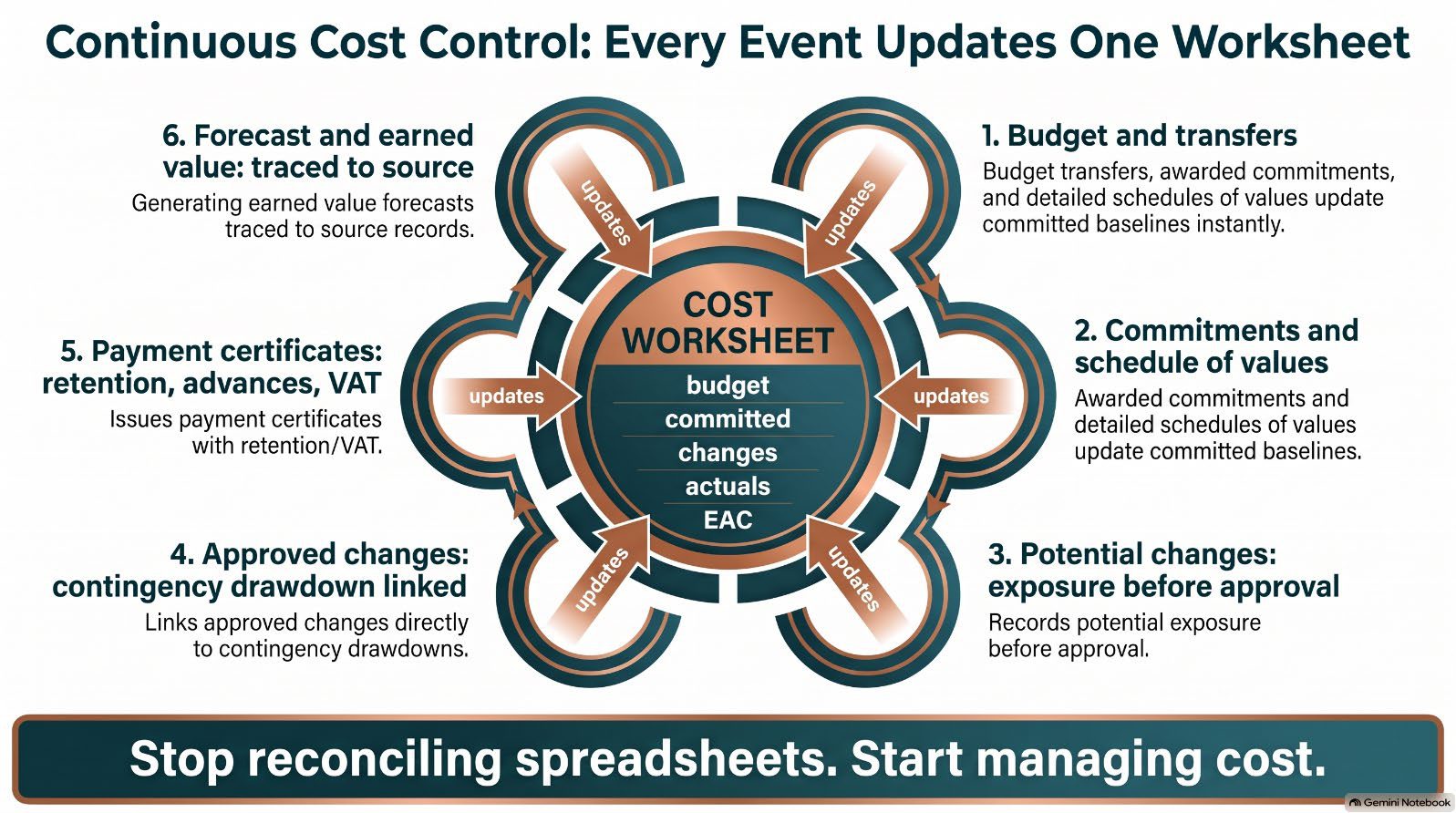
PMWEB treats cost as one linked data model rather than a set of documents. The budget, estimates, commitments, changes, payment certificates and forecasts all use the same cost breakdown structure, so each record updates the same cost worksheet.
Budget, funding and estimates
The approved budget is loaded against the project's cost breakdown structure, with funding sources recorded against it where the client requires. Budget transfers are handled as workflow-approved records rather than cell edits, so the original budget, approved transfers and revised budget are always visible. Estimates are held in PMWEB at each design milestone, classified using the firm's own estimate classification, and compared line by line with the budget and with the previous estimate. Value engineering proposals are captured as structured records with the option, the estimated saving, any life-cycle cost effect and the decision, so the reasoning survives beyond the workshop.
Bid analysis and commitments
Tender returns are levelled and compared with the pre-tender estimate in a bid analysis record, and the award recommendation follows the owner's approval route. On award, the commitment is created with its schedule of values, retention terms, advance payment and any bonds, and it becomes part of the committed cost on the cost worksheet. Where the client's ERP is the system of record for purchase orders, the commitment is synchronised through PMWEB's open APIs or its established integrations with SAP, Oracle or Microsoft Dynamics, so both systems show the same committed value.
Payment certification and cash flow
Contractor progress invoices are submitted against the schedule of values, reviewed line by line by the PMC, and routed for approval. The payment certificate calculates work done to date, previous payments, retention, advance payment recovery and VAT, and is issued with its full review trail. Approved payments update the actual cost column and the cash flow, which compares planned, forecast and actual expenditure over time so that the client's treasury and funding cycle can be planned.
Forecasting and earned value
Forecasting is where the linked model pays off. The estimate to complete can be set per cost line using the method the firm prefers, whether by remaining commitment plus exposure, by performance factor or by bottom- up reassessment, and the estimate at completion follows. Where the client requires earned value, PMWEB combines the cost baseline with progress from the schedule, integrated with Primavera P6 or MS Project, to calculate planned value, earned value, cost and schedule variances and performance indices. The forecast is therefore explainable: every number traces back to a budget line, a commitment, a change or a progress measurement.
Final cost reconciliation
At closeout, the final account for each commitment is reconciled against its schedule of values, approved changes, payments and retention release. The project's final cost is reconciled with the budget, with every variance explained by the change and contingency records behind it. What would otherwise be a months-long exercise becomes a review of records that already agree with each other.

Configuring PMWEB to Your Firm's Procedures
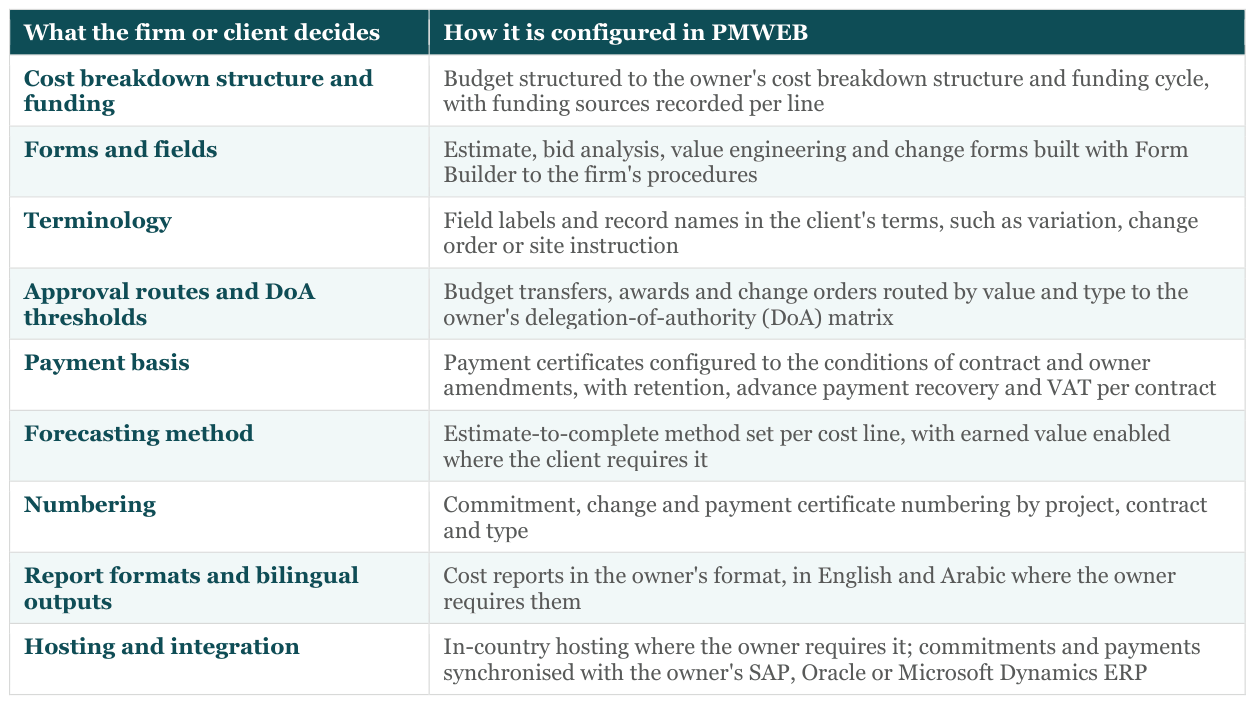
The CMAA Standard sets out what cost management must achieve; how a given firm and client structure, approve and report cost is theirs to decide. Each of those decisions is a configuration choice in PMWEB, held in the firm's cost templates and tailored per client.
Evidence That the Practice Is Working
- Forecast traceability. The proportion of the estimate at completion that traces directly to budget, commitment, change and payment records.
- Estimate reconciliation. Design-stage estimates reconciled to budget at each milestone, with variances explained.
- Change cycle time. Time from potential change order to approved change order or rejection.
- Pending exposure visibility. Potential and requested changes recorded with an estimated value before approval.
- Contingency transparency. Contingency drawdowns linked to an approved change order and approver.
- Payment review timeliness. Payment certificates issued within the contractual period after receipt of the contractor's application.
- ERP agreement. Commitments and payments in PMWEB matching the client's finance system at period end.
Key takeaway
Cost management under the CMAA Standard is a continuous discipline from budget to final cost reconciliation. When budget, estimates, commitments, changes, payment certificates and forecasts share one cost breakdown structure in PMWEB, the estimate at completion becomes something the PMC can retrieve and explain at any moment, rather than rebuild each month.
This is alignment, not certification. Each firm and client will structure cost in its own way, with its own thresholds and reports, and PMWEB is configured to them. The result is an auditable financial trail that the owner, its finance function and its auditors can trust.
Next in the series: Article 5 — Time Management: Schedules as Governance Instruments

Next step
Bring this to your portfolio.
Tell us which processes matter most to you, and we will show them running in PMWEB.