
Article 8 of 14 · PMWEB for PMC Firms: Digitalising the CMAA Standards of Practice
Contract Administration II: Notices, Claims Avoidance and Closeout
Most construction disputes are not lost in the arbitration room. They are lost on site, months earlier, in a notice that was never sent, a daily report that was never signed, or a letter that nobody can find. The PMC that controls its records controls the outcome.
Article 7 covered RFIs, change management and payment certification. This article covers the part of contract administration that carries the most commercial weight: contractual notices, the claims regime, dispute avoidance and the often neglected road from substantial completion to final account.
On major GCC projects, the conditions of contract, usually with the owner's own amendments, set a strict claims regime. Notices must be given within defined periods, fully detailed claims must follow within further defined periods, and the owner's representative or the Engineer named in the contract is expected to consult and then make a determination within its own time limits. Miss a period and entitlement can be lost. For a PMC in that role, this is the difference between an agreed final account and a formal dispute or arbitration.
Closeout carries its own risk. Completion certificates are issued with long snag lists, O&M manuals and as-built drawings arrive late and incomplete, warranties sit in email attachments, retention is released without a clear check that defects have been made good, and the lessons that could protect the next project are never written down. Each PMC firm handles these steps in its own way, and each owner has its own closeout requirements. What should not vary is the discipline: every notice tracked, every claim analysed against contemporaneous records, every closeout obligation verified before money is released.
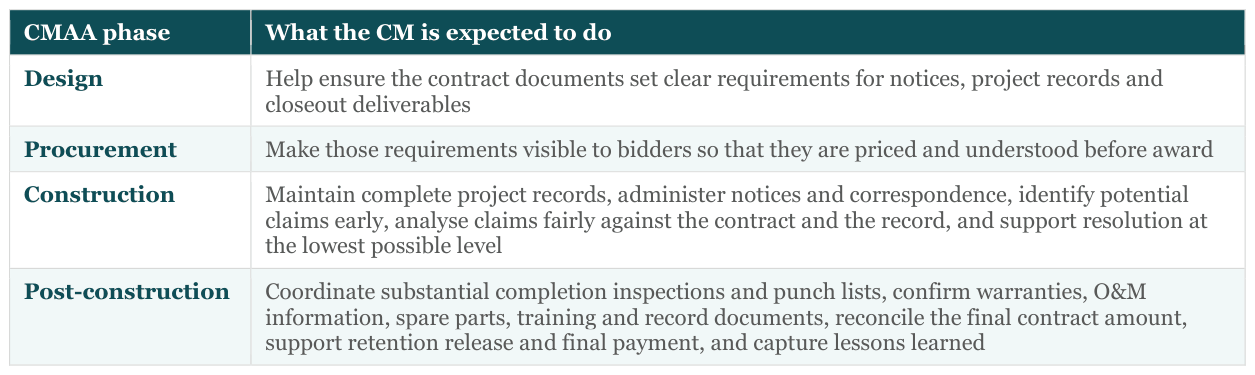
What the CMAA Standard Expects
The groundwork is laid earlier. When the CM helps the owner prepare the contract documents, clear requirements for notices, project records and closeout deliverables make the later administration far easier to perform and to evidence.
How GCC PMC Firms Typically Do It Today
- Notices live in the correspondence system, not in a register. Letters are logged by reference number, but nobody tracks which letters are contractual notices, which time bar they trigger and when the response period ends.
- Daily reports are completed but not used. Site teams fill in daily reports on paper or spreadsheets, often late, and they are rarely linked to the events they would later need to prove.
- Claims arrive as thick documents with thin evidence. When a contractor submits a detailed claim, the PMC team spends weeks reconstructing what happened from email and PDFs because the records were never structured.
- Determinations are drafted from scratch. The PMC's assessment and determination are prepared in Word, with no link back to the claim log, the programme or the cost records, and no view of the cumulative effect of claims on the contract.
- Closeout is a chase. Snag lists, O&M manuals, as-builts, warranties and spare parts are tracked on separate spreadsheets by different people, so retention release and the final account are delayed or, worse, made without full verification.
- Lessons learned are a meeting, not a record. Slides are circulated and nothing is captured in a form the next project can search.
How PMWEB Digitalises It
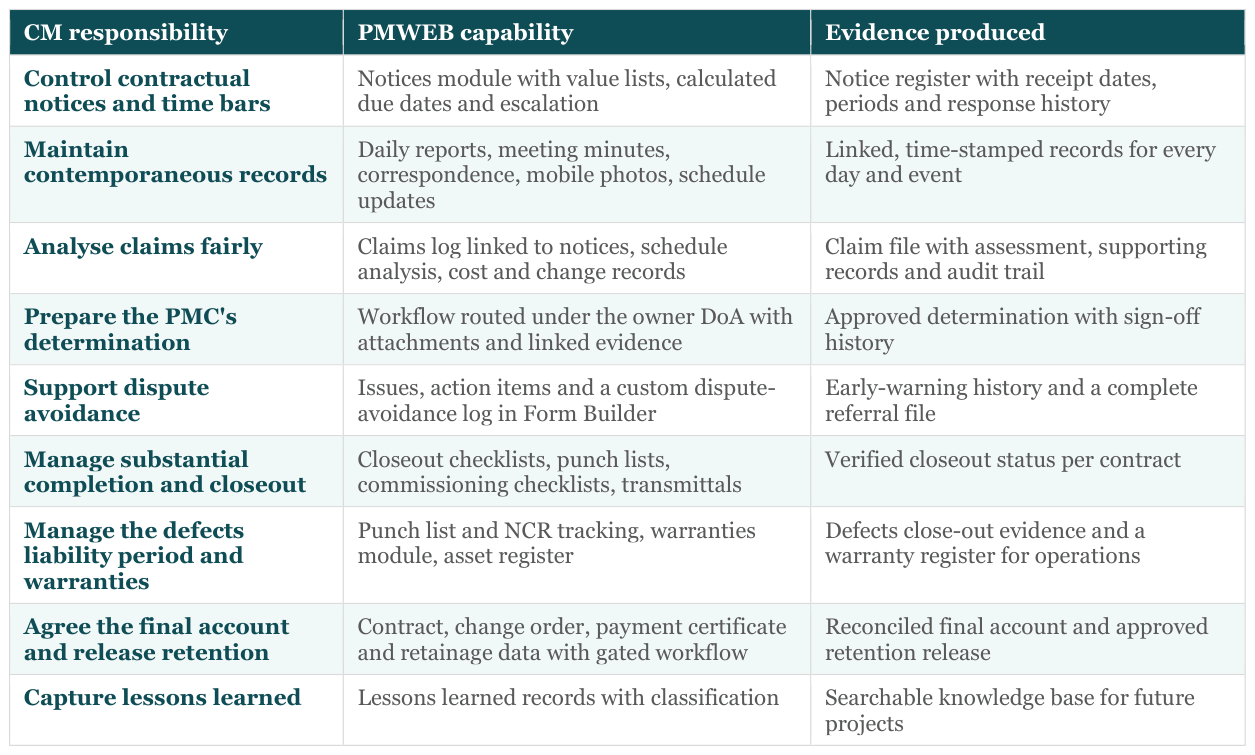
PMWEB does not replace the PMC's professional judgement. It gives the PMC a structured place to execute each step of the contract regime, links each record to its evidence and keeps an audit trail. Each firm configures forms, value lists and workflows to its own procedures and to the particular conditions of contract.
Notices and time bars
PMWEB's notices module records each contractual notice as a structured record rather than a letter in a folder. The record captures the contract, the party giving notice, the notice type from a value list, the event date, the date the notice was received, the governing contract clause as configured by the firm, and the response period that applies. The workflow engine calculates due dates and escalates approaching deadlines to the responsible PMC team member and the project manager. Incoming and outgoing correspondence is logged in the correspondence module and linked to the notice, so the chain of letters for any event can be seen in one place.
This works in both directions: it records whether a contractor's notice arrived within the period, and it makes the PMC's own obligations to respond, consult and determine within time limits visible and tracked.
Contemporaneous records
Claims avoidance starts with records made at the time. PMWEB daily reports capture manpower, equipment, weather, activities and events, with photos from the mobile app. Meeting minutes record decisions and actions. Schedule updates, integrated with Primavera P6 or MS Project, are stored period by period. Because each is a structured record, a notice or claim links directly to the records that relate to it.
Dispute avoidance
The CMAA Standard puts the weight on resolving disagreements at the lowest possible level. The PMC's contribution is to surface issues early and keep the record complete. In PMWEB, issues and action items track emerging disagreements before they become claims, and a custom form in Form Builder can log dispute- avoidance meetings, escalations and any referral to the dispute resolution mechanism the contract provides.
Completion, defects and final account
Closeout in PMWEB is managed through closeout checklists configured to the owner's requirements. The checklist brings together the items that must be complete for substantial completion and for final completion: punch list items closed, commissioning checklists signed off, O&M manuals and as-built drawings received and accepted through transmittals, training delivered, spare parts handed over and warranties recorded in the warranties module with their start and expiry dates. After substantial completion, defects notified during the defects liability period are tracked as punch list or non-conformance records with their close-out evidence. Assets and warranties can be passed to the asset register for the owner's operations team.
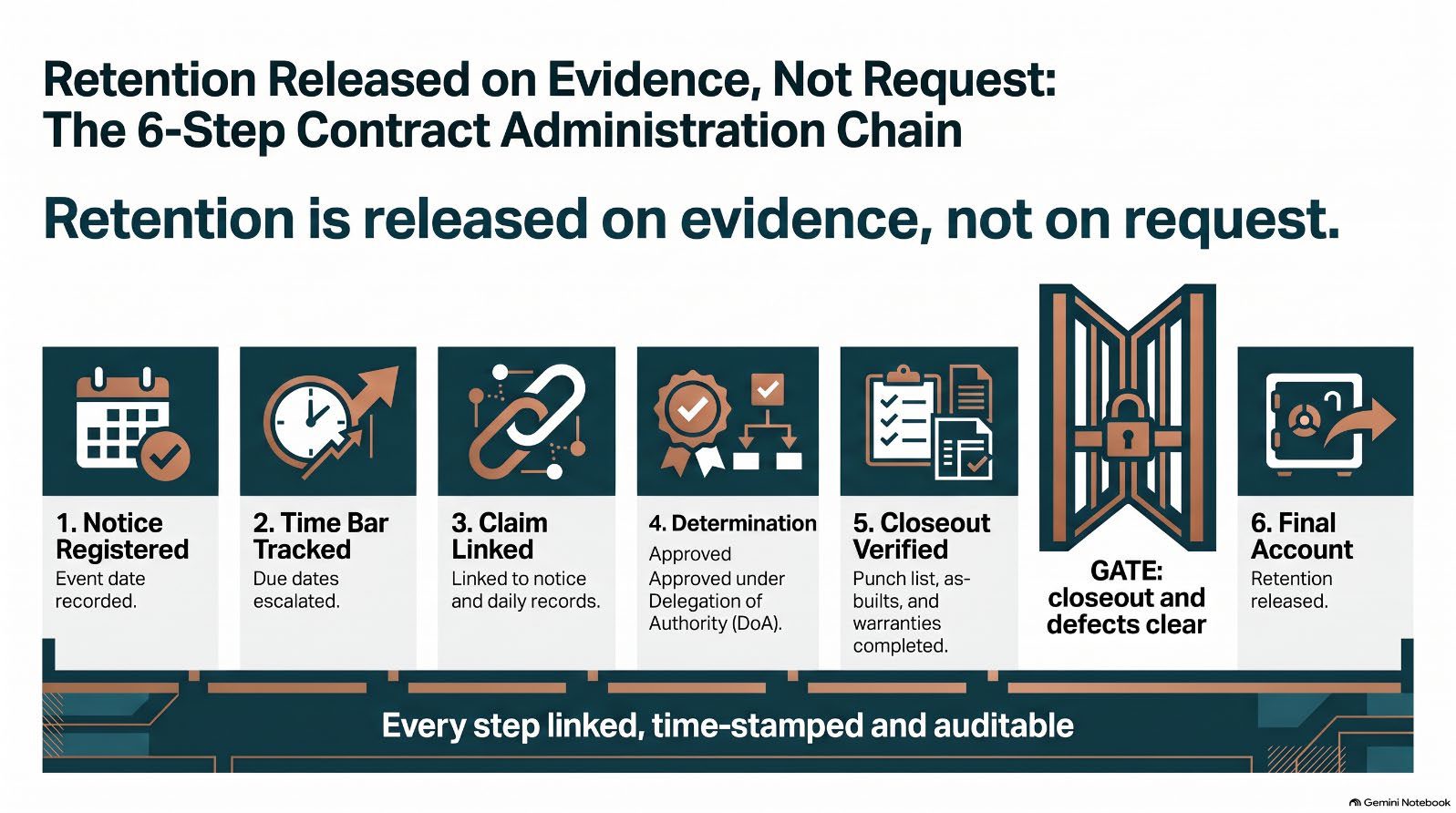
The final account is prepared from the data already in the system: original contract value, approved change orders, agreed or determined claims, payment certificates issued, retention held and any deductions. Retention release is routed through a workflow that checks the closeout checklist and defects status before it can be approved. Finally, lessons learned are captured as structured records, classified by discipline and topic, so they can be searched by the next project team.
Configuring PMWEB to Your Firm's Procedures
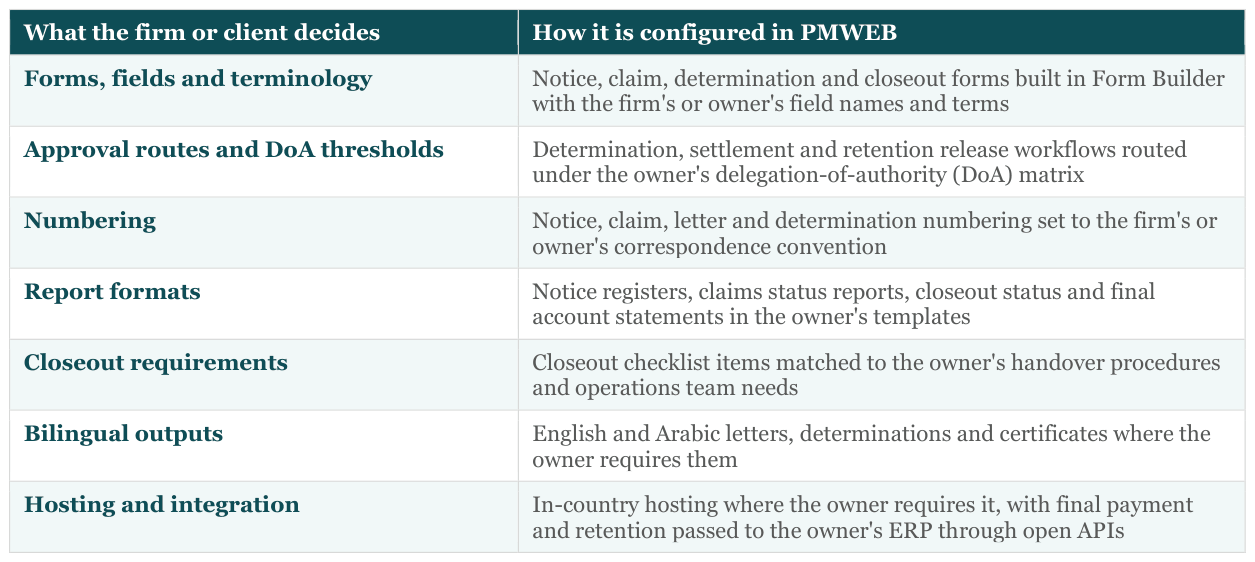
The CMAA Standard stays the reference; the way each PMC firm and each owner administer notices, claims and closeout does not. PMWEB is configured to the firm's and the client's procedures rather than imposing one method.

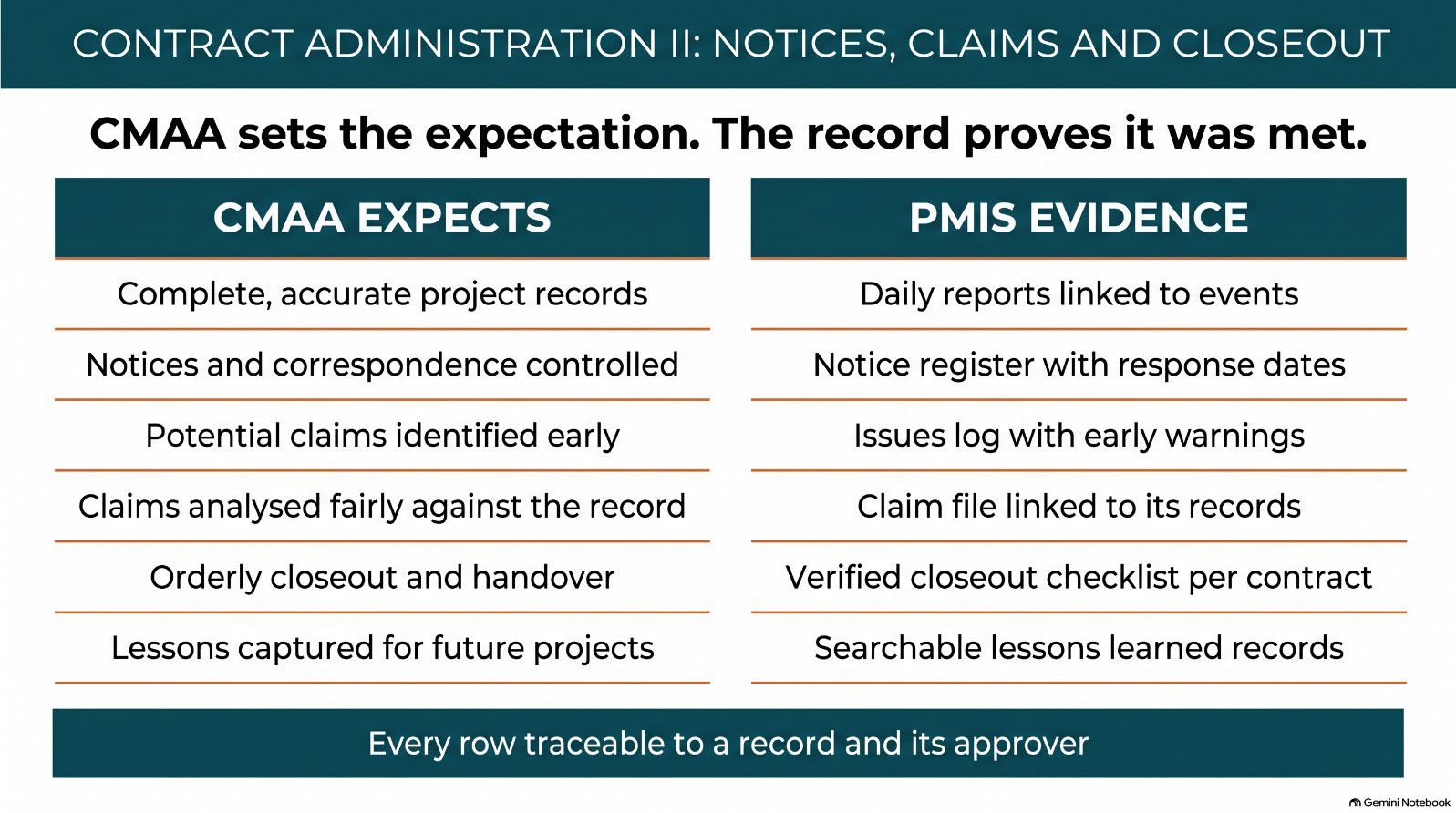
Evidence That the Practice Is Working
Useful indicators, all measurable from PMWEB records, include:
- Notice response timeliness: the share of contractual notices acknowledged and responded to within the configured period.
- Record completeness: daily reports submitted and approved on the day they cover, per contract.
- Claim linkage: the proportion of claims in the claims log linked to their originating notice and supporting contemporaneous records.
- Determination cycle time: elapsed time from receipt of a fully detailed claim to issue of the determination.
- Dispute escalation rate: the number of claims referred to the contract's dispute resolution mechanism compared with those agreed or determined without referral.
- Closeout readiness: open items on closeout checklists at substantial completion and their ageing through the defects liability period.
Key takeaway
Claims avoidance is a records discipline. The PMC that registers every notice, tracks every time bar and links every claim to the daily record gives the owner a fair and defensible position, and gives the contractor a clear and timely answer. That is what the CMAA Standard's emphasis on prevention looks like in practice.
Closeout is where the value of the whole project is either secured or lost. When closeout checklists, warranties, as-builts and the final account are managed as linked records in PMWEB, configured to the firm's procedures and the owner's conditions of contract, retention is released on evidence, the owner inherits usable asset information and the next project inherits real lessons. The CMAA Standard as the reference, the firm's procedures as the method, the record as the proof.
Next in the series: Article 9 — Safety Management

Next step
Bring this to your portfolio.
Tell us which processes matter most to you, and we will show them running in PMWEB.