
Article 13 of 14 · PMWEB for PMC Firms: Digitalising the CMAA Standards of Practice
Technology Management: Governing the PMIS as the CM's System of Record
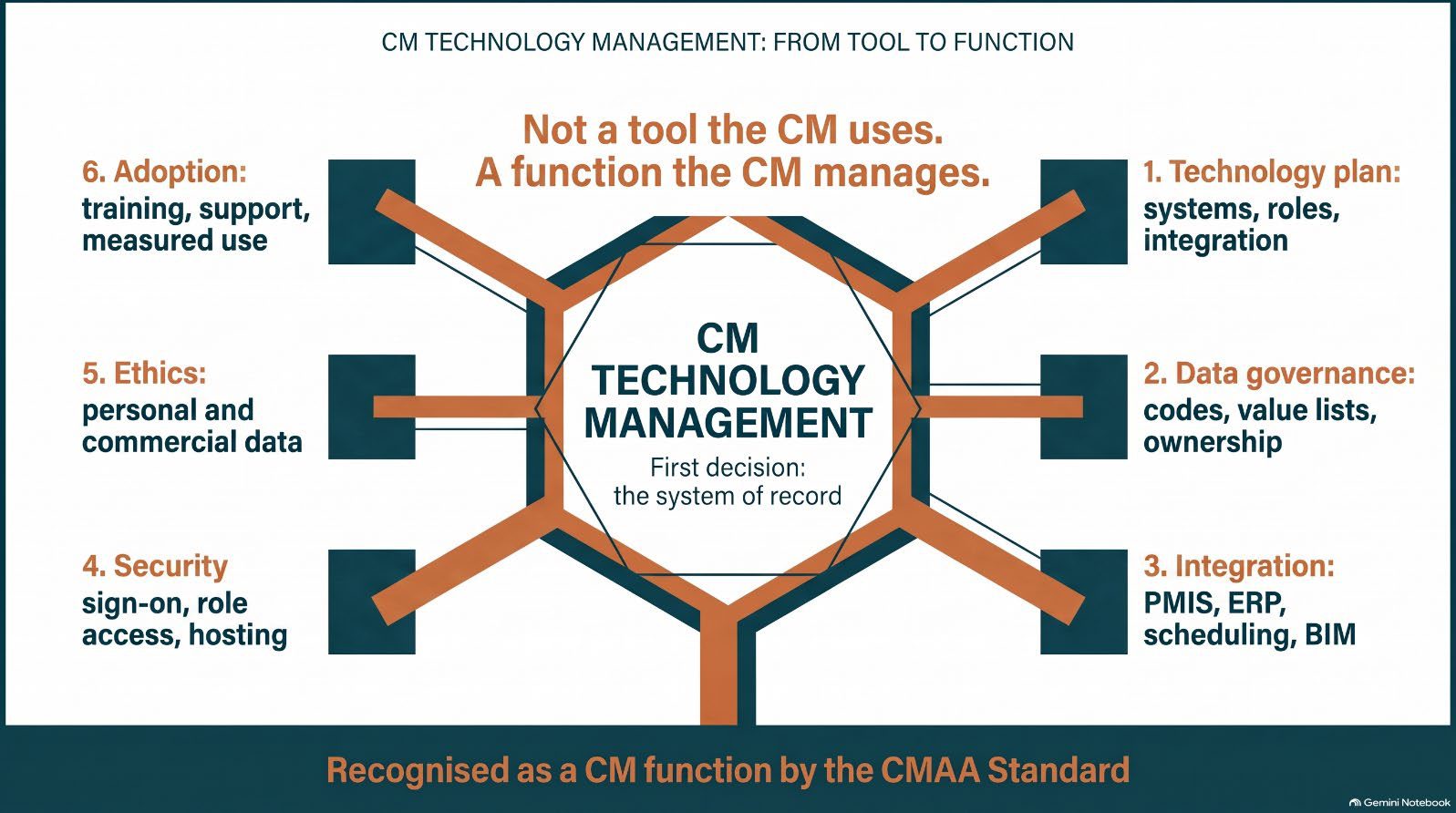
Technology is no longer something the CM simply uses; it is something the CM is expected to manage. The PMC that deliberately plans, configures, integrates, secures and governs the system holding its record of decisions, money, time and quality is the PMC that can prove its practice on every project.
Over the previous twelve articles, this series has walked through the functions of construction management, from delivery methods to programme management. In each, the same pattern appeared. The CMAA Standard describes what a competent CM does, each PMC firm executes that practice its own way, and the proof lives, or fails to live, in the data.
That makes technology the function that holds the others together. The 2021 edition of the CMAA Construction Management Standards of Practice recognised this by adding technology management as a CM function in its own right: choosing, configuring, integrating, securing and governing project technology is part of the CM's professional responsibility, not a task to hand entirely to IT.
In the GCC, the question arrives in a practical form. Owners run ERP platforms, scheduling tools, BIM models and their own IT policies, and they expect the PMC to fit into that landscape on day one. The PMC that treats its PMIS as a governed system of record, rather than as one more tool, is the one that can answer the owner's questions with evidence. This article sets out the technology management practice the CMAA Standard expects and how PMC firms govern PMWEB to deliver it.
What the CMAA Standard Expects
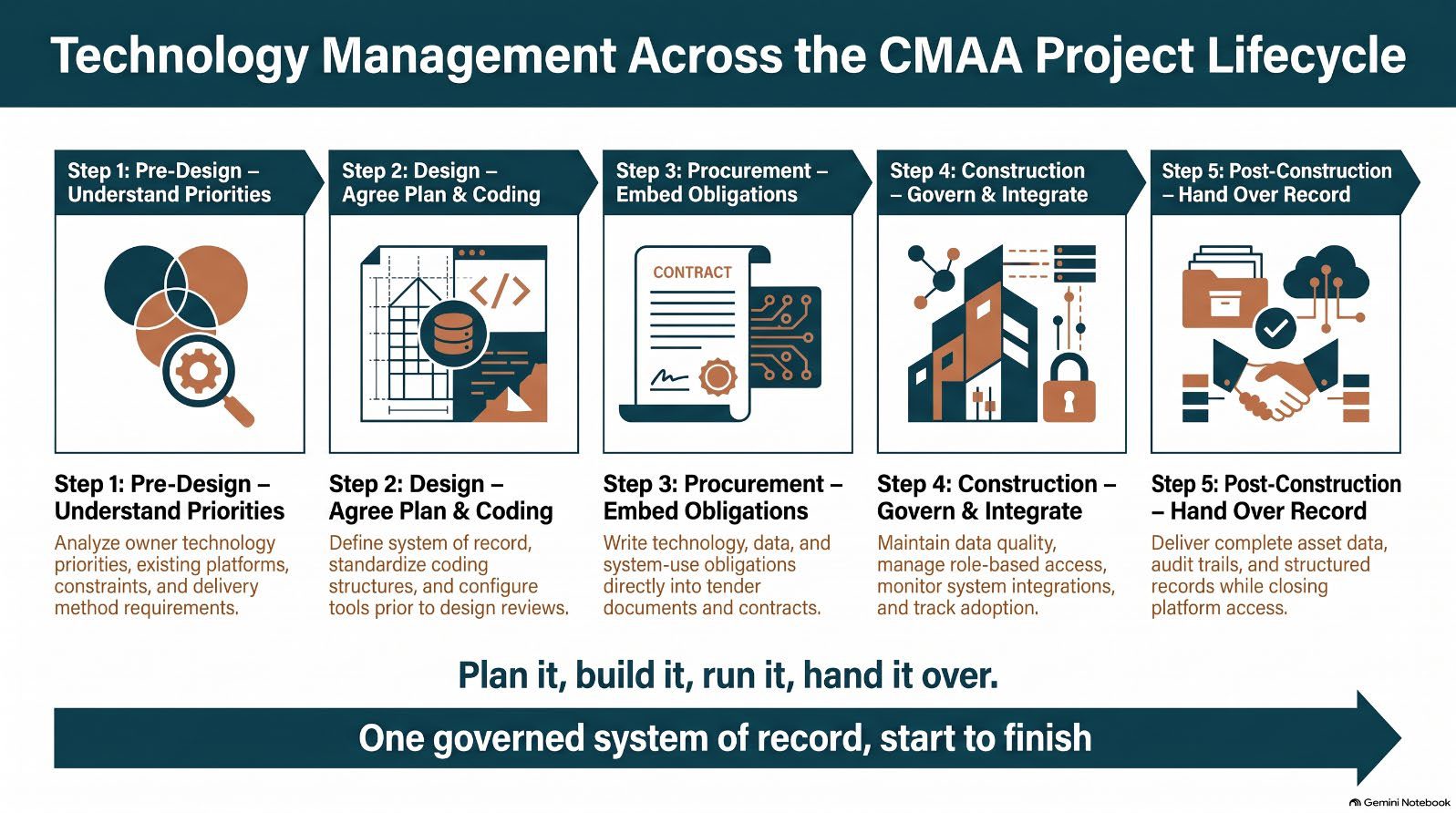
The CMAA Standard now expects the CM to take an active role in technology management. In general terms, it expects the CM to understand the owner's technology priorities and constraints, help plan which technology is used and how, make sure the right information is captured, controlled and available, protect it, and hand it over in a form the owner can use.
Planning and mobilisation
The CM is expected to understand what technology the owner has, what it needs to achieve, what investment is justified and what the delivery method implies for who uses which system. The result is a technology plan: the system of record for each process, roles and permissions, data standards and coding structures, integration points and security requirements.
Execution
The CM is expected to operate the agreed systems consistently, maintain data quality, manage access as people join and leave, keep integrations working, protect sensitive information and support users.
Handover and retention
The CM is expected to deliver records, asset information and the audit trail in a usable, structured form, in line with the owner's retention policies.
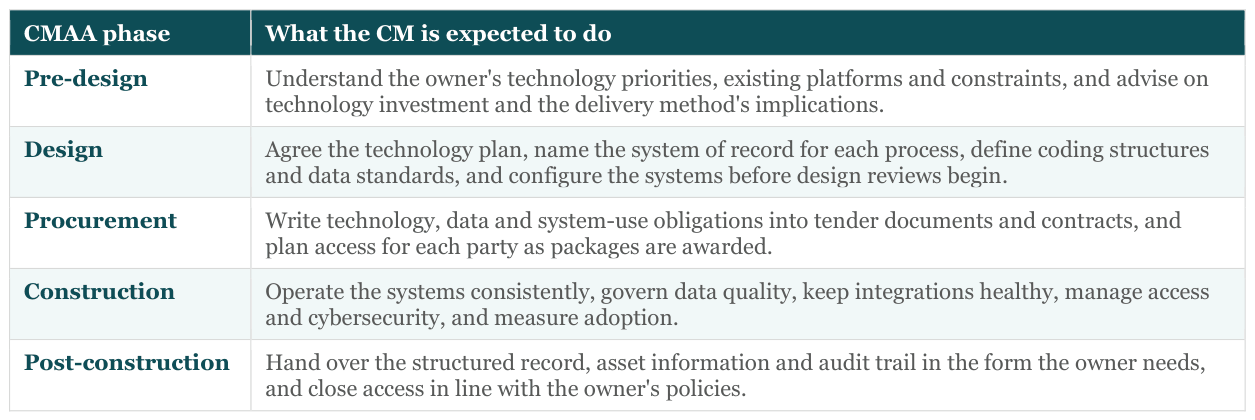
As in every function, each PMC firm executes technology management its own way. Some have a digital delivery team; others rely on project controls leads. Some owners mandate their own platforms; others expect the PMC to bring them. The CMAA Standard stays the reference; the technology plan and the PMWEB configuration follow the firm's practice and the owner's requirements.
How GCC PMC Firms Typically Do It Today
The gaps are familiar across the region:
- No explicit system of record. Change orders exist as PDFs in a shared folder, in a spreadsheet as a log and in the ERP as commitments, and they do not agree.
- Technology chosen by default. Tools accumulate project by project, chosen by whoever mobilised first, with no decision on which one holds the CM's record.
- Coding structures that differ. Cost breakdown, WBS, ERP cost centres and document numbering use different codes, so integration becomes monthly manual mapping.
- Access managed by spreadsheet. Accounts are created on request and rarely removed; former consultants keep access long after they leave.
- Integration by export. Data moves between systems by exported files, uploaded late and reconciled by hand.
- Adoption assumed. A single training day at launch, and within months key processes drift back to email.
How PMWEB Digitalises It
The system-of-record decision
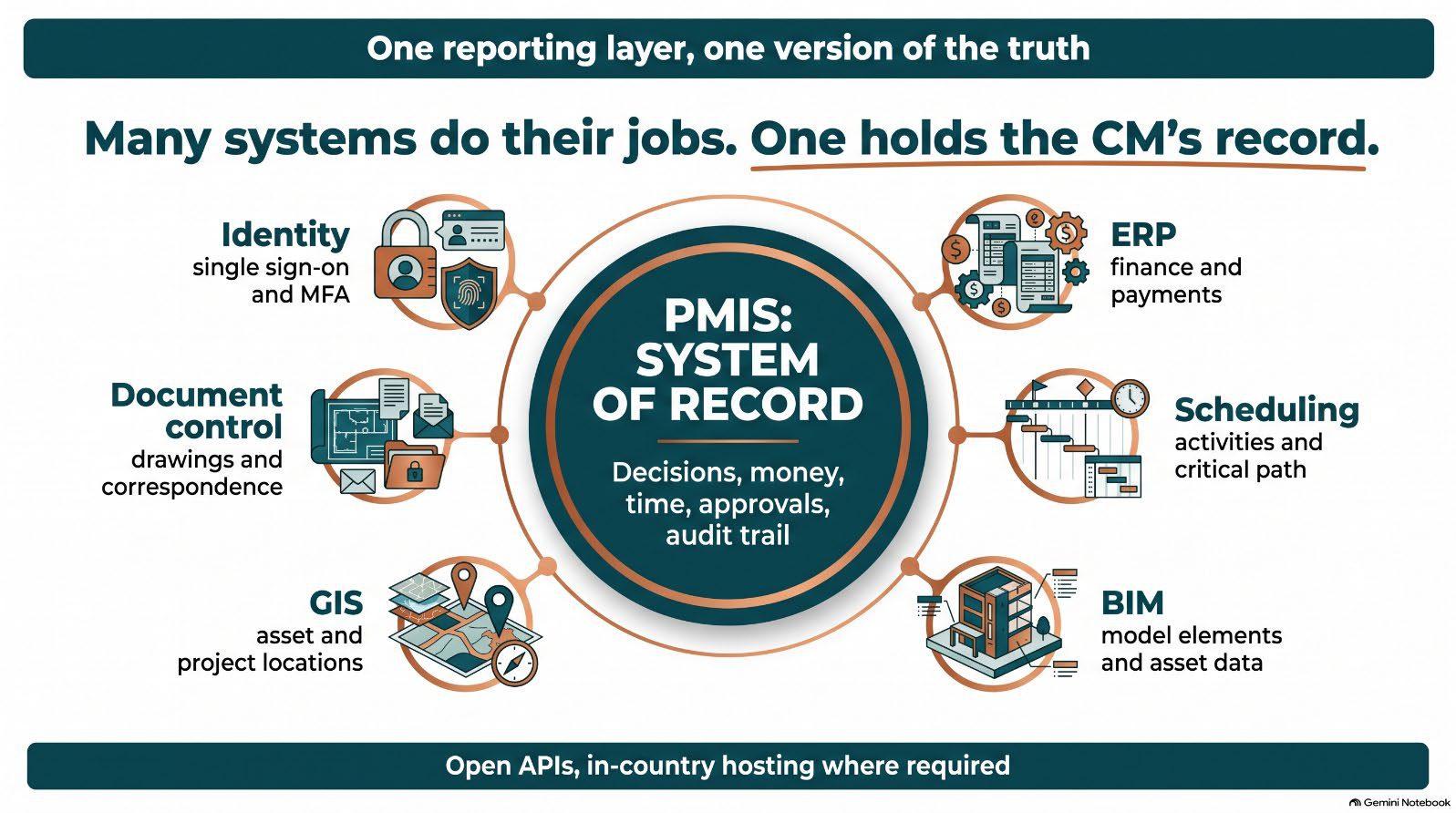
The CM's record is the record of business processes and the data they create: budgets and revisions, commitments and schedules of values, potential change orders, change order requests and change orders, These are not documents with a status. They are structured records with fields, calculations, relationships and rules. A change order updates the committed cost, draws down contingency, triggers an approval level under the DoA, may carry a time extension and adds to the cumulative variations on the contract. The CMAA Standard expects the CM to control cost, time, quality, contracts, safety and risk and to prove that it did, and that proof is in the process data: who decided what, when, under what authority, with what effect. That is why the PMC names PMWEB as the system of record for these processes, and why the decision belongs with the people accountable for the practice: the PMC's leadership, project controls and contract administration leads, working with the owner's IT team.
The technology plan and technology investment
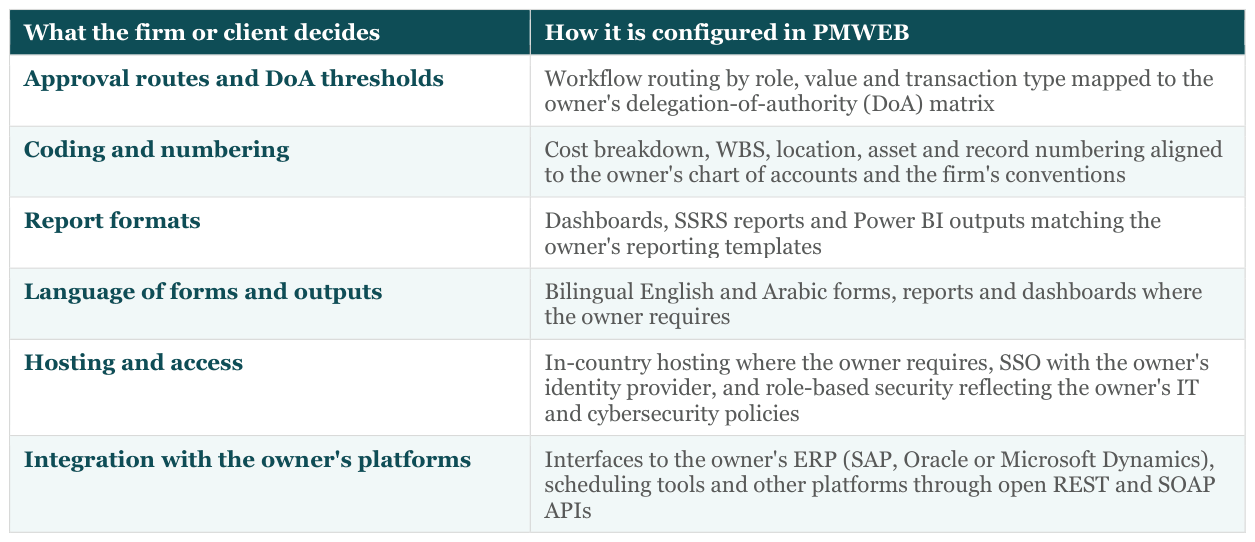
The PMC begins with a technology plan agreed with the owner, naming the system of record for each process, the supporting platforms, integration points, data standards, roles, security requirements and adoption plan. The plan reflects the delivery method: under CM agency the owner's parties need one set of access, under design- build the contractor's design team needs another, and in a PPP the concessionaire's reporting obligations shape what is captured. In PMWEB the plan becomes configuration: portfolio structure, modules, Form Builder forms, workflows, value lists and security roles, documented so the owner can see exactly how the plan was implemented and what the investment is delivering.
Data governance and coding structures
Data governance is the foundation of everything else. The PMC defines, with the owner, the coding structures that tie the systems together: cost breakdown structure, WBS, contract and package codes, location and asset codes, and document numbering. In PMWEB these are controlled value lists used by every form, so a cost code on a change order matches the budget, the schedule and the ERP. Mandatory fields and validation stop incomplete records entering the system, and ownership, retention and archiving rules are applied.
Integration architecture
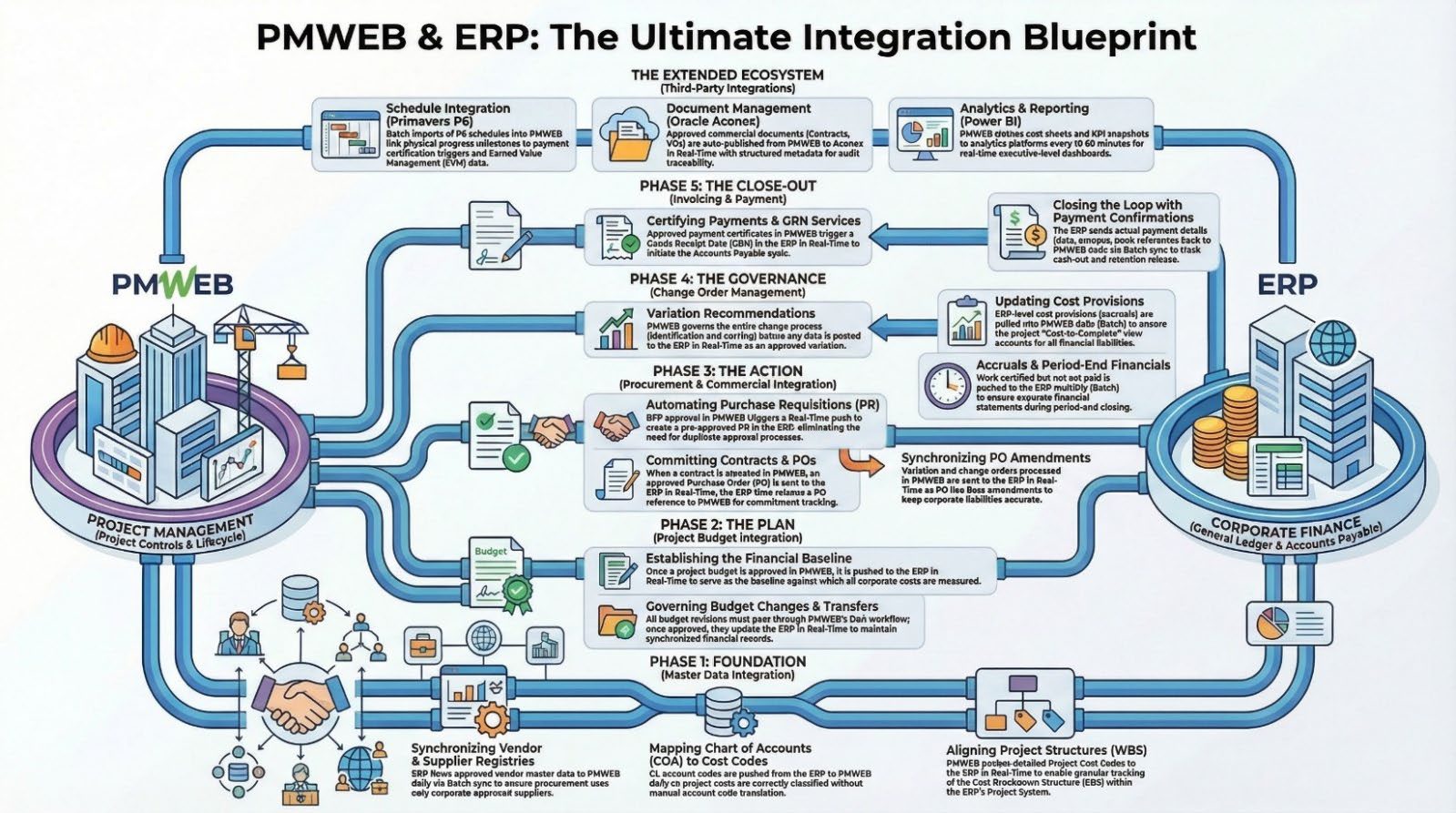
The integration architecture connects PMWEB with the owner's other platforms. Primavera P6 and MS Project schedules flow into PMWEB and milestones roll up to programme level. ERP integration with SAP, Oracle or Microsoft Dynamics exchanges commitments, invoices and payments so finance and project controls see the same figures. BIM model elements, GIS locations and the owner's document control platform are linked through PMWEB's open REST and SOAP APIs, and Power BI reports across all of it. Each integration is defined in the technology plan with direction, frequency, owner and error handling.
Cybersecurity
Security is designed in from the start. Single sign-on with the owner's identity provider means users authenticate with corporate credentials under the owner's multi-factor authentication policies. Role-based security controls what each user can see and do by project, module and record. Access is granted and removed through a controlled process with periodic reviews, hosting can be in-country where the owner requires, and the audit trail records every change.
Data ethics
CMAA's guidelines recognise that technology raises ethical questions. For a PMC these are practical: personal data in safety and incident records, commercial confidentiality between contractors, and fair use of performance Adoption and change management A system of record only works if people use it. The PMC plans adoption as managed change: role-based training tied to the configured procedures, a support channel, mobile app access for site teams and regular measurement of usage. Where a process drifts back to email, the PMC treats it as a finding and fixes the cause.
Handover and retention
At closeout the owner receives a structured record, not an archive of files. Closeout checklists confirm that every process is closed, the asset register is complete and warranties are attached, and the audit trail shows how every record reached its final state. Access is then closed or transferred in line with the owner's policies, and the data is retained or migrated as the technology plan specified.

Configuring PMWEB to Your Firm's Procedures
The CMAA Standard and its guidelines set the technology management expectation. The technology choices themselves belong to the firm and the owner, and PMWEB is configured to them.

Evidence That the Practice Is Working
A PMC can test whether its technology management is working as the CMAA Standard intends through indicators such as:
- System-of-record clarity: whether every CM process has a named system of record, and whether its records exist anywhere else.
- Data completeness: the proportion of records submitted with all mandatory fields and valid codes.
- Integration health: the number and age of unresolved integration errors between PMWEB and connected platforms.
- Access hygiene: the time taken to remove access for leavers, and the outcome of periodic access reviews.
- Adoption by process: the proportion of RFIs, change requests and inspections running through PMWEB rather than email.
- Reporting from live data: whether leadership reports come directly from the system without manual reconciliation.
Key takeaway
The 2021 CMAA Standard made technology management part of the CM's job, and the most important technology decision a PMC makes is which system holds the record of its practice. Planning that system, governing its data, integrating it with the owner's platforms, securing it and handing it over are now professional duties, not IT chores.
Across thirteen articles the pattern has held: the CMAA Standard is the reference, each firm executes it its own way, and the evidence lives in structured data. PMWEB lets GCC PMC firms configure their own practice, digitalise it function by function and prove it, record by record.
Next in the series: Article 14 — AI for PMC Firms: How PMWEB 2026 and the Releases That Follow Turn a Structured Practice into Better Project Delivery

Next step
Bring this to your portfolio.
Tell us which processes matter most to you, and we will show them running in PMWEB.