
Article 6 of 14 · PMWEB for PMC Firms: Digitalising the CMAA Standards of Practice
Quality Management: Submittals, Inspections, Non-Conformance and Commissioning
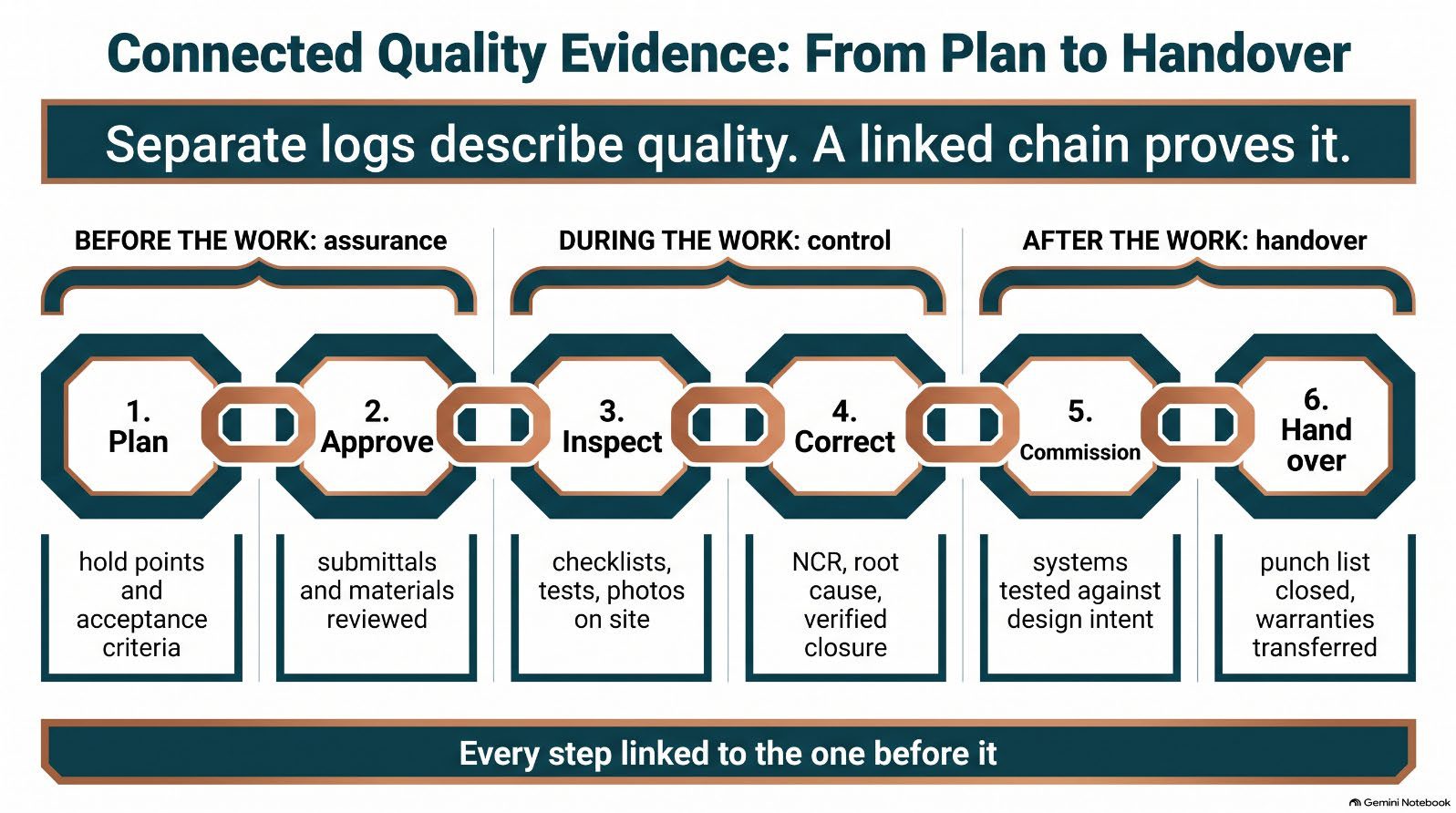
Quality on a construction project is not what the PMC believes was built; it is what the PMC can prove was reviewed, approved, inspected, tested and corrected. Firms that run quality as a connected chain of records give owners something far more valuable than assurance: they give them evidence.
Walk onto almost any large site in the GCC and you will find capable quality engineers, detailed inspection and test plans, and a document controller processing hundreds of submittals a month. What you will often not find is a single place where the owner can see, for one element of the works, the approved shop drawing, the approved material, the inspection request, the test results, the non-conformance raised and the corrective action that closed it. Each of those lives in its own log, in its own spreadsheet, maintained by its own team.
On a Qatari health authority hospital or an Abu Dhabi infrastructure programme, that fragmentation matters at two moments. The first is when something goes wrong and the owner asks how a non-compliant material reached the works. The second is at handover, when the operator asks for the commissioning records, the punch list status and the warranties, and the PMC spends weeks assembling what should already have been assembled.
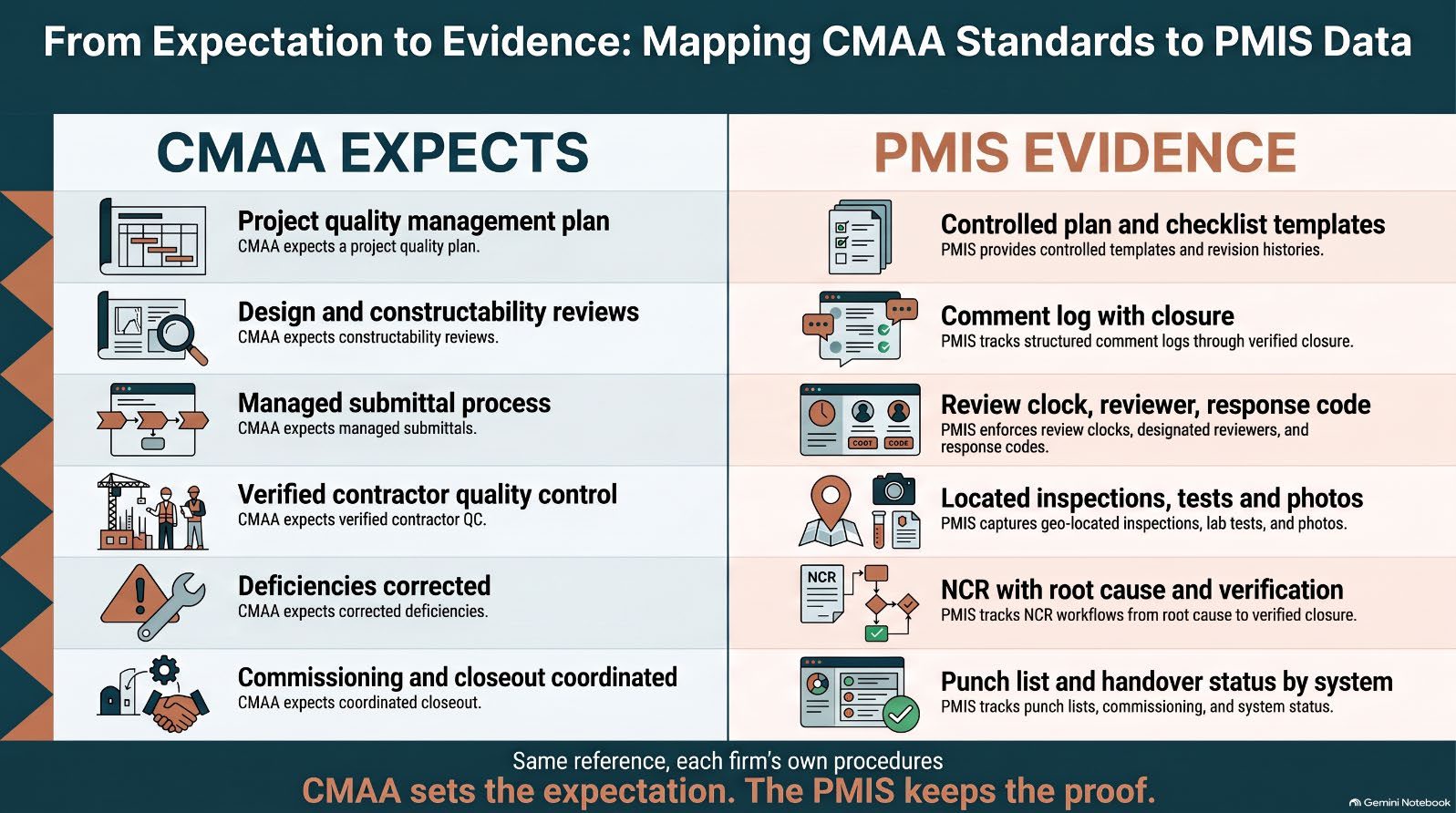
The CMAA Standards of Practice are clear that quality is a management system, not an inspection activity. They also leave room for each PMC firm, and each owner, to run that system its own way. Some firms review every submittal; others sample by risk. Some owners require third-party testing; others rely on the contractor's accredited laboratory. PMWEB is configured to those choices. The CMAA Standard stays the reference; the evidence that its expectations were met is what PMWEB produces.
What the CMAA Standard Expects
The CMAA Standard frames quality management as a responsibility the CM carries from the earliest phase. In pre-design and design, the CM is expected to help the owner define quality requirements, establish a quality During procurement and construction, the CMAA Standard expects the CM to manage the submittal process, verify that the contractor's quality control programme is operating, carry out or coordinate quality assurance inspections and testing, document deficiencies and require their correction, and keep the owner informed. In the post-construction phase, the CM is expected to coordinate commissioning, manage punch lists, confirm that deficiencies are closed, and assemble the documentation the owner needs to operate the facility.
A distinction runs through the Standard: the contractor owns quality control, the inspection and testing of its own work, while the PMC, on behalf of the owner, provides quality assurance, verifying that the contractor's system works and that the results meet the requirements. A PMC that performs the contractor's quality control for it has blurred responsibility; a PMC that does no verification has left the owner exposed.

How GCC PMC Firms Typically Do It Today
The regional practice is strong on people and weak on connection. The typical pain points are familiar to any quality manager.
- Separate logs for every process. Submittals, material approvals, inspection requests, test results and NCRs are tracked in separate spreadsheets, so no one can trace a single element of the works from approval to acceptance.
- Submittal reviews without a clock. Review periods set in the contract are tracked manually, and overdue reviews surface only when the contractor raises a delay notice citing late approvals.
- Inspections recorded on paper. Inspection request forms are signed on site and scanned days later, often without photos or a link to the approved drawing the inspector used.
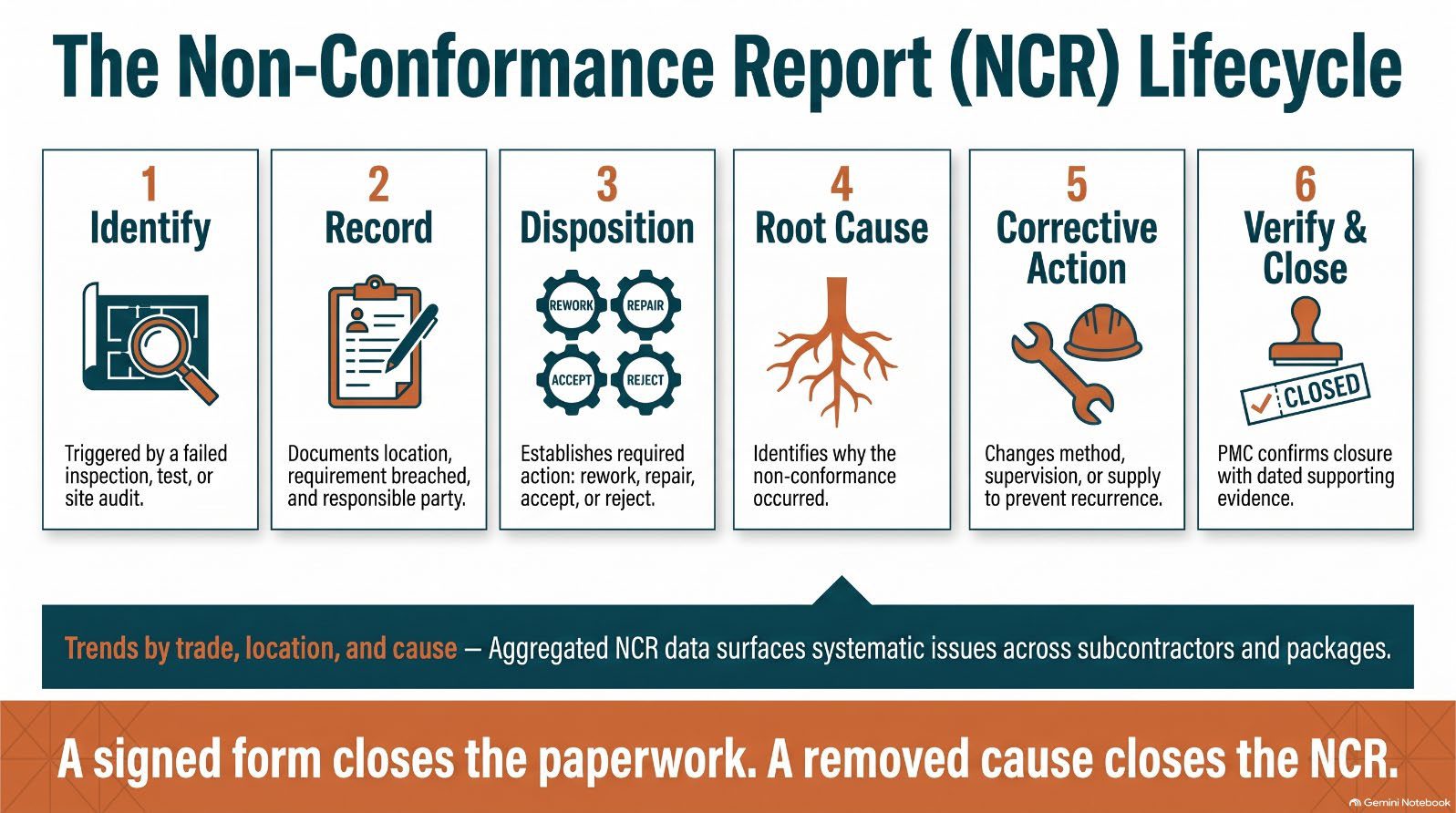
- NCRs that never quite close. Non-conformances are raised but the corrective action, the root cause and the verification of closure are not recorded consistently, so the same defect recurs across floors and packages.
- Commissioning handled as a separate project. Commissioning records are held by a specialist and delivered as a binder at the end, disconnected from the installation inspections that preceded them.
- Handover assembled at the last minute. Punch lists, as-built drawings, O&M manuals and warranties are gathered under pressure, delaying taking over and frustrating the operator.
How PMWEB Digitalises It
PMWEB treats each quality process as a structured record with its own workflow, and links those records together so that the chain of evidence exists as the work proceeds rather than being reconstructed afterwards.
Quality management plan and audits
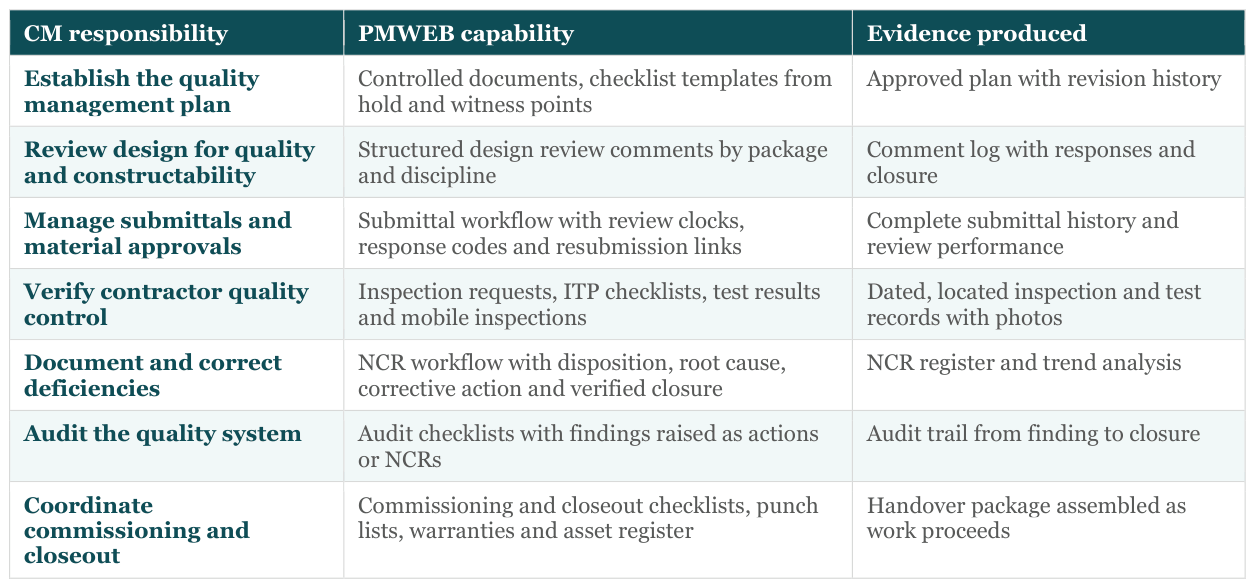
The project quality management plan, the procedures it references and the responsibility matrix are held in PMWEB document management with controlled revisions. The hold points and witness points from the plan become the templates for inspection checklists. Quality audits, whether of the contractor's quality system or the PMC's own, are scheduled and recorded as checklists, with findings raised as action items or NCRs so that audit results do not remain in a report nobody reopens.
Submittals, shop drawings and material approvals
Submittals are logged against the specification section and the contract package, with the contractual review period driving due dates. The workflow engine routes each submittal to the reviewers the PMC defines by discipline, type or value, with delegation and escalation when a reviewer is unavailable. Response codes are a value list configured to the firm's convention, for example approved, approved as noted, revise and resubmit, or rejected. Resubmissions are linked to the original so the full history is one click away. Material approval requests work the same way, with manufacturer data, test certificates and samples recorded, so that an approved material can later be linked to every inspection that checked it on site.
Inspection and test plans, inspection requests and testing
The approved inspection and test plan for each activity becomes a set of checklists in PMWEB. The contractor raises an inspection request against the relevant activity and location, which notifies the PMC inspector. On site, through the PMWEB mobile app, the inspector completes the checklist, attaches photos, records the result and references the approved drawing and material. Test results, whether from the contractor's laboratory or a third- party lab, are recorded against the same location and element. A failed inspection does not end in a signature; it can raise an NCR directly, carrying the context with it.
Commissioning, punch lists and handover
Commissioning checklists in PMWEB follow systems from pre-functional checks through functional performance testing, and each can be linked to the installation inspections and material approvals behind it. Punch lists are raised by location, trade and priority, often from the mobile app with photos, and closed by the
Configuring PMWEB to Your Firm's Procedures
The CMAA Standard is the same whether the project is in Riyadh, Doha or Dubai. What differs is how each PMC firm runs its quality system and what each owner expects to see. PMWEB is configured to those choices.


Evidence That the Practice Is Working
A PMC that has digitalised its quality practice in line with the CMAA Standard should be able to show it with indicators drawn directly from PMWEB. Each firm sets its own targets; these are the definitions.
- Submittal review timeliness. The share of submittals reviewed within the contractual review period, by discipline and reviewer.
- First-time approval rate. The proportion of submittals approved or approved as noted at first submission, indicating the quality of the contractor's documents.
- Inspection pass rate. The proportion of inspection requests passed at first inspection, by trade and activity.
- NCR closure time. The elapsed time from NCR issue to verified closure, by subcontractor and severity.
- Repeat NCRs. The number of NCRs sharing the same root cause across locations or packages, showing whether corrective action is working.
- Commissioning readiness. The number of open deficiencies against systems scheduled for commissioning.
- Punch list closure at taking over. Open punch items and outstanding closeout documents at the date of taking over.
The CMAA Standard asks PMC firms to manage quality as a system: plan it, assure it, control it, correct it and hand it over. That system is only as strong as the links between its records, from the approved shop drawing to the inspection, from the failed test to the NCR, from the commissioning checklist to the warranty.
PMWEB turns each quality process into a structured, linked record, configured to each firm's procedures and each owner's requirements. The result is a PMC that can show, in data, that its quality practice executes and evidences what the CMAA Standard expects.
Next in the series: Article 7 — Contract Administration I: RFIs, Change Management and Payment Certification

Next step
Bring this to your portfolio.
Tell us which processes matter most to you, and we will show them running in PMWEB.