
Article 1 of 14 · PMWEB for PMC Firms: Digitalising the CMAA Standards of Practice
From the CMAA Standard to a System of Record
The CMAA Standards of Practice tells a PMC firm what professional construction management looks like. A system of record proves that it happened, on every project, for every client. That is exactly what a PMIS like PMWEB is built to deliver.
Every Project Management Consultancy (PMC) firm in the GCC sells the same thing: professional practice. Owners, whether a government entity, a PIF-backed developer or a private master developer, hire a PMC because they want capital projects delivered the way a professional construction manager would deliver them.
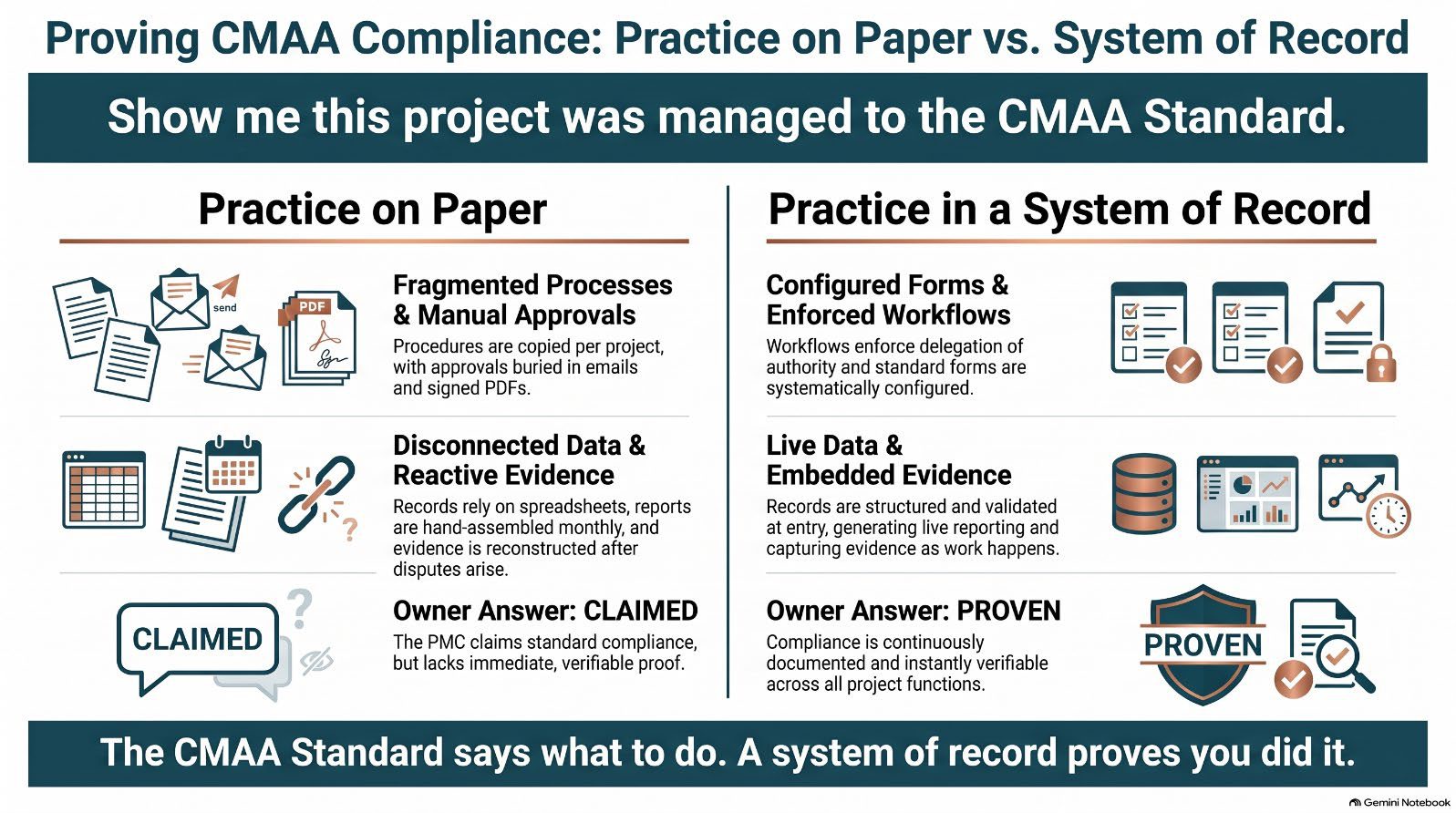
Yet ask most PMC firms to prove that practice was followed on a given project, and the answer sits in a scattered trail of spreadsheets, email threads, shared drives and the memory of a few senior people. The practice exists. The evidence does not.
That gap matters more in the GCC than almost anywhere else. Programmes are larger, owners are more sophisticated and reporting expectations keep rising. A PMC firm that cannot demonstrate its practice in data is competing on CVs and fee rates alone.
This series makes a simple argument: a PMC firm can use PMWEB to digitalise its project management processes, and prove that its practice meets a recognised professional benchmark. The benchmark used throughout is the Construction Management Association of America (CMAA) Construction Management Standards of Practice, one of the professional bodies that provides guidance to construction managers and PMC firms on the project management of capital construction projects.
What the CMAA Standards of Practice Defines
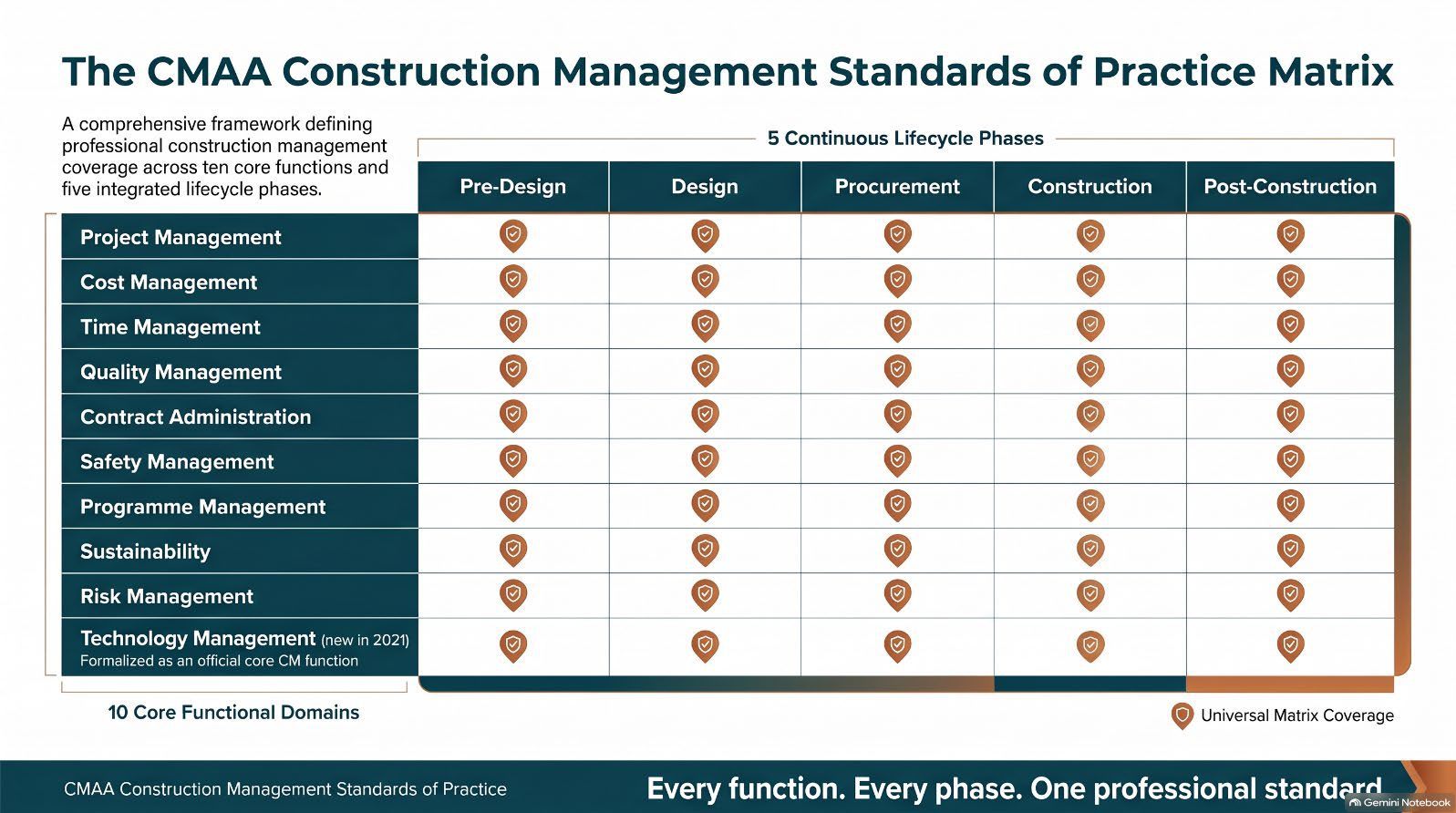
CMAA publishes the Construction Management Standards of Practice as its flagship reference. The current 2021 edition describes the range of services that make up professional construction management and sets the standard a construction manager (CM) is expected to meet or exceed. It is written for both sides of the table: owners procuring CM services and the firms providing them.
The result is effectively a matrix: for every function, in every phase, what a professional CM should be doing. CMAA supplements it with detailed guidelines for most functions, from cost and time management to claims and project closeout.
For a GCC PMC firm, this matrix is valuable for three reasons:
- It is a neutral benchmark. It is not a firm's own marketing language. Owners and their auditors can hold a PMC to it.
- It is delivery-method aware. It covers CM agency, CM at-risk, design-build and other methods, mirroring the mix of contracting models used across the region.
- It describes outcomes, not tools. It tells the CM what must be managed and reported, leaving how to the firm. That is exactly the space a PMIS fills.
The Gap Between Documented Practice and Executed Practice
Most established PMC firms already have a Project Management Plan template, a procedures manual and a set of standard forms. On paper, their practice aligns well with the CMAA Standard. The problem is what happens on the ground:
- Each project reinvents the procedures. Forms are copied, renamed and modified. After a few years the firm has as many versions of "the change order process" as it has projects.
- Practice lives in people. When a senior cost manager or document controller leaves, the way that project was run leaves with them.
- Approvals happen in email. The delegation of authority exists as a PDF, but nothing enforces it. Who approved a variation, and when, has to be reconstructed after the fact.
- Reporting is assembled, not generated. Monthly reports take days of copying figures from spreadsheets, and they are out of date the moment they are issued.
- Evidence is weakest when it is needed most. When a claim, audit or dispute arises, the PMC must defend its own performance with incomplete records.
Standard, Procedure, System
The way to close the gap is to separate three layers that are usually blurred together:

This separation matters because no two PMC firms execute the same way, and the same firm often works differently for different owners. A PMC delivering a hospital for a Qatari health authority, a mixed-use development for a Dubai master developer and a giga-project package in Saudi Arabia will face three sets of owner procedures, approval matrices and report formats.
The CMAA Standard does not change between those engagements. The procedures do. A useful PMIS must therefore be configurable at the procedure layer while staying consistent at the standard layer.
This is where PMWEB fits. Its business processes are delivered as configurable forms, workflows and reports rather than fixed screens:
- Forms can be adjusted to each firm's or client's fields and terminology.
- Workflows enforce the approval route and delegation of authority set out in the procedures, instead of relying on email.
- Cost, schedule and document records are linked, so a change order, its RFI, its schedule impact and its payment all sit in one audit trail.
- Reports and dashboards are generated from the data, not assembled by hand.
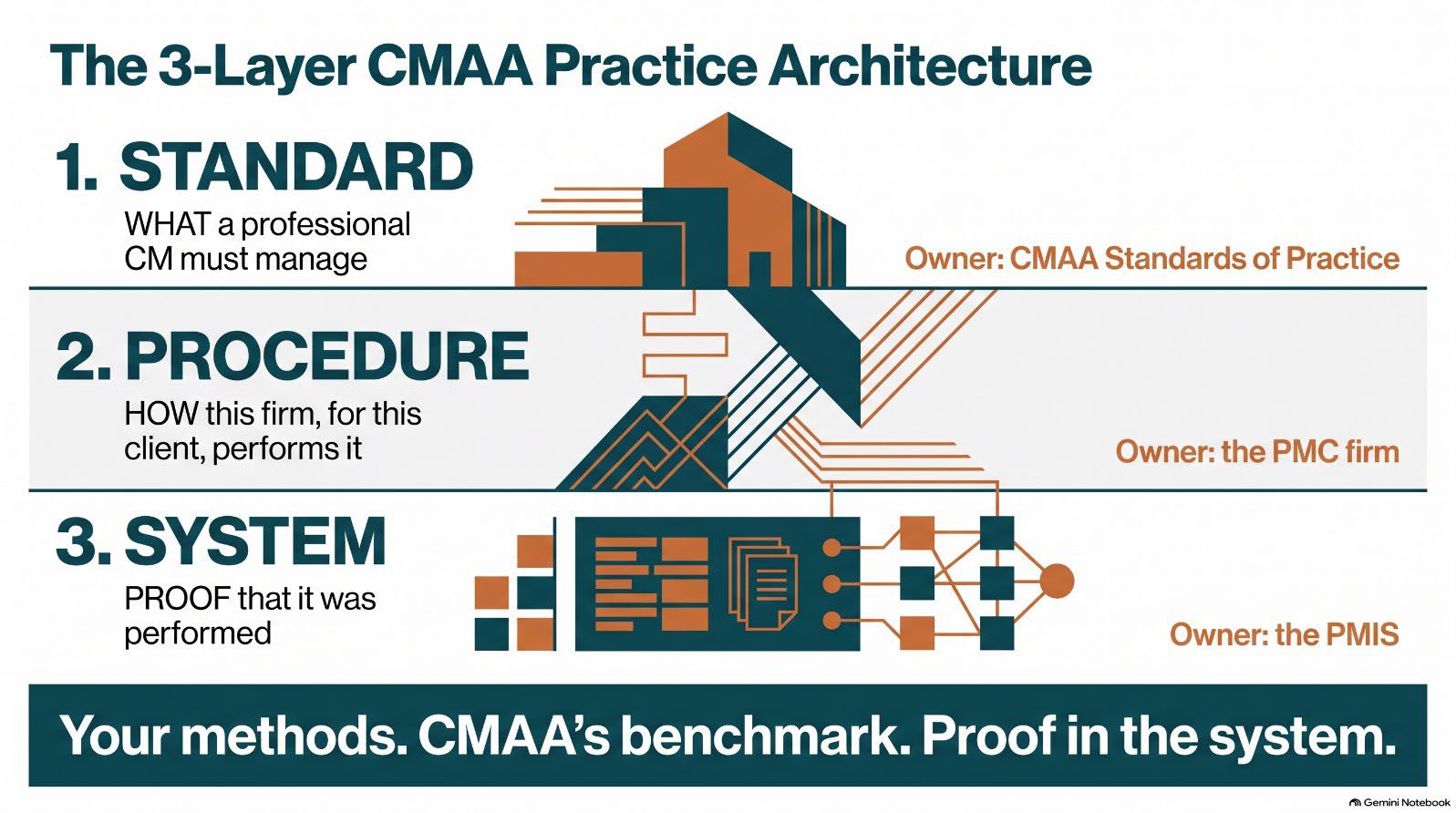
The outcome is alignment, not certification. CMAA does not certify software, and this series does not claim it does. The claim is narrower and more useful: every responsibility the CMAA Standard assigns to the CM can be executed, controlled and evidenced in PMWEB, in the way each PMC firm chooses to execute it.
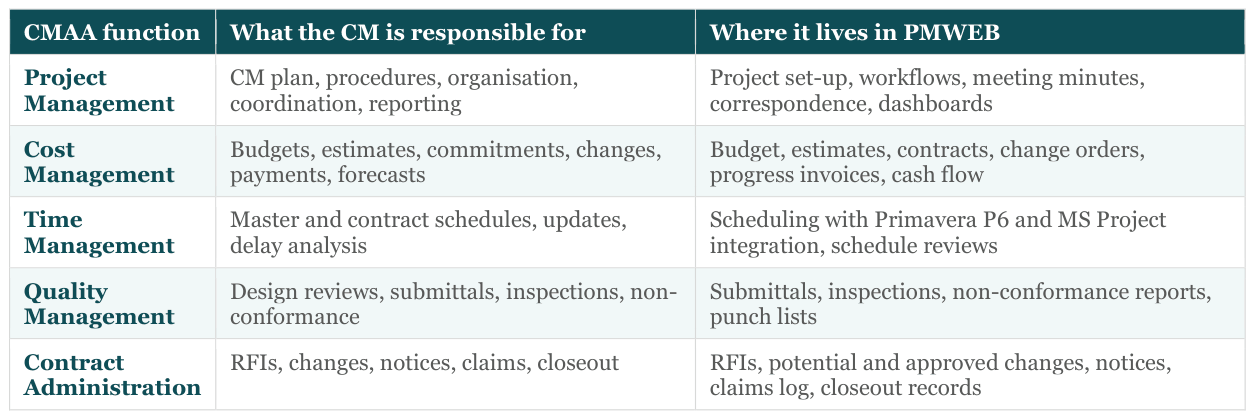
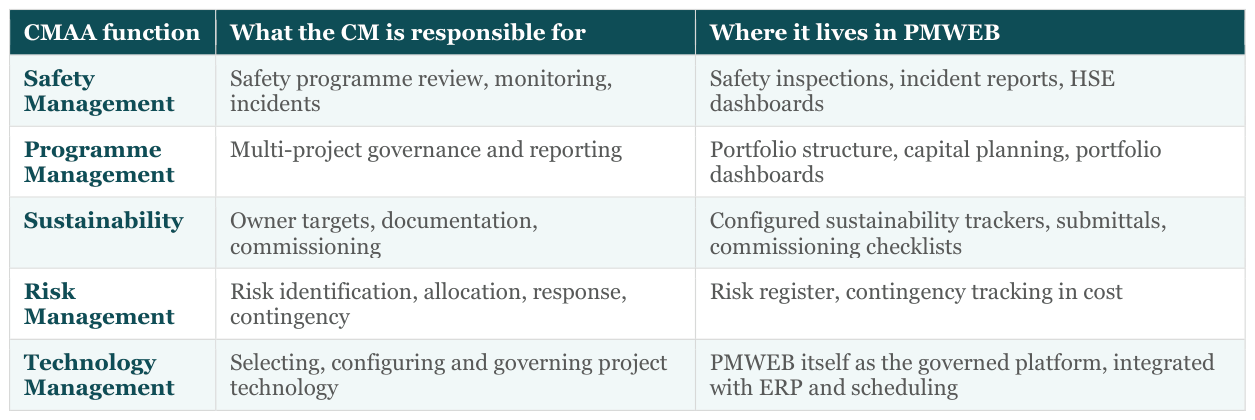
The CMAA Standard Mapped to PMWEB, at a Glance
Each function of the Standard maps to PMWEB modules that capture, route and report the CM's work. Each will get its own article in this series.
Why This Matters Now for GCC PMC Firms
- Technology is now part of the CM's professional duty The 2021 edition of the CMAA Standard added technology management as a CM function. Choosing, configuring and governing the project's systems is no longer an IT side-topic. It is part of what an owner should expect from its CM, and the PMIS decision belongs with the people accountable for the practice.
- GCC owners are raising the bar Across the region, owners increasingly expect: real-time visibility of cost, schedule and risk across their whole portfolio, not monthly PDFs; enforced delegation of authority and a full audit trail on every commitment and change; data hosted in-country where owner policy requires it; consistent reporting from every PMC working across their programmes.
- PMC firms work in two modes Sometimes the PMC runs its own platform as a firm-wide practice system; sometimes it operates inside the owner's platform. PMWEB supports both. A PMC can standardise its practice on its own PMWEB instance, and
What This Series Will Cover
Each article takes one function of the CMAA Standard. It summarises what the Standard expects of the CM, shows how GCC PMC firms typically handle the function today, demonstrates how PMWEB digitalises it with screenshots of the relevant records, and explains how each firm configures PMWEB to its own procedures. The final article explains how PMWEB 2026 and the releases that follow put this structured practice to work with AI, at project and programme level.
- From the CMAA Standard to a System of Record (this article)
- Delivery Methods: Configuring PMWEB for CM Agency, CM at-Risk, Design-Build and PPP
- Project Management: Turning the CM Plan and Procedures Manual into Workflows
- Cost Management: From Budget to Final Cost Reconciliation
- Time Management: Schedules as Governance Instruments
- Quality Management: Submittals, Inspections, Non-Conformance and Commissioning
- Contract Administration I: RFIs, Change Management and Payment Certification
- Contract Administration II: Notices, Claims Avoidance and Closeout
- Safety Management
- Risk Management
- Sustainability and Resiliency
- Programme Management: The PMC as the Owner's PMO
- Technology Management: Governing the PMIS as the CM's System of Record
- AI for PMC Firms: How PMWEB 2026 and the Releases That Follow Turn a Structured Practice into Better Project Delivery
If an owner asked you tomorrow to demonstrate, project by project, that your firm manages cost, time, quality, contracts and risk the way the CMAA Standards of Practice describes, how long would it take you to assemble the evidence?
If the answer is days or weeks, your practice is not yet digital. Follow this series to see what it looks like when the answer is minutes.
Next in the series: Article 2 — Delivery Methods: Configuring PMWEB for CM Agency, CM at-Risk, Design- Build and PPP

Next step
Bring this to your portfolio.
Tell us which processes matter most to you, and we will show them running in PMWEB.