
Article 9 of 14 · PMWEB for PMC Firms: Digitalising the CMAA Standards of Practice
Safety Management: The CM's Safety Role, Proven in Data
On every construction site, safety belongs first to the contractor who controls the work. But the owner's PMC is never a bystander. Its role is to plan, observe, verify, escalate and record, and on the day something goes wrong, the quality of that record is what everyone will examine.
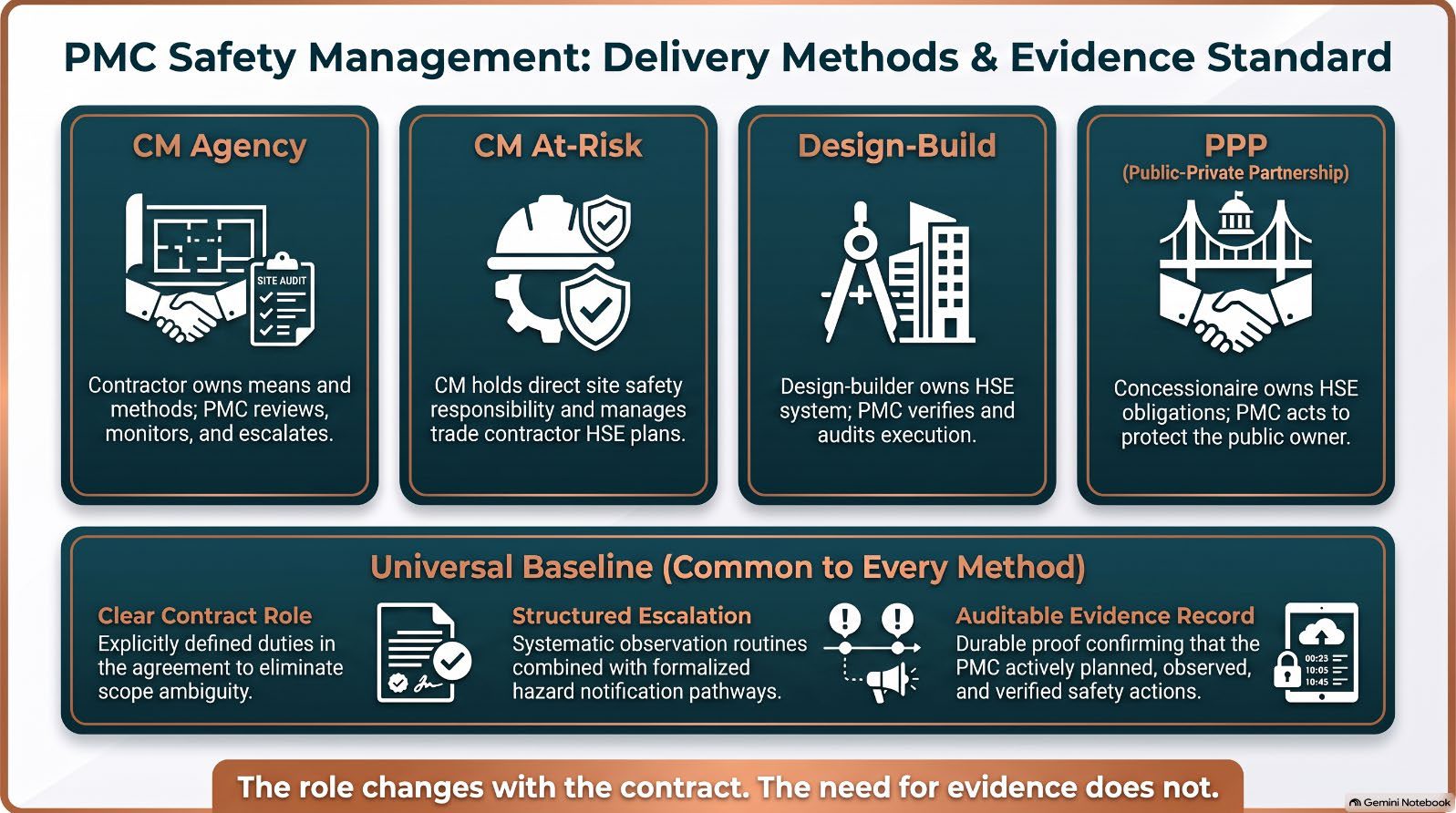
Safety management is the function where the PMC's role is most often misunderstood, sometimes by the PMC itself. Owners expect their consultant to keep the site safe. Contractors hold primary responsibility for the means and methods of their work and for the safety of their workforce. Regulators hold both to account. Between those expectations sits a PMC team that must be clear about what it does, what it does not do, and how it proves it did what it said.
In the GCC, the stakes are high and the conditions are demanding. Projects combine large, multinational workforces, compressed programmes, high-rise and deep excavation work, and extreme summer heat. Regulators and the HSE standards of major owners and giga-project developers set clear expectations, and those expectations increasingly include evidence: inspections completed, observations closed, incidents investigated, corrective actions verified.
Each PMC firm defines its safety role in its own way, shaped by its contract with the owner and by the delivery method. A PMC acting as CM agent on a traditional design-bid-build contract has a different role from a PMC overseeing a design-build contractor or a PPP concessionaire. What should not vary is the discipline: a clear role, a structured plan, consistent observation, and a record that shows the PMC acted on what it saw.
What the CMAA Standard Expects
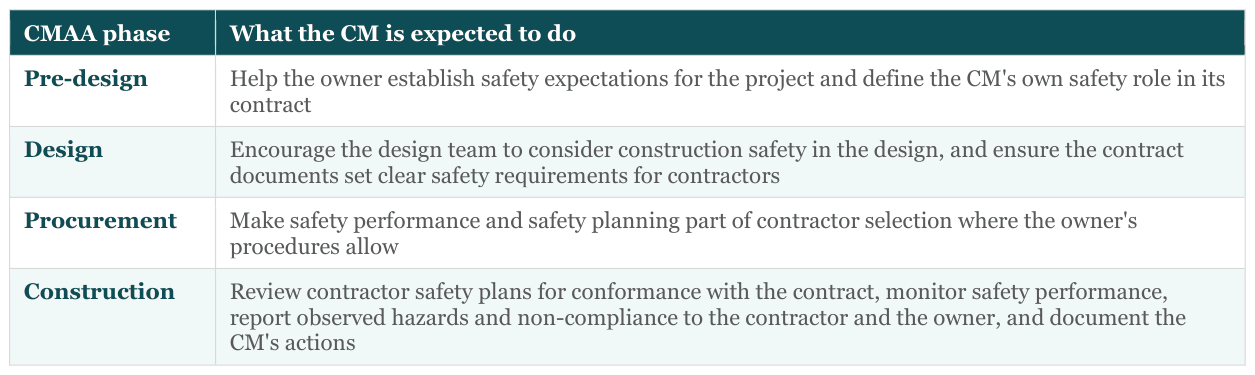
The CMAA Standard is careful about the CM's safety role. During pre-design and design, it expects the CM to help the owner establish safety expectations for the project, to encourage the design team to consider construction safety in the design, and to ensure that contract documents set clear safety requirements for During construction, the CMAA Standard expects the CM to review contractor safety plans for conformance with contract requirements, to monitor the contractor's safety performance, to report observed hazards and non- compliance to the contractor and the owner, and to document its actions, while making clear that the contractor remains responsible for the safety of its own work unless the CM has taken on that responsibility under its contract, as it may under CM at-risk. Throughout, the Standard recognises that the CM's exact safety responsibility depends on its contract with the owner, and that the CM must understand and respect those limits.
How GCC PMC Firms Typically Do It Today
- The role is unclear on paper. The PMC's safety duties are not spelled out in its appointment, so the team either overreaches into the contractor's responsibilities or does too little to protect the owner.
- Inspections are done on paper and typed up later. Safety walks produce handwritten notes and photos on personal phones, which are compiled into weekly reports days afterwards, if at all.
- Observations are raised but not closed. Unsafe conditions are reported to the contractor, but there is no reliable tracking of whether and when they were corrected.
- Incident information is scattered. Incident reports, investigation findings and corrective actions sit in different files, making trend analysis and reporting to the owner and regulators slow.
- Indicators are lagging only. Monthly reports focus on man-hours and lost-time incidents, with little visibility of leading indicators such as inspection completion, observation close-out or toolbox talk coverage.
- Heat-stress controls are managed informally. Summer working-hour restrictions, hydration and rest arrangements are announced on site but not systematically checked and recorded.
How PMWEB Digitalises It
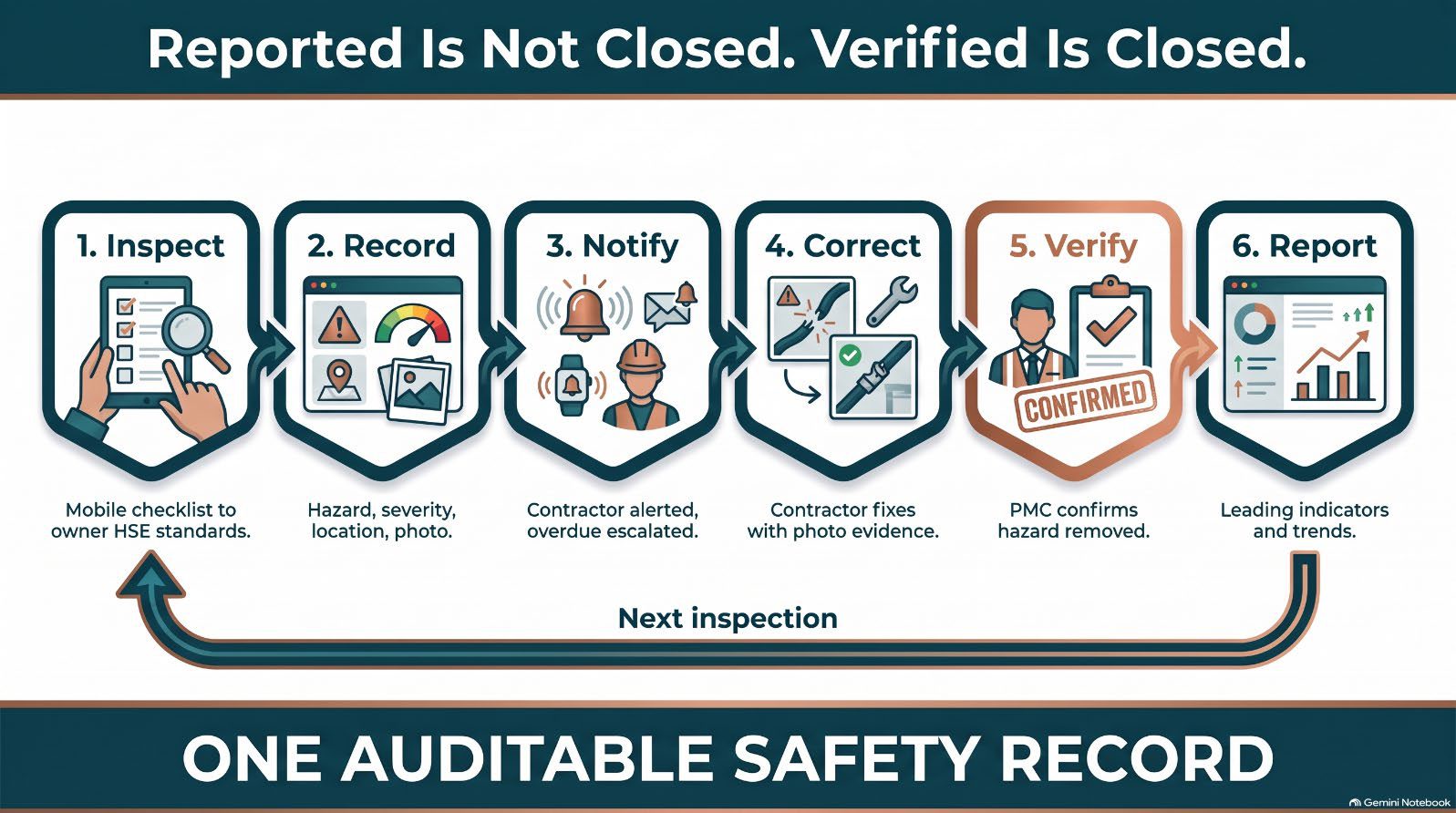
PMWEB does not take the contractor's safety responsibility away from the contractor, and it does not replace the contractor's own HSE management system. It gives the PMC a structured way to execute its own defined role: to plan, observe, escalate, verify and report. Each firm configures the forms, checklists and workflows to its own procedures and to the owner's HSE standards.
Planning: HSE plans and prevention through design
The owner's HSE requirements and the contractor's HSE plan are submitted and reviewed through PMWEB's submittals workflow, with review comments, revisions and approval status recorded. During design, the PMC can use a custom form built in Form Builder to log prevention-through-design reviews, capturing hazards identified in design, the design response and the residual risk handed over to the construction phase. These entries link to the risk register so that construction safety risks are visible alongside other project risks.
Permits to work
High-risk activities such as hot work, work at height, confined space entry, lifting operations and excavation are controlled by the contractor's permit-to-work system. The PMC's role is typically to verify that permits are in place and that their conditions are being followed. A permit verification checklist in PMWEB, completed from the mobile app, records which permits were checked, by whom and with what findings.
Site inspections, observations and toolbox talks
PMWEB safety inspections and observations are completed on site through the mobile app, using checklists configured to the owner's HSE standards and the firm's inspection procedure. Each observation records the location, the hazard category from a value list, the severity, the responsible contractor, photos and a required close-out date. The workflow notifies the contractor, tracks the response and escalates overdue items. Close-out requires evidence, typically a photo and a description of the corrective action, verified by the PMC inspector. Toolbox talks and safety meetings are recorded through meeting minutes or a custom form, capturing topic, attendance and actions.
Incidents, near misses and investigations
Incident reports in PMWEB capture incidents and near misses with date, time, location, type, severity, persons involved as permitted by the owner's privacy rules, immediate actions and photos. The workflow routes the report to the right people based on severity, so a serious incident reaches the owner's senior representatives immediately while a minor near miss follows a standard route. Investigations are recorded with root cause, contributing factors and corrective and preventive actions, each assigned as an action item with an owner and due date, and verified as complete before the incident is closed.
Heat-stress management: a GCC example
GCC summers bring a specific and serious hazard. Outdoor work during the hottest part of the day is restricted in the summer months, and owner HSE standards typically add requirements for shaded rest areas, drinking water, acclimatisation and monitoring of heat conditions. In PMWEB, the PMC can add a heat-stress section to its daily safety inspection checklist, record observations against it and report compliance across all contractors on a programme. The result is a record showing that the controls the owner required were verified, day by day.
Leading and lagging indicators
Because every inspection, observation, toolbox talk and incident is a structured record, PMWEB dashboards, SSRS reports and Power BI integration can report both leading and lagging indicators by project, contractor and period. Leading indicators include inspections completed against plan, observations raised and closed, and average close-out time. Lagging indicators include recordable incidents and lost-time incidents, calculated from incident records and the man-hours captured in daily reports.

Configuring PMWEB to Your Firm's Procedures
The CMAA Standard stays the reference for the CM's safety role. How each PMC firm performs that role, and what each owner requires, differs from project to project, and PMWEB is configured to those procedures.


Evidence That the Practice Is Working
The PMC should be able to show, from its own records, that its safety role is being performed as defined. Useful indicators include:
- Inspection completion: safety inspections completed against the planned frequency, by project and contractor.
- Observation close-out time: average time from an observation being raised to verified close-out.
- Overdue observations: the number of open observations beyond their close-out date, by contractor.
- Near-miss reporting: the volume and trend of near misses reported, as a sign of a healthy reporting culture.
- Investigation completion: incidents with a completed investigation and all corrective actions verified.
- Heat-stress compliance: heat-stress checks completed and findings recorded during the summer period.
- Toolbox talk coverage: toolbox talks recorded against the planned programme of topics.
The PMC's safety role is defined by its contract, and it is never the same as the contractor's. But whatever the role, the PMC must be able to show that it planned, observed, escalated and verified, as the CMAA Standard expects. A clear role, executed through structured inspections and evidence-based close-out, protects the workforce, the owner and the PMC itself.
PMWEB turns that role into a daily practice and a durable record, configured to the firm's procedures and the owner's HSE standards. The CMAA Standard as the reference, the firm's procedures as the method, the record as the proof.
Next in the series: Article 10 — Risk Management

Next step
Bring this to your portfolio.
Tell us which processes matter most to you, and we will show them running in PMWEB.