
Article 11 of 14 · PMWEB for PMC Firms: Digitalising the CMAA Standards of Practice
Sustainability and Resiliency: From Owner Goals to Measured Performance
Sustainability is no longer a design aspiration the PMC inherits and forgets. It is a set of commitments the owner will report on for decades, and the PMC is the party best placed to prove, credit by credit and record by record, that those commitments were actually delivered.
Across the GCC, owners now carry sustainability commitments well beyond the building. A Dubai master developer reports ESG performance to investors. An Abu Dhabi infrastructure owner must achieve the green building rating it specifies before the asset can be accepted. National net-zero agendas have turned a design team concern into a board-level reporting obligation.
The PMC sits in the middle. The designer sets targets, the contractor builds, the commissioning authority tests and the facility manager inherits. Somebody has to hold the thread from the owner's first goal to the measured performance of the operating asset, and in most GCC projects that is the PMC.
The difficulty is that sustainability evidence is scattered by nature: energy models with the designer, product declarations inside submittals, waste tickets on site, commissioning results in spreadsheets. Resiliency is often treated as a design question rather than a risk to manage. This article looks at what the CMAA Standard expects and how PMC firms use PMWEB to digitalise, govern and evidence it.
What the CMAA Standard Expects
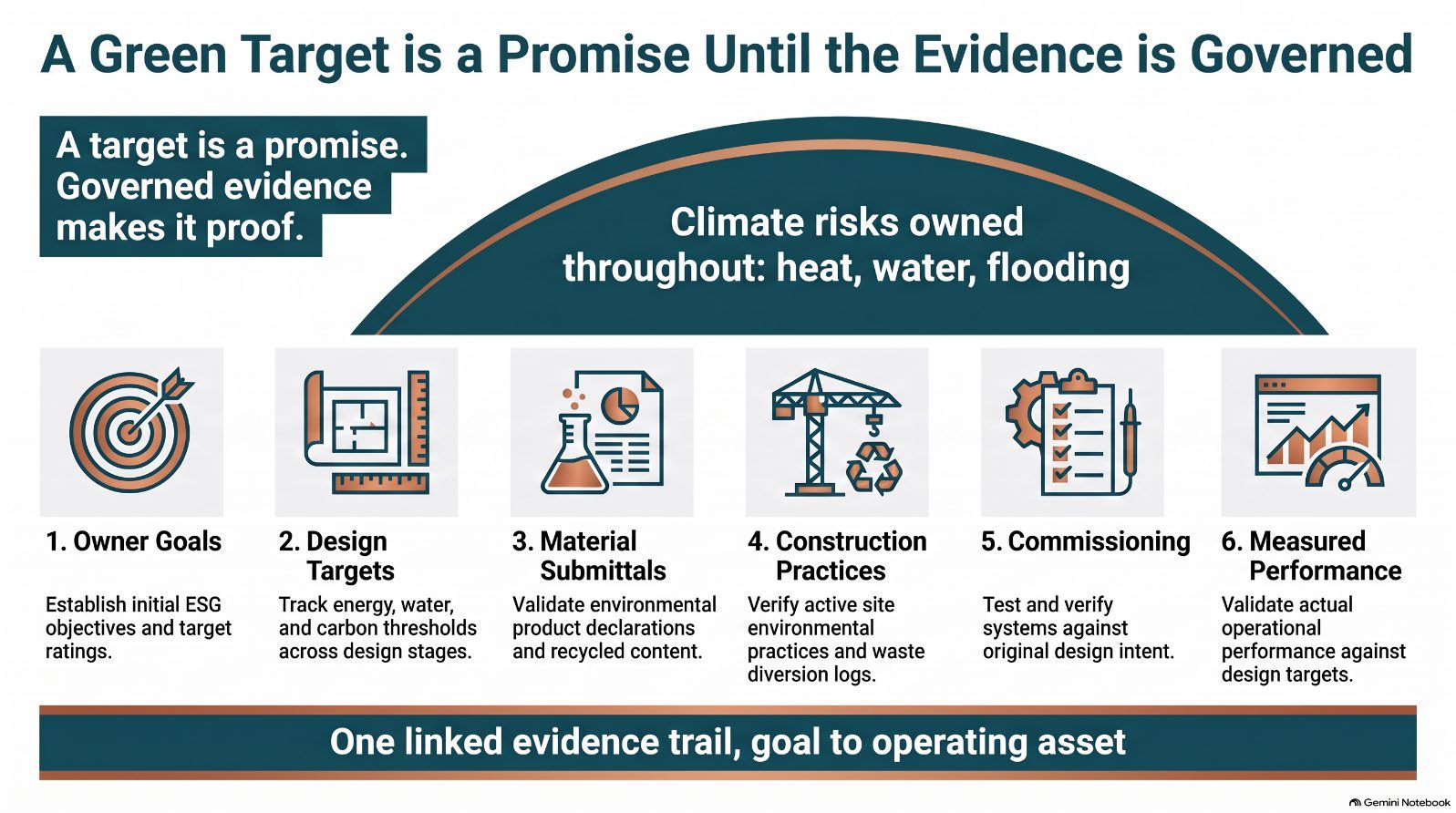
The CMAA Standard treats sustainability as a responsibility the CM carries across the life cycle, not a single design review. In broad terms, it expects the CM to understand the owner's sustainability goals, translate them into measurable requirements, and keep them visible through design, procurement, construction and handover. Resiliency, the asset's ability to withstand and recover from climate and operational stress, stays on the CM's agenda throughout.
Procurement and construction
The CM is expected to make sure sustainability requirements are written into procurement documents and contracts, verify that submittals and installed work reflect them, confirm that waste and site practices are managed as specified, and collect credit documentation as work proceeds rather than reconstructing it at the end.
Post-construction
The CM is expected to coordinate commissioning, support measurement and verification, and hand over complete operating information so the facility manager knows what each system is meant to achieve.

Each PMC firm executes these expectations in its own way. Some run a dedicated sustainability team; others embed a lead within design management and quality. Some clients want the PMC to manage the rating submission; others want verification only. The CMAA Standard stays the reference; the PMWEB configuration follows the firm's procedures and the client's scope.
How GCC PMC Firms Typically Do It Today
The same pain points appear on project after project:
- Credit tracking in a spreadsheet. A consultant's credit tracker that nobody else updates, with evidence chased at submission time from people who have left.
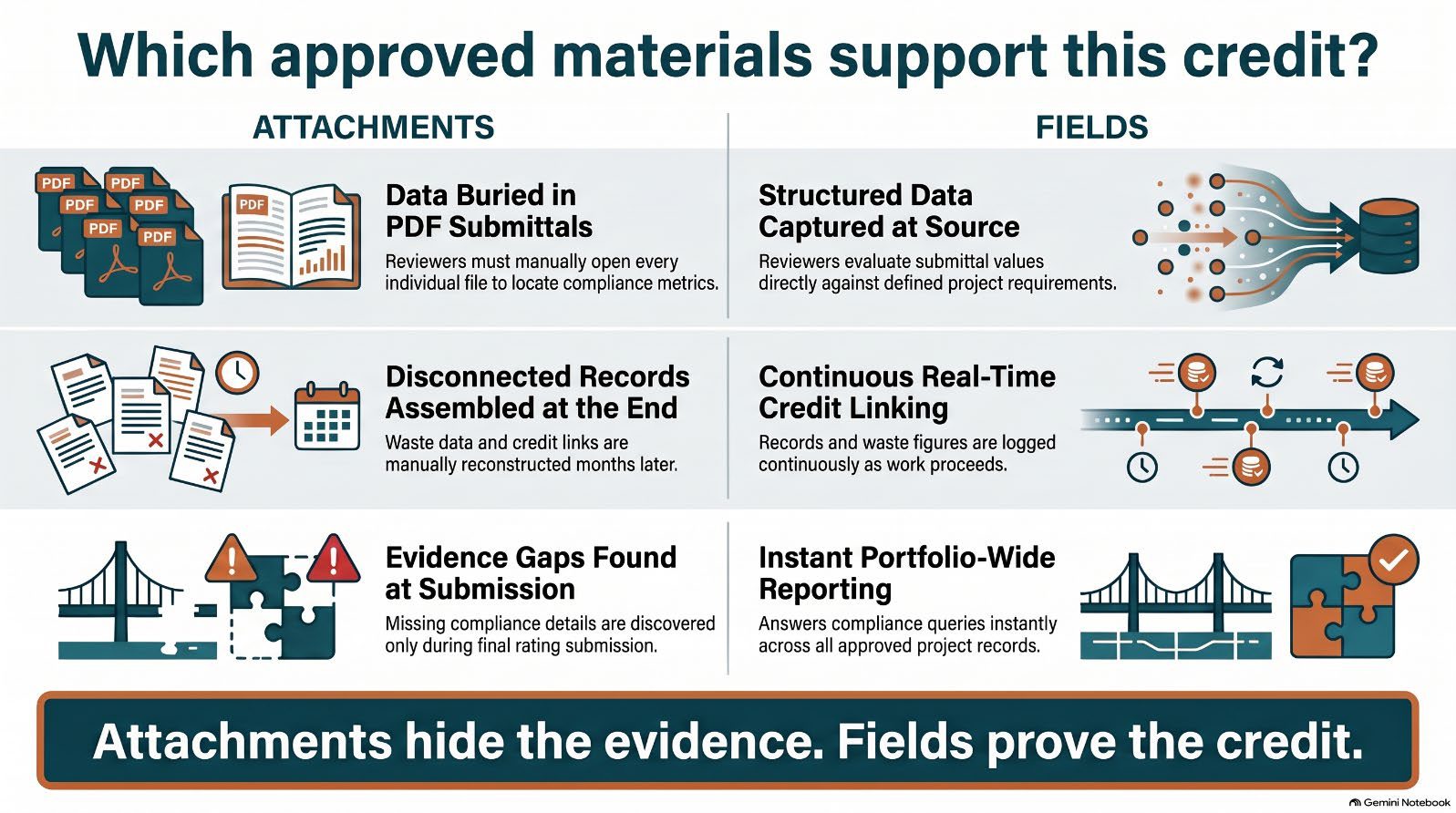
- Sustainability data buried in attachments. Product declarations and recycled content letters arrive as PDFs that nobody can report on without opening each one.
- Waste figures reconstructed at the end. Diversion tickets kept in a site cabinet and assembled months later, with gaps that cannot be closed.
- Commissioning treated as a test day. Enhanced commissioning compressed into a pre-handover rush, with issues tracked in a spreadsheet and closed by email.
- No link from targets to measured performance. The energy model says one thing, the building does another, and no record explains the difference.
- Resiliency left to the design. Heat, water scarcity and flash-flood exposure discussed in workshops but never entered in the risk register.
How PMWEB Digitalises It
PMWEB does not replace the energy modeller, the sustainability consultant or the commissioning authority. It turns their outputs into structured records with owners, workflows, approvals and links, so sustainability becomes a process the PMC can manage and prove.
Owner goals, rating targets and design-phase tracking
At project set-up, the PMC records the owner's goals and target rating in a sustainability requirements register built in Form Builder. Each target, whether an energy threshold, a water reduction, an embodied carbon Design stage reviews include sustainability checklist items. Where the design drifts from a target, the reviewer raises a linked action item, and the workflow engine routes it to the designer with a due date and escalation.
Material selection and submittals with sustainability data
The biggest structural change is to capture sustainability data as fields on the submittal, not only as attachments: recycled content, regional origin, environmental product declaration reference, low-emitting compliance, water efficiency. The reviewer confirms the values, and the submittal cannot be approved until the sustainability section is complete where it applies.
The PMC can then report across all approved submittals for a given credit without opening a single PDF. Substitution requests carry the same fields, so the sustainability impact is assessed before a change is accepted.
Construction waste and site practices
Waste management moves from a site cabinet to a daily record. Waste tickets are logged in a custom waste log or daily reports with stream, quantity, destination and diversion status, receipts attached. Site environmental practices are covered by inspection checklists, with shortfalls raised as non-conformance reports.
Credit documentation tracking
Every rating-system credit becomes a record linked to its evidence: the submittals, inspections, waste logs, commissioning records and design documents that support it. When the time comes to prepare the design-stage or construction-stage submission, the PMC is assembling a package from records already reviewed and approved rather than searching for them.

Enhanced commissioning
Enhanced commissioning starts in design, with the commissioning authority's review of the owner's project requirements and basis of design recorded as review comments and action items. During construction, commissioning checklists are configured by system type, and each failed item becomes an issue with an owner and due date. Seasonal and peak-load testing, which matters in a cooling-dominated climate, is scheduled and tracked rather than forgotten after handover.
Measurement and verification and handover to operations
Measurement and verification compares actual performance with modelled targets. A configured form records the metering period, measured and target values and any variance explanation, with an investigation workflow where variance exceeds the owner's tolerance. The asset register and warranties are handed over with the targets attached, so the facility manager knows what each system is supposed to achieve.
Climate and resiliency risk
Resiliency in the GCC is concrete. Extreme heat affects labour, worker welfare, curing, storage and cooling performance. Water scarcity shapes irrigation and cooling strategy. Flash flooding tests drainage, basements and access routes. The PMC configures climate and resiliency categories in the risk register so these risks have owners, mitigations and review dates, and links design decisions to the risks they address.
The CMAA Standard sets the expectation; each PMC firm and each client decides how it is executed. PMWEB is configured to those decisions rather than imposing its own.

Evidence That the Practice Is Working
A PMC can tell whether its sustainability process is genuinely working as the CMAA Standard intends by watching indicators such as these:
- Credit evidence completeness: the share of targeted credits with all required evidence linked and approved, reported by stage.
- Submittal sustainability data capture: the proportion of relevant submittals where sustainability fields are completed at approval rather than chased later.
- Waste record currency: the time between waste leaving site and its entry in the waste log with supporting receipts.
Key takeaway
Sustainability commitments in the GCC are now reported at board level and to investors. The PMC that can prove delivery, credit by credit and system by system, is protecting its client's reputation as well as the building's performance.
PMWEB lets each PMC firm run sustainability its own way while meeting the CMAA expectation: goals defined, targets tracked, evidence captured as structured data, commissioning governed, performance verified and climate risks owned. The rating system, approval routes and reports follow the owner's choices; the evidence trail stays the same.
Next in the series: Article 12 — Programme Management: The PMC as the Owner's PMO

Next step
Bring this to your portfolio.
Tell us which processes matter most to you, and we will show them running in PMWEB.