
Article 5 of 14 · PMWEB for PMC Firms: Digitalising the CMAA Standards of Practice
Time Management: Schedules as Governance Instruments
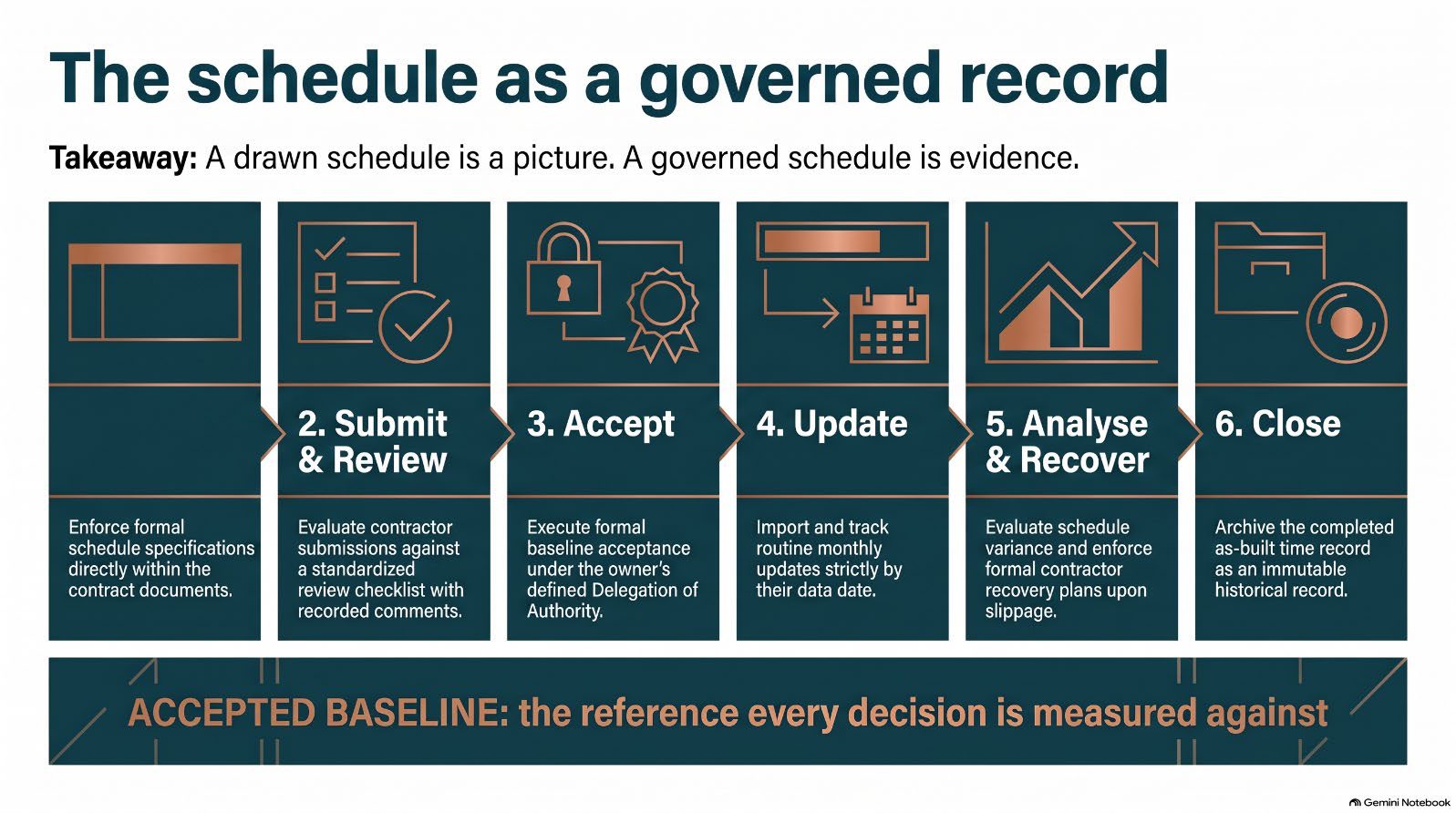
A schedule is not a picture of the project; it is a contractual instrument that the owner relies on to make decisions. PMC firms that treat it as a governed record, reviewed, accepted, updated and analysed under a defined process, are the ones whose time advice holds up when it matters most.
Across the GCC, every major project has a schedule. Very few have a schedule that the owner can defend. The master developer has a milestone chart for the board, the design consultant has a design programme in a spreadsheet, procurement runs long-lead items from a tracker, and the contractor submits a Primavera P6 file that the PMC reviews by email and comments on in a PDF. When a delay event arrives, and on a PIF-backed giga-project or a Kuwaiti ministry hospital it always does, the team discovers that nobody can say with confidence which baseline was accepted, which update was the last reliable one, or when the owner was first told about the slippage.
The CMAA Standards of Practice do not ask the PMC to produce a better Gantt chart. They ask it to establish the schedule as a governance instrument: specified, reviewed, accepted, updated, analysed, recovered and used to assess time entitlement fairly. Each step is a process, and each process produces a record.
As in every article in this series, the point is not that every PMC firm should run time management the same way. Each firm, and each client, has its own schedule specification, review checklist, update cycle and approval route. PMWEB is configured to those procedures. What stays constant is the CMAA Standard as the reference, and the evidence the system produces that the procedures were followed.
What the CMAA Standard Expects
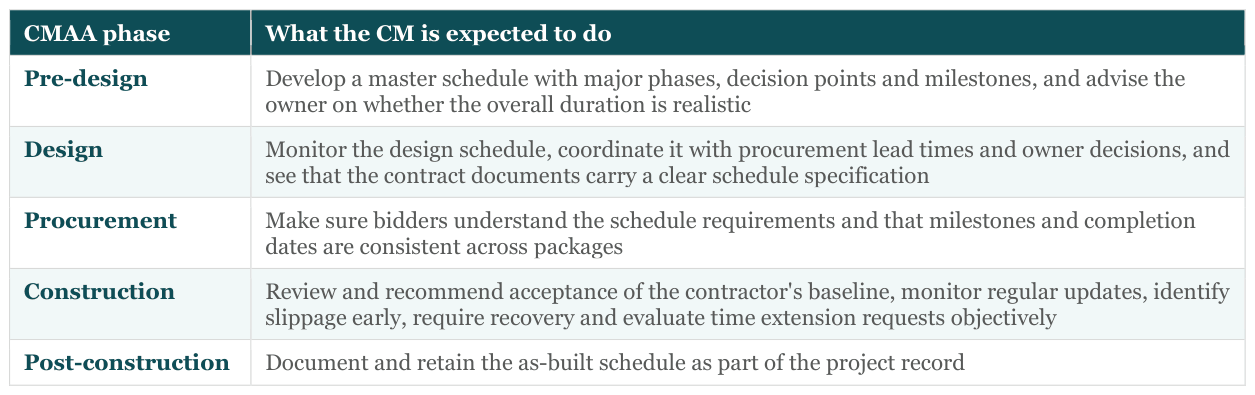
In construction, the CMAA Standard expects the CM to review the contractor's baseline schedule for completeness and reasonableness, recommend acceptance or rejection, monitor progress through regular updates, identify slippage early, require recovery where needed, and evaluate requests for time extension objectively. In post-construction, the CM is expected to ensure that the as-built schedule is documented and retained as part of the project record. Throughout, the Standard expects the CM to keep the owner informed so that decisions are taken with an accurate understanding of time.
How GCC PMC Firms Typically Do It Today
The practice in the region is capable and experienced. The weakness is almost never scheduling skill; it is the absence of a governed process around the schedule.
- Baselines accepted by email. The contractor's programme is reviewed, commented on and "accepted" in a chain of emails and marked-up PDFs, so there is no single record of which version became the contractual baseline and who approved it.
- Updates as files, not data. Monthly updates arrive as XER or MPP files stored in folders. Comparing this month's critical path with last month's, or with the baseline, is a manual exercise done under pressure.
- Design and procurement schedules live apart. The design programme, the long-lead procurement tracker and the construction schedule are maintained by different parties in different tools, so a late approval in design never visibly moves the construction dates until it is too late.
- Float treated as the contractor's property. Without a record of float consumption over time, disputes about who used the float, and when, become a matter of opinion.
- Time impact analysis prepared after the fact. Delay events are notified late and analysed months afterwards, when the contemporaneous records needed to support or reject the claim have scattered across inboxes.
- Schedule and cost reported separately. Progress is reported in percent complete and cost in commitments and invoices, with no earned value link to show whether the project is actually performing.
How PMWEB Digitalises It
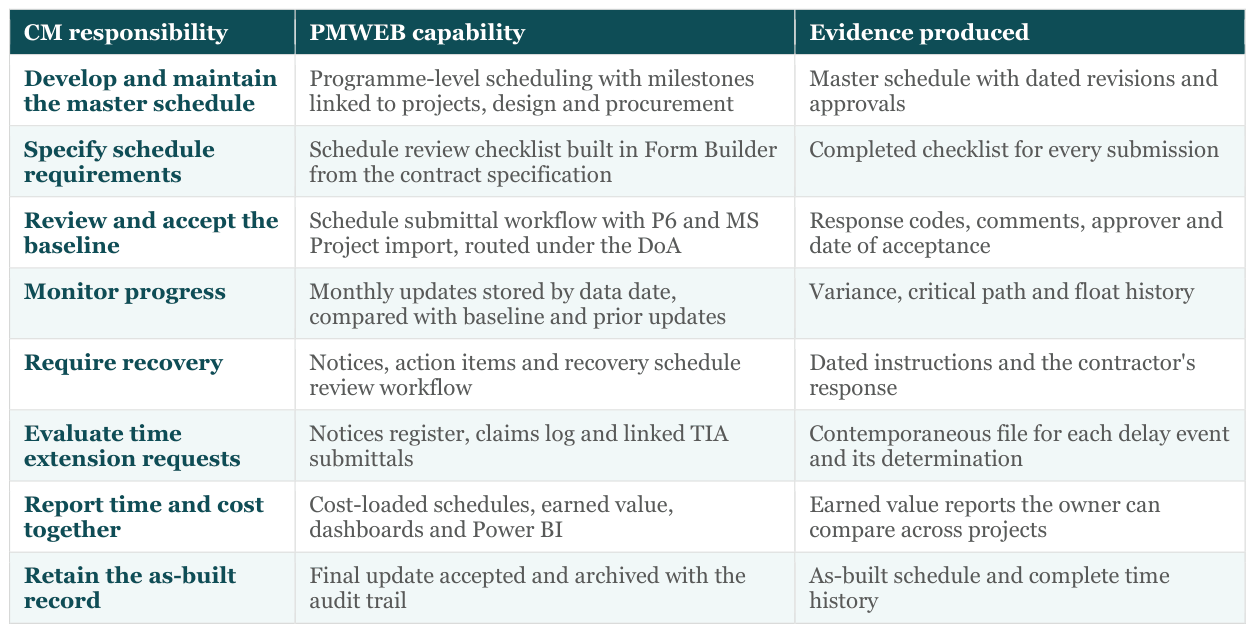
PMWEB does not replace Primavera P6 or MS Project. Planners continue to build and analyse schedules in the tool they know. PMWEB wraps those schedules in the governance process: it holds the schedule data in the project record, links it to cost, documents and decisions, and routes every submission, review and acceptance through the workflow engine with a full audit trail.
Master, design and procurement schedules
At the programme level, the PMC can hold a master schedule in PMWEB that sets the phases, gateways and key milestones for each project in the portfolio. Design and procurement schedules sit beneath it. Design deliverables can be tracked against submittal and transmittal dates, and long-lead items can be tracked against the commitments that procure them. When a design approval slips, the related procurement and construction milestones are visible in the same record, so the consequence is seen early rather than discovered on site.
Schedule specification, submission and review
The schedule specification, whether the firm's standard or the owner's, becomes a review checklist in PMWEB built with the Form Builder. It can capture the checks the PMC expects: calendars, logic density, open ends, constraints, lags, durations, resource and cost loading, the level of detail agreed, and the basis narrative. The contractor's baseline is submitted as a schedule submittal, the native file is imported through the Primavera P6 or MS Project integration, and the review is routed to the planner, the discipline leads and the project manager. Comments are recorded against the submittal, and the response code, whether accepted, accepted with comments, or revise and resubmit, is a value list, not a phrase in an email.
Monthly updates, critical path and float
Each monthly update is imported against its data date and stored alongside the previous updates and the baseline. Dashboards then show what a planner would otherwise assemble by hand: milestone variance, newly critical activities, float trends on near-critical paths, and forecast against contract completion. Each update follows the same review workflow as the baseline, so the PMC can show it was reviewed, not merely received.
Look-aheads and recovery
Short-interval look-ahead schedules can be tied to daily reports and meeting minutes, so the commitments made in the weekly progress meeting are recorded as action items with owners and dates. When slippage crosses a threshold the PMC has defined, a recovery plan request can be issued as a formal notice, and the contractor's recovery schedule returns through the same review route. The owner sees not just that the project is late but what has been required and what has been committed in response.
Time impact analysis and extension of time
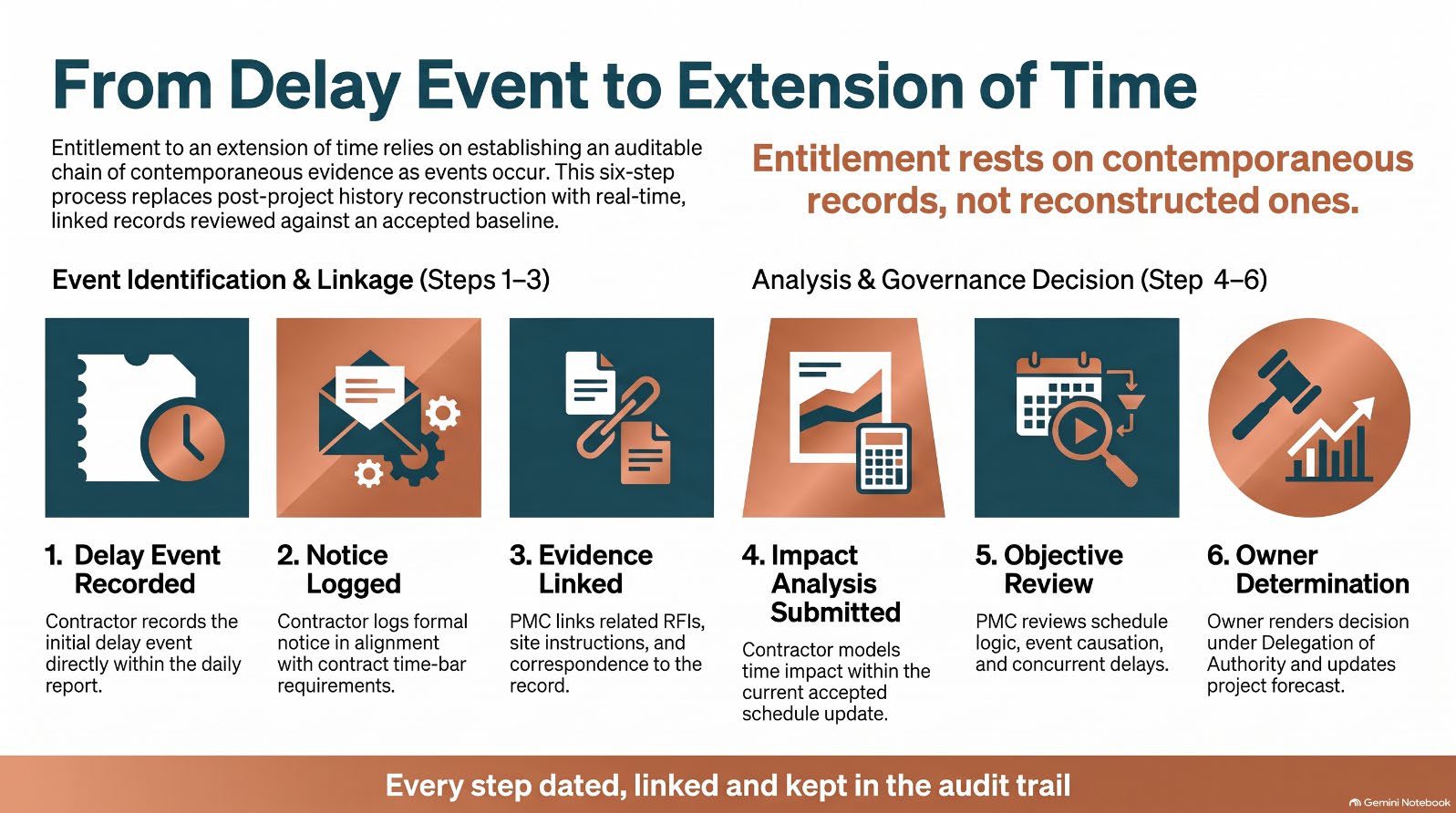
Under most conditions of contract, entitlement to an extension of time is assessed through a claims procedure, with notice obligations and time bars that the owner's particular conditions frequently tighten. PMWEB supports this discipline. A delay event is logged in the claims log or notices register with its date of occurrence and date of notice, and linked to the RFIs, site instructions, correspondence and daily reports that describe it. The contractor's time impact analysis, typically a fragnet inserted into the current accepted update for prospective analysis, is submitted and reviewed as a record. The PMC's assessment, the determination of the owner's representative or the Engineer named in the contract, and any agreed extension are recorded against the contract, and the revised completion date flows into the schedule and cost forecasts.
Where analysis happens after the event, recognised forensic schedule analysis methods rely on exactly what PMWEB retains: the accepted baseline, every contemporaneous update, and the dated records around each event. The PMC does not have to reconstruct the history; it is already there.
Linking schedule to cost for earned value
Because PMWEB holds both the cost structure and the schedule, the PMC can map schedule activities to cost codes and schedule of values lines, bring in cost-loaded schedules from P6, and calculate earned value measures such as schedule variance and schedule performance index alongside cost performance. Progress stops being a percent-complete opinion and becomes a measurement the owner can compare across projects.
As-built schedule
At completion, the final update with actual dates becomes the as-built schedule, accepted through the same workflow and archived with the baselines, updates, time impact analyses and extension decisions. That set is the project's time record, and it is ready for closeout, lessons learned and any dispute that follows.
Configuring PMWEB to Your Firm's Procedures
The CMAA Standard stays the reference. How each PMC firm, and each client, runs time management differs: the specification, the review checklist, the approval route and the report the owner wants to read. PMWEB is configured to those choices rather than imposing its own.

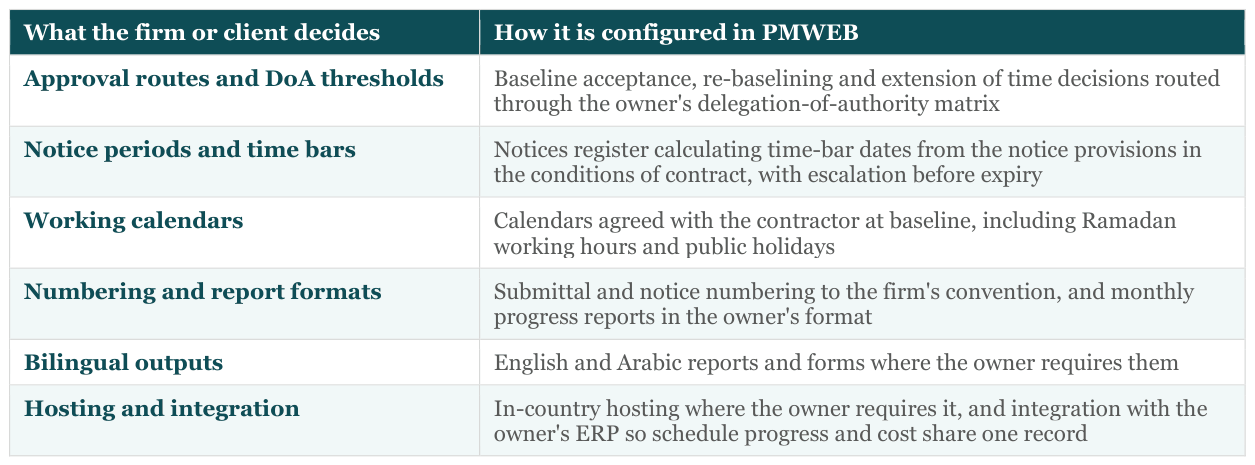
Evidence That the Practice Is Working
A PMC that has digitalised its time management practice in line with the CMAA Standard should be able to show it through indicators drawn directly from the system. Each firm will set its own thresholds; the definitions below are what to measure.
- Baseline acceptance time. The elapsed time from the contractor's first baseline submission to formal acceptance, by package.
- Review cycle count. The number of submission cycles each baseline and update required before acceptance, showing whether the specification is understood.
- Update discipline. The proportion of monthly updates received, reviewed and accepted within the period the contract requires.
- Float trend on the critical and near-critical paths. The movement of total float across successive updates, reported for each major milestone.
- Notice timeliness. The time between the date a delay event occurred and the date its notice was registered, and the number of notices reviewed before their time bar.
- Time impact analysis turnaround. The elapsed time from TIA submission to the PMC's recommendation and the owner's decision.
Key takeaway
The CMAA Standard does not ask PMC firms to become better at drawing schedules; it asks them to govern schedules. Specification, review, acceptance, update, analysis, recovery and time entitlement are processes, and each process must leave a record that an owner, an auditor or a tribunal can follow.
PMWEB keeps Primavera P6 and MS Project where planners want them and wraps the schedule in the workflow, linkage and audit trail that turn it into a governance instrument. Configured to each firm's procedures, each owner's conditions of contract and DoA, it lets the PMC show, in data, that its time management executes and evidences what the CMAA Standard expects.
Next in the series: Article 6 — Quality Management: Submittals, Inspections, Non-Conformance and Commissioning

Next step
Bring this to your portfolio.
Tell us which processes matter most to you, and we will show them running in PMWEB.